This enchanting cottage garden border pairs Gertrude Jekyll roses with the bold spires of Salvia May Night, the soft haze of Walkers Low catmint and the fresh brightness of ladys mantle. Aromatic, colorful and pollinator-friendly, it creates a timeless, low-maintenance walkway bursting with fragrance and summer charm.

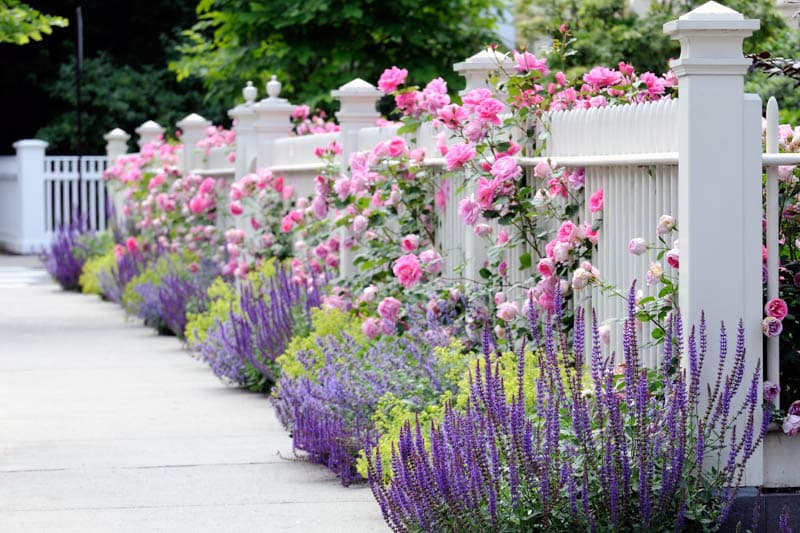


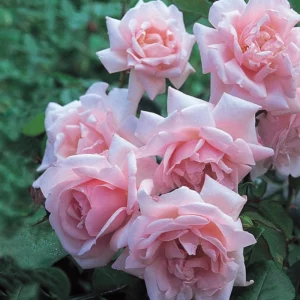
This cottage-style border combines fragrant pink roses with two shades of violet-blue and a soft layer of fresh green foliage. Rosa ‘Gertrude Jekyll’ provides the main shrub structure, while Nepeta ‘Walker’s Low’ forms broad, relaxed mounds around its base. Upright spikes of Salvia ‘May Night’ rise through the lower planting, and Alchemilla mollis fills the remaining spaces with rounded leaves and airy chartreuse flowers.
A white picket fence gives the planting a clear backdrop, but the border itself is deliberately loose. The perennials overlap slightly, the Salvia appears in repeated groups rather than a straight line, and the rose branches are allowed enough room to arch naturally. The result is recognizably cottage garden without looking overcrowded or overly arranged.
Main plants used: Rosa ‘Gertrude Jekyll’, Nepeta ‘Walker’s Low’, Salvia ‘May Night’, and Alchemilla mollis
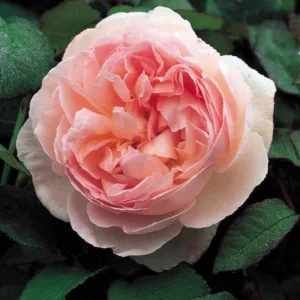
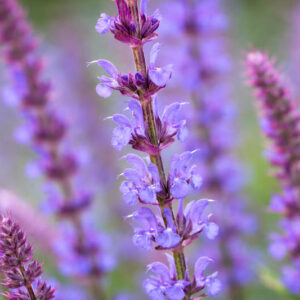
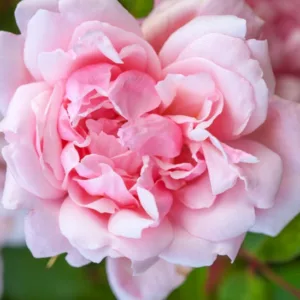
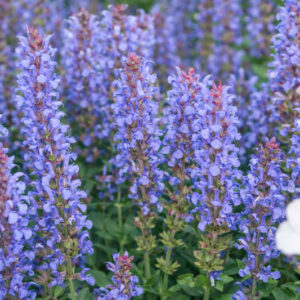
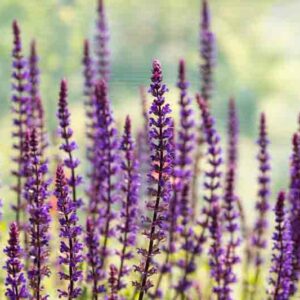
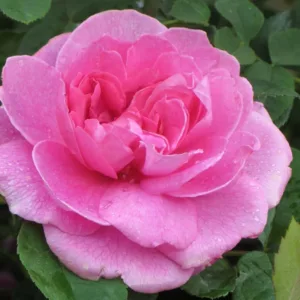
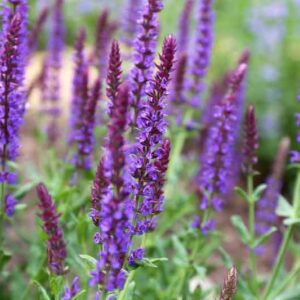
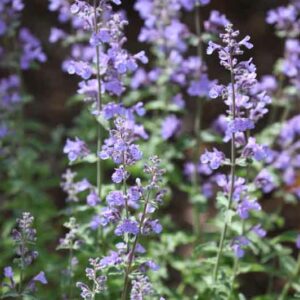
The plants have enough in common to feel cohesive but are different enough in form to avoid monotony. ‘Gertrude Jekyll’ carries large, densely petalled pink flowers above substantial shrub foliage. Nepeta is lower and softer, with many small lavender-blue flowers held above gray-green leaves. ‘May Night’ Salvia has a more upright habit, producing dense violet flower spikes.
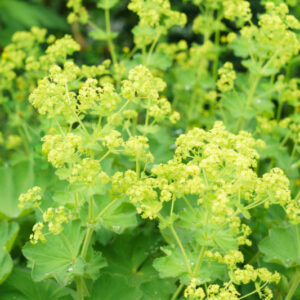
Lady’s Mantle adds a completely different foliage shape. Its rounded, scalloped leaves spread beneath the taller plants, while loose sprays of chartreuse flowers brighten the border in early summer without introducing another strong flower color.
The planting is most convincing when the perennials are repeated unevenly. Larger areas of Nepeta can run between the roses, while Salvia appears in smaller vertical groups. Alchemilla works best in pockets rather than as an unbroken edge.
Rosa ‘Gertrude Jekyll’ provides the main height, fragrance, and pink color. This strongly scented English rose repeat-flowers and can be grown as a substantial shrub or trained where appropriate. Give it fertile, well-drained soil, regular moisture during dry weather, and enough space for good air movement.
Nepeta ‘Walker’s Low’ forms spreading gray-green mounds with lavender-blue flowers over a long period. It performs best in full sun and well-drained soil and tolerates dry spells once established. Shearing plants after the first major flush often encourages fresh foliage and another round of bloom.
Salvia ‘May Night’ supplies the strongest vertical element. Its deep violet-blue spikes appear from late spring into summer and contrast well with the rounded rose flowers and looser Nepeta. Cutting back spent flower stems can encourage further flowering.
Alchemilla mollis, or Lady’s Mantle, forms low clumps of soft green leaves topped by chartreuse flower sprays. It appreciates somewhat more moisture than Nepeta and Salvia and can self-seed freely where conditions suit it. Remove faded flowers before seed ripens if unwanted seedlings become a problem.
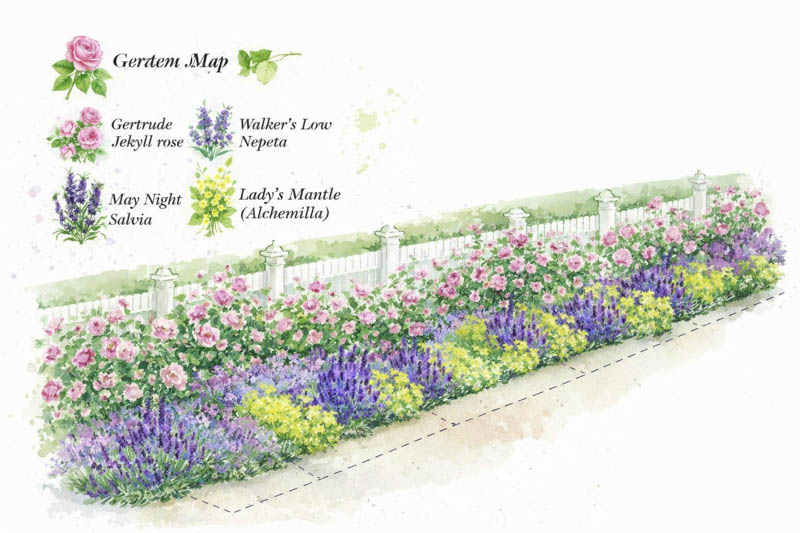
Create a relaxed cottage border with fragrant pink roses rising above broad violet-blue perennial planting and a soft green lower layer.
These percentages describe the overall balance of the four featured plants rather than equal numbers of individual plants.
Position ‘Gertrude Jekyll’ roses first, allowing enough room for their mature width and keeping them slightly away from the fence for airflow and access.
Repeat Nepeta in broad groups through the front and middle. Thread ‘May Night’ Salvia through those groups in irregular clusters rather than planting it as a straight row.
Use Alchemilla in smaller pockets along the front and between perennial groups, where its rounded foliage can soften transitions without becoming a continuous edging.
The plants do not need identical amounts of water. Nepeta and Salvia prefer good drainage and cope well with moderate dryness once established, while roses and Lady’s Mantle generally perform better with more consistent moisture. Avoid watering the entire border according to the needs of its driest plants.
All four plants broaden with age, and Alchemilla can seed into open spaces. Some thinning and division will eventually be useful, but there is no need to divide the perennials automatically on a fixed schedule if they remain healthy and flower well.
Finally, allow a little informality. The border will look more convincing if Nepeta spills slightly, Salvia appears at different depths, and the rose branches retain some natural arch rather than being clipped into rigid shapes.
| Hardiness |
4 - 8 |
|---|---|
| Heat Zones |
4 - 7 |
| Climate Zones | 2, 3, 4, 5, 6, 7, 8, 9, 14, 15, 16, 17, 18, 19, 20, 21, 22, 23, 24 |
| Exposure | Full Sun, Partial Sun |
| Season of Interest | Spring (Late), Summer (Early, Mid, Late), Fall |
| Maintenance | Low |
| Water Needs | Average |
| Soil Type | Chalk, Loam |
| Soil pH | Acid, Alkaline, Neutral |
| Soil Drainage | Moist but Well-Drained |
| Characteristics | Cut Flowers, Fragrant, Plant of Merit, Showy |
| Attracts | Butterflies, Hummingbirds |
| Landscaping Ideas | Beds And Borders, Edging, Hedges And Screens, Underplanting Roses And Shrubs, Walls And Fences |
| Garden Styles | Butterfly Garden, City and Courtyard, Informal and Cottage, Pollinator Garden, Traditional Garden |
| Hardiness |
4 - 8 |
|---|---|
| Heat Zones |
4 - 7 |
| Climate Zones | 2, 3, 4, 5, 6, 7, 8, 9, 14, 15, 16, 17, 18, 19, 20, 21, 22, 23, 24 |
| Exposure | Full Sun, Partial Sun |
| Season of Interest | Spring (Late), Summer (Early, Mid, Late), Fall |
| Maintenance | Low |
| Water Needs | Average |
| Soil Type | Chalk, Loam |
| Soil pH | Acid, Alkaline, Neutral |
| Soil Drainage | Moist but Well-Drained |
| Characteristics | Cut Flowers, Fragrant, Plant of Merit, Showy |
| Attracts | Butterflies, Hummingbirds |
| Landscaping Ideas | Beds And Borders, Edging, Hedges And Screens, Underplanting Roses And Shrubs, Walls And Fences |
| Garden Styles | Butterfly Garden, City and Courtyard, Informal and Cottage, Pollinator Garden, Traditional Garden |
Recreate this garden. Specify the percentages you would like to have of each plant and input the dimensions of your garden space.We'll give you a shopping list so you know how many plants you need.
| Plant | Quantity | |
|---|---|---|
| Rosa Gertrude Jekyll (English Rose) | N/A | Buy Plants |
| Salvia x sylvestris May Night (Wood Sage) | N/A | Buy Plants |
| Nepeta racemosa 'Walker's Low' (Catmint) | N/A | Buy Plants |
| Alchemilla mollis (Lady's Mantle) | N/A | Buy Plants |
Create a membership account to save your garden designs and to view them on any device.
Becoming a contributing member of Gardenia is easy and can be done in just a few minutes. If you provide us with your name, email address and the payment of a modest $25 annual membership fee, you will become a full member, enabling you to design and save up to 25 of your garden design ideas.
Join now and start creating your dream garden!
Create a membership account to save your garden designs and to view them on any device.
Becoming a contributing member of Gardenia is easy and can be done in just a few minutes. If you provide us with your name, email address and the payment of a modest $25 annual membership fee, you will become a full member, enabling you to design and save up to 25 of your garden design ideas.
Join now and start creating your dream garden!