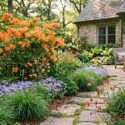
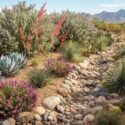
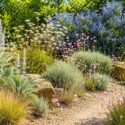
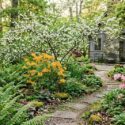
Create a breathtaking front garden with three low-growing evergreen plants. Perennial Phlox 'Violet Pinwheels' produces masses of vivid violet flowers in early to mid-late spring, while creeping Juniper 'Bar Harbor' provides year-round blue-green foliage. Aromatic Santolina completes the planting with silvery foliage and cheerful yellow summer flowers above.
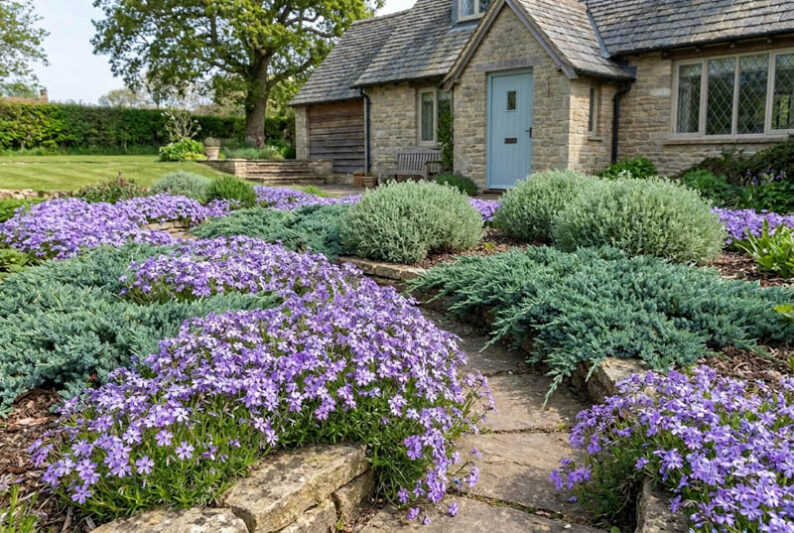


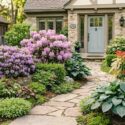
Who says evergreen gardens have to be all green? This charming cottage front garden bursts into life every spring, when vivid violet flowers spill across a stone pathway, surrounded by soft blue-green foliage and beautifully rounded silver shrubs.
The stars are Phlox ‘Violet Pinwheels’, Juniperus horizontalis ‘Bar Harbor’, and Santolina pinnata subsp. neapolitana. Together, they create a wonderfully textured landscape that looks attractive even after the spectacular spring flowers disappear.
The secret is simple: generous sweeps of flowering groundcover, low evergreen mats, and softly rounded shrubs. Natural stone adds warmth, while the informal planting makes the garden feel established and inviting.
Main plants used: Phlox ‘Violet Pinwheels’ (Creeping Phlox), Juniperus horizontalis ‘Bar Harbor’ (Creeping Juniper), and Santolina pinnata subsp. neapolitana (Green Santolina).
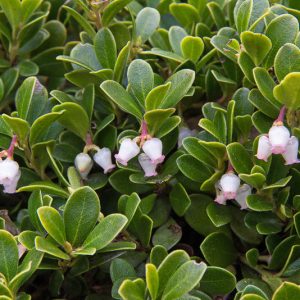
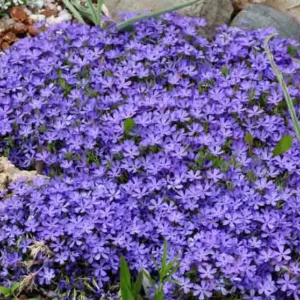
The first impression is all about color. ‘Violet Pinwheels’ creates brilliant pools of violet-purple flowers, their distinctive notched petals forming a remarkable spring carpet. Instead of scattering individual plants across the border, generous groups allow the flowers to create real impact.
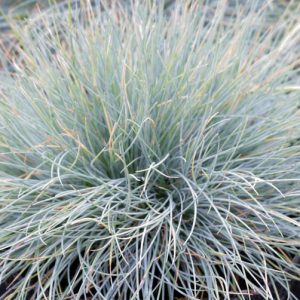
Between them, ‘Bar Harbor’ Creeping Juniper forms low, spreading mats of blue-green foliage. Its fine, feathery texture provides a calming contrast to the colorful Phlox and continues to anchor the garden throughout winter.
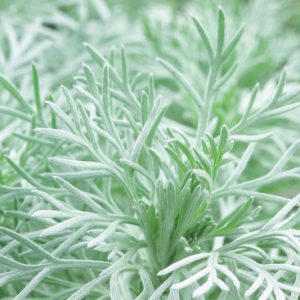
Green Santolina adds height without overwhelming the planting. Its finely divided, aromatic gray-green leaves form soft, rounded mounds that echo the natural curves of the surrounding landscape.
Warm stone steps and edging complete the design. The pale limestone makes the violet flowers appear even brighter, while the restrained planting palette feels both abundant and harmonious.
Phlox ‘Violet Pinwheels’ is a compact, evergreen hybrid Phlox with masses of vivid violet flowers in early to mid-late spring. Its low cushions of fine foliage gradually spread outward, making it especially attractive along sunny pathways and rock edges.
Juniperus horizontalis ‘Bar Harbor’ is a vigorous, ground-hugging evergreen conifer with attractive blue-green foliage that can develop purplish tones in winter. It is particularly valuable for covering sunny slopes and providing lasting structure.
Santolina pinnata subsp. neapolitana is a Mediterranean evergreen subshrub with aromatic, finely divided gray-green foliage. Its rounded shape contrasts with the spreading groundcovers, while small yellow button flowers appear in summer. It prefers sunny, sharply drained conditions.
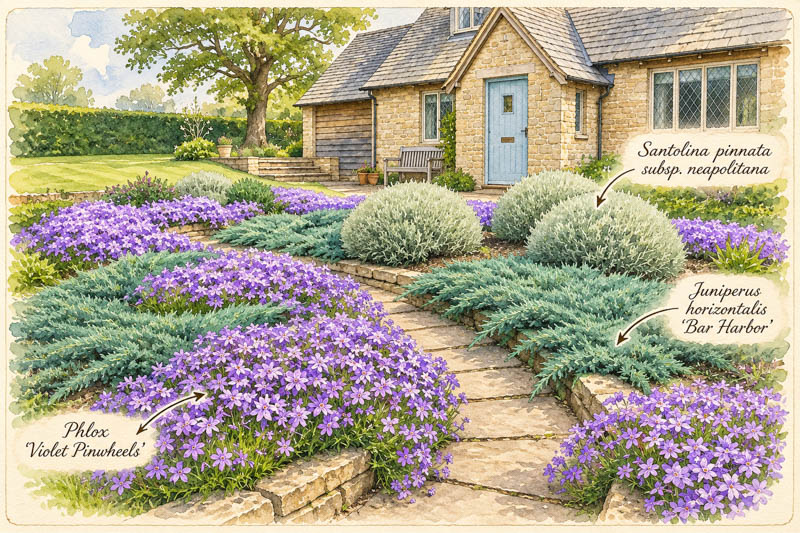
Create a colorful, low-maintenance evergreen front garden with spectacular violet spring flowers, soft silver foliage, and flowing blue-green groundcover.
Begin with a natural stone path leading toward the entrance. Plant generous drifts of violet Phlox along the edges, allowing a little foliage to soften the stones while keeping the walking surface clear. Position the spreading Junipers farther back, where they can develop into broad evergreen carpets without smothering neighboring plants. Repeat rounded Santolina shrubs at intervals to establish an informal rhythm. Leave enough space for the mature Junipers rather than crowding everything together.
Spring: The Phlox erupts into violet flowers, transforming the garden into a colorful tapestry. Silver Santolina and blue-green Juniper provide a beautiful background.
Summer: Once the Phlox flowers fade, its fine evergreen foliage remains attractive. Santolina may produce cheerful yellow button-like flowers above its silvery mounds.
Autumn and winter: The planting settles into quieter shades of green, silver, and blue. Creeping Juniper may develop subtle purple winter tones, while Santolina retains its foliage in suitable climates.
Although all three plants enjoy sunshine and good drainage, they grow at different rates. ‘Bar Harbor’ Juniper can spread several feet and may eventually overtake smaller Phlox plants if positioned too closely. Give it generous room from the beginning.
Santolina is sensitive to prolonged winter wet and severe cold. In cooler climates, choose a sheltered site or substitute a hardier silver-foliaged plant.
For more inspiration, explore Gardenia’s best plants for slopes and colorful garden path ideas.
The real beauty of this garden is its balance. Spectacular spring flowers provide the excitement, while long-lasting foliage and natural stone ensure the planting remains appealing throughout the year.
| Hardiness |
8 |
|---|---|
| Exposure | Full Sun |
| Season of Interest | Spring (Early, Mid, Late) |
| Maintenance | Low |
| Water Needs | Low, Average |
| Soil Type | Chalk, Loam, Sand |
| Soil pH | Acid, Neutral, Alkaline |
| Soil Drainage | Well-Drained |
| Characteristics | Evergreen |
| Landscaping Ideas | Ground Covers |
| Garden Styles | Informal and Cottage |



| Hardiness |
8 |
|---|---|
| Exposure | Full Sun |
| Season of Interest | Spring (Early, Mid, Late) |
| Maintenance | Low |
| Water Needs | Low, Average |
| Soil Type | Chalk, Loam, Sand |
| Soil pH | Acid, Neutral, Alkaline |
| Soil Drainage | Well-Drained |
| Characteristics | Evergreen |
| Landscaping Ideas | Ground Covers |
| Garden Styles | Informal and Cottage |
Recreate this garden. Specify the percentages you would like to have of each plant and input the dimensions of your garden space.We'll give you a shopping list so you know how many plants you need.
| Plant | Quantity | |
|---|---|---|
| Phlox 'Violet Pinwheels' (Creeping Phlox) | N/A | Buy Plants |
| Juniperus horizontalis 'Bar Harbor' (Creeping Juniper) | N/A | Buy Plants |
| Santolina pinnata subsp. neapolitana (Green Santolina) | N/A | Buy Plants |
Create a membership account to save your garden designs and to view them on any device.
Becoming a contributing member of Gardenia is easy and can be done in just a few minutes. If you provide us with your name, email address and the payment of a modest $25 annual membership fee, you will become a full member, enabling you to design and save up to 25 of your garden design ideas.
Join now and start creating your dream garden!