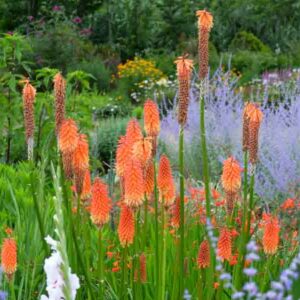
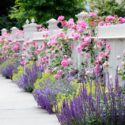
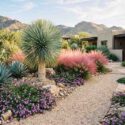
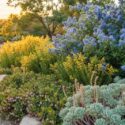
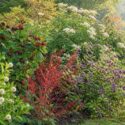
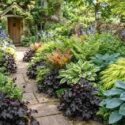
This full sun perennial border comes alive from early summer through fall with purple coneflowers, glowing daylilies, red hot pokers, Jerusalem sage, and airy tall verbena. Warm torch-like blooms rise through a purple pollinator haze, creating a layered, bench-side planting that feels vibrant, immersive, and alive with bees and butterflies.
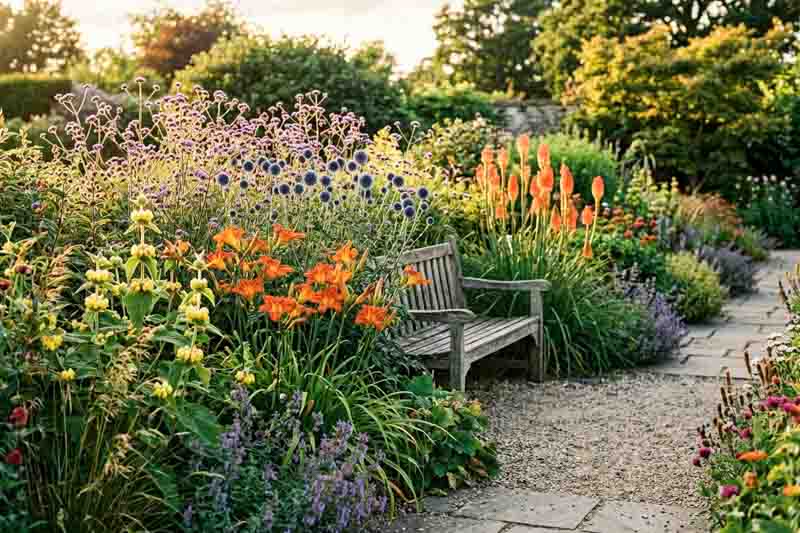


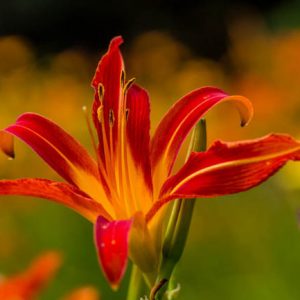
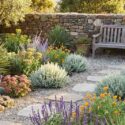
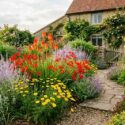
This sunny perennial garden surrounds a simple wooden bench with a loose mixture of warm and cool flower colors. Orange-red daylilies and Kniphofia provide the strongest color, while blue Echinops and purple Verbena bonariensis bring cooler tones through the planting. Phlomis russeliana adds pale yellow flowers and distinctive upright stems.
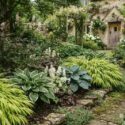
The garden feels established rather than newly arranged. Plants overlap, some stems lean into neighboring groups, and the taller flowers rise at different depths. Gravel and stone paths provide a quiet break between the dense planting, while hedges, shrubs, and mature trees give the seating area a sense of enclosure.
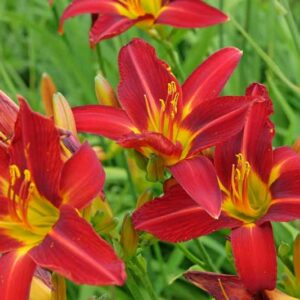
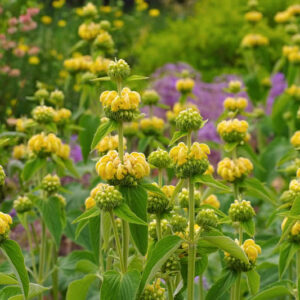
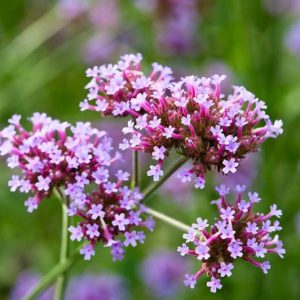
Main plants used: Hemerocallis ‘Stafford’, Phlomis russeliana, Kniphofia ‘Timothy’, Echinops ritro, and Verbena bonariensis
The plants have very different shapes, which helps a full border remain readable. Daylilies form broad clumps of arching foliage, Kniphofia produces upright flower spikes, Echinops carries rounded blue flower heads, and Verbena rises above the planting on thin stems. Phlomis sits between these forms, providing sturdy vertical stems and repeated whorls of flowers.
Warm and cool colors are also mixed rather than separated. The orange-red flowers appear in several parts of the garden, but they are broken up by blue Echinops, purple Verbena, and the softer yellow of Phlomis. The result is colorful without becoming dominated by a single hue.
The bench gives the planting a practical center. Rather than arranging every flower to face outward, the border wraps around the seating area and path, making the garden enjoyable from within as well as from a distance.
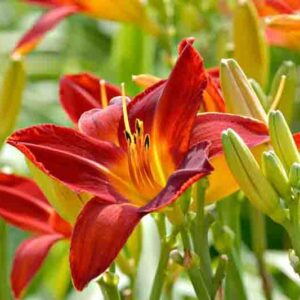
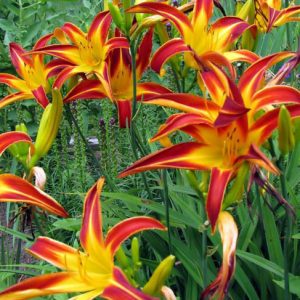
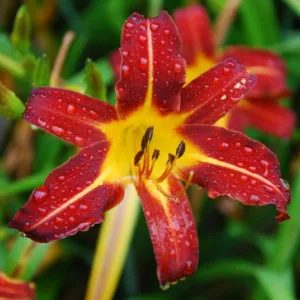
Hemerocallis ‘Stafford’ provides broad clumps of foliage and warm summer flowers. Use it in repeated groups rather than as a continuous edging plant. In the pictured garden, the daylilies sit comfortably among taller perennials rather than forming a strict front row.
Phlomis russeliana adds pale yellow flowers on upright stems and remains useful after flowering as the seedheads develop. It works well in medium-sized groups where its distinctive structure can be seen among softer foliage.
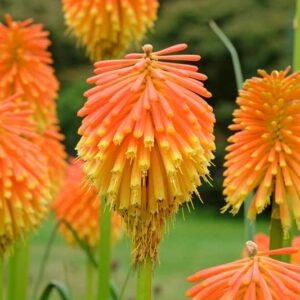
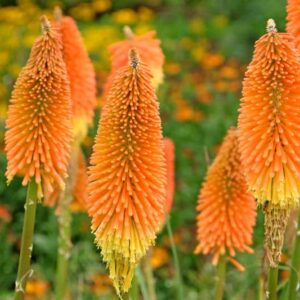
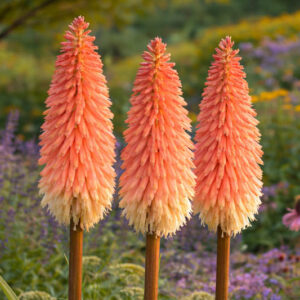
Kniphofia ‘Timothy’ provides some of the tallest and strongest warm-colored flowers. A few repeated groups are enough; too many upright spikes can make an informal border feel rigid.
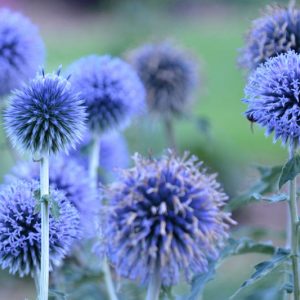
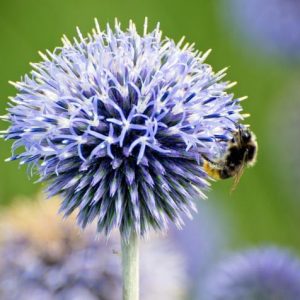
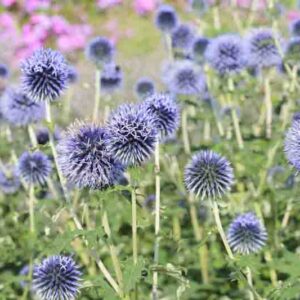
Echinops ritro introduces steel-blue globes that contrast with the warmer flowers. Its shape remains distinct even in a crowded summer border, and the flowers are attractive to pollinating insects.
Verbena bonariensis adds height without creating a solid screen. Its narrow stems allow other plants to remain visible through them, making it particularly useful around the bench and through the middle of the border.
Create a full summer border around a path or seating area, mixing broad flowering clumps with taller plants that rise through them without blocking views across the garden.
These percentages are a guide. In an established mixed border, other compatible perennials and shrubs can remain part of the composition.
Begin with the daylilies and Phlomis in broad, irregular groups through the front and middle.
Place Kniphofia where its taller flower spikes can be seen clearly, but avoid lining the plants up at equal intervals.
Repeat Echinops through the middle to carry the blue color across the border.
Allow Verbena to rise between the other plants rather than confining it to the back. Keep enough space around the bench and path for easy access.
This garden works because the planting is full but not uniform. Some groups are much larger than others, and the tall flowers do not occur in a predictable sequence. Repeating the plants without repeating the exact layout is what gives the border its mature character.
Leave a little room around the bench as the plants expand. A seating area is more inviting when flowers surround it without making it difficult to sit down, stand up, or move along the path.
| Hardiness |
7 - 9 |
|---|---|
| Heat Zones |
7 - 9 |
| Climate Zones | 8, 9, 14, 15, 16, 17, 18, 19, 20, 21, 22, 23, 24 |
| Exposure | Full Sun |
| Season of Interest | Summer (Early, Mid, Late), Fall |
| Maintenance | Low |
| Water Needs | Average |
| Soil Type | Loam |
| Soil pH | Acid, Neutral |
| Soil Drainage | Moist but Well-Drained, Well-Drained |
| Characteristics | Showy |
| Tolerances | Drought, Rabbit |
| Attracts | Bees, Butterflies, Birds |
| Landscaping Ideas | Beds And Borders |
| Garden Styles | Butterfly Garden, Informal and Cottage, Pollinator Garden, Prairie and Meadow |

| Hardiness |
7 - 9 |
|---|---|
| Heat Zones |
7 - 9 |
| Climate Zones | 8, 9, 14, 15, 16, 17, 18, 19, 20, 21, 22, 23, 24 |
| Exposure | Full Sun |
| Season of Interest | Summer (Early, Mid, Late), Fall |
| Maintenance | Low |
| Water Needs | Average |
| Soil Type | Loam |
| Soil pH | Acid, Neutral |
| Soil Drainage | Moist but Well-Drained, Well-Drained |
| Characteristics | Showy |
| Tolerances | Drought, Rabbit |
| Attracts | Bees, Butterflies, Birds |
| Landscaping Ideas | Beds And Borders |
| Garden Styles | Butterfly Garden, Informal and Cottage, Pollinator Garden, Prairie and Meadow |
Recreate this garden. Specify the percentages you would like to have of each plant and input the dimensions of your garden space.We'll give you a shopping list so you know how many plants you need.
| Plant | Quantity | |
|---|---|---|
| Kniphofia 'Timothy' (Red Hot Poker) | N/A | Buy Plants |
| Echinops ritro 'Veitch's Blue' (Globe Thistle) | N/A | Buy Plants |
| Hemerocallis 'Stafford' (Daylily) | N/A | Buy Plants |
| Phlomis russeliana (Jerusalem Sage) | N/A | Buy Plants |
| Verbena bonariensis (Purpletop Vervain) | N/A | Buy Plants |
Create a membership account to save your garden designs and to view them on any device.
Becoming a contributing member of Gardenia is easy and can be done in just a few minutes. If you provide us with your name, email address and the payment of a modest $25 annual membership fee, you will become a full member, enabling you to design and save up to 25 of your garden design ideas.
Join now and start creating your dream garden!
Create a membership account to save your garden designs and to view them on any device.
Becoming a contributing member of Gardenia is easy and can be done in just a few minutes. If you provide us with your name, email address and the payment of a modest $25 annual membership fee, you will become a full member, enabling you to design and save up to 25 of your garden design ideas.
Join now and start creating your dream garden!