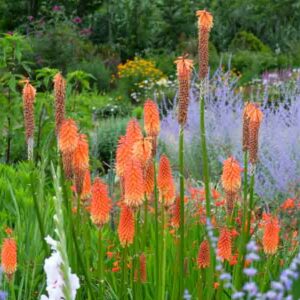
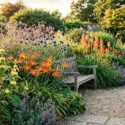
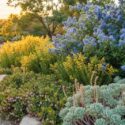
This sun-drenched perennial border peaks from mid to late summer, blending Anthemis tinctoria’s golden daisies with Crocosmia’s fiery sprays, Kniphofia’s torchlike spikes, and Perovskia’s airy lavender haze. Designed for pollinators, it delivers long bloom, bold contrast, graceful movement, and drought-tolerant beauty in cottage and naturalistic gardens.
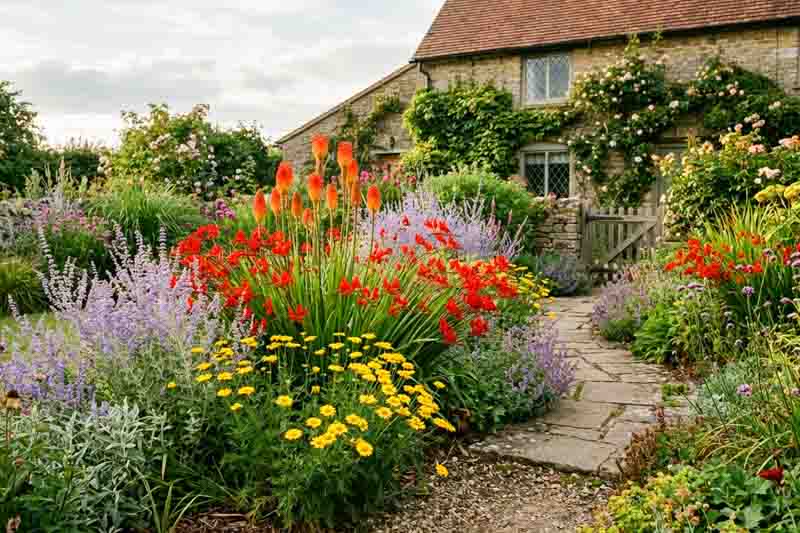


This sunny summer border combines yellow Anthemis, red-orange Crocosmia, upright Kniphofia, and lavender-blue Perovskia in a relaxed cottage-style planting. The four main perennials carry most of the color in the foreground, while roses and other flowering plants behind them add depth and help the border feel established.
The planting is colorful but not overwhelming. Anthemis forms broad patches near the front, Crocosmia moves through the middle on arching stems, and Kniphofia adds height in a few carefully placed groups. Perovskia introduces a cooler blue-violet note between the warmer yellows, reds, and oranges.
Main plants used: Anthemis tinctoria (Golden Marguerite), Crocosmia, Kniphofia (Red Hot Poker), and Perovskia (Russian Sage)
The border succeeds because the plants differ clearly in both form and height. Anthemis stays relatively low and spreads into broad patches, while Crocosmia carries its flowers on slender, arching stems. Kniphofia is more upright and architectural, and Perovskia has a much finer, looser texture.
Color is handled just as carefully. Yellow and red-orange can easily dominate a planting, so Perovskia is useful here for more than its flowers. The cooler blue-violet tones give the eye a break and make the warmer colors feel less intense.
The surrounding roses and mixed planting also matter. They keep the composition from looking like a self-contained four-plant scheme and give the border the layered look of a mature cottage garden.
Anthemis works best toward the front and middle of the border, where its yellow daisy-like flowers can form generous patches of color. The foliage is fine enough that even a larger group does not feel heavy.
Use several plants together rather than scattering single specimens. A broad, irregular drift is easier to read from a distance and gives the taller plants behind it something to rise through.
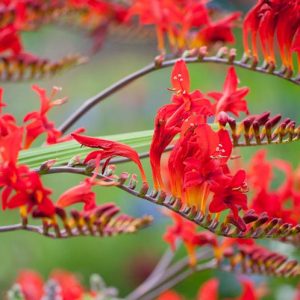
Crocosmia carries the red-orange color through the middle of the planting. Its arching flower stems bring a different line from both Anthemis and Kniphofia and help prevent the border from becoming too rigid.
Repeat it in several clumps rather than in a continuous band. Varying the position of those clumps slightly gives a more relaxed result.
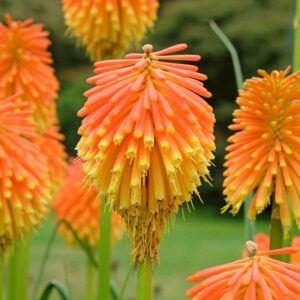
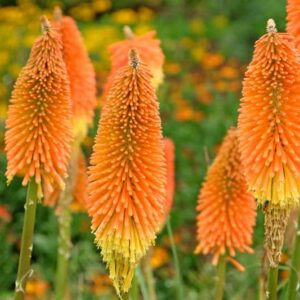
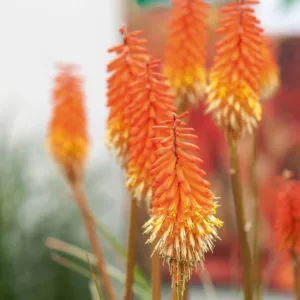
Kniphofia provides the strongest vertical element. Its tall flower spikes are easily seen above the surrounding plants, so relatively few are needed.
Small groups work better than a single specimen or a straight row. Place some slightly forward and others farther back so the spikes appear naturally through the planting.
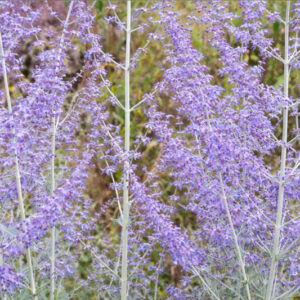
Perovskia brings the cooler color into the border. Its lavender-blue flowers and fine stems sit comfortably among the stronger yellows and reds and help soften the overall effect.
Rather than using it as one solid background block, repeat it through the middle and rear of the bed. This distributes the cooler color more evenly and allows neighboring flowers to show through.

Create a generous summer border with warm color in the foreground and middle, balanced by cooler Perovskia and a few taller Kniphofia spikes.
These proportions are a guide rather than a rule. In a mixed cottage border, roses and other compatible perennials can remain part of the composition.
Vary the size of the groups rather than repeating identical clumps throughout the bed.
Start with Anthemis in broad groups toward the front, but avoid making a straight yellow edge.
Place Perovskia through the middle and rear in several loose groups.
Add Crocosmia between them, allowing some clumps to sit farther forward than others.
Use Kniphofia sparingly, where its taller flower spikes can rise clearly above the surrounding plants.
If roses or other established perennials are already present, let them remain visible behind and between the main groups rather than trying to separate the planting into distinct blocks.
By midsummer, Anthemis provides much of the lower flower color, while Crocosmia and Kniphofia introduce stronger reds and oranges above it. Perovskia gradually becomes more prominent as its blue-violet flowers open.
Later in summer, the balance shifts toward Perovskia and the other mature plants around the border. The warmer flowers remain important, but they no longer carry the whole display. This change in emphasis is part of what keeps the planting interesting over several weeks.
This is a full, mixed perennial border rather than a true dry-garden scheme. Several of the plants tolerate summer dryness once established, but they still perform best when given enough moisture to develop well and soil that drains freely.
Do not worry about making every plant fully visible. Some overlap is desirable: Crocosmia can rise through Perovskia, Kniphofia can appear behind Anthemis, and neighboring roses can lean into the composition.
The border will also look more convincing if the groups are not perfectly equal. A larger patch here, a smaller clump there, and a little mingling between neighboring plants give the planting the relaxed character of an established garden.
| Hardiness |
5 - 8 |
|---|---|
| Heat Zones |
6 - 8 |
| Exposure | Full Sun |
| Season of Interest | Summer (Early, Mid, Late), Fall |
| Maintenance | Low |
| Water Needs | Low, Average |
| Soil Type | Loam, Sand |
| Soil pH | Acid, Neutral, Alkaline |
| Soil Drainage | Moist but Well-Drained, Well-Drained |
| Characteristics | Showy |
| Tolerances | Deer, Drought |
| Attracts | Bees, Butterflies, Hummingbirds, Birds |
| Landscaping Ideas | Beds And Borders |
| Garden Styles | Butterfly Garden, Informal and Cottage, Pollinator Garden, Prairie and Meadow |




| Hardiness |
5 - 8 |
|---|---|
| Heat Zones |
6 - 8 |
| Exposure | Full Sun |
| Season of Interest | Summer (Early, Mid, Late), Fall |
| Maintenance | Low |
| Water Needs | Low, Average |
| Soil Type | Loam, Sand |
| Soil pH | Acid, Neutral, Alkaline |
| Soil Drainage | Moist but Well-Drained, Well-Drained |
| Characteristics | Showy |
| Tolerances | Deer, Drought |
| Attracts | Bees, Butterflies, Hummingbirds, Birds |
| Landscaping Ideas | Beds And Borders |
| Garden Styles | Butterfly Garden, Informal and Cottage, Pollinator Garden, Prairie and Meadow |
Recreate this garden. Specify the percentages you would like to have of each plant and input the dimensions of your garden space.We'll give you a shopping list so you know how many plants you need.
| Plant | Quantity | |
|---|---|---|
| Anthemis tinctoria 'E.C. Buxton' (Golden Marguerite) | N/A | Buy Plants |
| Crocosmia 'Lucifer' (Montbretia) | N/A | Buy Plants |
| Kniphofia 'Joker's Wild' (Red Hot Poker) | N/A | Buy Plants |
| Salvia yangii (Russian Sage) | N/A | Buy Plants |
Create a membership account to save your garden designs and to view them on any device.
Becoming a contributing member of Gardenia is easy and can be done in just a few minutes. If you provide us with your name, email address and the payment of a modest $25 annual membership fee, you will become a full member, enabling you to design and save up to 25 of your garden design ideas.
Join now and start creating your dream garden!