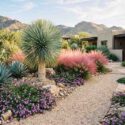
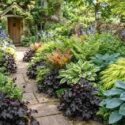
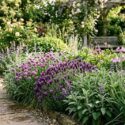
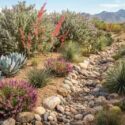
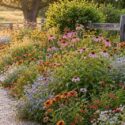
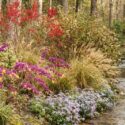
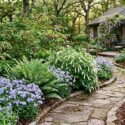
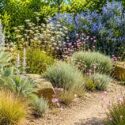
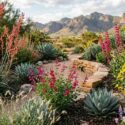
A relaxed wildflower border featuring Monarda, Mexican hat, blue sage, coneflowers, and native grasses—ideal for pollinators, birds, and dry, sunny sites.
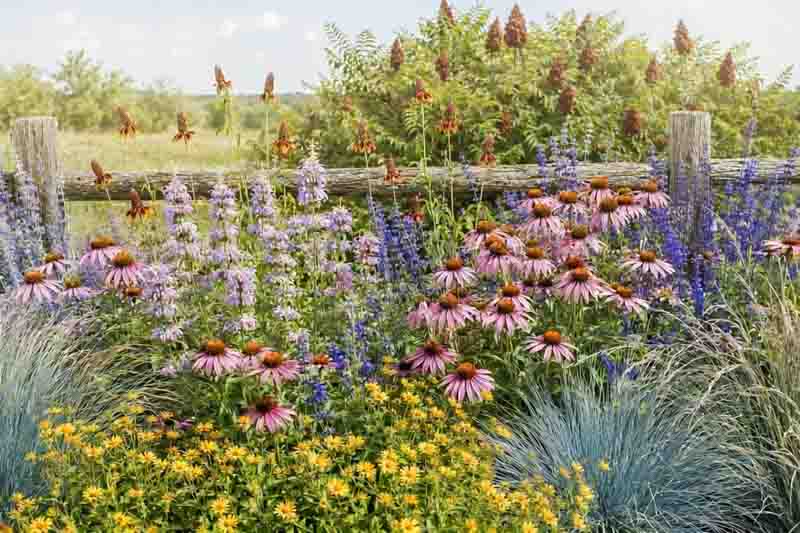


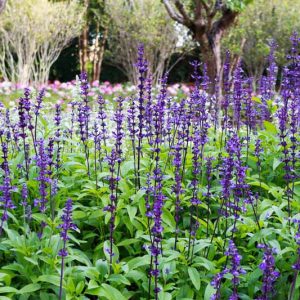
This sunny prairie-style planting brings together pink, lavender, violet-blue, yellow, rusty red, and tawny grass tones in a loose, layered border. Pink coneflowers rise through lower yellow Engelmann daisies, while the distinctive red-and-yellow flowers of Mexican Hat appear in smaller groups through the middle. Lemon Beebalm and Mealy Blue Sage add cooler vertical accents between them.
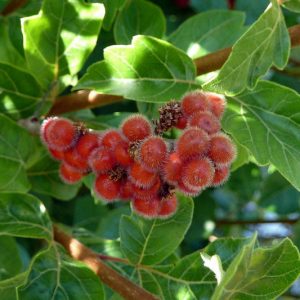
Two larger plants give the border its framework. Schizachyrium scoparium forms upright grassy clumps that take on warm copper and tan tones as the season progresses, while Rhus aromatica creates the broad green background. The sumac also contributes dark red fruit clusters that deepen the late-season color.
Main plants used: Monarda citriodora, Ratibida columnifera, Salvia farinacea, Echinacea, Engelmannia peristenia, Schizachyrium scoparium, and Rhus aromatica
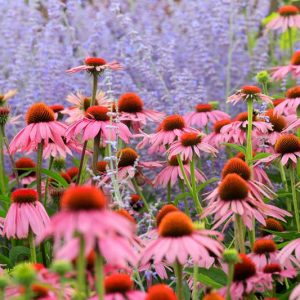
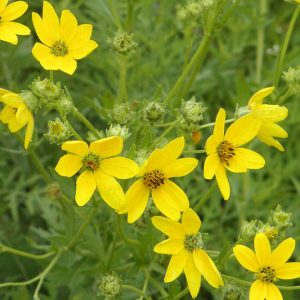
The planting feels varied because the flowers are different in both shape and height. Coneflowers have broad pink rays surrounding raised cones, Engelmann Daisy forms lower yellow masses, and Mexican Hat carries narrow drooping petals beneath elongated central cones. Lemon Beebalm and Mealy Blue Sage add more upright flower clusters between the daisy-shaped blooms.
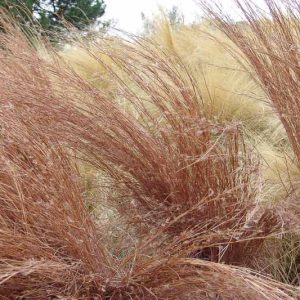
Little Bluestem changes the texture completely. Its fine, upright leaves and flowering stems create quieter areas between the brighter flowers. Fragrant Sumac is broader and more substantial, making it a useful background plant behind the finer prairie species.
The photograph also shows why loose repetition works better than rigid blocks. Coneflowers appear singly and in small groups, yellow flowers spread through several areas, and lavender and blue flowers recur without forming obvious stripes. The result feels established and varied rather than diagrammed.
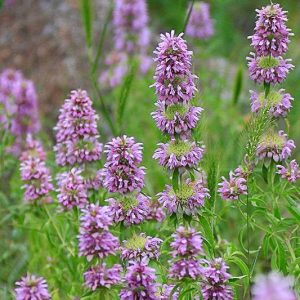
Monarda citriodora, or Lemon Beebalm, produces distinctive tiers of lavender flowers on upright stems. It is typically grown as an annual or biennial and readily reseeds where conditions suit it, making it particularly useful in naturalistic prairie-style planting.
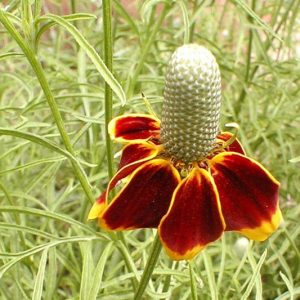
Ratibida columnifera brings one of the most recognizable prairie flower shapes. Its elongated central cones and drooping red, rust, or yellow-edged petals stand well above the foliage. It handles sun, heat, and relatively lean soils once established.
Salvia farinacea adds dense violet-blue flower spikes and a more compact habit. It flowers over a long period in warm climates and is frequently visited by bees, butterflies, and hummingbirds.
Echinacea provides the larger pink flowers scattered through the planting. Its raised cones remain useful after the petals fade, so some stems can be left standing into fall and winter for seed-eating birds.
Engelmannia peristenia forms loose groups of clear yellow daisies over finely divided foliage. It fits naturally through the front and middle of the border and is well adapted to sunny prairie conditions.
Schizachyrium scoparium is one of the main structural plants. Its upright clumps remain relatively narrow through summer, then develop copper, orange, and tawny tones in fall. Leave the stems standing through winter before cutting them back ahead of new spring growth.
Rhus aromatica forms the broadest mass in the garden. Its spreading branches and green foliage create an effective background for the finer prairie plants. Red fruits may follow the spring flowers, and the foliage often develops strong orange, red, or reddish-purple color in fall.
Create a sunny prairie border where flowering perennials mingle through an underlying framework of warm-season grass and low, spreading shrub growth.
These percentages describe the overall balance of the planting rather than equal numbers of individual plants. Fragrant Sumac will occupy considerably more physical space than most of the flowering perennials.
Position Fragrant Sumac first toward the back or outer edge, where its mature spread can be accommodated. Repeat Little Bluestem in substantial clumps through the middle and sides rather than creating a continuous grass screen.
Plant Echinacea, Engelmann Daisy, Mexican Hat, Lemon Beebalm, and Mealy Blue Sage in irregular groups through the spaces between them. Vary the size and spacing of each group so the planting feels settled rather than repetitive.
This combination is drought tolerant once established, but it should not be treated as a no-water planting. Newly installed plants need regular irrigation, and some of the flowering perennials will bloom better with occasional moisture during prolonged summer drought.
Several plants will also shift position over time. Lemon Beebalm and Mexican Hat can reseed, while Fragrant Sumac can spread outward by suckering. That movement suits a prairie-style garden, but occasional thinning helps prevent one species from gradually overwhelming its neighbors.
Finally, leave some spent stems and seedheads through winter rather than cutting the entire border down in fall. Coneflowers, Little Bluestem, and other prairie plants retain useful structure after flowering and can provide seeds or shelter for wildlife.
| Hardiness |
8 |
|---|---|
| Exposure | Full Sun |
| Season of Interest | Spring (Mid, Late), Summer (Early, Mid, Late), Fall |
| Maintenance | Low |
| Water Needs | Low, Average |
| Soil Type | Loam, Sand |
| Soil pH | Alkaline, Neutral |
| Soil Drainage | Well-Drained |
| Characteristics | Cut Flowers, Fruit & Berries, Showy |
| Native Plants | United States, Midwest, Southeast, Southwest, Kansas, Nebraska, Arkansas, Texas, New Mexico, Oklahoma |
| Tolerances | Drought, Dry Soil |
| Attracts | Bees, Butterflies, Birds |
| Landscaping Ideas | Beds And Borders |
| Garden Styles | Butterfly Garden, Informal and Cottage, Pollinator Garden, Prairie and Meadow |
| Hardiness |
8 |
|---|---|
| Exposure | Full Sun |
| Season of Interest | Spring (Mid, Late), Summer (Early, Mid, Late), Fall |
| Maintenance | Low |
| Water Needs | Low, Average |
| Soil Type | Loam, Sand |
| Soil pH | Alkaline, Neutral |
| Soil Drainage | Well-Drained |
| Characteristics | Cut Flowers, Fruit & Berries, Showy |
| Native Plants | United States, Midwest, Southeast, Southwest, Kansas, Nebraska, Arkansas, Texas, New Mexico, Oklahoma |
| Tolerances | Drought, Dry Soil |
| Attracts | Bees, Butterflies, Birds |
| Landscaping Ideas | Beds And Borders |
| Garden Styles | Butterfly Garden, Informal and Cottage, Pollinator Garden, Prairie and Meadow |
Recreate this garden. Specify the percentages you would like to have of each plant and input the dimensions of your garden space.We'll give you a shopping list so you know how many plants you need.
| Plant | Quantity | |
|---|---|---|
| Monarda citriodora (Lemon Bee Balm) | N/A | Buy Plants |
| Ratibida columnifera (Mexican Hat Plant) | N/A | Buy Plants |
| Salvia farinacea (Mealy Sage) | N/A | Buy Plants |
| Echinacea purpurea (Purple Coneflower) | N/A | Buy Plants |
| Engelmannia peristenia (Engelmann Daisy) | N/A | Buy Plants |
| Schizachyrium scoparium (Little Bluestem) | N/A | Buy Plants |
| Rhus aromatica (Fragrant Sumac) | N/A | Buy Plants |
Create a membership account to save your garden designs and to view them on any device.
Becoming a contributing member of Gardenia is easy and can be done in just a few minutes. If you provide us with your name, email address and the payment of a modest $25 annual membership fee, you will become a full member, enabling you to design and save up to 25 of your garden design ideas.
Join now and start creating your dream garden!
Create a membership account to save your garden designs and to view them on any device.
Becoming a contributing member of Gardenia is easy and can be done in just a few minutes. If you provide us with your name, email address and the payment of a modest $25 annual membership fee, you will become a full member, enabling you to design and save up to 25 of your garden design ideas.
Join now and start creating your dream garden!