A vibrant wildflower border with coneflower, Indian blanket, mistflower, and autumn sage - easy, drought-tolerant, and full of pollinators.
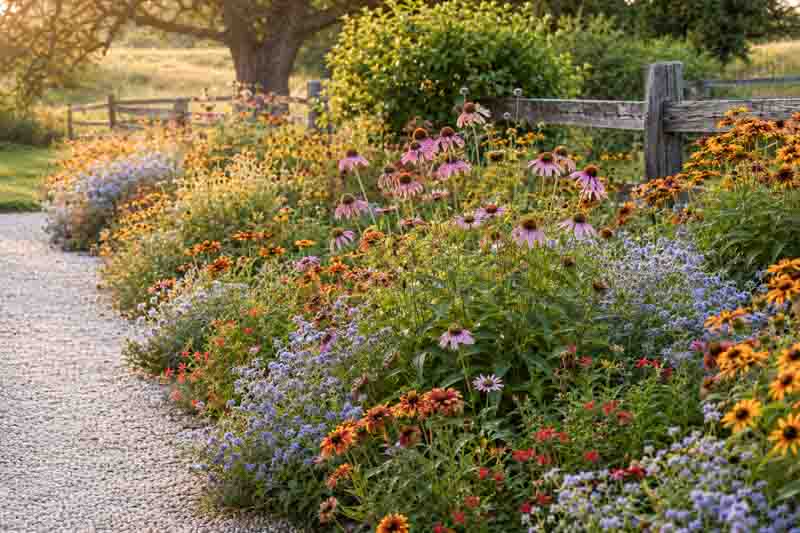


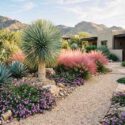
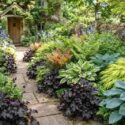
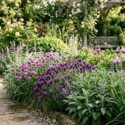
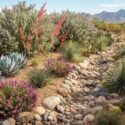
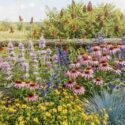
This sunny garden follows a pale gravel path through a loose mix of pink, lavender-blue, red, orange, and yellow flowers. Purple coneflowers rise through the center, surrounded by red-and-gold Gaillardia and yellow Black-eyed Susans. Gregg’s Mistflower forms softer lavender-blue clouds along the edges, while red-flowering Autumn Sage appears in smaller groups throughout the planting.
The border feels established rather than carefully arranged. Some plants form broad drifts, others appear in smaller pockets, and flowering stems lean naturally into neighboring groups. The ranch fence, open ground, and mature trees beyond the garden reinforce the informal Texas setting.
Main plants used: Echinacea purpurea, Gaillardia pulchella, Conoclinium greggii, Salvia greggii, and Rudbeckia hirta
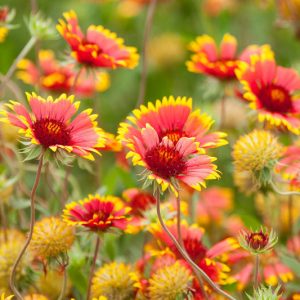
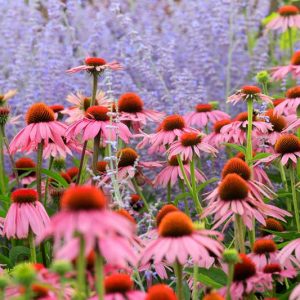
The border uses several familiar flower shapes without becoming repetitive. Echinacea purpurea has broad pink rays surrounding prominent orange-brown cones, while Gaillardia pulchella carries smaller red-and-yellow daisies. Rudbeckia hirta adds clear golden flowers with dark central cones, and Gregg’s Mistflower provides a completely different texture with clusters of small, fuzzy lavender-blue flowers.
The colors are repeated in different parts of the bed rather than arranged in separate bands. Gaillardia carries orange and red through the planting, while Autumn Sage picks up the red in smaller accents. Coneflowers provide the largest pink areas, and the mistflower cools the palette around the edges.
The photograph also shows why equal proportions do not need to look equal on the ground. Some species naturally form broader masses, while others are better scattered in smaller groups. That irregularity keeps the garden from looking diagrammed.
Echinacea purpurea provides some of the tallest and most recognizable flowers in the border. It performs well in full sun to light shade and tolerates a range of soils as long as drainage is reasonable. Leave some seedheads after flowering if you want winter structure and food for seed-eating birds.
Gaillardia pulchella supplies much of the warm red-and-gold color. It thrives in full sun, handles heat well, and is especially suited to lean, freely draining soil. Depending on conditions, it behaves as an annual or short-lived perennial and often maintains itself by reseeding.
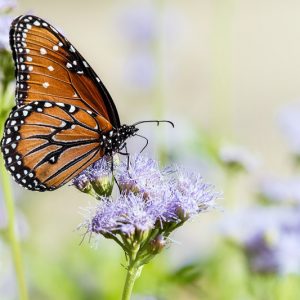
Conoclinium greggii creates the soft lavender-blue areas visible along the path. Its flowers are particularly valuable to butterflies later in the season. The plant spreads by rhizomes and can form broad colonies where it is happy, so give it room or thin it periodically if it begins to dominate.
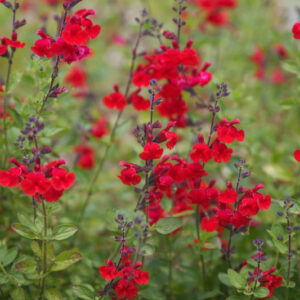
Salvia greggii adds red flowers and a more permanent shrubby framework among the softer wildflowers. Once established, it tolerates heat and dry periods well. Light pruning helps maintain a compact shape and encourages fresh flowering growth.
Rudbeckia hirta adds golden-yellow flowers with dark centers through the front and middle of the border. Individual plants can be short-lived, but they often reseed readily where conditions suit them.
Create a loose, colorful pollinator border along a gravel path, using repeated groups and natural overlap rather than formal rows or sharply separated blocks.
These percentages describe the overall balance of the five featured plants rather than equal numbers or five separate patches.
Start with irregular groups of Echinacea, Gaillardia, and Rudbeckia through the front and middle of the bed. Vary the size of each group and allow some plants to overlap.
Use Gregg’s Mistflower in broader pockets where it has room to spread, especially along the outer edges or in spaces where its softer texture can contrast with the daisy-like flowers.
Repeat Autumn Sage in smaller groups through the border to provide red accents and more permanent structure. Keep enough of the gravel path clear for comfortable walking, but allow a few stems to lean naturally toward the edge.
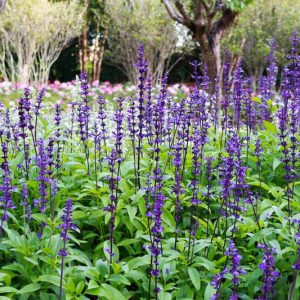
The plants in this border are all well suited to warm, sunny conditions, but they do not want exactly the same amount of moisture. Gaillardia and Autumn Sage are especially comfortable in drier, lean soils, while Echinacea and Gregg’s Mistflower generally perform better with somewhat more consistent moisture. Avoid treating the entire bed as either constantly moist or completely dry.
Gregg’s Mistflower can spread vigorously by rhizomes, while Gaillardia and Black-eyed Susan may maintain themselves through reseeding rather than through long-lived individual plants. The balance of the garden will therefore shift from year to year. Thin, move, or allow seedlings according to the effect you want rather than trying to freeze the planting in its original arrangement.
All five featured species are native to Texas, but their natural ranges within the state are not identical. Echinacea purpurea, for example, is native only to a limited part of northeast Texas, while Salvia greggii and Conoclinium greggii are more closely associated with western and southern parts of the state. For the strongest ecological fit, gardeners should consider which species are native to their own Texas ecoregion as well as to the state as a whole.
| Hardiness |
8 |
|---|---|
| Exposure | Full Sun |
| Season of Interest | Spring (Mid, Late), Summer (Early, Mid, Late), Fall |
| Maintenance | Low |
| Water Needs | Low, Average |
| Soil Type | Loam, Sand |
| Soil pH | Acid, Alkaline, Neutral |
| Soil Drainage | Moist but Well-Drained, Well-Drained |
| Characteristics | Cut Flowers, Showy |
| Native Plants | United States, Southwest, Texas, New Mexico |
| Tolerances | Drought |
| Attracts | Bees, Butterflies, Birds |
| Landscaping Ideas | Beds And Borders |
| Garden Styles | Butterfly Garden, Informal and Cottage, Pollinator Garden, Prairie and Meadow |
| Hardiness |
8 |
|---|---|
| Exposure | Full Sun |
| Season of Interest | Spring (Mid, Late), Summer (Early, Mid, Late), Fall |
| Maintenance | Low |
| Water Needs | Low, Average |
| Soil Type | Loam, Sand |
| Soil pH | Acid, Alkaline, Neutral |
| Soil Drainage | Moist but Well-Drained, Well-Drained |
| Characteristics | Cut Flowers, Showy |
| Native Plants | United States, Southwest, Texas, New Mexico |
| Tolerances | Drought |
| Attracts | Bees, Butterflies, Birds |
| Landscaping Ideas | Beds And Borders |
| Garden Styles | Butterfly Garden, Informal and Cottage, Pollinator Garden, Prairie and Meadow |
Recreate this garden. Specify the percentages you would like to have of each plant and input the dimensions of your garden space.We'll give you a shopping list so you know how many plants you need.
| Plant | Quantity | |
|---|---|---|
| Gaillardia pulchella (Firewheel) | N/A | Buy Plants |
| Salvia greggii (Autumn Sage) | N/A | Buy Plants |
| Salvia farinacea (Mealy Sage) | N/A | Buy Plants |
| Echinacea purpurea (Purple Coneflower) | N/A | Buy Plants |
| Conoclinium greggii (Palm-leaf Mistflower) | N/A | Buy Plants |
Create a membership account to save your garden designs and to view them on any device.
Becoming a contributing member of Gardenia is easy and can be done in just a few minutes. If you provide us with your name, email address and the payment of a modest $25 annual membership fee, you will become a full member, enabling you to design and save up to 25 of your garden design ideas.
Join now and start creating your dream garden!