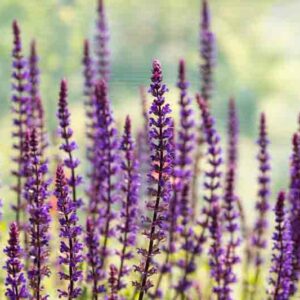
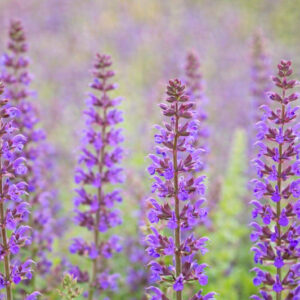
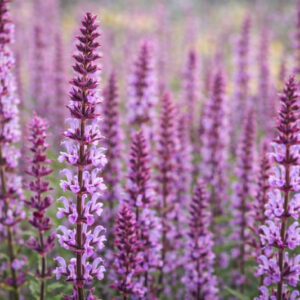
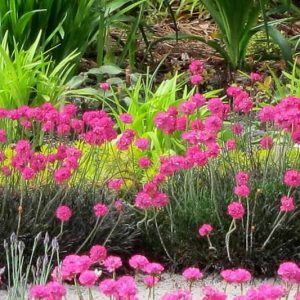
A sun-loving perennial border that looks designer-made: Salvia sylvestris ‘Mainacht’ blooms late spring-summer with purple spires, while Geranium sanguineum flowers late spring-summer in pink cushions. Thymus vulgaris edges the path with fragrance, Armeria maritima adds spring pom-poms, and Tulbaghia violacea sparkles in summer-fall.
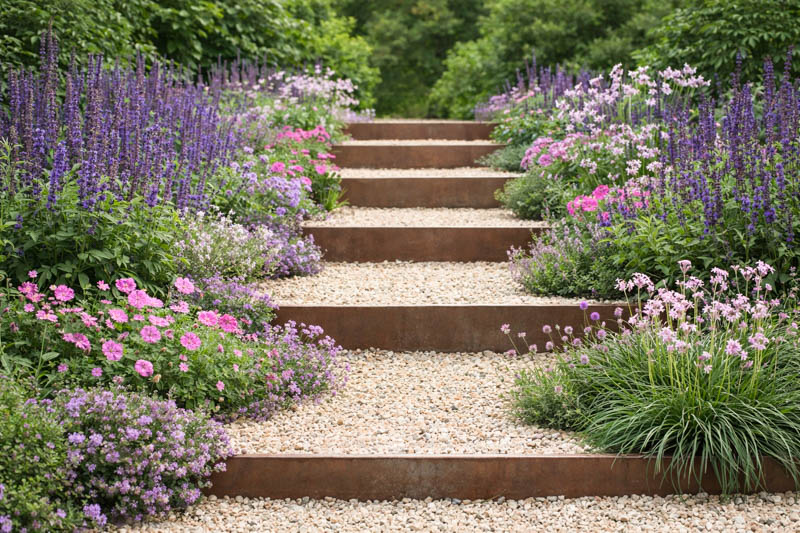


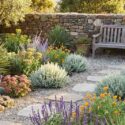
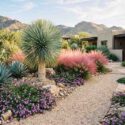
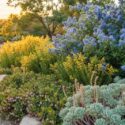
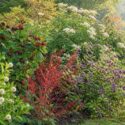
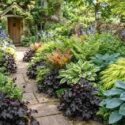
This sunny border follows a gravel step path through a planting of purple, pink, and soft green. Salvia × sylvestris ‘Mainacht’ provides the strongest vertical color, while Geranium sanguineum forms lower flowering mounds beside the path. Thyme and sea thrift stay close to the ground, and Tulbaghia violacea adds lighter purple flowers later in the season.
The border feels relaxed because the plants are grouped rather than lined up. Salvia appears in repeated clumps, geranium spreads into broader patches, and the smaller edging plants soften the gravel without covering it completely. The path remains clearly defined, which gives the planting enough structure to feel tidy even when the flowers overlap.
Main plants used: Salvia × sylvestris ‘Mainacht’, Geranium sanguineum, Thymus vulgaris, Armeria maritima, and Tulbaghia violacea
The strongest contrast is between height and habit. Salvia rises in narrow flower spikes, while Geranium stays lower and spreads outward. Thyme and Armeria sit closer to the gravel, so the planting steps down naturally toward the path.
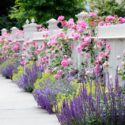
The limited palette helps too. Purple appears in both Salvia and Tulbaghia, while Geranium and Armeria introduce softer pink tones. Because the same colors recur at different heights, the border feels connected without needing a large number of species.
The gravel path is an important part of the composition. It gives the eye a break from the flowers and keeps the planting from becoming one continuous mass. Allowing a few leaves or stems to lean toward the edge is enough to soften the path without losing its shape.
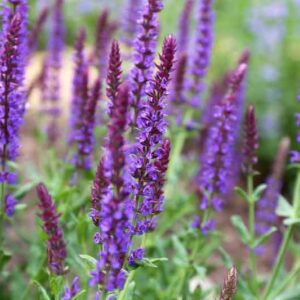
Salvia × sylvestris ‘Mainacht’ provides the main vertical element and much of the purple color. Use it in several groups along the path rather than as isolated single plants. Cutting back after the first main flush can encourage fresh growth and, in favorable conditions, further flowering.
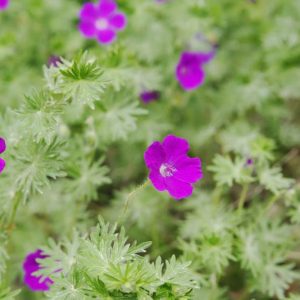
Geranium sanguineum is useful for filling the lower part of the border. Its rounded habit and pink flowers soften the transition between taller plants and the gravel. Allow clumps to spread naturally, but trim them back if they begin to obstruct the steps.
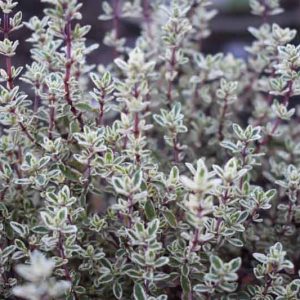
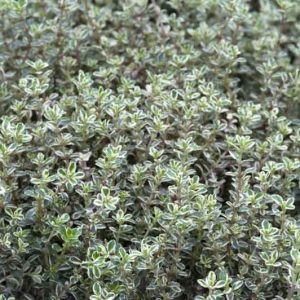
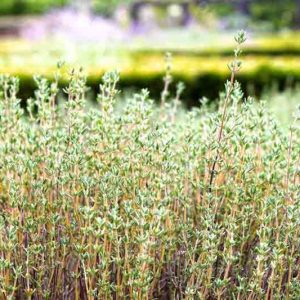
Thymus vulgaris brings fine foliage and fragrance close to the ground. It works best in sunny, well-drained positions and should not be planted where richer or wetter soil will encourage weak growth.
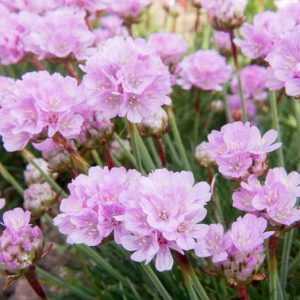
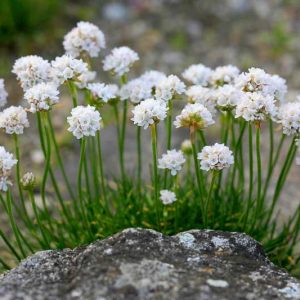
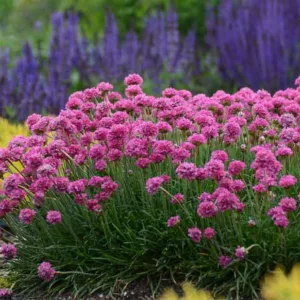
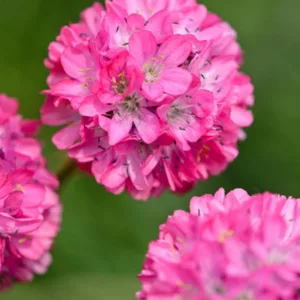
Armeria maritima forms compact evergreen tufts with rounded pink flower heads. Use it in small groups near the front, especially where you want a cleaner edge without introducing a formal line.
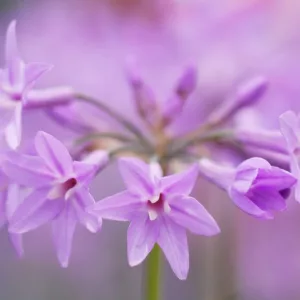
Tulbaghia violacea adds slim stems topped with lilac-purple flowers through summer and, in mild climates, sometimes beyond. It is best placed in small groups through the front and middle rather than concentrated in one block.
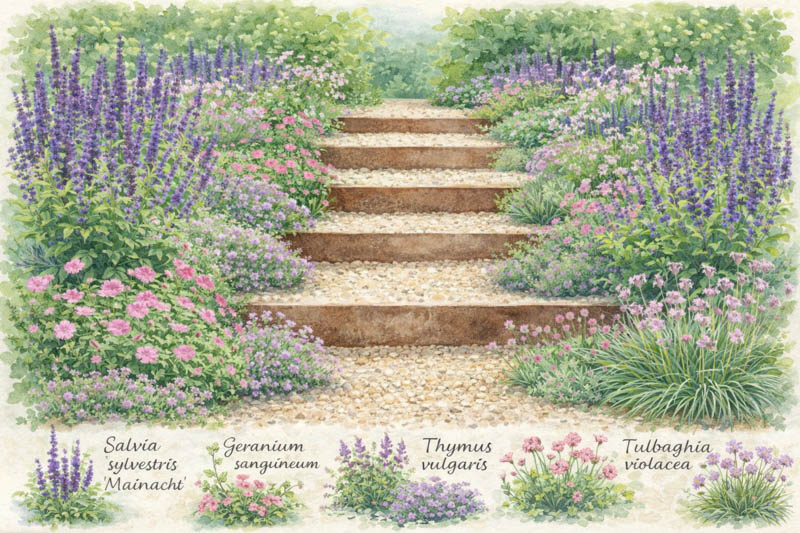
Create a sunny gravel-path border with repeated purple flower spikes, lower pink-flowering clumps, and neat but informal edging.
Treat these proportions as a guide rather than a fixed formula. Mature spread and the width of the path should determine the final balance.
Place Salvia first in repeated clumps through the middle of the border.
Use Geranium in broader patches around and between the Salvia to soften the lower layer.
Keep thyme and Armeria closer to the path, but avoid turning them into one continuous edging strip.
Add Tulbaghia in small groups through the front and middle so its later flowers appear in more than one place.
This combination is often relatively drought tolerant once established, but the plants do not all have identical water needs. Good drainage is more important than trying to keep the entire border uniformly dry.
Browsing by deer and rabbits is often limited because several plants have aromatic or strongly textured foliage, but resistance is never guaranteed.
Most importantly, allow enough space beside the steps for safe passage. A little overlap makes the border feel relaxed; plants spilling across the walking surface do not.
| Hardiness |
7 - 8 |
|---|---|
| Heat Zones |
7 - 8 |
| Climate Zones | 14, 15, 16, 17, 18, 19, 20, 21, 22, 23, 24 |
| Exposure | Full Sun |
| Season of Interest | Spring (Late), Summer (Early, Mid, Late), Fall |
| Maintenance | Low |
| Water Needs | Average |
| Soil Type | Loam, Sand |
| Soil pH | Alkaline, Neutral |
| Soil Drainage | Moist but Well-Drained, Well-Drained |
| Characteristics | Showy, Cut Flowers, Dried Arrangements |
| Tolerances | Drought, Deer |
| Attracts | Bees, Butterflies |
| Landscaping Ideas | Beds And Borders, Pathways |
| Garden Styles | Butterfly Garden, Gravel and Rock Garden, Informal and Cottage, Pollinator Garden |


| Hardiness |
7 - 8 |
|---|---|
| Heat Zones |
7 - 8 |
| Climate Zones | 14, 15, 16, 17, 18, 19, 20, 21, 22, 23, 24 |
| Exposure | Full Sun |
| Season of Interest | Spring (Late), Summer (Early, Mid, Late), Fall |
| Maintenance | Low |
| Water Needs | Average |
| Soil Type | Loam, Sand |
| Soil pH | Alkaline, Neutral |
| Soil Drainage | Moist but Well-Drained, Well-Drained |
| Characteristics | Showy, Cut Flowers, Dried Arrangements |
| Tolerances | Drought, Deer |
| Attracts | Bees, Butterflies |
| Landscaping Ideas | Beds And Borders, Pathways |
| Garden Styles | Butterfly Garden, Gravel and Rock Garden, Informal and Cottage, Pollinator Garden |
Recreate this garden. Specify the percentages you would like to have of each plant and input the dimensions of your garden space.We'll give you a shopping list so you know how many plants you need.
| Plant | Quantity | |
|---|---|---|
| Salvia x sylvestris May Night (Wood Sage) | N/A | Buy Plants |
| Geranium sanguineum (Bloody Cranesbill) | N/A | Buy Plants |
| Armeria maritima (Sea Thrift) | N/A | Buy Plants |
| Thymus vulgaris (Common Thyme) | N/A | Buy Plants |
| Tulbaghia violacea (Society Garlic) | N/A | Buy Plants |
Create a membership account to save your garden designs and to view them on any device.
Becoming a contributing member of Gardenia is easy and can be done in just a few minutes. If you provide us with your name, email address and the payment of a modest $25 annual membership fee, you will become a full member, enabling you to design and save up to 25 of your garden design ideas.
Join now and start creating your dream garden!
Create a membership account to save your garden designs and to view them on any device.
Becoming a contributing member of Gardenia is easy and can be done in just a few minutes. If you provide us with your name, email address and the payment of a modest $25 annual membership fee, you will become a full member, enabling you to design and save up to 25 of your garden design ideas.
Join now and start creating your dream garden!