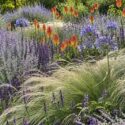
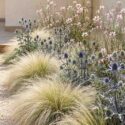
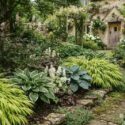
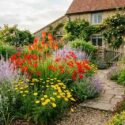
A modern cottage gravel path garden anchored by evergreen Thuja spires and panicle hydrangea Limelight, blooming mid-summer to fall. Rozanne geranium adds a long season of purple, while Carex, Festuca glauca, and Pennisetum provide airy motion. Add Cotinus for soft, smoky backdrop structure.
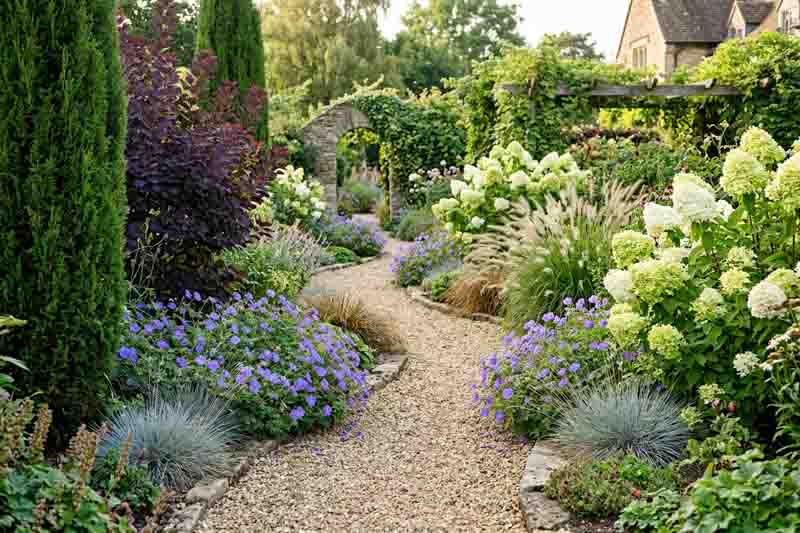


A pale gravel path curves through this mature mixed border, where narrow evergreens, dark foliage shrubs, flowering hydrangeas, perennials, and grasses are repeated in loose groups. The planting has plenty of structure, but it does not feel formal. Plants lean toward the path, grasses soften the edges, and several different heights are visible at once.
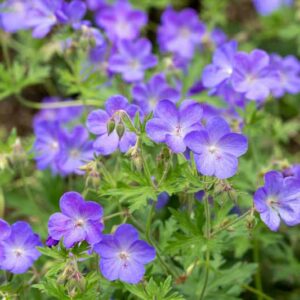
Hydrangea paniculata ‘Limelight’ provides the largest flower clusters, while narrow Thuja occidentalis ‘DeGroot’s Spire’ rises above the surrounding plants. Dark-leaved Cotinus coggygria creates depth behind them. Along the lower edge, purple-blue Geranium ‘Rozanne’, upright Hylotelephium, blue fescue, bronze sedge, and fountain grass fill the spaces between the shrubs and gravel.
Main plants used: Thuja occidentalis ‘DeGroot’s Spire’, Cotinus coggygria, Hydrangea paniculata ‘Limelight’, Geranium ‘Rozanne’, Hylotelephium, Carex comans, Festuca glauca, and Pennisetum orientale
The border is held together by repeated shapes rather than by a strict color scheme. The narrow Thuja appear several times along the path, while rounded hydrangeas and broader Cotinus shrubs provide heavier masses between them.
At ground level, the planting becomes much finer. Geranium spreads outward, Hylotelephium forms upright clumps, and the grasses range from compact blue tufts to larger arching forms. These differences keep the lower border interesting without competing with the shrubs.
The gravel path is an important part of the composition. Its pale surface creates open space beside a very full planting and makes the darker Cotinus foliage, purple flowers, and blue-gray grasses more noticeable.
Thuja occidentalis ‘DeGroot’s Spire’ provides the strongest vertical structure and remains useful through winter. Its narrow habit makes it particularly suitable beside paths where a broader conifer would eventually take up too much room.
Cotinus coggygria contributes darker foliage and a larger shrub presence. Give it enough room to develop rather than trying to keep it permanently squeezed between smaller perennials.
Hydrangea paniculata ‘Limelight’ produces large lime-green to creamy flower panicles that become softer in color as they age. It works well in substantial groups, but remember that mature shrubs occupy considerably more space than the surrounding perennials.
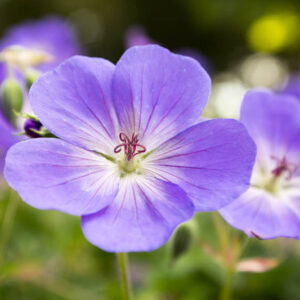
Geranium ‘Rozanne’ provides long-lasting violet-blue flowers near the path. Allow it to spread between neighboring plants, but trim stems where they begin to obstruct the walkway.
Hylotelephium adds fleshy foliage and broad late-summer flower heads. It needs good drainage and generally tolerates drier conditions better than the hydrangeas.
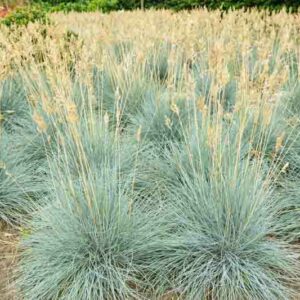
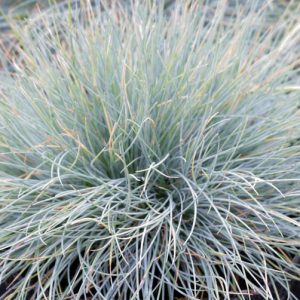
The grasses provide several different textures. Festuca glauca forms compact blue-gray clumps, Carex comans adds finer bronze foliage, and Pennisetum orientale carries larger arching leaves and soft flower plumes.

Create a mixed gravel-path border with year-round vertical structure, substantial summer flowers, dark foliage for contrast, and a varied lower layer of perennials and grasses.
Use these proportions as a guide only. Mature shrub size should determine the actual spacing and number of plants.
Place the Thuja, Cotinus, and Hydrangea first, allowing for their mature size.
Fill the front and middle with Geranium and Hylotelephium, leaving some irregular gaps rather than creating continuous bands.
Use grasses in several different-sized groups near the path and between the perennials. Keep enough gravel visible for the path to remain a strong part of the design.
This is not a uniformly drought-tolerant planting. The gravel suggests dry conditions visually, but ‘Limelight’ hydrangeas need considerably more moisture than sedum or blue fescue. Grouping plants according to their water needs, or adjusting irrigation within the bed, will produce a more reliable garden.
Also plan for mature shrub size from the start. Cotinus and Hydrangea can become substantial plants, and the border will be easier to maintain if the grasses and perennials are not packed tightly around them when young.
| Hardiness |
6 - 8 |
|---|---|
| Heat Zones |
7 |
| Climate Zones | 3, 3A, 3B, 4, 5, 6, 7, 8, 9, 15, 16, 17, 18, 19, 20, 21 |
| Exposure | Full Sun |
| Season of Interest | Summer (Mid, Late), Fall |
| Maintenance | Low |
| Water Needs | Average |
| Soil Type | Chalk, Loam, Sand |
| Soil pH | Alkaline, Neutral |
| Soil Drainage | Moist but Well-Drained, Well-Drained |
| Characteristics | Cut Flowers, Plant of Merit, Showy |
| Attracts | Birds, Butterflies |
| Landscaping Ideas | Beds And Borders |
| Garden Styles | Butterfly Garden, Informal and Cottage, Pollinator Garden, Traditional Garden |




| Hardiness |
6 - 8 |
|---|---|
| Heat Zones |
7 |
| Climate Zones | 3, 3A, 3B, 4, 5, 6, 7, 8, 9, 15, 16, 17, 18, 19, 20, 21 |
| Exposure | Full Sun |
| Season of Interest | Summer (Mid, Late), Fall |
| Maintenance | Low |
| Water Needs | Average |
| Soil Type | Chalk, Loam, Sand |
| Soil pH | Alkaline, Neutral |
| Soil Drainage | Moist but Well-Drained, Well-Drained |
| Characteristics | Cut Flowers, Plant of Merit, Showy |
| Attracts | Birds, Butterflies |
| Landscaping Ideas | Beds And Borders |
| Garden Styles | Butterfly Garden, Informal and Cottage, Pollinator Garden, Traditional Garden |
Recreate this garden. Specify the percentages you would like to have of each plant and input the dimensions of your garden space.We'll give you a shopping list so you know how many plants you need.
| Plant | Quantity | |
|---|---|---|
| Hydrangea paniculata 'Limelight' | N/A | Buy Plants |
| Festuca glauca 'Blaufuchs' (Blue Fescue) | N/A | Buy Plants |
| Geranium Rozanne (Cranesbill) | N/A | Buy Plants |
| Carex comans Bronze-Leaved (New Zealand Hair Sedge) | N/A | Buy Plants |
| Sedum 'Jose Aubergine' (Stonecrop) | N/A | Buy Plants |
| Thuja occidentalis 'Degroot's Spire' (American Arborvitae) | N/A | Buy Plants |
| Cotinus coggygria 'Royal Purple' (Smokebush) | N/A | Buy Plants |
| Pennisetum orientale (Oriental Fountain Grass) | N/A | Buy Plants |
Create a membership account to save your garden designs and to view them on any device.
Becoming a contributing member of Gardenia is easy and can be done in just a few minutes. If you provide us with your name, email address and the payment of a modest $25 annual membership fee, you will become a full member, enabling you to design and save up to 25 of your garden design ideas.
Join now and start creating your dream garden!