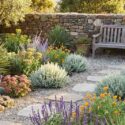
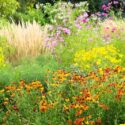
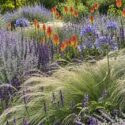
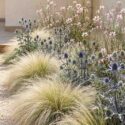
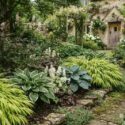
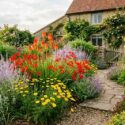
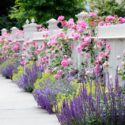
A sun-loving perennial border with a gravel path and mirrored drifts of helenium, monarda, veronicastrum virginicum, and aster frikartii. Expect peak color from mid-summer through fall: monarda in summer, veronicastrum in midsummer, helenium late summer, and asters into autumn - pollinator-rich and garden-photo gorgeous.
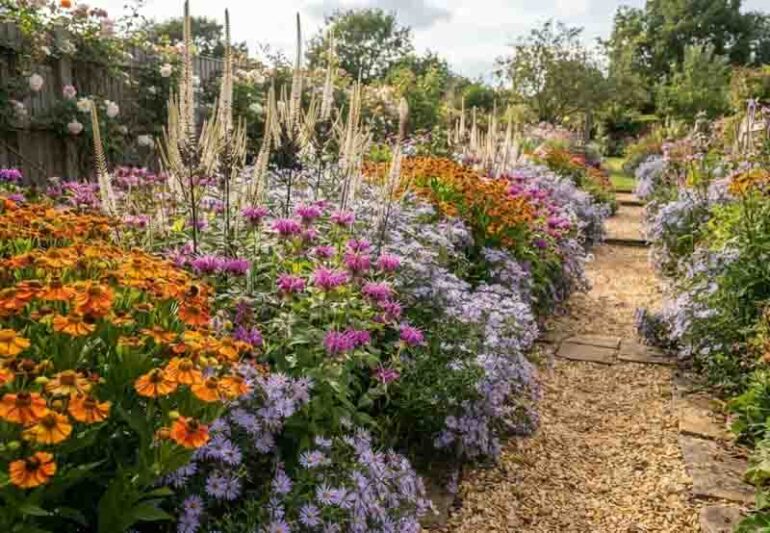


This generous summer border follows a narrow gravel path, with flowers leaning toward the edges and taller stems rising behind them. Orange Helenium, purple-pink Monarda, lavender-blue Aster × frikartii, and Veronicastrum virginicum provide the main color and structure, while roses and other established plants in the background give the garden the depth and informality of a mature cottage planting.
The two sides of the path use the same plant palette without mirroring each other exactly. Some flowers appear in broad patches, others in smaller groups, and the taller Veronicastrum spikes emerge at irregular intervals. That repetition keeps the garden coherent, while the variation prevents it from looking overly planned.
Main plants used: Helenium, Monarda (Bee Balm), Aster × frikartii, and Veronicastrum virginicum (Culver’s Root)
Use the same plants repeatedly along the path, but vary the size and position of each group. The repetition gives the border continuity; the irregularity keeps it relaxed.
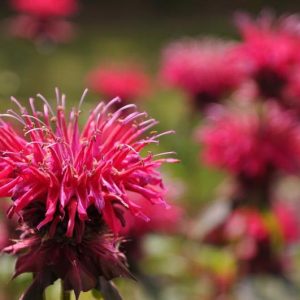
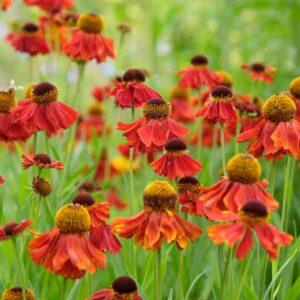
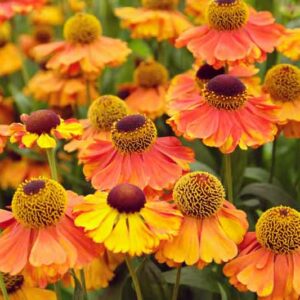
The strongest contrast comes from color. Helenium supplies the orange and copper tones, while Monarda and Aster × frikartii introduce pink, purple, and lavender-blue. Because the cooler shades recur throughout the planting, the orange remains lively without dominating the entire border.
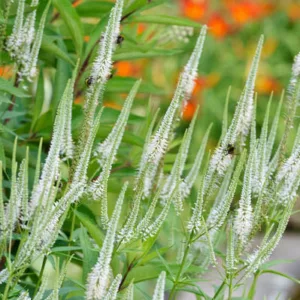
The flower shapes are equally varied. Helenium and asters have open, daisy-like blooms, Monarda forms rounded flower heads, and Veronicastrum carries narrow upright spikes. These differences help individual plants remain recognizable even where the border becomes dense.
The path itself is part of the design. Lower plants can spill slightly toward the edges, while taller stems remain farther back so the route ahead stays visible. The planting feels enclosed and abundant without becoming difficult to walk through.
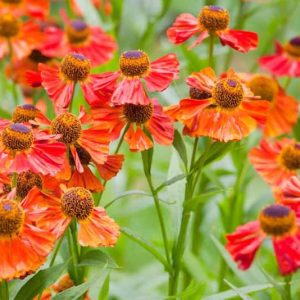
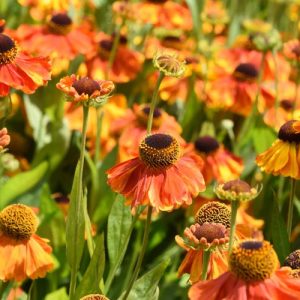
Helenium carries much of the warm color and is most effective in noticeable groups. Place some clumps near the path and others deeper in the border rather than creating one continuous orange band.
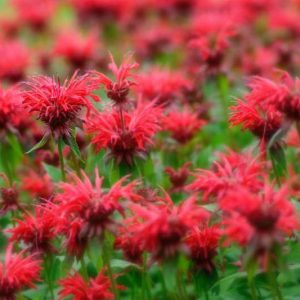
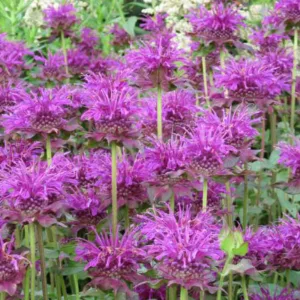
Monarda adds the stronger purple-pink tones and attracts plenty of pollinator activity. Several medium-sized groups work well. Leave enough space between plants for air to circulate, particularly where powdery mildew is a recurring problem.
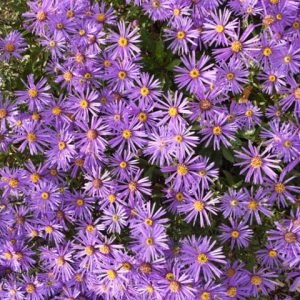
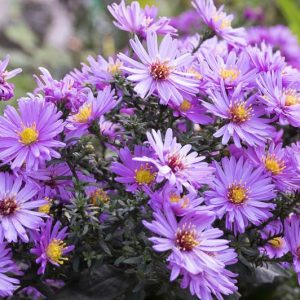
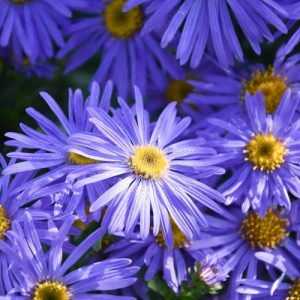
Aster × frikartii brings a softer lavender-blue and helps carry the display later into the season. It works well near the path edge or between warmer-flowered plants, where its open daisy-like blooms provide a cooler counterpoint.
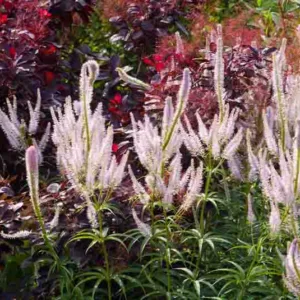
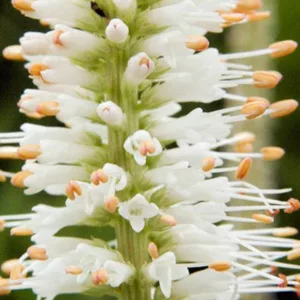
Veronicastrum virginicum is the tallest of the four. Use it in small groups through the middle and rear so its flower spikes rise above neighboring plants without forming a solid wall at the back.
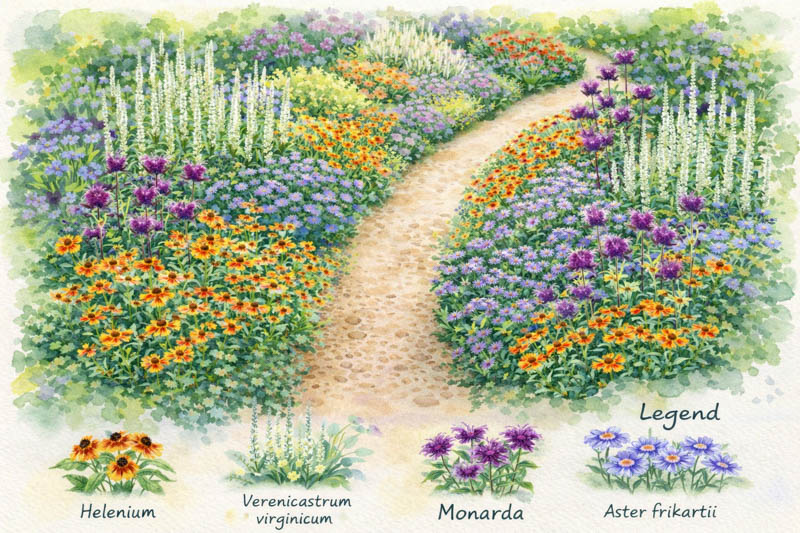
Create an informal summer border along a path, with broad flowering groups at lower levels and occasional taller plants rising through them.
Treat these proportions as a starting point. In a mature mixed border, roses and other compatible perennials can remain part of the planting.
Vary the group sizes instead of repeating identical clumps. One larger drift beside two smaller ones usually feels more natural.
Place Helenium and asters in broad groups toward the front and middle, allowing some foliage to soften the path edge.
Repeat Monarda through the middle rather than concentrating it in one place.
Use Veronicastrum farther back and occasionally through the middle so its taller spikes appear at different depths.
Do not make the two sides identical. Repeat plants and colors, but shift their positions and vary the group sizes.
By midsummer, Monarda and Helenium provide much of the strongest color. As summer progresses, Aster × frikartii becomes increasingly important, while Veronicastrum adds height above the fuller flowering layer.
Because the four plants overlap rather than flowering on exactly the same schedule, the border changes gradually instead of reaching one brief peak. Roses and other established plants behind them also help maintain interest as individual perennials begin to fade.
Do not plant too tightly simply to make the border look full in its first season. These perennials broaden considerably once established, and leaving a little room at the start makes later maintenance much easier.
Most importantly, resist making the layout too regular. The character of this garden comes from repeated plants that mingle, overlap, and sometimes lean toward the path. Keeping the palette consistent while allowing the groups to vary is what gives the border its relaxed, mature appearance.
| Hardiness |
5 - 8 |
|---|---|
| Heat Zones |
1 - 8 |
| Exposure | Full Sun |
| Season of Interest | Summer (Mid, Late), Fall |
| Maintenance | Low |
| Water Needs | Average |
| Soil Type | Clay, Loam |
| Soil pH | Acid, Alkaline, Neutral |
| Soil Drainage | Moist but Well-Drained |
| Characteristics | Fragrant, Showy |
| Tolerances | Deer, Rabbit |
| Attracts | Bees, Butterflies, Hummingbirds, Birds |
| Landscaping Ideas | Beds And Borders, Pathways |
| Garden Styles | Butterfly Garden, Informal and Cottage, Pollinator Garden, Prairie and Meadow |

| Hardiness |
5 - 8 |
|---|---|
| Heat Zones |
1 - 8 |
| Exposure | Full Sun |
| Season of Interest | Summer (Mid, Late), Fall |
| Maintenance | Low |
| Water Needs | Average |
| Soil Type | Clay, Loam |
| Soil pH | Acid, Alkaline, Neutral |
| Soil Drainage | Moist but Well-Drained |
| Characteristics | Fragrant, Showy |
| Tolerances | Deer, Rabbit |
| Attracts | Bees, Butterflies, Hummingbirds, Birds |
| Landscaping Ideas | Beds And Borders, Pathways |
| Garden Styles | Butterfly Garden, Informal and Cottage, Pollinator Garden, Prairie and Meadow |
Recreate this garden. Specify the percentages you would like to have of each plant and input the dimensions of your garden space.We'll give you a shopping list so you know how many plants you need.
| Plant | Quantity | |
|---|---|---|
| Veronicastrum virginicum 'Album' (Culver's Root) | N/A | Buy Plants |
| Monarda 'Scorpion' (Bee Balm) | N/A | Buy Plants |
| Helenium 'Waltraut' (Sneezeweed) | N/A | Buy Plants |
| Aster x frikartii 'Monch' (Frikart's Aster) | N/A | Buy Plants |
Create a membership account to save your garden designs and to view them on any device.
Becoming a contributing member of Gardenia is easy and can be done in just a few minutes. If you provide us with your name, email address and the payment of a modest $25 annual membership fee, you will become a full member, enabling you to design and save up to 25 of your garden design ideas.
Join now and start creating your dream garden!
Create a membership account to save your garden designs and to view them on any device.
Becoming a contributing member of Gardenia is easy and can be done in just a few minutes. If you provide us with your name, email address and the payment of a modest $25 annual membership fee, you will become a full member, enabling you to design and save up to 25 of your garden design ideas.
Join now and start creating your dream garden!