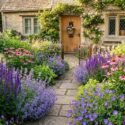
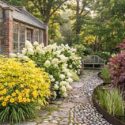
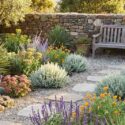
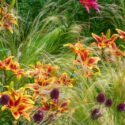
Scarlet Maltese Cross, golden Daylilies, and deep violet Salvia create a vivid summer border with striking color and clear structure. Broad purple drifts anchor the warmer flowers, while tall red flowerheads rise above the planting. It is bold, cheerful, and easy to adapt to a sunny perennial garden.
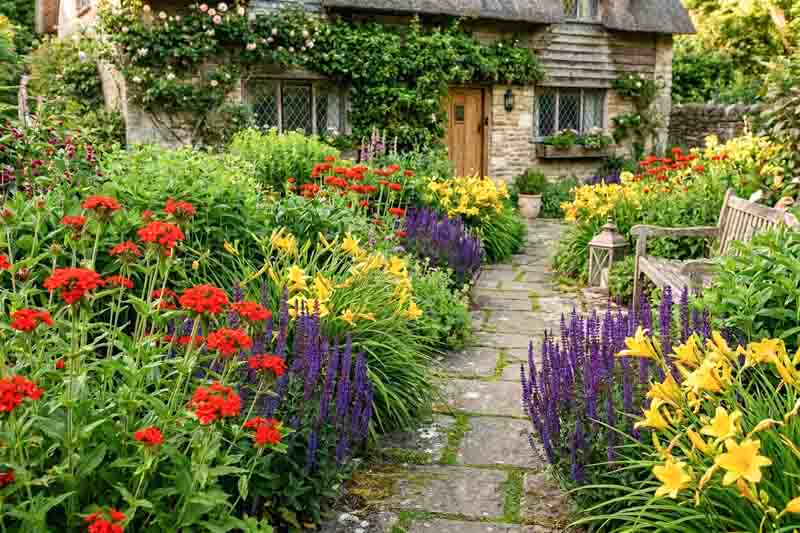


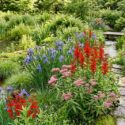
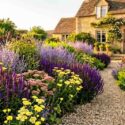
This vivid summer border brings together three strong colors without losing its sense of order. Scarlet-red Lychnis chalcedonica rises through golden Hemerocallis ‘Golden Chimes’, while Salvia nemorosa ‘Caradonna’ forms rich violet-purple drifts along the front and through the lower part of the planting.
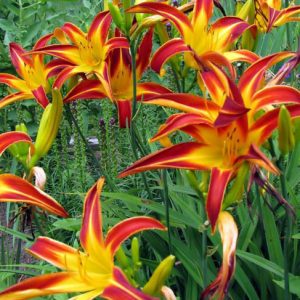
The effect is bold, but not chaotic. The Daylilies provide broad sweeps of warm yellow, Maltese Cross adds taller red flowerheads, and the Salvia cools everything down with dense vertical spikes. Repeating the same three plants across the border gives the planting rhythm and keeps the strong colors connected.
Main plants used: Lychnis chalcedonica (Maltese Cross), Hemerocallis ‘Golden Chimes’ (Daylily), and Salvia nemorosa ‘Caradonna’ (Sage)
Let the Salvia form the cool-colored base, then repeat the Daylilies and Maltese Cross in loose groups rather than separating each plant into its own block.
The color contrast is immediate. Golden Daylilies and scarlet Maltese Cross create a hot summer palette, while the violet spikes of ‘Caradonna’ provide just enough cool color to keep the planting balanced.
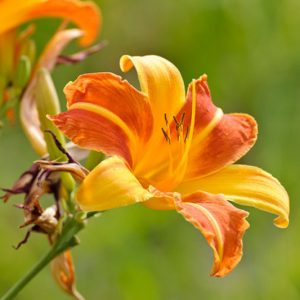
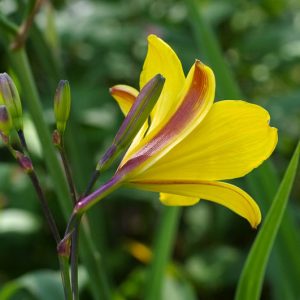
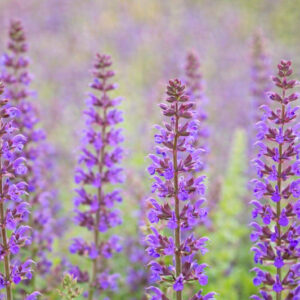
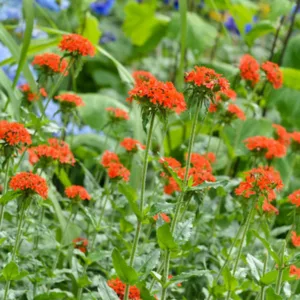
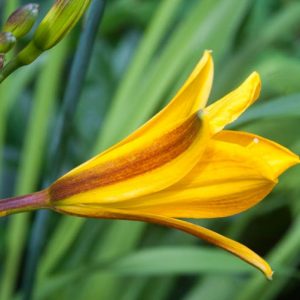
The three plants also have very different shapes. Daylilies form broad clumps of arching foliage with trumpet-shaped flowers, Salvia creates narrow vertical spikes, and Maltese Cross carries flat-topped clusters of small scarlet flowers on taller stems. Those differences keep each plant recognizable even when they mingle.
Height is used well too. Salvia stays relatively low, Daylilies fill the middle layer, and the Maltese Cross rises above both. The border feels full, but the taller stems are open enough that they do not form a heavy wall at the back.
Lychnis chalcedonica provides the tallest and brightest red accents. Plant it in small, irregular groups through the middle and rear so its flowerheads appear above the Daylilies without forming a continuous row.
Hemerocallis ‘Golden Chimes’ carries much of the warm color. Its golden-yellow flowers are most effective in noticeable groups, repeated across the planting rather than concentrated in one section.
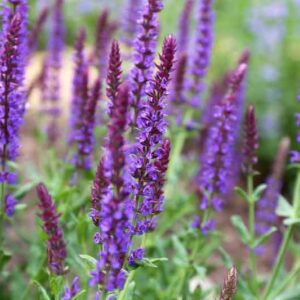
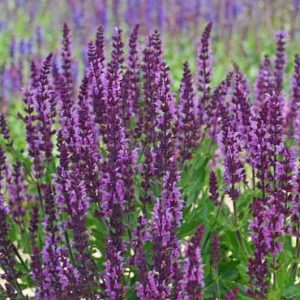
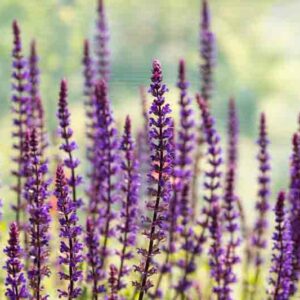
Salvia nemorosa ‘Caradonna’ forms the cooler foundation. Its dark stems and violet-purple flower spikes are especially useful along the front edge and between the warmer-flowered plants.
Create a bold summer border with strong warm color, grounded by repeated drifts of deep violet Salvia.
Keep Salvia slightly more abundant so the darker violet color visually anchors the brighter red and yellow flowers.
Vary the size of the clumps. A few broad Salvia drifts with smaller repetitions of the red and yellow flowers will look more natural than identical groups.
Use Salvia ‘Caradonna’ in broad drifts along the front and through the middle.
Plant ‘Golden Chimes’ behind and between the Salvia, allowing its flowers and arching foliage to emerge through the purple spikes.
Place Maltese Cross farther back and occasionally through the middle so its red flowerheads rise above the planting at irregular intervals.
Salvia begins the display with dense violet spikes, followed by the golden flowers of ‘Golden Chimes’ and the scarlet heads of Maltese Cross. Together they create a particularly strong early- to midsummer show.
Once the first flush of Salvia begins to fade, cutting the plants back can encourage fresh growth and often a second, lighter flowering later in the season. The Daylily foliage continues to provide structure after individual flowers have passed.
This is a strong-color combination, so it benefits from repetition and restraint. Use plenty of violet Salvia, repeat the golden Daylilies in broad clumps, and let the red Maltese Cross act as the highest accent rather than the dominant mass.
For an even longer season, add later-flowering companions in compatible colors, such as asters, Helenium, or ornamental grasses, while keeping the same loose, repeated planting style.
| Hardiness |
4 - 8 |
|---|---|
| Heat Zones |
5 - 8 |
| Climate Zones | 2, 2A, 2B, 3, 3A, 3B, 4, 5, 6, 7, 8, 9, 10, 14, 15, 16, 17, 18, 19, 20, 21, 22, 23, 24 |
| Exposure | Full Sun |
| Season of Interest | Summer (Early, Mid) |
| Maintenance | Low |
| Water Needs | Average |
| Soil Type | Chalk, Loam, Sand |
| Soil pH | Acid, Neutral, Alkaline |
| Soil Drainage | Moist but Well-Drained, Well-Drained |
| Characteristics | Cut Flowers, Showy |
| Tolerances | Rabbit |
| Attracts | Bees, Butterflies, Hummingbirds, Birds |
| Landscaping Ideas | Beds And Borders |
| Garden Styles | Butterfly Garden, Coastal Garden, Informal and Cottage, Pollinator Garden |


| Hardiness |
4 - 8 |
|---|---|
| Heat Zones |
5 - 8 |
| Climate Zones | 2, 2A, 2B, 3, 3A, 3B, 4, 5, 6, 7, 8, 9, 10, 14, 15, 16, 17, 18, 19, 20, 21, 22, 23, 24 |
| Exposure | Full Sun |
| Season of Interest | Summer (Early, Mid) |
| Maintenance | Low |
| Water Needs | Average |
| Soil Type | Chalk, Loam, Sand |
| Soil pH | Acid, Neutral, Alkaline |
| Soil Drainage | Moist but Well-Drained, Well-Drained |
| Characteristics | Cut Flowers, Showy |
| Tolerances | Rabbit |
| Attracts | Bees, Butterflies, Hummingbirds, Birds |
| Landscaping Ideas | Beds And Borders |
| Garden Styles | Butterfly Garden, Coastal Garden, Informal and Cottage, Pollinator Garden |
Recreate this garden. Specify the percentages you would like to have of each plant and input the dimensions of your garden space.We'll give you a shopping list so you know how many plants you need.
| Plant | Quantity | |
|---|---|---|
| Lychnis chalcedonica (Maltese Cross) | N/A | Buy Plants |
| Hemerocallis 'Golden Chimes' (Daylily) | N/A | Buy Plants |
| Salvia nemorosa 'Caradonna' (Woodland Sage) | N/A | Buy Plants |
Create a membership account to save your garden designs and to view them on any device.
Becoming a contributing member of Gardenia is easy and can be done in just a few minutes. If you provide us with your name, email address and the payment of a modest $25 annual membership fee, you will become a full member, enabling you to design and save up to 25 of your garden design ideas.
Join now and start creating your dream garden!
Create a membership account to save your garden designs and to view them on any device.
Becoming a contributing member of Gardenia is easy and can be done in just a few minutes. If you provide us with your name, email address and the payment of a modest $25 annual membership fee, you will become a full member, enabling you to design and save up to 25 of your garden design ideas.
Join now and start creating your dream garden!