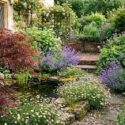
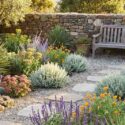
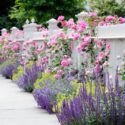
Create a romantic cottage border with fragrant Rosa Mundi, an old Gallica shrub rose bearing striking crimson-and-pink striped flowers, and lavender-blue Clematis 'Arabella'. These flowering plants offer a beautiful late spring to early summer display, with the non-clinging clematis continuing into autumn. Perfect for sunny borders, traditional rose gardens, and informal cottage plantings.
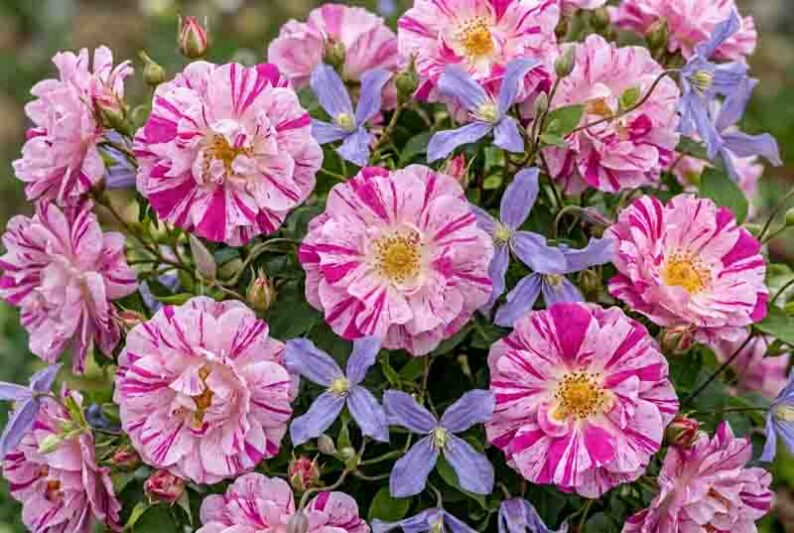


Imagine a cottage garden filled with extraordinary pink-and-crimson striped roses mingling with delicate lavender-blue clematis flowers. Every rose has its own unique pattern, while the star-shaped clematis blooms bring beautiful lightness. Romantic, colorful, and wonderfully informal, this charming pairing captures the spirit of an old-fashioned rose garden.
Two flowering plants create the display: Rosa gallica ‘Versicolor’ (Rosa Mundi) and Clematis ‘Arabella’. Both can begin flowering in late spring, creating a beautiful contrast of crimson-striped roses and violet-blue stars. Rosa Mundi flowers once, while ‘Arabella’ continues through summer into early autumn.
Main plants used: Rosa gallica ‘Versicolor’ and Clematis ‘Arabella’.
Rosa gallica ‘Versicolor’, better known as Rosa Mundi, is one of the oldest striped roses in cultivation. Its fragrant, semi-double flowers display irregular streaks of crimson, deep pink, and pale blush, surrounding golden stamens. Flowering once in late spring to early summer, it creates a spectacular display that may be followed by decorative hips.
Clematis ‘Arabella’ provides the perfect contrast. Its star-shaped flowers open violet-blue and gradually soften to lavender-blue. Unlike climbing clematis, ‘Arabella’ is non-clinging, with flexible stems that can scramble through neighboring shrubs or trail across the ground.
The combination works because the cool blue clematis balances the rose’s exuberant pink markings. Their overlapping spring flowers create a memorable display, while ‘Arabella’ extends the color long after Rosa Mundi has finished blooming.
Create a romantic cottage border with fragrant striped roses and lavender-blue clematis weaving naturally through the planting.
Visual proportions during overlapping flowering, not plant quantities.
Position Rosa Mundi in the middle of a sunny border, allowing room for its spreading habit. Plant Clematis ‘Arabella’ nearby but outside the rose’s crown, then guide selected stems through the outer branches. Let others spill naturally around the base, keeping both plants accessible for maintenance.
In late spring, Rosa Mundi produces its unforgettable flush of crimson-striped flowers, overlapping with the first violet-blue blooms of Clematis ‘Arabella’. As the roses fade, the clematis continues flowering through summer into early autumn. Rose hips may provide additional interest if spent flowers are retained.
| Hardiness |
4 - 8 |
|---|---|
| Climate Zones | 2, 2A, 2B, 3, 3A, 3B, 4, 5, 6, 7, 8, 9, 10, 11, 14, 15, 16, 17, 18, 19, 20, 21, 22, 23, 24 |
| Exposure | Full Sun, Partial Sun |
| Season of Interest | Spring (Late), Summer (Early, Mid, Late) |
| Maintenance | Average |
| Water Needs | Average |
| Soil Type | Chalk, Clay, Loam, Sand |
| Soil pH | Alkaline, Neutral |
| Soil Drainage | Moist but Well-Drained |
| Characteristics | Cut Flowers, Fragrant, Plant of Merit, Showy |
| Attracts | Bees, Butterflies, Hummingbirds |
| Landscaping Ideas | Arbors, Pergolas, Trellises, Wall-Side Borders, Walls And Fences |
| Garden Styles | Butterfly Garden, City and Courtyard, Informal and Cottage, Pollinator Garden, Traditional Garden |



| Hardiness |
4 - 8 |
|---|---|
| Climate Zones | 2, 2A, 2B, 3, 3A, 3B, 4, 5, 6, 7, 8, 9, 10, 11, 14, 15, 16, 17, 18, 19, 20, 21, 22, 23, 24 |
| Exposure | Full Sun, Partial Sun |
| Season of Interest | Spring (Late), Summer (Early, Mid, Late) |
| Maintenance | Average |
| Water Needs | Average |
| Soil Type | Chalk, Clay, Loam, Sand |
| Soil pH | Alkaline, Neutral |
| Soil Drainage | Moist but Well-Drained |
| Characteristics | Cut Flowers, Fragrant, Plant of Merit, Showy |
| Attracts | Bees, Butterflies, Hummingbirds |
| Landscaping Ideas | Arbors, Pergolas, Trellises, Wall-Side Borders, Walls And Fences |
| Garden Styles | Butterfly Garden, City and Courtyard, Informal and Cottage, Pollinator Garden, Traditional Garden |
Recreate this garden. Specify the percentages you would like to have of each plant and input the dimensions of your garden space.We'll give you a shopping list so you know how many plants you need.
| Plant | Quantity | |
|---|---|---|
| Rosa mundi (Gallica Rose) | N/A | Buy Plants |
| Clematis 'Arabella' (Integrifolia Group) | N/A | Buy Plants |
Create a membership account to save your garden designs and to view them on any device.
Becoming a contributing member of Gardenia is easy and can be done in just a few minutes. If you provide us with your name, email address and the payment of a modest $25 annual membership fee, you will become a full member, enabling you to design and save up to 25 of your garden design ideas.
Join now and start creating your dream garden!