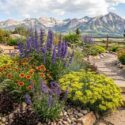
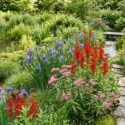
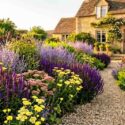
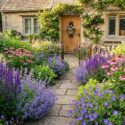
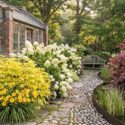
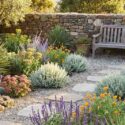
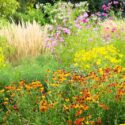
Turn a sunny, moisture-rich garden into a summer meadow with purple Dense Blazing Star, fragrant pink Swamp Milkweed, delicate Blue Vervain, and graceful Tussock Sedge. These native flowering perennials and sedges bloom from midsummer into early fall, attracting monarchs, bees, and butterflies while creating a romantic, wildlife-friendly retreat.
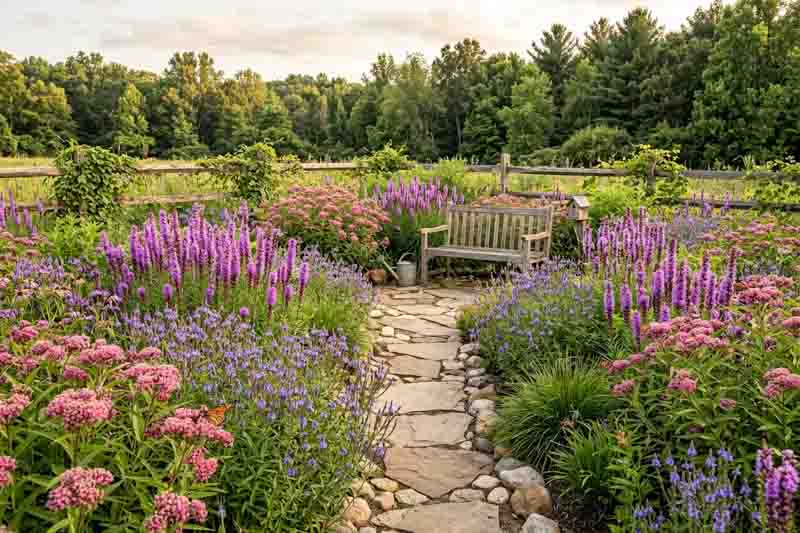


Imagine following a winding stone path through a meadow of purple flower spikes, fragrant pink milkweed blossoms, and delicate blue-violet flowers. Butterflies drift between the blooms, native sedges soften the edges, and a weathered wooden bench offers the perfect place to enjoy the summer display. This beautiful garden combines the romance of a cottage border with the ecological richness of a native wildflower meadow.
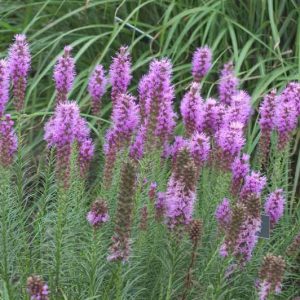
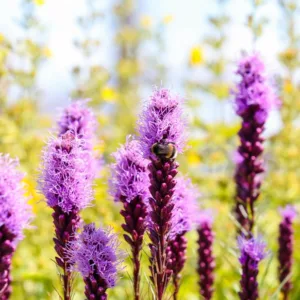
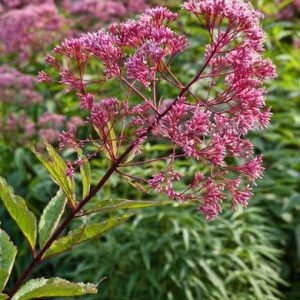
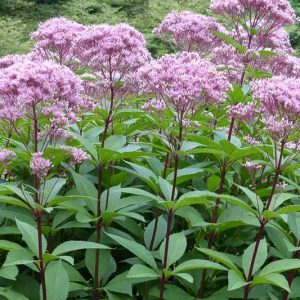
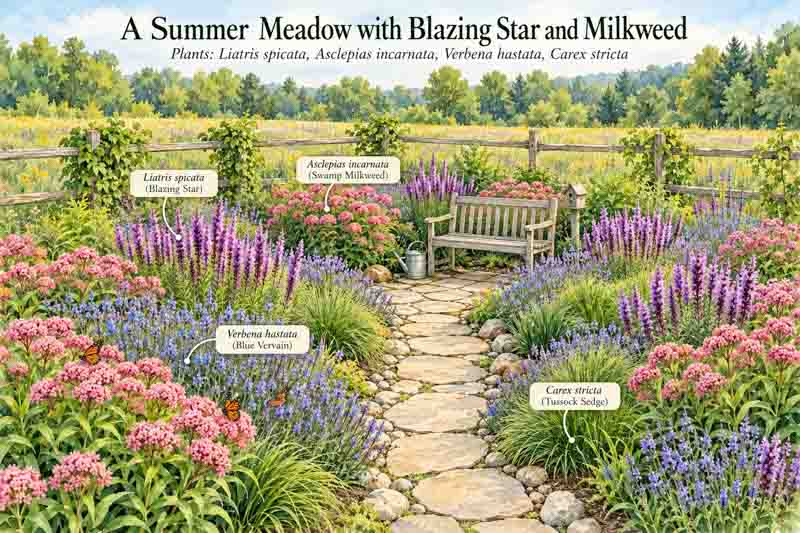
Four North American natives create the planting: Liatris spicata (Dense Blazing Star), Asclepias incarnata (Swamp Milkweed), Verbena hastata (Blue Vervain), and Carex stricta (Tussock Sedge). Their contrasting flowers, overlapping bloom periods, and graceful foliage create a wildlife-friendly garden particularly suited to sunny sites with naturally moist soil.
Main plants used: Liatris spicata, Asclepias incarnata, Verbena hastata, and Carex stricta.
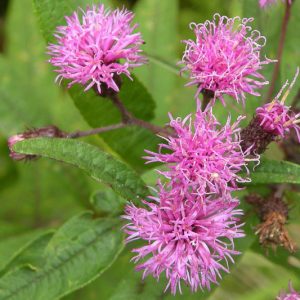
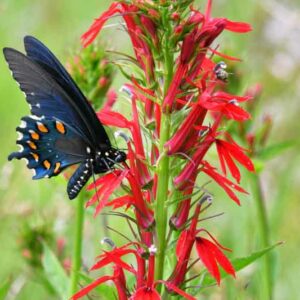
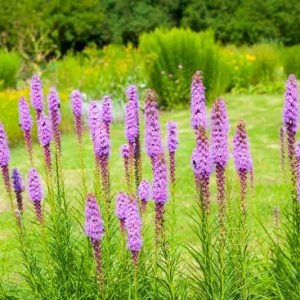
The combination of purple, pink, and blue gives this meadow its romantic character. Liatris spicata provides the vertical accents, producing dense spikes of purple flowers in midsummer to late summer. Its distinctive blooms open from the top downward, attracting butterflies and native bees.
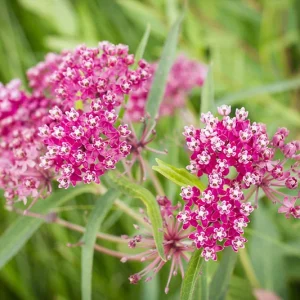
Asclepias incarnata brings generous clusters of fragrant rosy-pink flowers, typically blooming from midsummer into late summer. As a host plant for monarch caterpillars and an important nectar source, it adds ecological value as well as beautiful color.
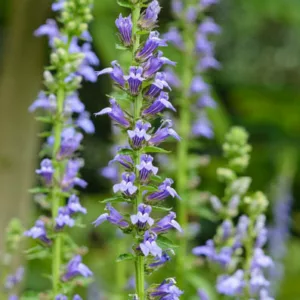
Between them, Verbena hastata contributes slender, branching spikes of tiny blue-violet flowers. Its airy habit softens the larger flower forms and provides nectar for a wide range of pollinating insects.
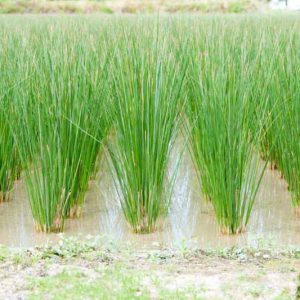
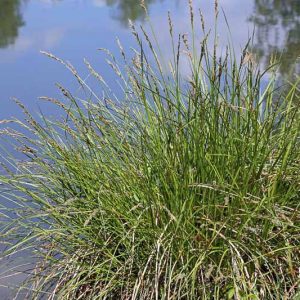
At ground level, Carex stricta forms substantial tussocks of arching green foliage. These natural mounds give the planting structure and are particularly useful in moist soil. The winding stone path, rustic fence, and simple wooden bench complete the welcoming meadow atmosphere.
Create a colorful native summer meadow with purple and pink flowers, graceful sedges, abundant pollinator activity, and a winding path leading toward a quiet garden bench.
Approximate visual proportions, not exact plant quantities. Increase the sedge proportion in wetter areas.
Let the winding stone path lead toward the wooden bench. Position Dense Blazing Star in repeated groups along slightly raised, well-drained areas. Weave Swamp Milkweed and Blue Vervain between them, allowing their pink and violet flowers to mingle. Place Tussock Sedge in the lowest, moistest pockets, leaving room for its substantial clumps. Keep mature foliage clear of the path and seating area.
Spring brings fresh sedge growth and emerging perennial foliage. By midsummer, Blazing Star produces vivid purple spikes, Swamp Milkweed opens fragrant pink flower clusters, and Blue Vervain adds delicate violet-blue blooms. In autumn, milkweed seedpods, dried flower stems, and sedge foliage provide texture and wildlife interest.
| Hardiness |
3 - 8 |
|---|---|
| Exposure | Full Sun |
| Season of Interest | Summer (Mid, Late), Fall |
| Maintenance | Low |
| Water Needs | Average |
| Soil Type | Loam, Sand |
| Soil pH | Acid, Neutral, Alkaline |
| Soil Drainage | Moist but Well-Drained |
| Characteristics | Showy |
| Native Plants | Alabama, Connecticut, Delaware, Illinois, Indiana, Iowa, Kansas, Kentucky, Maryland, Massachusetts, Michigan, Midwest, Missouri, Nebraska, New Jersey, New York, North Carolina, Northeast, Ohio, Southeast, Southwest, Tennessee, Texas, United States, Virginia, West Virginia, Wisconsin |
| Attracts | Bees, Butterflies, Hummingbirds, Birds |
| Landscaping Ideas | Beds And Borders |
| Garden Styles | Butterfly Garden, Informal and Cottage, Pollinator Garden, Prairie and Meadow |

| Hardiness |
3 - 8 |
|---|---|
| Exposure | Full Sun |
| Season of Interest | Summer (Mid, Late), Fall |
| Maintenance | Low |
| Water Needs | Average |
| Soil Type | Loam, Sand |
| Soil pH | Acid, Neutral, Alkaline |
| Soil Drainage | Moist but Well-Drained |
| Characteristics | Showy |
| Native Plants | Alabama, Connecticut, Delaware, Illinois, Indiana, Iowa, Kansas, Kentucky, Maryland, Massachusetts, Michigan, Midwest, Missouri, Nebraska, New Jersey, New York, North Carolina, Northeast, Ohio, Southeast, Southwest, Tennessee, Texas, United States, Virginia, West Virginia, Wisconsin |
| Attracts | Bees, Butterflies, Hummingbirds, Birds |
| Landscaping Ideas | Beds And Borders |
| Garden Styles | Butterfly Garden, Informal and Cottage, Pollinator Garden, Prairie and Meadow |
Recreate this garden. Specify the percentages you would like to have of each plant and input the dimensions of your garden space.We'll give you a shopping list so you know how many plants you need.
| Plant | Quantity | |
|---|---|---|
| Liatris spicata (Blazing Star) | N/A | Buy Plants |
| Asclepias incarnata (Swamp Milkweed) | N/A | Buy Plants |
| Verbena hastata (American Blue Vervain) | N/A | Buy Plants |
| Carex stricta (Tussock Sedge) | N/A | Buy Plants |
Create a membership account to save your garden designs and to view them on any device.
Becoming a contributing member of Gardenia is easy and can be done in just a few minutes. If you provide us with your name, email address and the payment of a modest $25 annual membership fee, you will become a full member, enabling you to design and save up to 25 of your garden design ideas.
Join now and start creating your dream garden!