Bring an old, overgrown lilac back to life without destroying its future flowers. Learn how to identify aging stems, choose gradual renewal or hard renovation, reduce excessive height, manage suckers, protect grafted cultivars, thin vigorous regrowth, and rebuild a younger lilac that flowers beautifully at garden level again.
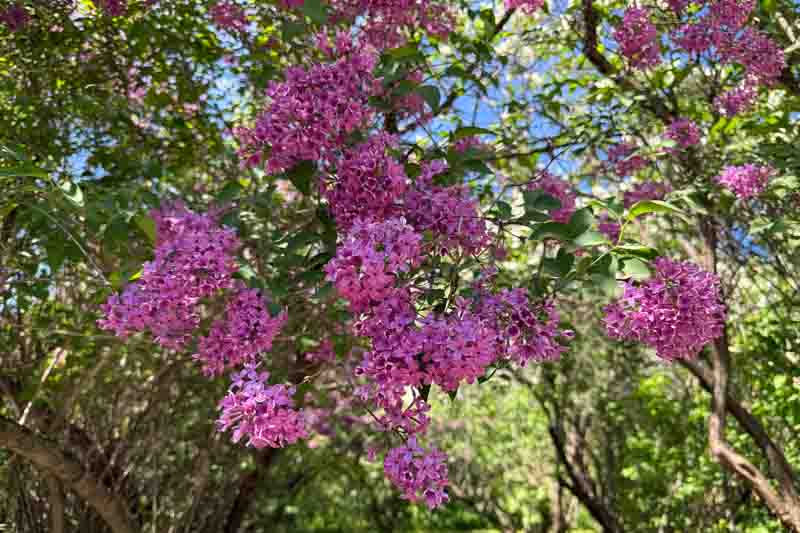


An old lilac can look magnificent in bloom and hopeless for the other eleven months of the year. Flowers may sit 10 or 12 ft above your head, thick gray stems crowd the center, the lower half is bare, and dozens of young shoots compete around the base. At that point, trimming the top will not solve the problem. The shrub needs renewal from within.
The good news is that many mature lilacs (Syringa) respond remarkably well to rejuvenation. The important question is not simply whether to cut an old lilac back, but how aggressively to do it.
For most aging lilacs, gradual renewal is the safer and more attractive approach: remove the oldest stems over several years while preserving younger flowering wood. A severely neglected multi-stemmed shrub can sometimes be renovated much harder, even to within a few inches of the ground, but that is a rebuilding project with a substantial cost in flowers.
Before making the first cut, answer four questions:
Gardenia’s rejuvenation rule: Remove the least amount of old framework necessary to create a younger one. Hard renovation is a rescue strategy, not the default treatment for every old lilac.
Age alone is not a reason to prune. Some old lilacs remain beautifully structured and flower generously for decades. Rejuvenation becomes useful when the framework begins working against the plant.
Typical signs include flowers moving progressively higher, heavy old stems dominating the center, bare lower growth, crowded shoots at the base, branches rubbing through the middle, or a shrub that has become too large and difficult to manage.
One of the clearest patterns is a lilac that flowers only around the upper canopy while the lower six feet consist mainly of old trunks. That shrub is still flowering, but the framework carrying the flowers is no longer useful at garden level.
Read the structure: Flowers high above eye level + thick old stems + vigorous young shoots near the base usually point toward gradual renewal rather than fertilizer or top-pruning.
Rejuvenation pruning depends on the plant being able to produce vigorous replacement growth. Before removing major stems, look at the foliage, bark, roots, and recent growth.
A healthy but overgrown lilac may have an unattractive shape yet still produce strong shoots and normal leaves. A declining shrub may show widespread yellowing, wilting, extensive dieback, soft or damaged stems, serious borer activity, or roots sitting in persistently wet soil.
Those problems should not be confused with old age. Cutting a severely stressed plant almost to the ground will not correct waterlogged roots, disease, or an unsuitable site.
If the shrub is vigorous but structurally old, proceed with renewal. If it is visibly declining, identify the underlying problem first.
Gardenia’s Why Is My Lilac Not Blooming? 10 Causes and How to Fix Them separates healthy-but-flower-poor lilacs from shrubs suffering broader plant-health problems.
This is one of the most important checks in the entire process.
Many lilacs are grown on their own roots, but some older named cultivars were grafted onto another lilac rootstock. If you cut a grafted plant below its graft union, shoots that return from below that point may belong to the rootstock rather than the cultivar you intended to preserve.
Look for a visible change in bark, swelling, union, or difference in stem character near the base. Also examine suckers. Shoots that look noticeably different from the flowering top may be coming from the rootstock.
Before hard renovation: If you cannot determine whether an old lilac is grafted, do not automatically cut the entire shrub to 4-6 in. Gradual removal of selected old stems is the safer approach until you understand how the plant is structured.
There are two fundamentally different ways to rejuvenate an old lilac.
Remove a portion of the oldest stems near ground level and retain younger, vigorous stems. Repeat over several seasons until a younger framework replaces the old one.
This is usually the best choice when the shrub is healthy, still has worthwhile structure, and you want to preserve flowering while improving it.
Cut most or all of a suitable multi-stemmed lilac back very low and allow the plant to rebuild from vigorous new shoots.
This is appropriate only when the old framework is so poor that gradual renewal offers little advantage and the plant is healthy enough to regenerate.
| Situation | Best Approach | Flower Cost |
|---|---|---|
| Old but still attractive and flowering | Gradual renewal | Low to moderate |
| Flowers only at the top, many old stems | Gradual renewal | Moderate |
| Huge, tangled, mostly old framework | Gradual renewal or hard renovation | Moderate to major |
| Collapsed or unusable but otherwise vigorous multi-stemmed shrub | Hard renovation may be justified | Major, potentially several years |
Gradual rejuvenation is the method most gardeners should consider first. It improves the shrub without erasing its entire flowering framework.
Start by identifying the oldest stems. They are usually the thickest, darkest, roughest, and least flexible canes in the clump.
Remove up to about one-third of the oldest stems at or near ground level. Keep vigorous younger shoots that are well spaced and growing in useful directions.
Remove roughly half of the old stems that remain. Thin excessive new growth so that the shrub develops a limited number of strong replacement canes rather than an impenetrable thicket.
Remove the remaining old framework that needs replacing and refine the younger stems. The result should be a mixed-age structure dominated by healthy, well-spaced younger wood.
The exact percentage does not need to become an accounting exercise. The principle is more important: replace old stems from the ground rather than repeatedly shortening them from the top.
For substantial renewal of old stems, late winter or very early spring is practical because the shrub is leafless, its framework is easy to see, and large stems are easier to reach.
The tradeoff is flowering. Lilacs carry spring flower buds on growth produced during the previous season, so any flowering stems removed before bloom obviously cannot flower that spring.
If preserving the current display matters more, selected old stems can instead be removed soon after flowering. That allows you to enjoy the flowers first and then begin renewal.
Gardenia’s timing distinction: Late-winter renewal makes the structure easier to see. Post-bloom renewal preserves that year’s flowers. Choose the timing according to the goal rather than treating one calendar date as universally correct.
For a full explanation of pruning timing, see Gardenia’s When and How to Prune Lilacs Without Losing Next Year’s Flowers.
Sometimes gradual renewal is not the most practical choice. A large multi-stemmed lilac may be almost entirely composed of old, tangled canes with little useful structure remaining.
For a healthy, suitable shrub, drastic renovation can mean cutting the old stems back to roughly 4-6 in. (10-15 cm) above ground level in late winter or early spring.
This induces vigorous new shoots from the lower plant. By the end of the growing season, some can grow several feet tall.
The following dormant season, do not keep every new shoot. Select several of the strongest, healthiest, best-spaced stems and remove the rest near ground level. This prevents the rejuvenated lilac from immediately becoming congested again.
Hard renovation removes essentially all existing flowering wood. Flowering may be sparse or absent for several years while the shrub rebuilds. Some lilacs resume flowering in about 2-3 years, while others may take 3-5 years to flower well again, depending on cultivar, vigor, growing conditions, and the severity of the renovation.
If keeping next spring’s flowers matters, do not choose hard renovation.
A hard-pruned lilac often responds with enthusiasm. That is good news, but twenty vigorous shoots are not automatically better than eight.
The goal is to create a new framework, not another thicket.
Choose stems that are vigorous, upright or gracefully outward-growing, and spaced around the base. Remove weak, crowded, inward-growing, damaged, or badly positioned shoots.
Over the following seasons, retain enough young stems to create a full shrub while allowing light and air through the interior.
The objective after renovation: Do not recreate the old problem with younger wood. Strong, well-spaced replacement stems are more useful than the maximum possible number of shoots.
Suckers often frustrate gardeners, but during lilac rejuvenation they can be extremely useful.
On an own-root plant, vigorous basal shoots are genetically the same plant and can become the next generation of flowering stems. Well-positioned young shoots should therefore be evaluated rather than automatically removed.
On a grafted lilac, shoots arising from below the graft belong to the rootstock and may differ from the named cultivar. These should not become the new framework.
Remove excess suckers that crowd the base, wander beyond the allotted space, or grow in poor directions, while retaining useful replacement stems on own-root plants.
If flowers are fifteen feet in the air, it is tempting to simply cut the entire shrub across the top. Resist that impulse.
Heading back all stems to the same height leaves the old framework in place and often stimulates dense growth around the cuts. The shrub becomes shorter temporarily without actually becoming younger.
The better strategy is to remove selected tall old stems at their base and let younger stems replace them. Where a specific branch needs shortening, cut it back to a suitable lateral branch rather than leaving a blunt stub.
Over several seasons, flowers gradually return to younger stems lower in the plant.
Think replacement, not haircut: If an old lilac is too tall, rejuvenate from the ground up. Repeatedly cutting the top produces shorter old stems, not a renewed shrub.
A rejuvenated shrub needs favorable growing conditions to rebuild effectively, but it does not need to be pampered with excessive fertilizer.
Make sure the lilac receives full sun. A shrub that became overgrown beneath increasingly mature trees may need improved light as much as it needs pruning.
Water during prolonged dry periods, particularly while new shoots are developing. Maintain a modest layer of organic mulch over the root zone, keeping it away from direct contact with the stems.
Avoid automatic high-nitrogen feeding. Vigorous replacement shoots are useful, but excessively soft leafy growth does not necessarily accelerate flowering.
For complete cultural guidance, see Gardenia’s How to Grow and Care for Lilacs.
The answer depends heavily on how much flowering wood was removed.
A lilac receiving gradual renewal may continue flowering throughout the process because part of the mature framework remains each year.
A hard-renovated shrub is different. After being cut almost to ground level, it first has to build replacement stems, branches, and eventually mature flowering wood. Flowering may therefore be sparse or absent for several years. Some lilacs resume flowering in about 2-3 years, while others may take 3-5 years to flower well again, depending on cultivar, vigor, growing conditions, and the severity of the renovation.
That temporary loss of flowers is the price of replacing an unusable old framework in one operation.
Set expectations before cutting: Gradual renewal protects continuity of bloom. Hard renovation prioritizes the future shrub over the next few flower displays.
Not always.
If a mature common lilac naturally wants to grow 10-12 ft tall but has been planted beneath a 5-ft window, repeated rejuvenation does not solve the underlying problem. It merely resets the conflict.
In a genuinely tight space, replacing an oversized shrub with a naturally compact lilac may provide a much better long-term result. Gardenia’s Pretty Lilacs for Small Gardens includes compact choices designed for limited spaces.
You can also use Gardenia’s Lilac Comparison Tool to compare mature size, hardiness, growing conditions, bloom season, and other characteristics before replacing an old plant.
| What You See | Best First Move | Likely Strategy |
|---|---|---|
| Healthy old shrub, good flowers, slightly crowded | Remove selected old stems | Light renewal |
| Flowers mostly high, lower stems bare | Remove oldest canes from base | Three-year renewal |
| Dense mass of old and young stems | Reduce old framework and thin young shoots | Gradual renewal |
| Healthy but almost completely unusable old framework | Confirm plant is suitable and not grafted below intended cuts | Hard renovation may be justified |
| Yellowing, wilting, widespread dieback | Diagnose health problem first | Do not assume rejuvenation is the cure |
Gardenia’s rejuvenation priority: Diagnose the framework before choosing the saw. Preserve productive younger wood, replace genuinely old stems, and use drastic renovation only when the existing structure is no longer worth preserving.
Major renewal can be done in late winter or early spring when the leafless framework is easy to see. If you want to enjoy the current spring flowers first, selected old stems can instead be removed shortly after flowering.
The preferred method for most old lilacs is gradual renewal. Remove about one-third of the oldest stems near ground level, retain strong younger shoots, and continue replacing old stems over roughly three seasons.
A healthy, suitable multi-stemmed lilac can sometimes tolerate hard renovation to roughly 4-6 in. above ground in late winter or early spring. However, this is drastic treatment and should not automatically be used on every old lilac.
Gradually renewed lilacs can continue flowering throughout the process. After hard renovation, flowering may be sparse or absent for several years. Some lilacs resume flowering in about 2-3 years, while others may take 3-5 years to flower well again, depending on cultivar, vigor, growing conditions, and the severity of the renovation.
For gradual renewal, remove up to roughly one-third of the oldest stems in the first year. Continue replacing the remaining old framework over the next two seasons while thinning excessive new growth.
Yes, when removing an old cane during renewal, cut it at or near ground level rather than simply shortening the top. This allows younger basal stems to replace the old framework.
Remove some of the tallest, oldest stems from the base and retain younger, lower-growing replacement stems. Avoid cutting the entire top flat because that leaves the old framework in place and encourages dense regrowth around the cuts.
No. On own-root lilacs, vigorous basal shoots can become useful replacement stems during rejuvenation. On grafted plants, suckers from below the graft belong to the rootstock and should not replace the named cultivar.
Yes, but identify the graft union first. Do not cut the entire plant below the graft or the regrowth may come from the rootstock rather than the named cultivar. Gradual removal of selected stems is safer when the graft is uncertain.
The oldest stems may have become tall, bare, and congested, leaving most flowering growth in the upper canopy. Gradual renewal replaces those aging stems with younger shoots that can eventually flower lower on the plant.
Do not automatically use heavy fertilizer. Give the shrub full sun, appropriate moisture, good drainage, and mulch. Excess nitrogen can encourage excessive leafy growth without necessarily improving future flowering.
Rejuvenate a healthy shrub whose mature size and climate requirements still suit the site. If the plant is fundamentally too large, poorly adapted, severely diseased, or growing in an unsuitable location, replacement may provide a better long-term solution.
Updated: September 2026 • Reviewed by Gardenia Editors
| Hardiness |
3 - 7 |
|---|---|
| Plant Type | Shrubs, Trees |
| Plant Family | Oleaceae |
| Genus | Syringa |
| Exposure | Full Sun |
| Season of Interest | Spring (Mid, Late) |
| Maintenance | Low |
| Water Needs | Average |
| Soil Type | Chalk, Clay, Loam, Sand |
| Soil pH | Alkaline, Neutral |
| Soil Drainage | Moist but Well-Drained, Well-Drained |
| Characteristics | Cut Flowers, Fragrant, Showy |
| Landscaping Ideas | Beds And Borders, Hedges And Screens, Patio And Containers |
| Garden Styles | City and Courtyard, Informal and Cottage |
| Hardiness |
3 - 7 |
|---|---|
| Plant Type | Shrubs, Trees |
| Plant Family | Oleaceae |
| Genus | Syringa |
| Exposure | Full Sun |
| Season of Interest | Spring (Mid, Late) |
| Maintenance | Low |
| Water Needs | Average |
| Soil Type | Chalk, Clay, Loam, Sand |
| Soil pH | Alkaline, Neutral |
| Soil Drainage | Moist but Well-Drained, Well-Drained |
| Characteristics | Cut Flowers, Fragrant, Showy |
| Landscaping Ideas | Beds And Borders, Hedges And Screens, Patio And Containers |
| Garden Styles | City and Courtyard, Informal and Cottage |
Create a membership account to save your garden designs and to view them on any device.
Becoming a contributing member of Gardenia is easy and can be done in just a few minutes. If you provide us with your name, email address and the payment of a modest $25 annual membership fee, you will become a full member, enabling you to design and save up to 25 of your garden design ideas.
Join now and start creating your dream garden!
Create a membership account to save your garden designs and to view them on any device.
Becoming a contributing member of Gardenia is easy and can be done in just a few minutes. If you provide us with your name, email address and the payment of a modest $25 annual membership fee, you will become a full member, enabling you to design and save up to 25 of your garden design ideas.
Join now and start creating your dream garden!