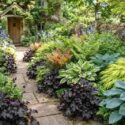
Create a layered shade border with a clean variegated hosta edging, arching Solomon’s seal (Polygonatum biflorum) and pink rhododendron shrubs. Rhododendrons bloom in spring, Solomon’s seal flowers in late spring, and hosta foliage stays bold all season. Perfect for gravel paths and woodland gardens.


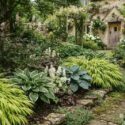
This woodland-style border combines broad variegated Hosta leaves, arching stems of Polygonatum biflorum (Solomon’s Seal), and pink-flowering Rhododendrons beside a gravel path. The Hosta forms the lowest layer, Solomon’s Seal rises loosely through the middle, and the shrubs provide height and a strong spring display behind them.
The planting relies as much on foliage as flowers. After the Rhododendrons finish blooming and the small white flowers of Solomon’s Seal fade, the contrasting leaf shapes continue to carry the border through summer. It is especially effective beneath high tree canopies or along the shaded side of a house where direct afternoon sun is limited.
Main plants used: variegated Hosta, Polygonatum biflorum, and pink-flowering Rhododendron
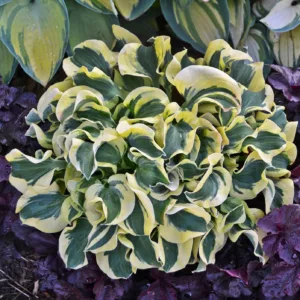
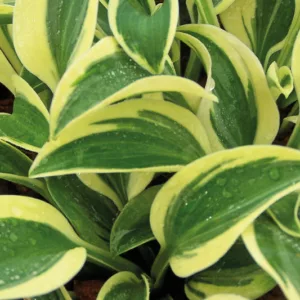
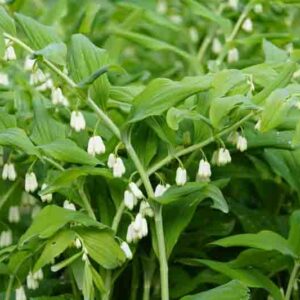
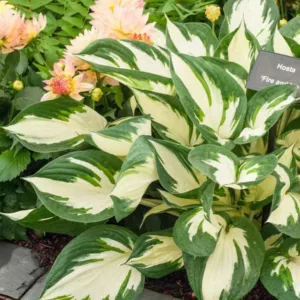
The strongest contrast comes from foliage. Hosta leaves are broad and substantial, especially effective when variegated forms are used near a path. Solomon’s Seal has much narrower leaves arranged along graceful arching stems, giving the middle of the border a lighter texture.
Rhododendrons add a third scale. Their woody framework gives the border permanent height, while the spring flower clusters introduce a concentrated burst of pink above the green and cream foliage.
The plants also occupy different vertical levels without needing to be separated into rigid bands. Hosta can extend around the bases of Solomon’s Seal, and individual Polygonatum stems can emerge between Hosta clumps. This overlap helps the planting look established rather than newly assembled.
Variegated Hosta provides the broadest leaves and the strongest foreground mass. Cream- or white-edged cultivars can brighten shade, particularly against dark soil or gravel. Hostas prefer fertile, moisture-retentive soil and generally perform best where they are protected from hot afternoon sun. Slugs and snails can damage emerging foliage, especially in spring.
Polygonatum biflorum, or Solomon’s Seal, is a North American woodland perennial with arching stems and pairs or small clusters of hanging greenish-white flowers in spring. It prefers humus-rich soil and partial to full shade. Once established, plants can gradually spread by underground rhizomes to form attractive colonies.
Pink-flowering Rhododendron provides the background shrub layer. Rhododendrons generally prefer acidic, organic-rich soil with good drainage and consistent moisture. Their shallow roots are sensitive to both prolonged drought and waterlogged conditions, so an organic mulch can be useful where summers are dry. Evergreen or deciduous habit depends on the species or cultivar selected.

Create a layered shade border with broad variegated foliage at ground level, arching woodland perennials through the middle, and flowering shrubs behind.
These percentages describe the visual balance of the planting, not equal numbers of individual plants. Mature Rhododendrons occupy considerably more space than either perennial.
Place the Rhododendrons first, allowing for their mature width and keeping access around the shrubs for maintenance.
Plant Solomon’s Seal in broad, irregular groups through the middle rather than in a narrow row. Give the stems enough space to arch naturally without leaning heavily over neighboring plants.
Use Hostas in repeated clumps toward the front and between the Polygonatum groups. Let some plants sit closer to the path and others slightly farther back so the edge does not become too formal.
Soil chemistry matters in this combination. Hostas and Solomon’s Seal tolerate a reasonably broad pH range, but Rhododendrons require acidic conditions. In alkaline soil, they may develop chlorosis and perform poorly, so check the site before planting.
Tree roots can also make apparently shady sites surprisingly dry. A border beneath mature trees may need supplemental water during extended dry spells even if it receives little direct sun.
Finally, Solomon’s Seal gradually forms colonies where it is happy, while Hostas broaden into substantial clumps. Allow some room for this development instead of filling every gap when the border is first planted.
| Hardiness |
3 - 7 |
|---|---|
| Heat Zones |
1 - 7 |
| Climate Zones | 1, 1A, 1B, 2, 2A, 2B, 3, 3A, 3B, 4, 5, 6, 7 |
| Exposure | Partial Sun |
| Season of Interest | Spring (Late), Summer (Early) |
| Maintenance | Low |
| Water Needs | Average |
| Soil Type | Clay, Loam, Sand |
| Soil pH | Acid |
| Soil Drainage | Moist but Well-Drained |
| Characteristics | Showy |
| Landscaping Ideas | Beds And Borders, Pathways |
| Garden Styles | City and Courtyard, Informal and Cottage, Traditional Garden, Woodland Garden |



| Hardiness |
3 - 7 |
|---|---|
| Heat Zones |
1 - 7 |
| Climate Zones | 1, 1A, 1B, 2, 2A, 2B, 3, 3A, 3B, 4, 5, 6, 7 |
| Exposure | Partial Sun |
| Season of Interest | Spring (Late), Summer (Early) |
| Maintenance | Low |
| Water Needs | Average |
| Soil Type | Clay, Loam, Sand |
| Soil pH | Acid |
| Soil Drainage | Moist but Well-Drained |
| Characteristics | Showy |
| Landscaping Ideas | Beds And Borders, Pathways |
| Garden Styles | City and Courtyard, Informal and Cottage, Traditional Garden, Woodland Garden |
Recreate this garden. Specify the percentages you would like to have of each plant and input the dimensions of your garden space.We'll give you a shopping list so you know how many plants you need.
| Plant | Quantity | |
|---|---|---|
| Polygonatum biflorum (Small Solomon's Seal) | N/A | Buy Plants |
| Hosta 'Fire and Ice' (Plantain Lily) | N/A | Buy Plants |
| Rhododendron 'Rosy Lights' | N/A | Buy Plants |
Create a membership account to save your garden designs and to view them on any device.
Becoming a contributing member of Gardenia is easy and can be done in just a few minutes. If you provide us with your name, email address and the payment of a modest $25 annual membership fee, you will become a full member, enabling you to design and save up to 25 of your garden design ideas.
Join now and start creating your dream garden!