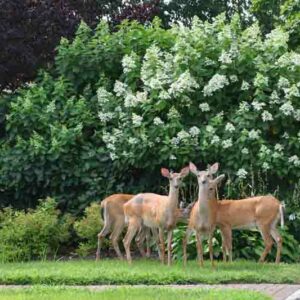
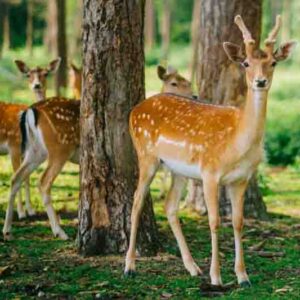
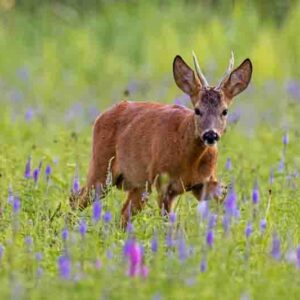
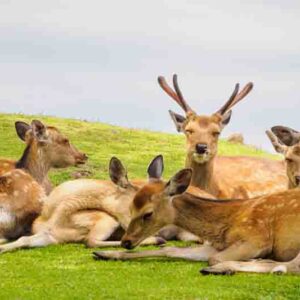
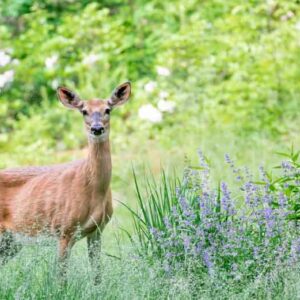
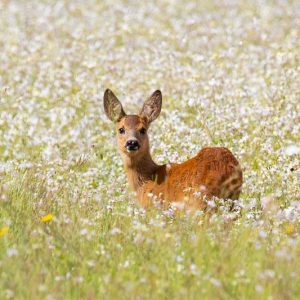
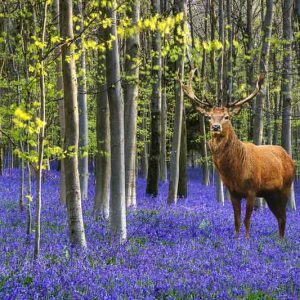
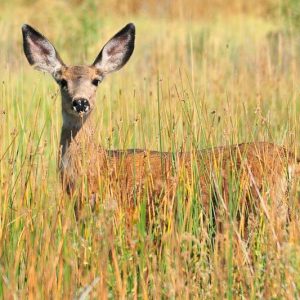
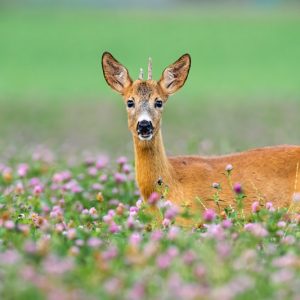
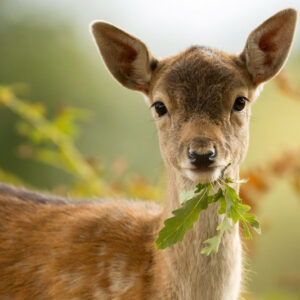
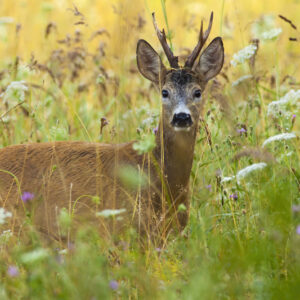
Deer can browse branches, destroy young leaders, and seriously damage tree trunks with their antlers. Discover the best deer-resistant trees for shade, screening, fall color, native gardens, and small spaces - plus which trees offer the strongest resistance and why even deer-resistant young trees may still need protection.


Planting a tree is a long-term investment, which makes deer damage especially frustrating. A perennial can recover from a rough season. A young tree that repeatedly loses its leader, has its lower branches stripped, or suffers severe bark damage from antler rubbing may never develop properly.
The answer is not to search for a mythical “deer-proof tree.” No tree is completely immune. Some species are genuinely less attractive to browsing deer, but resistance changes with deer density, season, drought, winter severity, food availability, and the habits of local herds.
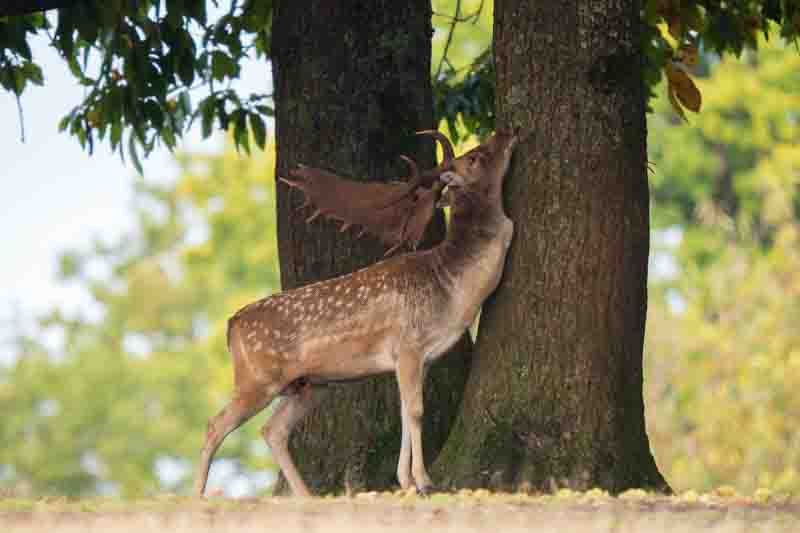
Trees also face a second kind of deer damage that has nothing to do with whether the leaves taste good. Bucks may rub their antlers against young trunks in fall, scraping or stripping bark. A tree can therefore have excellent browsing resistance and still need physical protection while it is young.
The most useful approach is to reduce browsing risk first, then choose among those trees for climate, soil, drainage, moisture, light, mature size, and the role the tree needs to play in the landscape.
Deer-resistant trees are trees that deer tend to browse less readily than highly palatable species. Pawpaw, river birch, katsura tree, American holly, pitch pine, and Japanese tree lilac have particularly strong published resistance records. No tree is deer-proof, and young trunks may still need protection from antler rubbing.
Deer resistance is more useful as a scale than as a yes-or-no label. Rutgers separates landscape plants into categories ranging from Rarely Damaged to Frequently Severely Damaged. Among trees, pawpaw, river birch, paper birch, katsura tree, American holly, pitch pine, red pine, Japanese black pine, and Japanese tree lilac fall into the strongest Rarely Damaged category.
Other excellent trees sit one level lower. Paperbark maple, Japanese maple, red maple, sugar maple, serviceberries, Kousa dogwood, European beech, and several others are rated Seldom Severely Damaged. These can still be very good choices, but they should not be presented as equal to the strongest group where deer pressure is intense.
Local experience matters because deer behavior is inconsistent. University Extension lists sometimes disagree, and that does not necessarily mean one source is wrong. A species may be ignored in one neighborhood and sampled in another, especially during winter, drought, or periods of high deer pressure.
If reducing deer browsing is your first priority, these six are excellent places to start. Rutgers places each in its Rarely Damaged tree category.
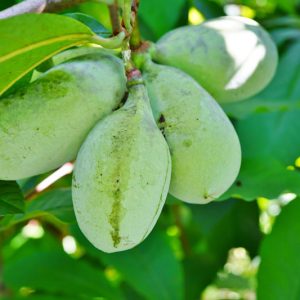
Pawpaw is one of the most distinctive native choices for a deer-prone landscape. Large tropical-looking leaves give it an unexpectedly lush appearance, while unusual purple spring flowers can be followed by large edible fruits when pollination is successful.
Pawpaw usually develops as a small understory tree and works particularly well at woodland edges or in naturalistic plantings. It prefers fertile, moisture-retentive but well-drained soil and can grow in sun or partial shade. Root suckering may eventually produce colonies.
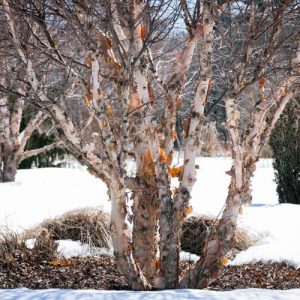
River birch combines a strong deer-resistance record with an ability to handle moisture that would trouble many ornamental trees. Its peeling bark, often in shades of cream, salmon, tan, and cinnamon, gives the tree considerable winter interest.
This is a substantial tree, so give it room. It is especially useful around rain gardens, low areas, ponds, and stream margins where periodically wet soil is part of the site rather than a problem to be corrected.
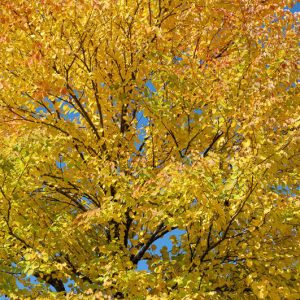
Katsura tree is an elegant deciduous shade tree with rounded, heart-shaped leaves. The foliage emerges in bronzy or reddish tones, matures to blue-green, then turns yellow, orange, or apricot in fall. Fallen leaves can develop a sweet scent often compared with caramel or burnt sugar.
Katsura performs best in moisture-retentive soil and appreciates protection from severe drought and drying winds. It can become a large tree, so it belongs where there is room for a broad canopy.
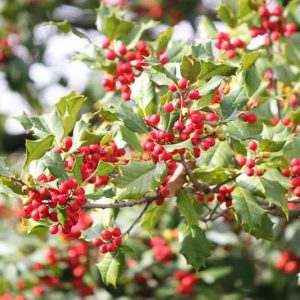
American holly provides evergreen structure, leathery spiny foliage, and brilliant red berries on pollinated female plants. It is an excellent native specimen, screen, or woodland-edge tree.
Male and female flowers occur on separate plants, so fruiting females need a compatible male pollinator nearby. Its persistent foliage also provides valuable shelter for birds.
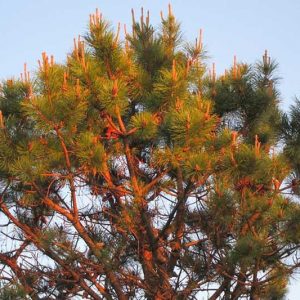
Pitch pine is a rugged native evergreen adapted to challenging sites, especially sandy, acidic, nutrient-poor soils. Its irregular form suits naturalistic, coastal, native, and wildlife-oriented landscapes better than highly formal gardens.
Where poor soil, exposure, or drought eliminates fussier evergreens, pitch pine can be a practical and characterful choice.
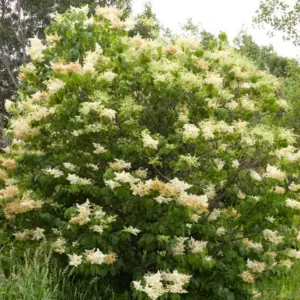
Japanese tree lilac deserves more attention as a deer-resistant small tree. Rutgers places it in its Rarely Damaged category, giving it a stronger published resistance record than many ornamental flowering trees.
Large clusters of creamy-white flowers appear in early summer, after many spring-flowering trees have finished. It performs best in full sun and well-drained soil and generally develops into a small tree or large multi-stemmed specimen rather than a full-size canopy tree.
| Plant Type | Trees |
|---|---|
| Genus | Acer, Amelanchier, Betula, Cornus, Ginkgo, Ilex, Lupinus, Magnolia, Syringa |
| Tolerance | Deer |
These trees also belong on a deer-conscious shortlist, but the evidence is more nuanced. Some are rated Seldom Severely Damaged by Rutgers, while others are described as deer resistant or moderately resistant by university Extension sources.
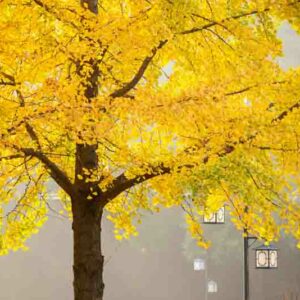
Ginkgo is one of the toughest landscape trees available. NC State lists it as resistant to deer and notes its tolerance of drought, heat, air pollution, salt, and urban conditions.
Its fan-shaped leaves turn a brilliant clear yellow in fall. Male cultivars are generally preferred around streets, patios, and residential landscapes because female trees produce fleshy seed coverings with a famously unpleasant odor.
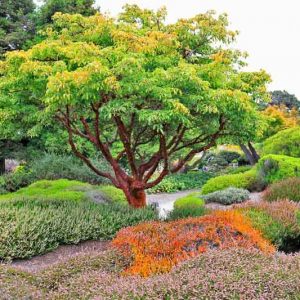
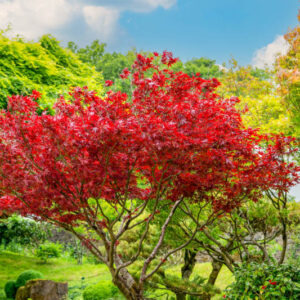
Paperbark maple is one of the finest small trees for year-round interest. Cinnamon-brown bark exfoliates in thin curls, while the foliage often develops rich orange and red tones in autumn.
Rutgers places it in the Seldom Severely Damaged category. That makes it a good choice for deer-prone gardens, although not one of the strongest species where browsing pressure is extreme.
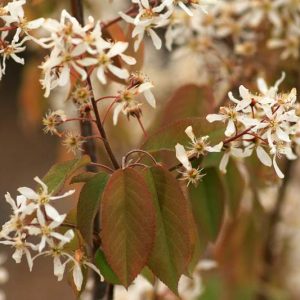
Downy serviceberry earns its place with four seasons of interest: white spring flowers, edible summer berries, colorful fall foliage, and attractive gray bark.
Rutgers’ broader deer-resistance scale places serviceberries in the Seldom Severely Damaged category, while newer Rutgers native-landscape guidance specifically describes downy serviceberry as deer resistant. That makes it a useful lower-risk native choice rather than a top-tier guarantee.
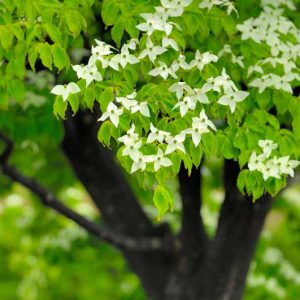
Kousa dogwood is a graceful small tree with white flower-like bracts in late spring, red fruit, rich fall color, and attractive exfoliating bark.
Rutgers rates it Seldom Severely Damaged rather than Rarely Damaged. It is therefore best presented as a good lower-risk ornamental tree, not as a species deer will always ignore.
American hornbeam is a superb native small tree for woodland gardens, stream edges, and partly shaded sites. Its smooth, sinewy gray trunk gives rise to the common name musclewood, while the foliage can develop yellow, orange, or red tones in fall.
NC State describes American hornbeam as moderately resistant to deer damage. It is a valuable native tree for deer-conscious landscapes, but it should not be placed in the same resistance tier as pawpaw or American holly.
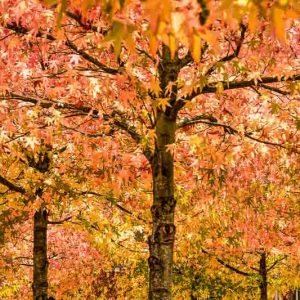
Sweetgum is a large native shade tree with star-shaped foliage and some of the most vivid fall color of any eastern North American tree. University of Maryland includes it among deer-resistant native woody plants.
Its mature size and hard, spiny fruits make siting important. Sweetgum is better suited to lawns, naturalistic areas, rain-garden settings, and large landscapes than to a narrow bed beside a patio.
Native status and deer resistance are separate traits. A tree can be native to your region and still be readily browsed. White-tailed deer naturally feed on many native woody plants, so “native” should never be treated as shorthand for “deer resistant.”
For eastern North American gardens, useful lower-risk native choices include pawpaw, river birch, American holly, American hornbeam, downy serviceberry, sweetgum, sassafras, sweetbay magnolia, wax myrtle, American beech, and pitch pine. Which of these is truly native to your garden depends on your state and ecoregion.
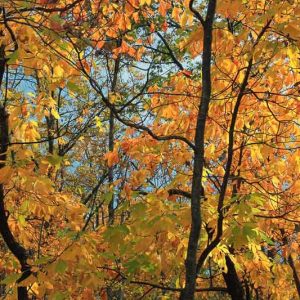
Sassafras is a distinctive eastern native tree with mitten-shaped, three-lobed, or unlobed leaves often appearing on the same plant. Its foliage can turn brilliant shades of yellow, orange, scarlet, and purple in fall.
Rutgers includes sassafras in native planting guidance as a deer-resistant choice. It is best suited to naturalistic landscapes where its tendency to produce root suckers and form colonies is not a drawback.
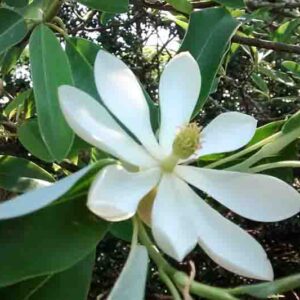
Sweetbay magnolia is a graceful native tree with creamy-white, lemon-scented flowers and glossy leaves with silvery undersides. Depending on climate, it may be deciduous, semi-evergreen, or nearly evergreen.
It is particularly valuable for moist to wet sites and woodland edges, where it brings fragrance and a refined appearance without demanding dry soil. Deer resistance is generally good, although no magnolia should be considered completely immune to browsing.
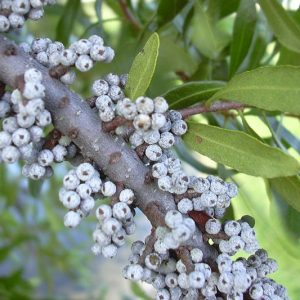
Wax myrtle is a fast-growing native broadleaf evergreen or semi-evergreen shrub that can also be trained as a small multi-trunked tree. Its aromatic foliage, dense branching, and tolerance of salt, wind, poor soil, drought, and periodic wetness make it especially useful in coastal and southeastern landscapes.
NC State describes wax myrtle as highly resistant to deer damage. Mature plants can reach about 20-25 feet, making it a useful choice for screening, wildlife gardens, naturalistic plantings, or sites where evergreen structure is needed without planting a large canopy tree.
Evergreen selection deserves special care because some familiar screening plants are also deer favorites. Yews can be severely browsed, and arborvitae are frequent targets where deer pressure is high.
American holly and pitch pine are much safer starting points. Eastern redcedar can also be useful. University of Maryland includes Juniperus virginiana among deer-resistant native woody plants, but also documents an important limitation: deer may browse its lower branches heavily enough to produce a visible browse line.
That is a good reminder that “deer resistant” does not always mean “undamaged.” A tree can remain broadly useful in deer country while showing localized browsing under heavy pressure.
Once deer resistance has narrowed the field, the site’s growing conditions should make the next decisions. Mature size, hardiness, heat tolerance, drainage, soil moisture, pH, and light determine whether the tree will actually succeed.
This is the part of deer-resistant tree planting that is most often overlooked. Browsing resistance describes whether deer are likely to eat foliage and twigs. It does not mean the trunk is safe from antlers.
During fall, bucks rub their antlers against young woody plants. The bark may be scraped, shredded, or stripped away, damaging the tissues that transport water and nutrients. Severe girdling can kill a tree even when deer have never shown any interest in eating its leaves.
University of Maryland Extension recommends protecting all young tree trunks from buck rub, even when the foliage itself is deer resistant.
Some popular trees are perfectly reasonable in deer country but should not be presented as equally dependable.
Red maple and sugar maple are rated by Rutgers as Seldom Severely Damaged. They may work very well where deer pressure is moderate, but they are not in the strongest resistance category.
Eastern redcedar is widely included on deer-resistant native lists, yet University of Maryland documents lower-branch browsing where deer populations are high.
Dogwoods should be considered at species level. Kousa dogwood has a respectable deer-resistance record, but it is better to evaluate the particular Cornus species than assume every dogwood behaves alike.
Age and scale matter too. Light browsing on a mature shade tree may be little more than cosmetic. Repeated loss of the leader or lower framework branches on a newly planted tree can alter its structure for years.
A deer-resistant tree is only a good choice if it also suits the site and has room to mature. Gardenia’s Deer-Smart Tree Match looks at deer resistance, young-tree vulnerability, climate, growing conditions, mature size, and landscape role together.
The key question: “Will deer usually leave it alone, will it thrive here, and will it still fit this garden in 20 years?”
Use the Gardenia Plant Finder to find deer-resistant trees suited to your climate, soil, light, moisture, and available space. Browse Deer-Resistant Garden Ideas for planting inspiration, then use the Garden Design Tool to see how your tree works with the rest of the planting.
There is no single tree that fits every deer-prone garden. The useful shortlist changes with the job the tree needs to perform.
One distinction is worth remembering after every shortlist has been made: a species can resist browsing and still need protection from antler rubbing while young.
For plants beyond trees, explore Gardenia’s complete guide to deer-resistant plants or use the Plant Finder to narrow trees by hardiness, sun, soil, drainage, moisture, mature size, native status, and other garden conditions.
Trees with particularly strong published deer-resistance records include pawpaw, river birch, katsura tree, American holly, pitch pine, and Japanese tree lilac. No tree is completely deer-proof, and young trunks may still need protection from antler rubbing.
Yes. Deer may browse young branches, and bucks can seriously injure slender trunks by rubbing their antlers against the bark. Even trees with deer-resistant foliage may need temporary trunk or cage protection while young.
American holly and pitch pine have strong deer-resistance records. Eastern redcedar is also widely considered resistant, although deer may browse its lower branches where deer pressure is high.
Depending on region, useful native choices include pawpaw, river birch, American holly, American hornbeam, downy serviceberry, sweetgum, sassafras, sweetbay magnolia, and pitch pine. Native status should be checked for your state or ecoregion.
Resistance varies among dogwood species. Kousa dogwood is rated by Rutgers as seldom severely damaged, so it is a useful lower-risk choice but not one of the strongest deer-resistant trees.
Some maples have moderate deer resistance, but they should not all be treated alike. Rutgers rates paperbark maple, Japanese maple, red maple, and sugar maple as seldom severely damaged rather than rarely damaged.
Use a sturdy tree guard or wire-mesh cage that prevents antlers from reaching the trunk while leaving adequate room for trunk growth and airflow. Inspect the protection regularly so it does not rub against or constrict the tree.
No. Deer preferences vary with local populations, season, weather, and food availability. Resistant trees reduce the likelihood of serious browsing but cannot guarantee that deer will never damage them.
Updated: September 2026
| Plant Type | Trees |
|---|---|
| Genus | Acer, Amelanchier, Betula, Cornus, Ginkgo, Ilex, Lupinus, Magnolia, Syringa |
| Tolerance | Deer |
Create a membership account to save your garden designs and to view them on any device.
Becoming a contributing member of Gardenia is easy and can be done in just a few minutes. If you provide us with your name, email address and the payment of a modest $25 annual membership fee, you will become a full member, enabling you to design and save up to 25 of your garden design ideas.
Join now and start creating your dream garden!
Create a membership account to save your garden designs and to view them on any device.
Becoming a contributing member of Gardenia is easy and can be done in just a few minutes. If you provide us with your name, email address and the payment of a modest $25 annual membership fee, you will become a full member, enabling you to design and save up to 25 of your garden design ideas.
Join now and start creating your dream garden!