Japanese Barberry Cherry Bomb, Berberis thunbergii 'Monomb'
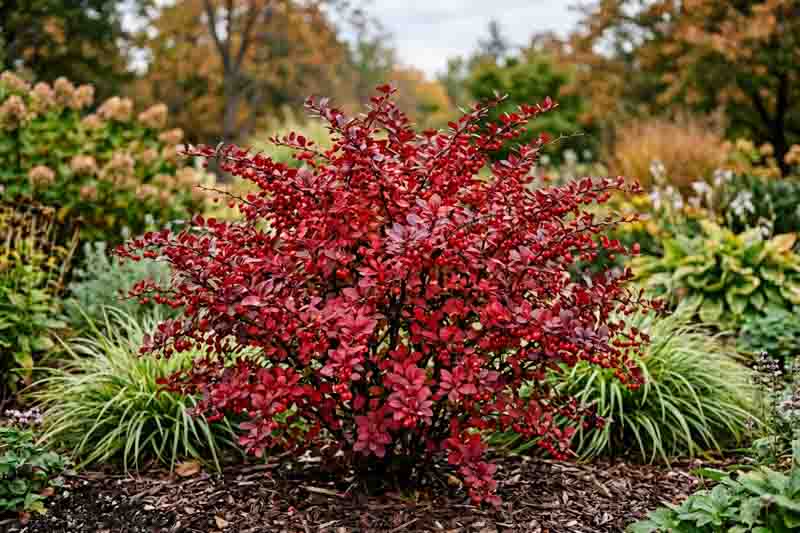


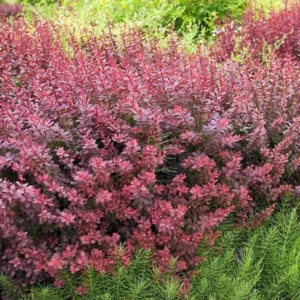
Berberis thunbergii Cherry Bomb® (‘Monomb’) is a compact deciduous Japanese barberry grown for its dense crimson foliage, rounded habit, and bright red fall and winter berries. Slowly reaching about 3-4 ft. tall and wide, it brings strong, season-long color to sunny borders, foundation plantings, low hedges, and barrier plantings.
Cherry Bomb® is also remarkably tough. Once established, it tolerates moderate drought, urban pollution, road salt, and deer browsing. Its sharp spines make it useful where a genuinely defensive shrub is wanted. However, because it belongs to the invasive Japanese barberry species, whether it is an appropriate garden plant depends heavily on where you live.
Summary: Compact, rounded deciduous shrub with dense crimson-red foliage and thorny branches.
Use: Excellent for low hedges, borders, foundations, accents, and barrier plantings where locally permitted.
Highlight: Deep foliage color from spring through fall, followed by bright red berries.
Important: Japanese barberry is invasive or regulated in parts of North America. Check local rules before planting.
| Botanical Name | Berberis thunbergii ‘Monomb’ |
|---|---|
| Trade Name | Cherry Bomb® Japanese Barberry |
| Family | Berberidaceae |
| Plant Type and Habit | Compact, dense, rounded deciduous shrub |
| Hardiness | USDA Zones 4-8 |
| Size | 3-4 ft. tall and wide (90-120 cm) |
| Growth Rate | Slow |
| Exposure | Full sun for best foliage color; some partial shade tolerated |
| Soil | Average, well-drained soil; avoid persistently wet sites |
| Foliage | Dense, deep crimson-red deciduous leaves |
| Flowers and Fruit | Small yellow spring flowers followed by bright red berries |
Cherry Bomb® belongs to Berberis thunbergii, a species considered invasive or regulated in several parts of North America. Some Japanese barberry cultivars are specifically documented as producing little or no viable seed, but Cherry Bomb® is not marketed as a sterile selection and produces red berries. Gardenia therefore recommends checking current local restrictions rather than assuming that a compact named cultivar is exempt from the invasive concerns associated with the species.
Cherry Bomb® is the registered trade name for Berberis thunbergii ‘Monomb’, a Japanese barberry cultivar introduced by Monrovia. The species is native to eastern Asia and has long been cultivated for its adaptability, colorful foliage, dense branching, and thorny growth.
This is a dense, rounded shrub that slowly reaches approximately 3-4 ft. tall and wide. Its compact proportions make it easier to use beneath windows, along broad paths, or as a low hedge than larger forms of Japanese barberry.
Cherry Bomb® is grown primarily for its foliage. The small leaves develop a rich crimson to purple-red color that gives the shrub strong visual impact throughout the growing season. Full sun produces the deepest coloration, while plants receiving more shade generally become greener.
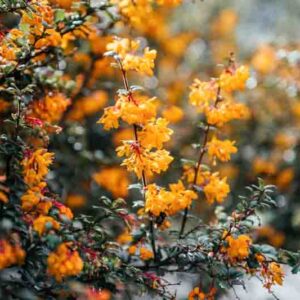
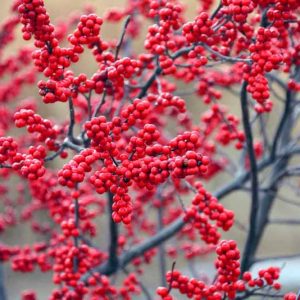
Small yellow flowers appear in spring. They are far less conspicuous than the foliage but can attract pollinating insects. Bright red berries follow and may remain visible into fall and winter, when birds can eat and disperse them.
Cherry Bomb® is hardy in USDA Zones 4-8. Its crimson foliage supplies the main display from spring through fall, while bright berries and a dense twiggy framework can extend interest after the leaves drop.
The spring flowers can provide some forage for pollinating insects, and birds may consume the red berries. Wildlife use, however, should not be confused with ecological benefit. Where Japanese barberry is invasive, birds that eat the fruit can also help disperse seeds beyond cultivated gardens.
Cherry Bomb® is considered deer resistant, aided by its dense growth and sharp spines. Like any resistant shrub, it may still be browsed where deer pressure is severe or alternative food is limited.
Once established, Cherry Bomb® tolerates moderate drought and performs well in demanding urban conditions. It is also reported to tolerate road salt and pollution, traits that can make it useful in exposed landscapes where Japanese barberry is permitted.
The branches carry sharp spines, making sturdy gloves advisable when pruning or working around mature plants. Avoid positioning Cherry Bomb® immediately beside narrow paths, play areas, entrances, or other places where people regularly brush against the shrub.
Berberis thunbergii is invasive in parts of the United States, where escaped plants can form dense thickets and displace native vegetation. Regulations vary by jurisdiction, and some regions restrict its sale or cultivation. Before planting Cherry Bomb®, check current local rules. Gardeners in affected areas can explore native alternatives to Japanese barberry.
Cherry Bomb® combines a rounded 3-4 ft. habit with especially deep crimson foliage. It is larger than dwarf cultivars such as ‘Crimson Pygmy’ but more compact than many full-sized forms of Berberis thunbergii. Its dense branching makes it particularly effective as a low hedge or substantial color accent.
Cherry Bomb® may grow in partial shade, but surviving there is not the same as achieving its best ornamental effect. Gardenia recommends full sun where practical for the deepest crimson foliage. If an established plant becomes noticeably greener, inadequate light is one of the first things to investigate.
Full sun is best for compact growth and intense red foliage. Some partial shade is tolerated, particularly in hotter climates, but increasing shade generally reduces color intensity.
Grow Cherry Bomb® in average, well-drained soil. Japanese barberry adapts to several soil types and pH levels but performs poorly where roots remain persistently wet. Water deeply and regularly during establishment. Once established, the shrub tolerates periods of moderate dryness.
Cherry Bomb® is more tolerant of lean soil and occasional dryness than of chronically wet roots. If choosing between improving fertility and improving drainage, Gardenia would prioritize drainage.
Plant at the same depth it grew in its container, water thoroughly, and allow approximately 3-4 ft. for its mature spread. Think carefully about circulation around the shrub: a thorny plant that is attractive in a border can become irritating if it eventually leans across a walkway.
Cherry Bomb® requires relatively little pruning. Remove damaged, dead, or crossing branches and shape established plants in late winter if necessary. Heavy shearing is rarely needed unless a formal hedge is intended.
Cherry Bomb® is propagated vegetatively so new plants retain the cultivar’s compact habit and deep crimson foliage. Stem cuttings are the usual method for maintaining named Japanese barberry cultivars true to type.
Japanese barberry is generally tough and relatively trouble-free. Poor drainage is one of the most important avoidable problems. Powdery mildew and occasional leaf problems may occur, but healthy plants in sunny, well-drained positions usually require little intervention.
Check light before reaching for fertilizer. Red-leaved Japanese barberries generally color best in strong light, and unnecessary feeding can encourage growth without restoring the deep crimson effect you planted it for.
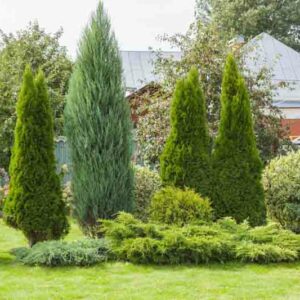
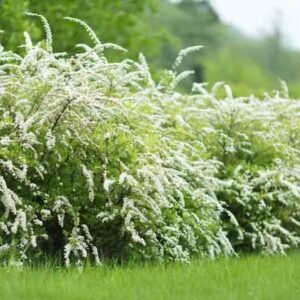
These companions substantially overlap with Cherry Bomb® in hardiness, sun exposure, and preference for well-drained soil. Their lighter flowers, foliage, and contrasting forms keep the crimson shrub from becoming a dark visual block.
Use Cherry Bomb® as a concentrated block of dark color rather than repeating burgundy foliage everywhere. Gardenia recommends surrounding it with lighter green, blue-gray, golden, or fine-textured plants. The contrast makes the crimson foliage look richer while keeping the overall planting from becoming visually heavy.
Before building a planting around Japanese barberry, first establish whether it is appropriate and permitted where you live. If it is, choose companions that genuinely share its site conditions.
Cherry Bomb® Japanese Barberry slowly reaches about 3 to 4 feet tall and wide, forming a dense, rounded shrub suitable for low hedges, foundations, borders, and barrier plantings.
Full sun is recommended for the richest crimson foliage and dense growth. Japanese barberry tolerates some partial shade, but the leaves may become greener as shade increases.
Cherry Bomb® is a cultivar of Berberis thunbergii, a species considered invasive or regulated in parts of North America. It produces red berries and is not documented as a sterile selection, so Gardenia recommends checking current local restrictions before planting.
Yes. Cherry Bomb® is considered deer resistant. Its dense branching and sharp spines also make it useful for defensive or barrier plantings.
Yes. Once established, Cherry Bomb® tolerates moderate drought. Water regularly during establishment, then reduce watering frequency as the root system develops.
Monrovia – Cherry Bomb® Japanese Barberry, Berberis thunbergii ‘Monomb’
USDA National Invasive Species Information Center – Japanese Barberry
USDA Forest Service – Berberis thunbergii, Japanese Barberry
USDA APHIS – Black Stem Rust and Barberry
Gardenia – Berberis thunbergii (Japanese Barberry)
Updated: October 2026 • Reviewed by Gardenia Editors
| Hardiness |
4 - 8 |
|---|---|
| Heat Zones |
5 - 8 |
| Climate Zones | 2, 2B, 3A, 3B, 4, 5, 6, 7, 8, 9, 10, 11, 12, 13, 14, 15, 16, 17, 18, 19, 20, 21, 22, 23, 24, A3 |
| Plant Type | Shrubs |
| Plant Family | Berberidaceae |
| Genus | Berberis |
| Common names | Japanese Barberry |
| Exposure | Full Sun, Partial Sun |
| Season of Interest | Spring (Mid, Late), Summer (Early, Mid, Late), Fall, Winter |
| Height | 3' - 4' (90cm - 120cm) |
| Spread | 3' - 4' (90cm - 120cm) |
| Spacing | 36" - 48" (90cm - 120cm) |
| Maintenance | Low |
| Water Needs | Low, Average |
| Soil Type | Chalk, Clay, Loam, Sand |
| Soil pH | Acid, Alkaline, Neutral |
| Soil Drainage | Moist but Well-Drained, Well-Drained |
| Characteristics | Showy |
| Tolerances | Drought, Deer, Dry Soil, Clay Soil, Salt, Heat, Fire, Erosion |
| Attracts | Birds, Bees |
| Garden Uses | Beds And Borders, Hedges And Screens, Patio And Containers, Small Gardens |
| Garden Styles | City and Courtyard, Coastal Garden, Informal and Cottage, Pollinator Garden |
| Toxic to Humans | No known toxicity |
| Toxic to Cats | No known toxicity |
| Toxic to Dogs | No known toxicity |
| Toxic to Horses | No known toxicity |


| Hardiness |
4 - 8 |
|---|---|
| Heat Zones |
5 - 8 |
| Climate Zones | 2, 2B, 3A, 3B, 4, 5, 6, 7, 8, 9, 10, 11, 12, 13, 14, 15, 16, 17, 18, 19, 20, 21, 22, 23, 24, A3 |
| Plant Type | Shrubs |
| Plant Family | Berberidaceae |
| Genus | Berberis |
| Common names | Japanese Barberry |
| Exposure | Full Sun, Partial Sun |
| Season of Interest | Spring (Mid, Late), Summer (Early, Mid, Late), Fall, Winter |
| Height | 3' - 4' (90cm - 120cm) |
| Spread | 3' - 4' (90cm - 120cm) |
| Spacing | 36" - 48" (90cm - 120cm) |
| Maintenance | Low |
| Water Needs | Low, Average |
| Soil Type | Chalk, Clay, Loam, Sand |
| Soil pH | Acid, Alkaline, Neutral |
| Soil Drainage | Moist but Well-Drained, Well-Drained |
| Characteristics | Showy |
| Tolerances | Drought, Deer, Dry Soil, Clay Soil, Salt, Heat, Fire, Erosion |
| Attracts | Birds, Bees |
| Garden Uses | Beds And Borders, Hedges And Screens, Patio And Containers, Small Gardens |
| Garden Styles | City and Courtyard, Coastal Garden, Informal and Cottage, Pollinator Garden |
| Toxic to Humans | No known toxicity |
| Toxic to Cats | No known toxicity |
| Toxic to Dogs | No known toxicity |
| Toxic to Horses | No known toxicity |
How many Berberis thunbergii Cherry Bomb® (Japanese Barberry) do I need for my garden?
| Plant | Quantity | |
|---|---|---|
| Berberis thunbergii Cherry Bomb® (Japanese Barberry) | N/A | Buy Plants |
Create a membership account to save your garden designs and to view them on any device.
Becoming a contributing member of Gardenia is easy and can be done in just a few minutes. If you provide us with your name, email address and the payment of a modest $25 annual membership fee, you will become a full member, enabling you to design and save up to 25 of your garden design ideas.
Join now and start creating your dream garden!