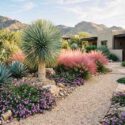
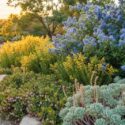
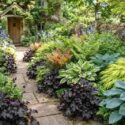
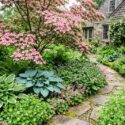
This vibrant front garden proves how a few well-chosen plants can create unforgettable curb appeal. Fiery orange Berberis darwinii, cloudlike Magnolia stellata, and golden Euonymus fortunei set the scene, while tulips and lavender add color, fragrance, and seasonal charm. A beautifully layered design bursting with personality and spring magic.
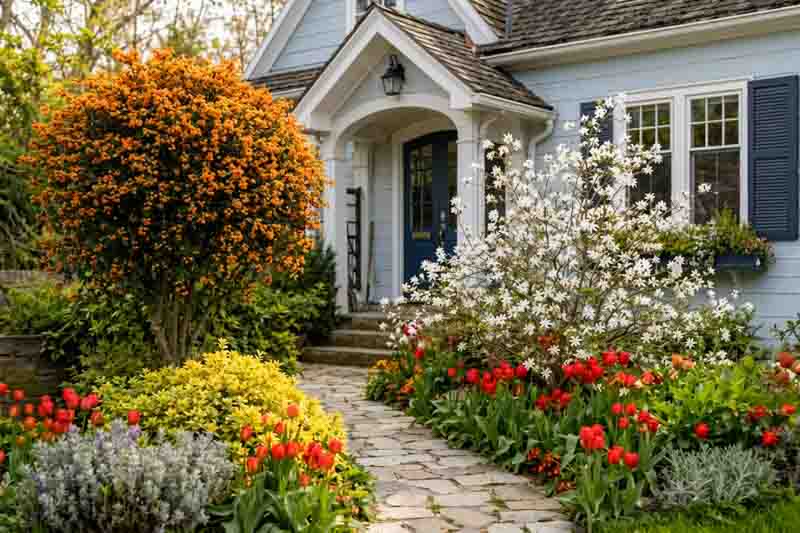


This compact front garden brings together spring flowers, evergreen structure, bright foliage, bulbs, and a low aromatic edge. Berberis darwinii provides the strongest warm color with its orange flowers, while Magnolia stellata opens nearby in a cloud of white. Golden Euonymus fortunei, red tulips, and Lavandula angustifolia ‘Hidcote’ fill the lower layers and carry the planting beyond the main spring display.
The combination works particularly well in a front garden because the plants contribute at different heights. Berberis and Magnolia form the main shrub layer, Euonymus fills some of the space below them, tulips appear seasonally through the gaps, and ‘Hidcote’ lavender creates a lower silver-green edge that flowers later.
Main plants used: Berberis darwinii, Magnolia stellata, Euonymus fortunei, Lavandula angustifolia ‘Hidcote’, and red Tulipa
The spring display relies on contrast. The vivid orange flowers of Berberis darwinii and red tulips provide the warmest colors, while the white Magnolia lightens the composition. Golden Euonymus adds another foliage tone, and the gray-green leaves of ‘Hidcote’ provide a quieter foreground.
The plant shapes are equally different. Magnolia develops a broad, branching habit, while Berberis is denser and more evergreen in character. Euonymus stays lower, tulips rise temporarily through the bed, and lavender forms compact mounds along the front.
This is useful in a small front garden because the planting does not depend on one short flowering period. The tulips are temporary, but the shrubs and foliage plants remain after the bulbs have finished, and the lavender takes over with its own summer flowers.
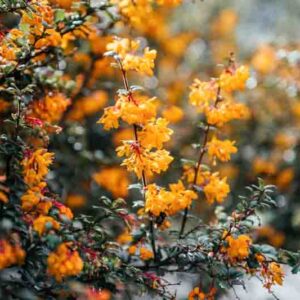
Berberis darwinii contributes evergreen foliage and masses of orange spring flowers, followed by dark blue-black berries. It can reach a substantial size, with a spread commonly ranging from about 4-10 ft (1.2-3 m), depending on growing conditions and pruning. In a compact front garden, one well-placed specimen is usually enough.
Magnolia stellata produces white, star-shaped flowers on bare or emerging branches in spring. Its open branching habit contrasts well with the denser Berberis. Give it humus-rich soil that holds some moisture without remaining waterlogged, and avoid unnecessary pruning.
Euonymus fortunei provides a lower evergreen foliage layer. Golden or variegated cultivars can brighten the base of the shrubs even when nothing is flowering, but mature size and habit vary considerably between selections.
Important: Euonymus fortunei is invasive or restricted in some parts of North America. Check local guidance before planting it and use a non-invasive alternative where necessary.
Red tulips provide a short but vivid spring accent. Plant them in loose groups rather than a straight row, and allow the foliage to yellow naturally after flowering so the bulbs can replenish their reserves.
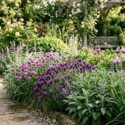
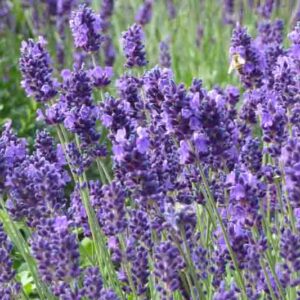
Lavandula angustifolia ‘Hidcote’ is well suited to the sunnier edge of the planting. Its compact silver-green foliage contrasts with the broader shrub leaves, and its deep violet-purple flowers extend the display into summer. Good drainage is essential, particularly in winter.
Create a compact front garden with strong spring color, permanent shrub structure, and a lower layer that remains attractive after the tulips have finished flowering.
These percentages are a design guide rather than a literal plant count. The shrubs will occupy much more physical space than the bulbs or lavender.
Position the Magnolia and Berberis first, leaving enough room for their mature spread and keeping them clear of windows, doors, and paths.
Use Euonymus as a lower foliage layer between or in front of the shrubs, provided it is suitable for your region.
Place ‘Hidcote’ lavender along the sunniest and best-drained part of the bed, then plant tulips in irregular groups through the open spaces rather than in a continuous strip.
The main plants do not all want identical conditions. Magnolia performs best with more consistent moisture, whereas ‘Hidcote’ lavender needs full sun and excellent drainage. In a small border, use the slightly moister interior for the Magnolia and reserve the drier outer edge for the lavender.
Check the exact Euonymus cultivar before planting because growth habit and mature dimensions vary widely. Where Euonymus fortunei is invasive or restricted, replace it with a non-invasive evergreen or golden-foliaged plant suited to your region.
Finally, resist filling every gap when the shrubs are young. Magnolia and Berberis will occupy considerably more room as they mature, while tulips can provide temporary spring color in the open spaces during the early years.
| Hardiness |
7 - 8 |
|---|---|
| Heat Zones |
7 - 8 |
| Climate Zones | 5, 6, 7, 8, 9, 14, 15, 16, 17 |
| Exposure | Full Sun |
| Season of Interest | Spring (Mid, Late), Summer (Early, Mid, Late) |
| Maintenance | Low |
| Water Needs | Low, Average |
| Soil Type | Loam, Sand |
| Soil pH | Acid, Neutral |
| Soil Drainage | Well-Drained |
| Characteristics | Cut Flowers, Showy, Fruit & Berries |
| Attracts | Bees, Butterflies, Birds |
| Landscaping Ideas | Beds And Borders |
| Garden Styles | Butterfly Garden, City and Courtyard, Informal and Cottage, Pollinator Garden |





| Hardiness |
7 - 8 |
|---|---|
| Heat Zones |
7 - 8 |
| Climate Zones | 5, 6, 7, 8, 9, 14, 15, 16, 17 |
| Exposure | Full Sun |
| Season of Interest | Spring (Mid, Late), Summer (Early, Mid, Late) |
| Maintenance | Low |
| Water Needs | Low, Average |
| Soil Type | Loam, Sand |
| Soil pH | Acid, Neutral |
| Soil Drainage | Well-Drained |
| Characteristics | Cut Flowers, Showy, Fruit & Berries |
| Attracts | Bees, Butterflies, Birds |
| Landscaping Ideas | Beds And Borders |
| Garden Styles | Butterfly Garden, City and Courtyard, Informal and Cottage, Pollinator Garden |
Recreate this garden. Specify the percentages you would like to have of each plant and input the dimensions of your garden space.We'll give you a shopping list so you know how many plants you need.
| Plant | Quantity | |
|---|---|---|
| Berberis darwinii (Darwin’s Barberry) | N/A | Buy Plants |
| Magnolia stellata 'Royal Star' (Star Magnolia) | N/A | Buy Plants |
| Euonymus fortunei (Wintercreeper) | N/A | Buy Plants |
| Lavandula angustifolia 'Hidcote' (Lavender) | N/A | Buy Plants |
| Tulipa 'Red Emperor' (Fosteriana Tulip) | N/A | Buy Plants |
Create a membership account to save your garden designs and to view them on any device.
Becoming a contributing member of Gardenia is easy and can be done in just a few minutes. If you provide us with your name, email address and the payment of a modest $25 annual membership fee, you will become a full member, enabling you to design and save up to 25 of your garden design ideas.
Join now and start creating your dream garden!