Elf Mountain Laurel, Dwarf Mountain Laurel, Mountain Laurel 'Elf', Kalmia latifolia f. myrtifolia 'Elf'
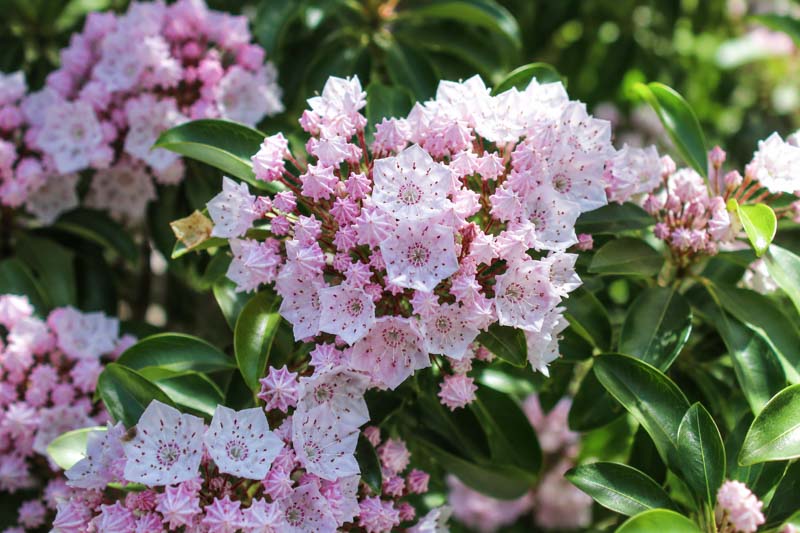
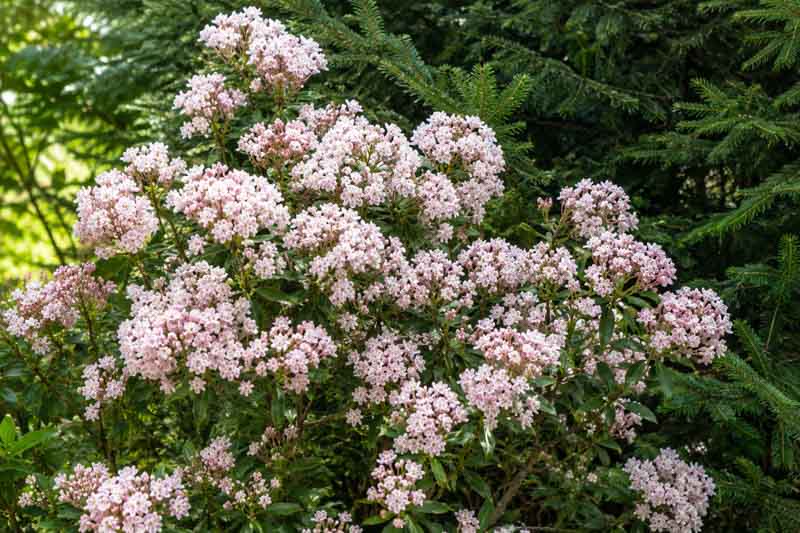


Kalmia latifolia ‘Elf’, commonly known as Elf Mountain Laurel or Dwarf Mountain Laurel, is a compact broadleaf evergreen shrub prized for glossy foliage, pink-tinted buds, and charming white spring flowers. It brings the elegance of native mountain laurel into a smaller, more refined form that fits beautifully in woodland gardens, shaded foundations, acid-loving borders, containers, and compact landscapes.
Slow-growing, polished, and naturally tidy, ‘Elf’ is ideal for gardeners who want year-round structure, spring bloom, deer resistance, and native woodland character without the size of a full mountain laurel. It pairs naturally with rhododendrons and azaleas, pieris, leucothoe, wintergreen, ferns, and other woodland plants that thrive in acidic soil.
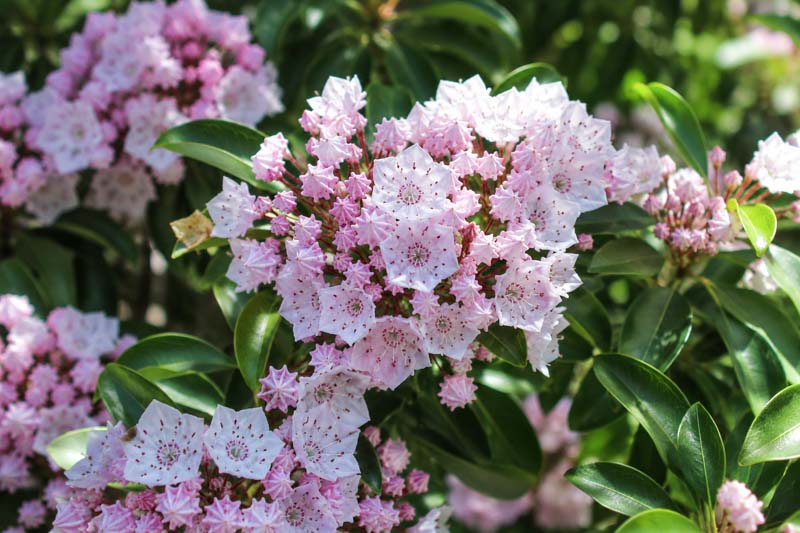
Compact, slow-growing broadleaf evergreen shrub with glossy leaves and pink buds that open to white, cup-shaped flowers in late spring.
Use: Excellent for woodland gardens, shaded foundations, acid-loving shrub borders, small gardens, containers, native plantings, and rhododendron collections.
Highlight: A dwarf mountain laurel that brings elegant evergreen structure and bright spring flowers to smaller spaces.
Note: Needs acidic, moist, well-drained soil and should not be planted too deeply.
| Botanical Name | Kalmia latifolia ‘Elf’ |
|---|---|
| Family | Ericaceae – heath family |
| Common Names | Elf Mountain Laurel, Dwarf Mountain Laurel, Mountain Laurel ‘Elf’ |
| Plant Type and Habit | Compact broadleaf evergreen shrub; dense, rounded, slow-growing habit |
| Hardiness | Usually USDA Zones 4 to 8, with best performance in cool, sheltered sites |
| Size | Typically 2 to 3 ft. tall and 2 to 4 ft. wide; often about 3 ft. by 3 ft. after 10 years |
| Light | Partial shade, dappled shade, or morning sun with afternoon shade |
| Soil | Acidic, humus-rich, moist, cool, well-drained soil |
| Bloom Time | Late spring to early summer, often May to June |
| Flower Color | Light pink buds opening to white flowers, often with delicate markings |
| Wildlife Value | Flowers attract bees, butterflies, and other pollinators; evergreen foliage provides cover |
| Deer and Rabbit Resistance | Generally deer-resistant and rabbit-resistant because foliage is toxic and unpalatable |
Treat ‘Elf’ like a miniature rhododendron: shallow roots, acidic soil, steady moisture, cool mulch, and protection from harsh afternoon sun.
Deep planting, alkaline soil, compacted clay, and winter wind are the fastest ways to make mountain laurel struggle.
‘Elf’ gives you native character, evergreen polish, and spring flowers without overwhelming a small bed.
Kalmia latifolia ‘Elf’ is a dwarf cultivar of Kalmia latifolia, the beloved Mountain Laurel native to eastern North America. The species is famous for glossy evergreen leaves, picturesque branching, and intricate late spring flowers. ‘Elf’ keeps that woodland elegance but compresses it into a smaller shrub suited to refined garden spaces.
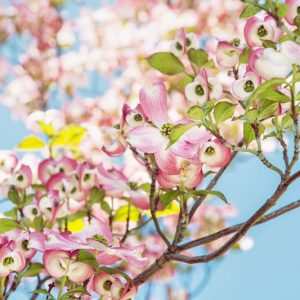
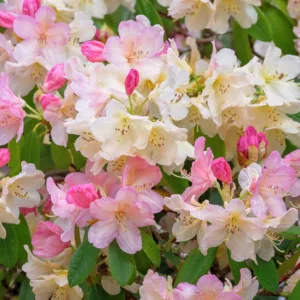
The buds are usually soft pink, giving the plant a pearly blush before bloom. They open to white or creamy white flowers, sometimes with subtle internal markings. The blossoms sit in clusters above the foliage, creating a delicate, lace-like display in late spring to early summer.
‘Elf’ is slow-growing, dense, and rounded. Most plants reach about 2 to 3 feet tall and 2 to 4 feet wide, though size varies with climate, soil, moisture, and age. Its compact scale makes it useful near paths, under windows, beside shaded entries, and at the front of evergreen borders.
Bloom usually occurs in May or June. The flowers are small but abundant, with the distinctive mountain laurel cup shape. Like the species, they have an unusual pollination mechanism: the stamens are tucked into pockets and spring outward when touched by visiting insects.
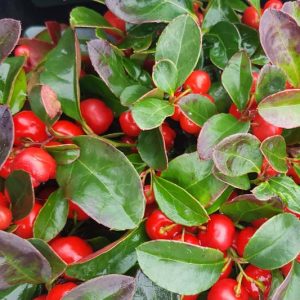
The foliage is evergreen, leathery, glossy, and deep green. It gives ‘Elf’ year-round value, especially in winter when deciduous companions are bare. In exposed cold sites, leaves may bronze or scorch, so the best placement is sheltered, lightly shaded, and mulched.
‘Elf’ is commonly grown in USDA Zones 4 to 8. It performs best where summers are not excessively hot, roots stay cool, and soil moisture remains steady. In warm climates, avoid harsh afternoon sun and choose bright shade or morning sun with afternoon protection.
All parts of Kalmia latifolia are toxic if ingested. Mountain laurel contains grayanotoxins that can harm humans, pets, horses, goats, sheep, and other livestock. Do not plant it where animals may browse heavily, and keep clippings away from pets or grazing animals. For broader safety context, see Poisonous Flowers and Plants: Identifying Toxic Risks Around You.
‘Elf’ is generally resistant to deer and rabbits. Browsing can still happen during severe food shortages, but the foliage is usually avoided because it is toxic and unpalatable.
Kalmia latifolia ‘Elf’ is not considered invasive in garden settings. It is compact, slow-growing, and does not spread aggressively by runners. Seedlings are uncommon in cultivated landscapes and easy to remove if they appear.
Mountain laurels are shallow-rooted. Planting too deep is a common mistake. Keep the crown high, mulch lightly, and never bury the stems.
Partial shade is ideal. Think woodland edge, high filtered shade, or morning sun with afternoon shade. In cooler northern gardens, ‘Elf’ can take more sun if the soil remains evenly moist. In hot gardens, afternoon shade helps prevent leaf scorch.
Soil is the make-or-break factor. ‘Elf’ needs acidic, humus-rich, free-draining soil that stays lightly moist but never soggy. A pH around 5.0 to 6.5 is ideal. Avoid lime, alkaline irrigation water, compacted clay, and wet planting pockets. Improve the site with leaf mold, fine pine bark, composted bark, or other acidic organic matter.
Water deeply during the first growing season so roots can establish. After that, maintain even moisture during dry spells, especially in summer and before the ground freezes. Drought stress can cause leaf browning, bud drop, sparse flowering, and decline. Mulch with pine bark, pine needles, shredded leaves, or leaf mold to keep roots cool.
Feed lightly, if at all. A spring topdressing of composted leaf mold or pine bark is often enough. If growth is pale and soil pH is correct, use a fertilizer formulated for acid-loving plants. Avoid overfeeding, which can encourage soft growth.
Prune immediately after flowering, before next year’s buds develop. Remove dead, broken, or crossing branches and shape lightly only if needed. ‘Elf’ naturally stays compact, so heavy pruning is rarely necessary. Deadheading spent flower clusters can improve appearance.
In cold or windy climates, protect ‘Elf’ from drying winter winds and harsh winter sun. Keep mulch over the root zone, water well before hard freezes, and avoid exposed sites near reflective walls or pavement. Burlap screens can help in severe winter locations.
‘Elf’ can grow in a container if given acidic potting mix, excellent drainage, and consistent moisture. Use a mix for rhododendrons, azaleas, or camellias. In cold climates, protect the container from freeze-thaw cycles because potted roots are less insulated than garden roots.
Because ‘Elf’ is a named cultivar, seed-grown plants may not come true. To preserve the cultivar, use semi-ripe cuttings in mid-summer or layering from a low branch.
Propagation can be slow, so most gardeners are better served by buying nursery-grown plants. Avoid disturbing established shrubs because mountain laurels have shallow, sensitive root systems.
‘Elf’ is generally low-maintenance in the right site, but stressed plants are more vulnerable to pests and diseases. Proper planting depth, acidic soil, steady moisture, and airflow are the best defenses.
Design ‘Elf’ where its compact shape, glossy evergreen foliage, and intricate spring flowers can be enjoyed up close. It is especially effective along shaded paths, near entries, in small woodland gardens, and at the front of acid-loving shrub borders. The best companions share its preference for acidic, humus-rich, moist but well-drained soil, partial shade, cool roots, and shelter from harsh afternoon sun.
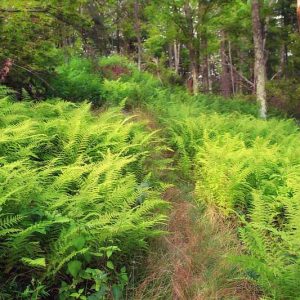
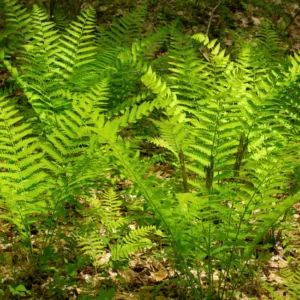
Think of ‘Elf’ as the polished evergreen anchor. Surround it with compact rhododendrons, pieris, leucothoe, wintergreen, and soft ferns for a layered woodland planting.
Kalmia latifolia Elf is a dwarf cultivar of mountain laurel. It is a compact broadleaf evergreen shrub with glossy foliage, pink-tinted buds, and white late spring flowers.
Kalmia latifolia Elf typically grows about 2 to 3 feet tall and 2 to 4 feet wide. It is slow-growing and often reaches about 3 feet by 3 feet after 10 years.
Partial shade is best. Kalmia latifolia Elf grows well in dappled woodland light or morning sun with afternoon shade. In cool climates it can tolerate more sun if soil remains moist.
Kalmia latifolia Elf needs acidic, humus-rich, moist, well-drained soil. It dislikes alkaline soil, compacted clay, poor drainage, drought, and deep planting.
Yes. Kalmia latifolia Elf is generally deer-resistant because the foliage is toxic and unpalatable. Deer may still browse it during severe food shortages.
Yes. Kalmia latifolia Elf is poisonous if ingested. All parts of mountain laurel contain toxic compounds that can harm people, pets, horses, sheep, goats, and other livestock.
Yes. Kalmia latifolia Elf can grow in containers if planted in acidic, well-drained potting mix and watered consistently. In cold climates, protect the pot from winter freeze-thaw cycles.
Prune Kalmia latifolia Elf immediately after flowering. Light shaping and removal of dead or damaged growth are usually enough because this cultivar naturally stays compact.
Gardenia – Kalmia latifolia Mountain Laurel: https://www.gardenia.net/plant/kalmia-latifolia-mountain-laurel
Missouri Botanical Garden – Kalmia latifolia ‘Elf’: https://www.missouribotanicalgarden.org/PlantFinder/PlantFinderDetails.aspx?taxonid=249925
RHS Plants – Kalmia latifolia f. myrtifolia ‘Elf’: https://www.rhsplants.co.uk/plants/_/kalmia-latifolia-f-myrtifolia-elf/classid.2000039552/
Updated: June 2026 – Reviewed by Gardenia Editors
| Hardiness |
4 - 8 |
|---|---|
| Heat Zones |
5 - 9 |
| Climate Zones | 2, 3, 4, 5, 6, 7, 16, 17 |
| Plant Type | Shrubs |
| Plant Family | Ericaceae |
| Common names | Mountain Laurel |
| Exposure | Partial Sun |
| Season of Interest | Spring (Late), Summer (Early) |
| Height | 2' - 3' (60cm - 90cm) |
| Spread | 2' - 4' (60cm - 120cm) |
| Spacing | 24" - 48" (60cm - 120cm) |
| Maintenance | Low |
| Water Needs | Average |
| Soil Type | Clay, Loam, Sand |
| Soil pH | Acid, Neutral |
| Soil Drainage | Moist but Well-Drained |
| Characteristics | Showy, Evergreen |
| Tolerance | Deer, Clay Soil, Rabbit, Dry Soil, Rocky Soil |
| Attracts | Butterflies, Hummingbirds |
| Garden Uses | Beds And Borders, Hedges And Screens |
| Garden Styles | Coastal Garden, Informal and Cottage, Prairie and Meadow |


| Hardiness |
4 - 8 |
|---|---|
| Heat Zones |
5 - 9 |
| Climate Zones | 2, 3, 4, 5, 6, 7, 16, 17 |
| Plant Type | Shrubs |
| Plant Family | Ericaceae |
| Common names | Mountain Laurel |
| Exposure | Partial Sun |
| Season of Interest | Spring (Late), Summer (Early) |
| Height | 2' - 3' (60cm - 90cm) |
| Spread | 2' - 4' (60cm - 120cm) |
| Spacing | 24" - 48" (60cm - 120cm) |
| Maintenance | Low |
| Water Needs | Average |
| Soil Type | Clay, Loam, Sand |
| Soil pH | Acid, Neutral |
| Soil Drainage | Moist but Well-Drained |
| Characteristics | Showy, Evergreen |
| Tolerance | Deer, Clay Soil, Rabbit, Dry Soil, Rocky Soil |
| Attracts | Butterflies, Hummingbirds |
| Garden Uses | Beds And Borders, Hedges And Screens |
| Garden Styles | Coastal Garden, Informal and Cottage, Prairie and Meadow |
How many Kalmia latifolia ‘Elf’ (Mountain Laurel) do I need for my garden?
| Plant | Quantity | |
|---|---|---|
| Kalmia latifolia ‘Elf’ (Mountain Laurel) | N/A | Buy Plants |
Create a membership account to save your garden designs and to view them on any device.
Becoming a contributing member of Gardenia is easy and can be done in just a few minutes. If you provide us with your name, email address and the payment of a modest $25 annual membership fee, you will become a full member, enabling you to design and save up to 25 of your garden design ideas.
Join now and start creating your dream garden!
Create a membership account to save your garden designs and to view them on any device.
Becoming a contributing member of Gardenia is easy and can be done in just a few minutes. If you provide us with your name, email address and the payment of a modest $25 annual membership fee, you will become a full member, enabling you to design and save up to 25 of your garden design ideas.
Join now and start creating your dream garden!