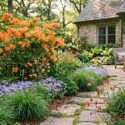
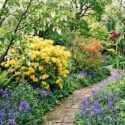
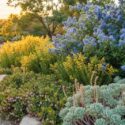
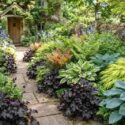
This garden wall planting pairs carpet-forming perennials with spring bulbs for a vivid cascade. Aubrieta (groundcover) drapes the stones in mid-to-late spring, saxifraga (cushion perennial) adds mounded texture and starry blooms, and muscari (bulb) punctuates the edge with blue spikes in mid spring.
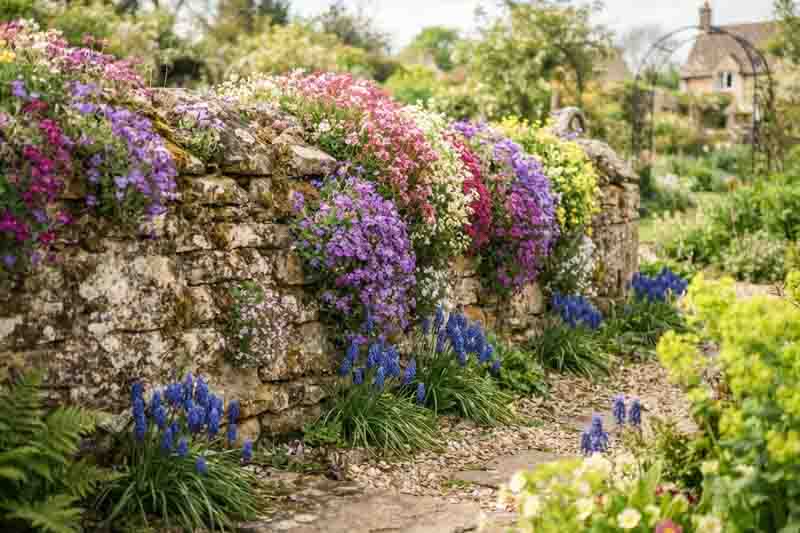


This spring planting makes the most of an old stone wall by using plants that naturally suit crevices, ledges, and sharply drained soil. Aubrieta and Saxifraga spill over the top and face of the wall in loose patches of purple, pink, white, and yellow, while Muscari forms dense blue clumps at the base beside the gravel path.
The effect is informal rather than carefully patterned. Some plants trail farther than others, colors overlap, and small gaps in the stone remain visible. That unevenness suits the weathered wall and the cottage-garden setting far better than a perfectly repeated sequence would.
Main plants used: Aubrieta, Saxifraga, and Muscari (Grape Hyacinth)
The old stone wall provides much of the character. Its rough surface, ledges, and crevices allow low-growing plants to spread irregularly instead of forming a flat border. Aubrieta is particularly effective where it can trail over the upper stones, while Saxifraga fits naturally into smaller pockets and shallower planting areas.
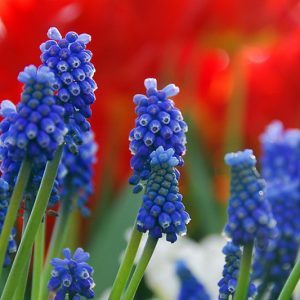
Muscari behaves differently. Rather than spreading across the wall face, it forms upright groups at ground level. The deep blue flower spikes give the eye something more defined beneath the softer masses of Aubrieta and Saxifraga.
The mixture of colors is broader than a simple purple-and-blue scheme. Pale pink, white, deeper magenta, lavender, and yellow all appear along the wall. Because the plants remain low and the stone is visible between them, the variety feels lively rather than crowded.
Aubrieta is most useful on the top and upper face of the wall, where stems can spread outward and trail over the stone. It flowers heavily in spring and can be trimmed lightly after bloom to keep clumps compact.
Saxifraga works well in shallower pockets and along irregular ledges. Depending on the species or cultivar, flowers may be white, pink, red, or yellow. Use several small groups rather than trying to create one continuous strip.
Muscari is best planted in clusters at the foot of the wall and occasionally in larger pockets where there is enough soil. The bulbs naturalize readily in favorable conditions and can gradually form broader colonies.
Create a spring wall planting that softens old stone without hiding it completely, using low perennials above and blue bulbs at ground level.
Treat these percentages as a guide only. The size and depth of usable planting pockets should determine where each plant goes.
Use Aubrieta in the larger planting pockets along the top so some stems can trail downward.
Fit Saxifraga into smaller ledges and crevices where there is enough soil for the roots.
Plant Muscari in uneven groups along the base of the wall rather than at identical intervals. Allow some sections of stone and gravel to remain visible between plants.
A wall planting can dry out much faster than an ordinary garden bed. Even plants that appreciate good drainage need regular water while their roots are becoming established, especially when planted in shallow pockets.
Also expect the planting to change with time. Aubrieta may spread farther over the stones, Saxifraga clumps will broaden, and Muscari can naturalize. Thin or divide plants when necessary rather than trying to preserve the exact original arrangement.
That gradual change is part of the appeal. An old stone wall looks most convincing when the plants settle into it rather than appearing permanently arranged.
| Hardiness |
5 - 7 |
|---|---|
| Heat Zones |
5 - 7 |
| Exposure | Full Sun, Partial Sun |
| Season of Interest | Spring (Mid, Late) |
| Maintenance | Low |
| Water Needs | Average |
| Soil Type | Chalk, Loam, Sand |
| Soil pH | Neutral, Alkaline |
| Soil Drainage | Well-Drained |
| Characteristics | Showy |
| Tolerances | Deer |
| Attracts | Bees |
| Landscaping Ideas | Edging, Ground Covers |
| Garden Styles | Gravel and Rock Garden, Informal and Cottage |



| Hardiness |
5 - 7 |
|---|---|
| Heat Zones |
5 - 7 |
| Exposure | Full Sun, Partial Sun |
| Season of Interest | Spring (Mid, Late) |
| Maintenance | Low |
| Water Needs | Average |
| Soil Type | Chalk, Loam, Sand |
| Soil pH | Neutral, Alkaline |
| Soil Drainage | Well-Drained |
| Characteristics | Showy |
| Tolerances | Deer |
| Attracts | Bees |
| Landscaping Ideas | Edging, Ground Covers |
| Garden Styles | Gravel and Rock Garden, Informal and Cottage |
Recreate this garden. Specify the percentages you would like to have of each plant and input the dimensions of your garden space.We'll give you a shopping list so you know how many plants you need.
| Plant | Quantity | |
|---|---|---|
| Aubrieta deltoidea (Rock Cress) | N/A | Buy Plants |
| Saxifraga x arendsii 'Touran Pink' (Saxifrage) | N/A | Buy Plants |
| Muscari armeniacum (Grape Hyacinth) | N/A | Buy Plants |
Create a membership account to save your garden designs and to view them on any device.
Becoming a contributing member of Gardenia is easy and can be done in just a few minutes. If you provide us with your name, email address and the payment of a modest $25 annual membership fee, you will become a full member, enabling you to design and save up to 25 of your garden design ideas.
Join now and start creating your dream garden!