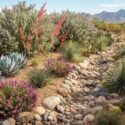
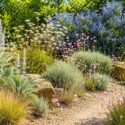
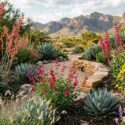
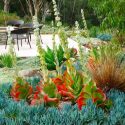
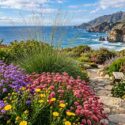
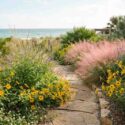
Transform a sunny slope with blue-flowering Ceanothus 'Yankee Point', aromatic Cleveland Sage, scarlet California Fuchsia, creamy-pink California Buckwheat, and graceful Deer Grass. These drought-tolerant native shrubs, flowering perennials, and ornamental grasses provide color from spring through fall, while creating valuable pollinator habitat and year-round hillside structure.
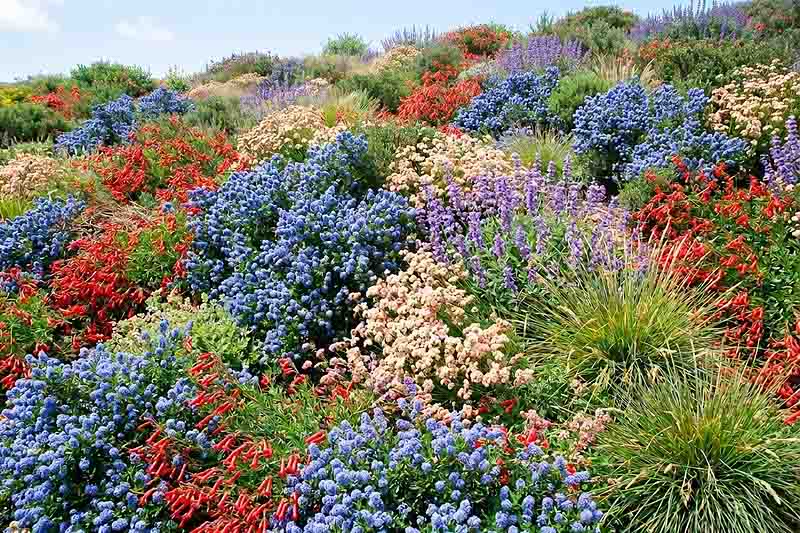


Imagine a California hillside covered with brilliant blue wild lilacs, scarlet-red flowers, soft lavender blossoms, and clouds of creamy-pink buckwheat. Graceful native grasses catch the breeze, while the colorful plants follow the natural contours of the slope. Inspired by California’s coastal scrub and chaparral landscapes, this beautiful garden combines spectacular seasonal color with water-wise planting.
Five California natives create the display: Ceanothus ‘Yankee Point’ (California Lilac), Salvia clevelandii (Cleveland Sage), Epilobium canum (California Fuchsia), Eriogonum fasciculatum (California Buckwheat), and Muhlenbergia rigens (Deer Grass). Together, they offer contrasting colors, pollinator habitat, and year-round structure.
Main plants used: Ceanothus ‘Yankee Point’, Salvia clevelandii, Epilobium canum, Eriogonum fasciculatum, and Muhlenbergia rigens.
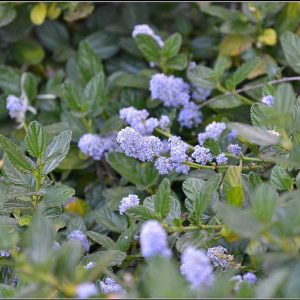
Ceanothus ‘Yankee Point’ creates beautiful evergreen carpets covered with clusters of brilliant blue flowers in spring. Its broad, spreading habit makes it particularly valuable for covering sunny banks and slopes.
Salvia clevelandii introduces fragrant gray-green foliage and distinctive whorls of violet-blue flowers in spring to early summer. Its aromatic leaves and nectar-rich blooms attract bees, butterflies, and hummingbirds.
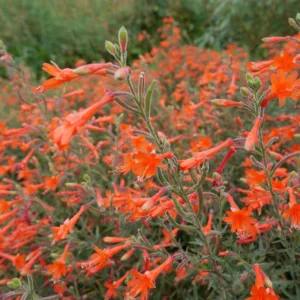
Epilobium canum provides a spectacular late-season contrast with slender, scarlet-orange tubular flowers. Blooming mainly from late summer into fall, California Fuchsia is especially valuable to hummingbirds when earlier flowers have faded.
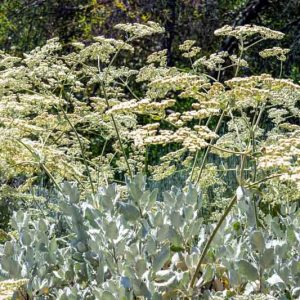
Eriogonum fasciculatum adds rounded clusters of creamy-white to pale pink flowers that gradually develop warm rusty tones. This evergreen California Buckwheat supports numerous native bees and butterflies.
Muhlenbergia rigens completes the design with graceful fountains of narrow green leaves and slender summer flower stalks. Its substantial clumps provide movement and structure even between flowering seasons.
The combination works because cool blue flowers contrast with warm red accents, while buckwheat and grasses soften the planting. Flowering succession extends the garden’s interest beyond a single season.
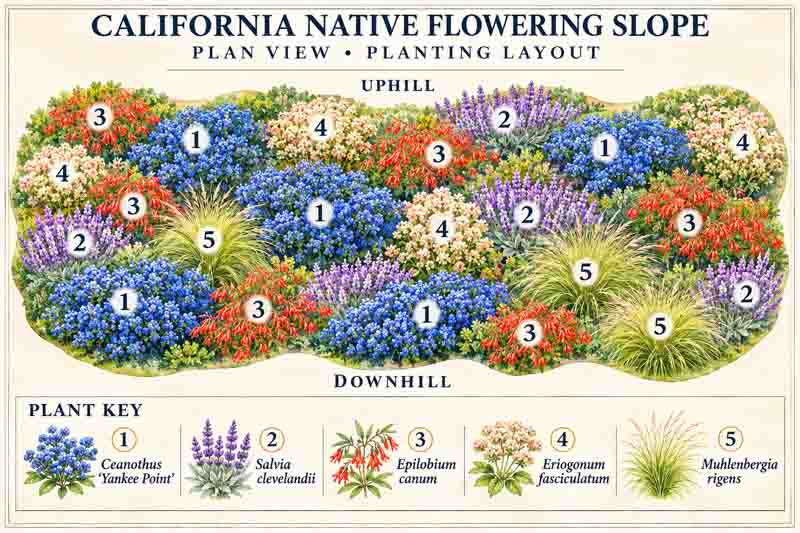
Create a colorful, low-water California hillside with brilliant spring blues, vivid late-season reds, soft buckwheat flowers, and graceful native grasses.
Approximate visual proportions, not plant quantities or mature coverage.
Position Ceanothus ‘Yankee Point’ in generous patches across the hillside, leaving room for its mature spread. Repeat Cleveland Sage and California Buckwheat between the evergreen areas. Add California Fuchsia in open, sunny pockets, then place Deer Grass in widely spaced clumps for texture and movement. Follow the natural slope rather than planting rigid rows.
Spring brings brilliant blue Ceanothus flowers, followed by violet Cleveland Sage. California Buckwheat adds creamy blossoms in late spring and summer, while Deer Grass produces graceful flowering stems. Late summer and fall belong to scarlet California Fuchsia, with buckwheat seedheads and evergreen foliage extending seasonal interest.
| Hardiness |
9 - 10 |
|---|---|
| Climate Zones | 8, 9, 14, 15, 16, 17, 18, 19, 20, 21, 22, 23, 24 |
| Exposure | Full Sun |
| Season of Interest | Spring (Mid, Late), Summer (Early, Mid, Late), Fall |
| Maintenance | Low |
| Water Needs | Low |
| Soil Type | Loam, Sand |
| Soil pH | Acid, Neutral, Alkaline |
| Soil Drainage | Well-Drained |
| Characteristics | Showy |
| Tolerances | Drought |
| Attracts | Bees, Butterflies, Hummingbirds, Birds |
| Landscaping Ideas | Banks And Slopes |
| Garden Styles | Butterfly Garden, Informal and Cottage, Pollinator Garden, Prairie and Meadow |


| Hardiness |
9 - 10 |
|---|---|
| Climate Zones | 8, 9, 14, 15, 16, 17, 18, 19, 20, 21, 22, 23, 24 |
| Exposure | Full Sun |
| Season of Interest | Spring (Mid, Late), Summer (Early, Mid, Late), Fall |
| Maintenance | Low |
| Water Needs | Low |
| Soil Type | Loam, Sand |
| Soil pH | Acid, Neutral, Alkaline |
| Soil Drainage | Well-Drained |
| Characteristics | Showy |
| Tolerances | Drought |
| Attracts | Bees, Butterflies, Hummingbirds, Birds |
| Landscaping Ideas | Banks And Slopes |
| Garden Styles | Butterfly Garden, Informal and Cottage, Pollinator Garden, Prairie and Meadow |
Recreate this garden. Specify the percentages you would like to have of each plant and input the dimensions of your garden space.We'll give you a shopping list so you know how many plants you need.
| Plant | Quantity | |
|---|---|---|
| Ceanothus griseus var. horizontalis 'Yankee Point' (Californian Lilac) | N/A | Buy Plants |
| Eriogonum fasciculatum (California Buckwheat) | N/A | Buy Plants |
| Salvia clevelandii (Cleveland Sage) | N/A | Buy Plants |
| Epilobium canum (California Fuchsia) | N/A | Buy Plants |
| Muhlenbergia rigens (Deer Grass) | N/A | Buy Plants |
Create a membership account to save your garden designs and to view them on any device.
Becoming a contributing member of Gardenia is easy and can be done in just a few minutes. If you provide us with your name, email address and the payment of a modest $25 annual membership fee, you will become a full member, enabling you to design and save up to 25 of your garden design ideas.
Join now and start creating your dream garden!