Transform a garden fence with bright pink Rambling Rose 'American Pillar' and velvety crimson Clematis 'Ernest Markham'. These vigorous flowering climbers create a spectacular midsummer display, with abundant rose clusters contrasting against large clematis blooms. The clematis continues into early autumn, bringing lasting color to romantic cottage gardens and pergolas.
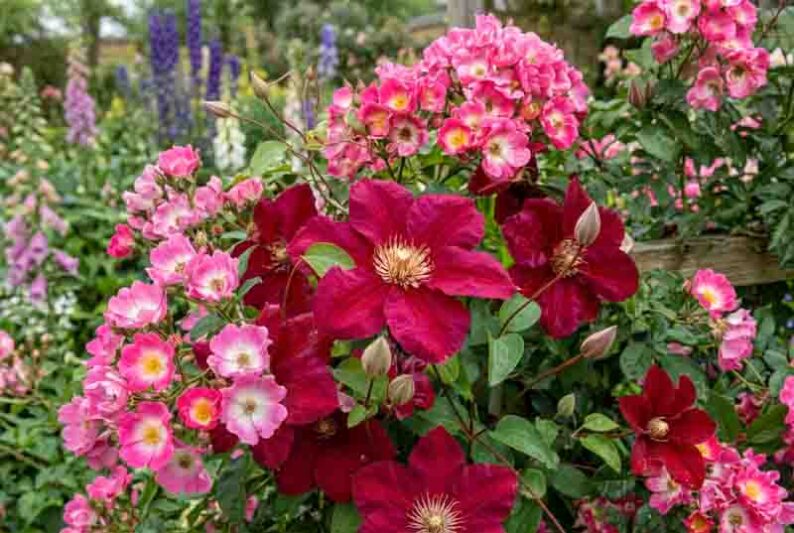


Imagine a rustic wooden fence overflowing with hundreds of bright pink roses, their little white centers glowing among enormous, velvety crimson clematis flowers. The two climbers weave through one another, creating a spectacular tapestry of pink and red. Bold, romantic, and wonderfully exuberant, this combination brings the generous charm of an old-fashioned cottage garden to a summer border.
Two vigorous flowering climbers create the display: Rosa ‘American Pillar’ (Rambling Rose) and Clematis ‘Ernest Markham’. Their contrasting flower sizes, rich colors, and overlapping summer blooms create an eye-catching display, with the clematis extending the flowering season after the rose’s main flush has finished.
Main plants used: Rosa ‘American Pillar’ and Clematis ‘Ernest Markham’.
The beauty of this pairing begins with Rosa ‘American Pillar’, a vigorous rambling rose that produces enormous clusters of bright carmine-pink, single flowers, each with a distinctive white eye and golden stamens. The blooms, approximately 2 inches (5 cm) across, create a spectacular display against its glossy, dark green foliage.
Unlike repeat-flowering climbing roses, ‘American Pillar’ flowers once, usually around midsummer. Its generous flowering flush can cover long stretches of fencing or a substantial pergola, creating an unforgettable seasonal display.
Clematis ‘Ernest Markham’ introduces a completely different scale and texture. Its large, rich crimson-magenta flowers, reaching approximately 6 inches (15 cm) across, feature broad, velvety sepals surrounding pale golden-buff stamens. The dramatic blooms stand out beautifully against the smaller pink roses.
Flowering from summer into early autumn, the clematis can overlap with the rose’s midsummer display before continuing to provide color after the rose has finished.
The pairing succeeds because the colors are closely related but the flower sizes are strikingly different. The small roses create abundant pink clusters, while the larger clematis flowers become dramatic focal points. Against weathered timber, the result feels exuberant rather than formal.
Create a vibrant romantic climbing display with clusters of bright pink roses and large crimson clematis flowers mingling across a rustic fence or pergola.
Approximate visual proportions during overlapping bloom, not exact plant quantities.
Install a strong fence, pergola, or substantial arch capable of supporting the mature rambler. Train Rose ‘American Pillar’ horizontally or diagonally to encourage flowering along its stems. Position Clematis ‘Ernest Markham’ beside the rose and guide its shoots upward through wires or mesh. Keep the lower clematis stems accessible for annual pruning and avoid allowing the vigorous rose to overwhelm them.
Spring brings vigorous green shoots and glossy rose foliage. Around midsummer, ‘American Pillar’ produces its spectacular flush of pink flowers, potentially coinciding with the first crimson blooms of Clematis ‘Ernest Markham’. As the rose petals fade, the clematis continues flowering through summer and sometimes into early autumn. Later, rose hips may provide additional interest if the spent flowers are left in place.
| Hardiness |
4 - 9 |
|---|---|
| Heat Zones |
5 - 9 |
| Exposure | Full Sun, Partial Sun |
| Season of Interest | Summer (Mid, Late) |
| Maintenance | Average |
| Water Needs | Average |
| Soil Type | Chalk, Clay, Loam, Sand |
| Soil pH | Alkaline, Neutral |
| Soil Drainage | Moist but Well-Drained |
| Characteristics | Showy |
| Tolerances | Clay Soil |
| Attracts | Bees, Butterflies, Hummingbirds |
| Landscaping Ideas | Arbors, Pergolas, Trellises, Wall-Side Borders, Walls And Fences |
| Garden Styles | Butterfly Garden, City and Courtyard, Informal and Cottage, Pollinator Garden |



| Hardiness |
4 - 9 |
|---|---|
| Heat Zones |
5 - 9 |
| Exposure | Full Sun, Partial Sun |
| Season of Interest | Summer (Mid, Late) |
| Maintenance | Average |
| Water Needs | Average |
| Soil Type | Chalk, Clay, Loam, Sand |
| Soil pH | Alkaline, Neutral |
| Soil Drainage | Moist but Well-Drained |
| Characteristics | Showy |
| Tolerances | Clay Soil |
| Attracts | Bees, Butterflies, Hummingbirds |
| Landscaping Ideas | Arbors, Pergolas, Trellises, Wall-Side Borders, Walls And Fences |
| Garden Styles | Butterfly Garden, City and Courtyard, Informal and Cottage, Pollinator Garden |
Recreate this garden. Specify the percentages you would like to have of each plant and input the dimensions of your garden space.We'll give you a shopping list so you know how many plants you need.
| Plant | Quantity | |
|---|---|---|
| Clematis 'Ernest Markham' (Late Large-Flowered Clematis) | N/A | Buy Plants |
| Rosa 'American Pillar' (Rambling Rose) | N/A | Buy Plants |
Create a membership account to save your garden designs and to view them on any device.
Becoming a contributing member of Gardenia is easy and can be done in just a few minutes. If you provide us with your name, email address and the payment of a modest $25 annual membership fee, you will become a full member, enabling you to design and save up to 25 of your garden design ideas.
Join now and start creating your dream garden!