A vibrant meadow border featuring Helenium, Echinops and Echinacea pallida creates bold colour, movement and a pollinator-filled summer display.
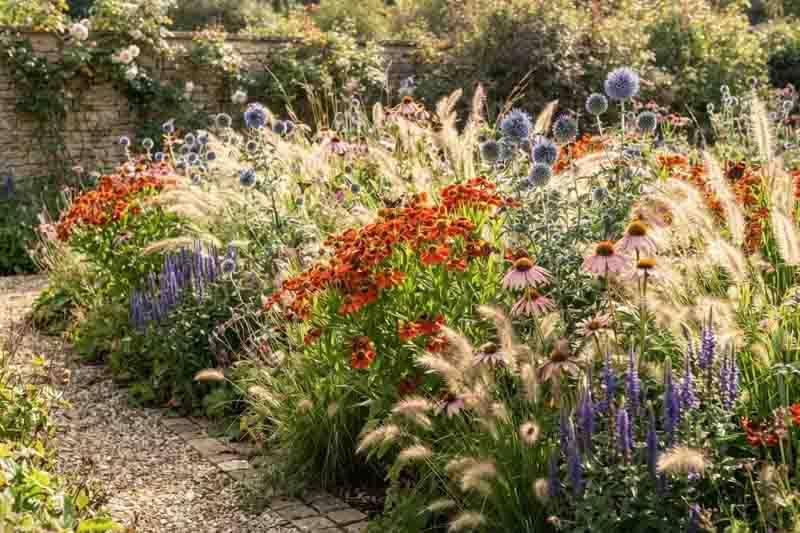


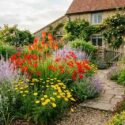
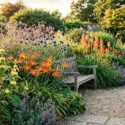
This broad sunny border comes into its own in late summer, when warm orange Helenium, steel-blue globe thistles, pale pink coneflowers, purple flower spikes, and soft grasses are all contributing at once. The plants fill a generous bed beside a gravel path, with an old stone wall and established shrubs forming a quiet background.
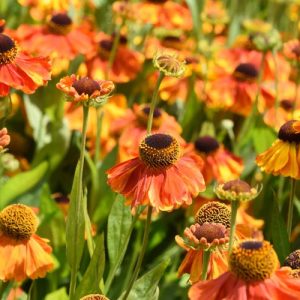
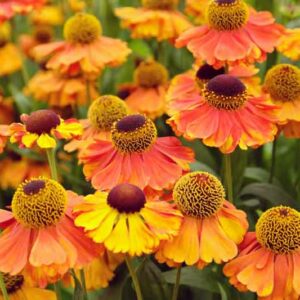
The planting is deliberately loose. Helenium appears in substantial groups rather than a single block, Echinops bannaticus rises through the border at different heights, and Echinacea pallida is scattered between the stronger orange and blue areas. Fountain grass threads through much of the bed, catching the light and softening the edges of the taller perennials.
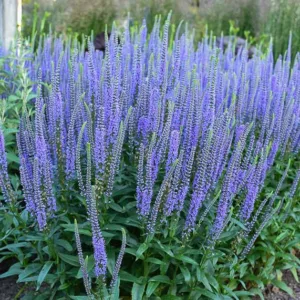
Main plants used: Helenium, Echinops bannaticus, Echinacea pallida, Cenchrus alopecuroides (syn. Pennisetum alopecuroides), and Veronica
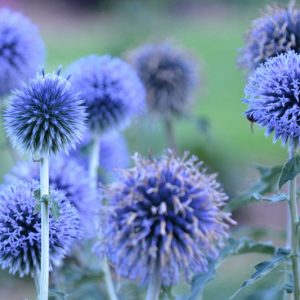
The strongest contrast is between warm and cool colors. Helenium supplies the orange and rusty-red tones, while Echinops brings blue-gray spherical flower heads. Pale pink Echinacea sits comfortably between the two, preventing the palette from becoming too sharply divided.
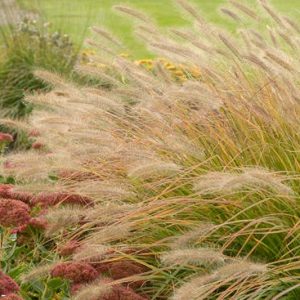
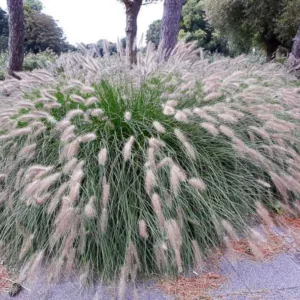
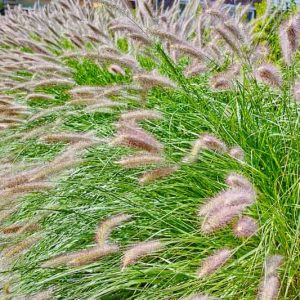
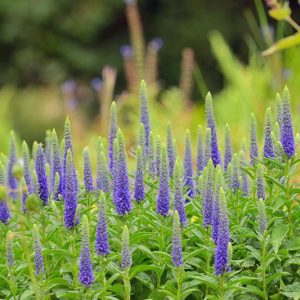
The flower shapes are equally varied. Helenium and Echinacea have open daisy-like blooms, Echinops forms almost perfectly round heads, and Veronica rises in narrow spikes. The fountain grass adds a completely different texture, with fine leaves and soft flower heads that move through the spaces between the perennials.
The image also shows the value of repetition without symmetry. Orange Helenium reappears farther down the border, Echinops is scattered through several areas, and the grasses form broad, irregular patches rather than a neat edging. That variation gives the planting depth when viewed along the path.
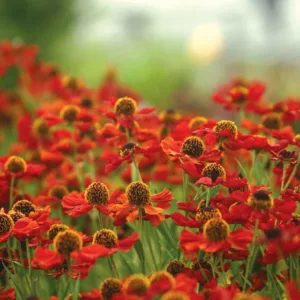
Helenium provides most of the warm color. It performs best in full sun with soil that does not become excessively dry during active growth. Use several substantial groups rather than scattered single plants, and deadhead if you want to prolong flowering.
Echinops bannaticus contributes both height and strong form. Its steel-blue flower heads remain distinct even when surrounded by softer plants. Once established, it is more tolerant of dry conditions than Helenium and prefers good drainage.
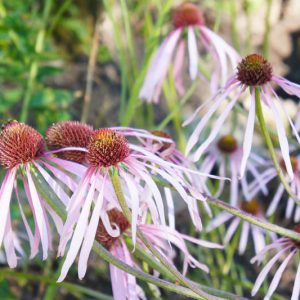
Echinacea pallida has narrow, strongly drooping petals that give the flowers a lighter appearance than many other coneflowers. It works well in smaller repeated groups through the middle of the border and generally prefers sunny, well-drained conditions.
Cenchrus alopecuroides adds broad areas of fine texture and becomes especially noticeable when its flower heads catch late-day light. Give mature clumps enough room to arch outward rather than squeezing them between upright perennials.
Veronica adds smaller areas of blue-purple vertical color near the front and middle. Repeating it in several groups helps connect the stronger Echinops blue with the rest of the border.

Create a full late-summer border with substantial warm-colored flower groups, repeated blue accents, pale coneflowers, and grasses woven throughout.
Use these proportions as a starting point rather than an exact formula. In a mature border, grasses and other supporting plants can occupy additional space between the featured groups.
Begin with several substantial groups of Helenium through the middle of the bed.
Add Echinops and Echinacea between and behind them, varying the size and position of each group.
Use fountain grass throughout rather than only at the edge, then repeat smaller groups of Veronica near the front and middle. Keep the path clear, but allow some grasses and flowers to lean naturally toward it.
The plants in this border do not have identical moisture needs. Helenium performs best where the soil retains some summer moisture, whereas Echinops and Echinacea pallida are better suited to freer-draining conditions. In a broad bed, small differences in soil moisture can help accommodate the entire combination.
Also give the grasses enough space. Their arching habit is part of what makes the garden successful, and crowding them too tightly between taller perennials will remove much of that effect.
| Hardiness |
5 - 8 |
|---|---|
| Heat Zones |
6 - 8 |
| Climate Zones | 2B, 3, 3A, 3B, 4, 5, 6, 7, 8, 9, 14, 15, 16, 17, 18, 19, 20, 21 |
| Exposure | Full Sun |
| Season of Interest | Summer (Early, Mid, Late), Fall |
| Maintenance | Low |
| Water Needs | Low, Average |
| Soil Type | Chalk, Loam, Sand |
| Soil pH | Acid, Neutral, Alkaline |
| Soil Drainage | Moist but Well-Drained, Well-Drained |
| Characteristics | Cut Flowers, Showy |
| Tolerances | Deer |
| Attracts | Bees, Butterflies, Birds |
| Landscaping Ideas | Beds And Borders |
| Garden Styles | Butterfly Garden, Informal and Cottage, Pollinator Garden |

| Hardiness |
5 - 8 |
|---|---|
| Heat Zones |
6 - 8 |
| Climate Zones | 2B, 3, 3A, 3B, 4, 5, 6, 7, 8, 9, 14, 15, 16, 17, 18, 19, 20, 21 |
| Exposure | Full Sun |
| Season of Interest | Summer (Early, Mid, Late), Fall |
| Maintenance | Low |
| Water Needs | Low, Average |
| Soil Type | Chalk, Loam, Sand |
| Soil pH | Acid, Neutral, Alkaline |
| Soil Drainage | Moist but Well-Drained, Well-Drained |
| Characteristics | Cut Flowers, Showy |
| Tolerances | Deer |
| Attracts | Bees, Butterflies, Birds |
| Landscaping Ideas | Beds And Borders |
| Garden Styles | Butterfly Garden, Informal and Cottage, Pollinator Garden |
Recreate this garden. Specify the percentages you would like to have of each plant and input the dimensions of your garden space.We'll give you a shopping list so you know how many plants you need.
| Plant | Quantity | |
|---|---|---|
| Echinacea pallida (Pale Purple Coneflower) | N/A | Buy Plants |
| Helenium 'Rubinzwerg' (Sneezeweed) | N/A | Buy Plants |
| Echinops bannaticus 'Blue Glow' (Globe Thistle) | N/A | Buy Plants |
| Pennisetum alopecuroides (Fountain Grass) | N/A | Buy Plants |
| Veronica spicata 'Royal Candles' (Spike Speedwell) | N/A | Buy Plants |
Create a membership account to save your garden designs and to view them on any device.
Becoming a contributing member of Gardenia is easy and can be done in just a few minutes. If you provide us with your name, email address and the payment of a modest $25 annual membership fee, you will become a full member, enabling you to design and save up to 25 of your garden design ideas.
Join now and start creating your dream garden!