Which butterfly bush is best for your garden? Compare 15 standout Buddleja varieties by size, flower color, hardiness, bloom season, fertility, container use, and pruning. Learn which compact and low-fertility selections make the smartest choices, when butterfly bush can be invasive, and how to pair it with true host plants.
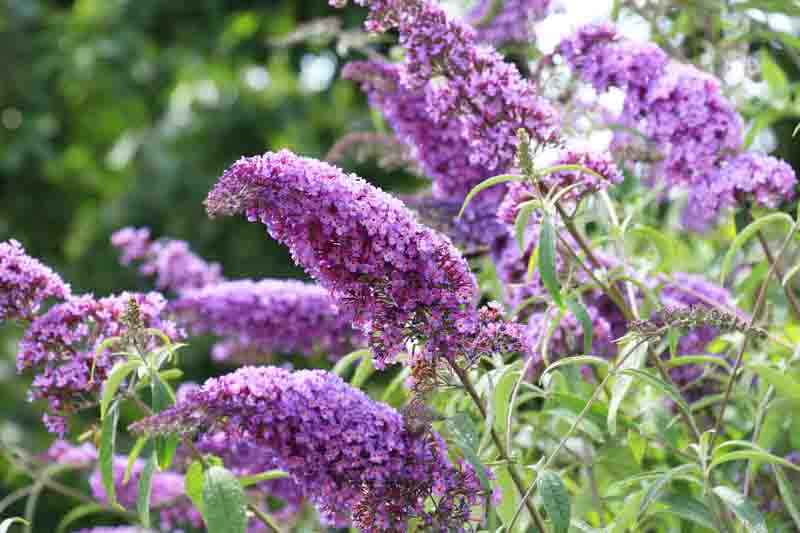


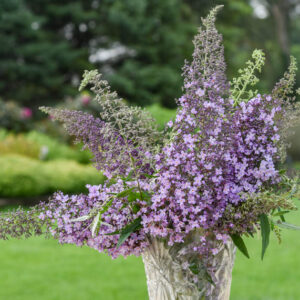
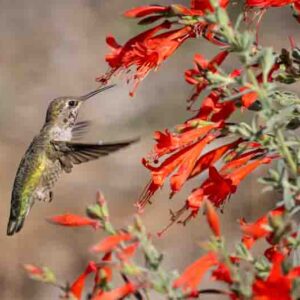
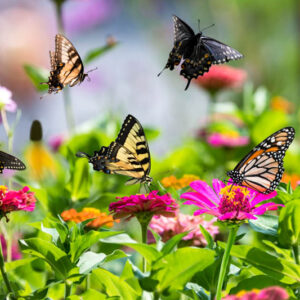
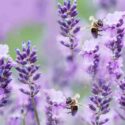
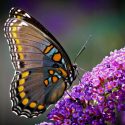
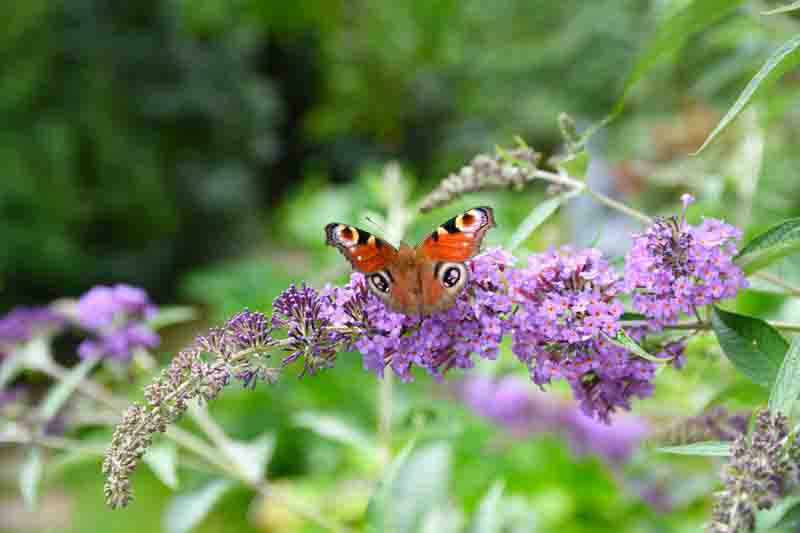
Butterfly Bush earns its common name. When a mature Buddleja is covered in fragrant summer flower panicles, butterflies can arrive in remarkable numbers, joined by bees and hummingbirds taking advantage of the nectar.
But choosing the best Butterfly Bush is more complicated than choosing purple, pink, or white flowers. Mature size ranges from tiny shrubs suitable for containers to vigorous plants that need several feet of space. Some cultivars belong to Buddleja davidii, a species that can spread aggressively and is regulated in parts of the United States. Others have been bred for greatly reduced fertility or belong to hybrid groups with different regulatory status.
There is also an ecological distinction worth understanding: Butterfly Bush is primarily a nectar plant for adult butterflies, not a substitute for the host plants their caterpillars require.
Gardenia’s approach: do not choose Butterfly Bush by flower color alone. Check whether it is appropriate in your region, compare mature size and fertility, consider flowering performance and garden use, then pair it with host plants that support the butterfly life cycle.
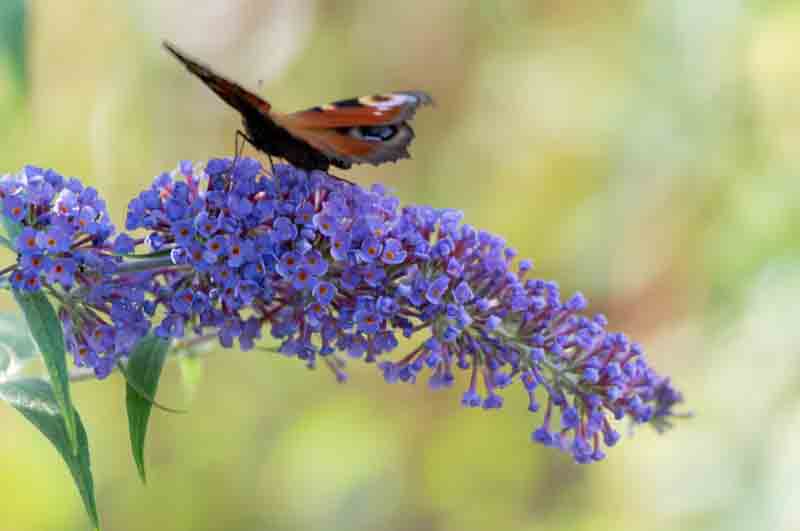
Yes – but mainly because it feeds adult butterflies.
The long, nectar-rich flower clusters of Buddleja can be highly attractive to butterflies, especially from midsummer into fall when many spring-flowering shrubs have finished. Many cultivars also attract bees and hummingbirds, making Butterfly Bush one of the most conspicuous warm-season wildlife shrubs.
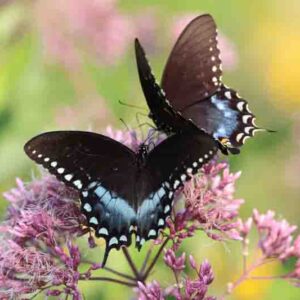
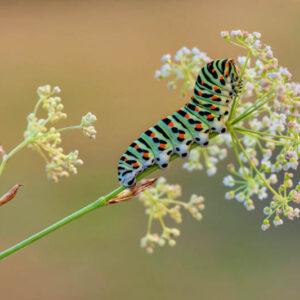
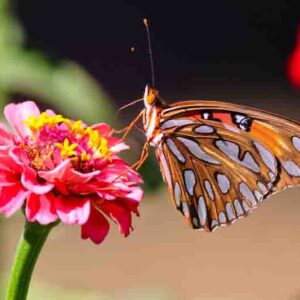
What it usually does not provide is the specialized foliage needed by butterfly caterpillars. A Monarch needs milkweed. A Spicebush Swallowtail uses spicebush or sassafras. A Gulf Fritillary uses passionflowers.
That changes how Butterfly Bush should be used. Think of Buddleja as part of the adult feeding layer of a butterfly garden. If you want the planting to support reproduction as well as visiting adults, add caterpillar host plants nearby.
Nectar plant and host plant are not the same job. Butterfly Bush can feed adult butterflies. Host plants feed caterpillars. A stronger butterfly garden provides both.
This belongs near the beginning of the buying decision, not buried in the care instructions.
Buddleja davidii is native to Asia and has escaped cultivation in parts of North America. It can establish along roadsides, riverbanks, disturbed ground, and other open sites. Its invasive status and legal treatment vary considerably by region.
In Oregon, most Buddleja davidii cultivars cannot be propagated, transported, or sold unless they are on the state’s approved sterile-cultivar list. Washington also regulates Buddleja davidii but exempts accepted sterile cultivars that meet its standards.
Modern breeding has produced some substantially less fertile selections. Lo & Behold ‘Blue Chip’, for example, has very low fertility and produces little random seeding. It is among the cultivars approved in Oregon.
That does not mean every compact Butterfly Bush is sterile, nor does a hybrid name automatically guarantee that a cultivar has been tested to the same standard.
Dwarf does not mean sterile. Mature size and seed production are different traits. Where invasiveness is a concern, verify the exact cultivar rather than relying on words such as “compact,” “dwarf,” or “hybrid.”
Gardeners in regulated areas should check current state and local guidance before planting. Where fertile Butterfly Bush is considered invasive, an approved sterile cultivar – or a suitable alternative – may be the better choice.
The cultivars below highlight useful differences in size, habit, color, and garden use. They are not universal planting recommendations. In regions where Buddleja davidii is invasive or regulated, prioritize cultivars permitted by local authorities or consider appropriate alternatives.
| Variety | Approx. Size | Flower Color | Best Fit | Fertility / Regional Note |
|---|---|---|---|---|
| Lo & Behold ‘Blue Chip’ | 1-2 ft. | Blue-purple | Containers, edging, small gardens | Very low fertility; approved sterile cultivar in Oregon |
| Buzz Magenta | 3-5 ft. | Magenta | Containers, small borders | Buzz breeding program targeted sterility; verify current regional approval |
| Buzz Ivory | 3-5 ft. | Ivory white | Containers, light-colored borders | Buzz breeding program targeted sterility; verify current regional approval |
| Buzz Midnight | 3-5 ft. | Deep purplish blue | Compact borders, containers | Buzz breeding program targeted sterility; verify current regional approval |
| Humdinger Magenta Munchkin | About 2-3 ft. | Rich magenta | Low borders, smaller gardens | Check current local status before planting |
| ‘Dark Dynasty’ | About 3 ft. | Royal purple | Compact dark-flowered borders | B. davidii cultivar; check regional restrictions |
| ‘Prince Charming’ | 3-4 ft. | Cerise pink | Compact colorful borders | B. davidii cultivar; check regional restrictions |
| ‘Queen of Hearts’ | Compact-medium | Rich pink-red | Mixed borders, pollinator gardens | B. davidii cultivar; check regional restrictions |
| ‘Princess Pink’ | Compact-medium | Pink | Smaller mixed borders | B. davidii cultivar; check regional restrictions |
| ‘Blue Knight’ | Medium | Deep blue-purple | Color-focused mixed borders | B. davidii cultivar; check regional restrictions |
| ‘Black Knight’ | Large, vigorous | Very dark purple | Large borders, dramatic color | Traditional B. davidii; avoid where invasive or regulated |
| ‘Pink Delight’ | Medium-large | Bright pink | Large flower spikes, shrub borders | Traditional B. davidii; check invasive status |
| ‘Grand Cascade’ | 5-6 ft. tall, 7-8 ft. wide | Lavender | Large borders, cascading flowers | B. davidii cultivar; check regional restrictions |
| ‘Honeycomb’ | 5-7 ft. | Creamy yellow | Unusual color, larger borders | B. x weyeriana hybrid; confirm current local guidance |
| ‘Bicolor’ / ‘Flower Power’ | About 6-8 ft. | Lavender-purple + orange | Specimen shrub, unusual color | Interspecific hybrid; confirm current local guidance |
Best choice is regional, not universal. In areas where Buddleja davidii is invasive or regulated, a legally approved sterile cultivar may be a more responsible choice than a classic seed-producing variety. Elsewhere, mature size, flowering performance, climate, and garden fit may carry more weight.
If space is tight, there is little reason to wrestle with an 8-foot shrub. Compact Butterfly Bushes can provide months of flowers at a scale that works beside a patio, along a path, at the front of a border, or in a large container.
Lo & Behold ‘Blue Chip’ is the smallest of the featured selections, generally reaching only about 1-2 feet high and wide. Its low, spreading habit makes it especially useful where even a 4-foot shrub would be too large. Its very low fertility is another important distinction.
Buzz Magenta gives you a more substantial shrub, generally around 3-5 feet, with vivid magenta flowers and a compact habit compared with traditional Butterfly Bushes. It can work in a generous container or a small sunny border where you want more visual presence than ‘Blue Chip’ provides.
Humdinger Magenta Munchkin fits between those two extremes. At roughly 2-3 feet tall, it creates a fuller flowering mound without taking over a modest garden bed.
Other compact cultivars worth comparing include Buzz Ivory, Buzz Midnight, and ‘Dark Dynasty’. Their presence in the comparison table makes it easy to choose by color and eventual size without turning this section into another long list.
Measure mature spread, not the nursery pot. Even a “compact” Butterfly Bush can become several feet wide. Choose a cultivar that naturally fits the available space instead of planning to keep an oversized shrub permanently restrained by pruning.
| Hardiness |
5 - 9 |
|---|---|
| Heat Zones |
1 - 9 |
| Plant Type | Shrubs |
| Plant Family | Scrophulariaceae |
| Genus | Buddleia |
| Exposure | Full Sun |
| Season of Interest | Summer (Mid, Late), Fall |
| Attracts | Butterflies, Hummingbirds |
Butterflies are coming for nectar, not to coordinate your color scheme. Gardeners, fortunately, get to care about both.
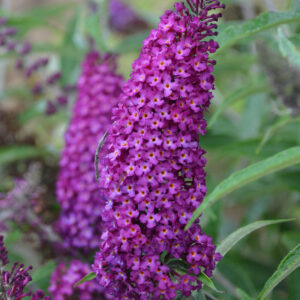
For the darkest flowers, ‘Black Knight’ remains the classic. Its deep purple blooms can appear almost black, especially from a distance, and give it far more visual drama than the softer lavender cultivars.
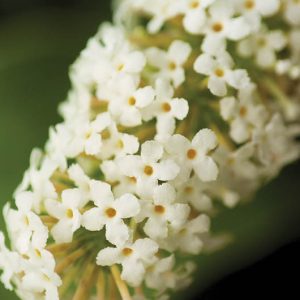
For a completely different effect, Buzz Ivory produces creamy ivory-white flowers that work particularly well in white gardens, pastel combinations, and borders where a dark purple Buddleja would feel too heavy.
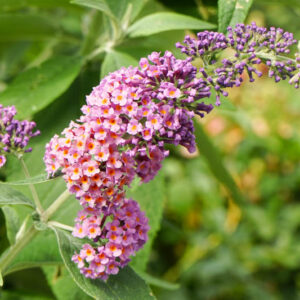
The most unusual color combination belongs to ‘Bicolor’ / ‘Flower Power’. Its flower clusters open in lavender-purple shades and develop warm orange tones, creating the distinctive two-tone effect that gives the cultivar its appeal.
The broader palette is much larger. ‘Blue Knight’ and Buzz Midnight extend the blue-purple range. ‘Pink Delight’, ‘Prince Charming’, ‘Queen of Hearts’, ‘Princess Pink’, and Magenta Munchkin cover pink through rich magenta. ‘Honeycomb’ supplies the rare creamy-yellow option.
Choose color after fit. A gorgeous purple or pink cultivar is still the wrong plant if it is too large for the site or inappropriate in your region. First settle size and fertility, then enjoy choosing the color.
If oversized flower panicles are your priority, three Butterfly Bushes stand out: ‘Lilac Cascade’, ‘Grand Cascade’, and ‘Pink Delight’. These are not dwarf patio plants. Their appeal comes from allowing long, arching flower clusters to develop without constantly cutting the shrubs back to fit a confined space.
‘Lilac Cascade’ produces some of the longest flower panicles in the group. Its pale lilac clusters can reach up to about 18 inches long, arching gracefully from a shrub roughly 5-6 feet tall and around 6 feet wide. It flowers from late summer toward frost, creating an impressive late-season display.
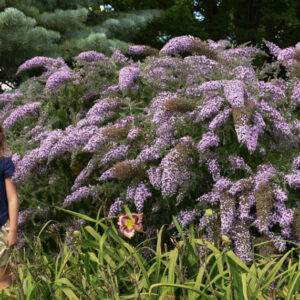
‘Grand Cascade’ has a broader, strongly cascading habit. Its fragrant lavender panicles can reach about 12-14 inches long and are unusually substantial, while the shrub itself can spread 7-8 feet wide. It works best as a large border or specimen plant where its arching stems can be appreciated rather than squeezed into a narrow space.
‘Pink Delight’ is the standout if you want huge flower spikes in bright pink. Its sweetly scented panicles can reach about 15 inches long and appear from midsummer into early fall, sometimes continuing until frost. Mature plants generally reach about 5-7 feet tall and wide.
Choose by form as well as flower length: ‘Lilac Cascade’ offers exceptionally long pale-lilac panicles, ‘Grand Cascade’ combines length with thick cascading clusters, while ‘Pink Delight’ delivers its drama in clear bright pink.
Gardenia’s Butterfly Bush Selection Method evaluates a cultivar in five steps: regional legality and invasive status, mature size, fertility, flowering performance, and whether it is paired with host plants that support butterfly caterpillars.
1. Check regional status first.
Before comparing flower colors, determine whether Buddleja davidii is invasive, restricted, or regulated where you garden.
2. Match mature size to the space.
A 1-2-foot ‘Blue Chip’ and a broad 7-foot Butterfly Bush solve completely different design problems.
3. Verify fertility.
Where self-seeding is a concern, look for documented low fertility or officially approved sterile cultivars rather than assuming a dwarf plant is safer.
4. Compare flowering performance.
Consider bloom period, color, panicle size, habit, and whether the cultivar suits a container, small border, or large landscape.
5. Add caterpillar host plants.
Use Buddleja for adult nectar, then complete the butterfly habitat with host plants appropriate to the butterfly species living in your region.
This order matters. Two Butterfly Bushes with similar purple flowers can differ dramatically in eventual size, fertility, legal status, and garden use.
Gardenia’s shortcut: region first, fertility second, size third, flowers fourth. Then ask what host plants will complete the butterfly habitat.
Butterfly Bush is generally easy to grow, but the best flowering comes from getting a few basics right: sun, drainage, sensible watering, restrained feeding, and timely pruning.
Important: deadheading can reduce seed production on fertile plants, but it is not a substitute for choosing an appropriate cultivar where Butterfly Bush is invasive or regulated.
A Butterfly Bush covered with feeding adults can look like perfect butterfly habitat. It is only one piece of it.
Pair Buddleja with caterpillar hosts for butterflies that occur locally. Milkweeds support Monarch caterpillars. Spicebush supports Spicebush Swallowtails. Pawpaw supports Zebra Swallowtails, while Purple Passionflower is an important Gulf Fritillary host.
Then extend nectar beyond the Butterfly Bush itself. Coneflowers, asters, goldenrods, blazing stars, bee balm, phlox, and other flowering plants can provide overlapping food before, during, and after peak Buddleja bloom.
Gardenia’s Butterfly Host Plants Guide connects butterflies with the plants their caterpillars need, while How to Create a Butterfly Garden brings nectar plants, host plants, shelter, and garden structure together.
Butterfly Bush brings butterflies to the table. Host plants give them somewhere to raise the next generation.
A useful Butterfly Bush comparison should not end with “pick your favorite color.” The right choice depends on whether the plant belongs in your region, whether its fertility is acceptable, whether its mature dimensions suit the space, and whether the surrounding planting supplies the other resources butterflies need.
Explore Gardenia’s Buddleja collection to compare Butterfly Bush species and cultivars in greater detail, including size, hardiness, flowering season, garden use, and individual plant characteristics.
Use the Gardenia Plant Finder to narrow plants by hardiness, sunlight, soil, drainage, moisture, mature size, tolerances, wildlife value, and other garden conditions.
Then take the plants you are considering into the Gardenia Garden Design Tool to compare bloom timing and seasonal interest, check plant compatibility, estimate quantities, and combine Butterfly Bush with host plants and companion flowers that can make the planting work as a whole.
A Butterfly Bush list tells you what cultivars exist. Gardenia helps you decide which one fits your garden – and what should grow with it.
Choose by region first, fertility second, mature size third, then flower color. That order avoids many of the mistakes hidden by a simple “best varieties” list.
There is no single best cultivar for every garden. First choose a Butterfly Bush that is appropriate and legal in your region, then compare fertility, mature size, bloom and garden use. Lo & Behold ‘Blue Chip’ is a compact, very low-fertility cultivar that attracts butterflies and is approved for sale in Oregon.
Buddleja davidii can be invasive and is regulated in some regions. Oregon restricts most Buddleja davidii but permits approved sterile cultivars, while Washington exempts accepted sterile cultivars from its quarantine. Always check current local guidance before planting.
Butterfly Bush is primarily a nectar source for adult butterflies rather than an important caterpillar host plant. Pair it with regional host plants such as milkweed, spicebush, pawpaw, violets, or passionflowers to support more of the butterfly life cycle.
Lo & Behold ‘Blue Chip’ is one of the smallest widely grown Butterfly Bushes, generally reaching about 1 to 2 feet tall and wide. Buzz cultivars, Magenta Munchkin and other compact selections provide additional choices for small gardens.
Yes. Compact cultivars such as ‘Blue Chip’ and Buzz Magenta can grow in large containers if they receive full sun, good drainage and enough root space. Choose a cultivar by its mature size rather than its size in the nursery pot.
‘Lilac Cascade’ can produce pale lilac flower panicles up to about 18 inches long. ‘Pink Delight’ can reach about 15 inches, while ‘Grand Cascade’ produces broad cascading lavender panicles about 12 to 14 inches long.
Most Buddleja davidii cultivars flower on new growth and are commonly pruned in early to mid-spring. This encourages vigorous flowering shoots while avoiding the frost damage that can follow severe winter pruning in cold climates.
Combine Butterfly Bush with caterpillar host plants and other nectar plants. Milkweed supports Monarchs, spicebush supports Spicebush Swallowtails, pawpaw supports Zebra Swallowtails and passionflowers support Gulf Fritillaries.
| Hardiness |
5 - 9 |
|---|---|
| Heat Zones |
1 - 9 |
| Plant Type | Shrubs |
| Plant Family | Scrophulariaceae |
| Genus | Buddleia |
| Exposure | Full Sun |
| Season of Interest | Summer (Mid, Late), Fall |
| Attracts | Butterflies, Hummingbirds |
Create a membership account to save your garden designs and to view them on any device.
Becoming a contributing member of Gardenia is easy and can be done in just a few minutes. If you provide us with your name, email address and the payment of a modest $25 annual membership fee, you will become a full member, enabling you to design and save up to 25 of your garden design ideas.
Join now and start creating your dream garden!