Small evergreen shrubs bring lasting structure, rich foliage, flowers, and winter color to gardens of every size. Discover 35 beautiful choices for sunny borders, shady corners, foundation plantings, and containers. Learn which varieties stay compact, what conditions they need, and how to create attractive, low-maintenance combinations throughout the seasons.


A beautiful garden shouldn’t disappear when the flowers fade. In winter, when perennials have retreated underground and deciduous shrubs stand bare, a few well-chosen evergreens can make all the difference. A rounded green shrub beside the front steps, a golden conifer catching the low afternoon sun, or a compact flowering evergreen near the patio gives the garden shape and character in every season.
The best small evergreen shrubs offer much more than winter greenery. They can provide colorful foliage, fragrant flowers, year-round privacy, low hedges, and permanent structure in places where larger shrubs would overwhelm the space.
But choosing wisely matters. A plant labeled “dwarf” may eventually become surprisingly large. A shrub described as evergreen may lose foliage during severe winters. And a beautiful compact conifer may struggle in the wrong soil or climate.
Explore these 35 evergreen shrub selections, discover their strengths and limitations, and learn how to choose plants that will remain attractive, healthy, and appropriately sized for your garden.
Quick answer: For low evergreen borders, consider compact boxwoods or Japanese hollies. For golden foliage, look at dwarf conifers or small anise ‘Florida Sunshine’. For fragrance, WHITE DAZZLER Mexican orange and compact Pittosporum are appealing in mild climates. For narrow vertical accents, consider an upright juniper. The best choice depends on mature size, hardiness, sunlight, and drainage.
Not every evergreen belongs in every garden. A shrub that thrives in a cool woodland border may struggle against a sun-baked wall, while a conifer that looks beautifully compact in a nursery pot may eventually crowd a narrow path.
Gardenia’s small evergreen shrub selection guide compares different landscape needs with actual plants featured in Gardenia’s collection and highlights the trade-offs worth considering before you buy.
| Your garden goal | Featured shrub to consider | What to know before planting |
|---|---|---|
| Fragrant flowers near a patio | Choisya x dewitteana WHITE DAZZLER | Compact and fragrant, but best suited to sufficiently mild climates with good drainage |
| Bright foliage in a sheltered shady border | Illicium parviflorum ‘Florida Sunshine’ | Golden foliage creates contrast; needs suitable moisture and regional conditions |
| A narrow upright accent | Juniperus chinensis ‘Stricta’ | Naturally upright, but narrow does not mean permanently short; needs sun and drainage |
| A rounded, glossy-leaved foundation shrub | Pittosporum tobira ‘Nanum’ | Naturally mounded and useful for mild-climate gardens; not suitable for severe cold |
| Golden foliage with a vertical silhouette | Taxus baccata ‘Standishii’ | Slow-growing and columnar; yews are highly toxic if ingested |
| A low formal hedge | Compact boxwood or Japanese holly cultivars | Compare disease resistance, mature spread, and soil suitability |
| A sunny, low-water planting | Compact junipers or suitable dwarf pines | Choose for regional heat tolerance; drainage is essential |
These are starting points, not interchangeable recommendations. WHITE DAZZLER and ‘Nanum’ may be appealing in a mild coastal garden, while a hardy dwarf conifer can be a much better choice where winters are severe. The sun, moisture, and temperature requirements of the exact cultivar always take priority.
The key question isn’t simply “Which shrub is smallest?” It is “Which shrub will naturally fit this particular space in ten or twenty years without constant correction?” That distinction saves money, maintenance, and disappointment.
From glossy broadleaf evergreens and fragrant flowering shrubs to compact conifers with gold, silver-blue, or deep green foliage, these selections illustrate just how much variety a small evergreen planting can offer.
Explore the plant cards below to compare hardiness, sunlight, seasons of interest, mature height, and spread. Save your favorites to your Gardenia collection, and pay particular attention to plants whose natural growth habit suits the space you have available.
A note about size: This collection includes naturally compact shrubs, dwarf cultivars, low-growing evergreen subshrubs, and a few narrow upright selections. Some may eventually exceed 5 feet in height or spread. Always check the mature dimensions on each plant card before choosing a shrub for a confined space.
| Plant Type | Shrubs |
|---|---|
| Genus | Abies, Buxus, Chamaecyparis, Ilex, Lavandula, Loropetalum, Picea, Pieris, Pinus, Rhododendron, Taxus, Thuja |
| Characteristics | Evergreen |











There is no single official size limit for a small evergreen shrub. For a typical residential garden, plants that remain around 3-5 feet tall, or that spread low without obstructing views, are often the most useful. However, a narrow columnar shrub and a low, wide groundcover can occupy very different kinds of space.
Two measurements matter: eventual height and mature width. A shrub planted beside a front door must leave room for people to pass, while one beneath a window needs to remain low enough to preserve light and views.
In horticulture, “dwarf” generally describes a plant that grows more slowly or remains smaller than the typical form of its species. It doesn’t mean growth stops after a few years. Some dwarf conifers continue increasing in size for decades.
A nursery may provide a ten-year measurement rather than an ultimate mature size. That’s useful for planning the early years, but not enough to guarantee the shrub will remain within a narrow planting bed.
Likewise, compact refers to a relatively restrained growth habit, while slow-growing describes how quickly a plant increases in size. Neither term guarantees permanent miniature proportions.
Gardenia’s size check: Before choosing a shrub, identify its natural form, mature spread, and whether the nursery’s stated dimensions refer to ten-year growth or full maturity. A naturally compact shrub is usually a better long-term choice than a vigorous one kept small through repeated pruning.
Broadleaf evergreens such as boxwood, holly, Choisya, and Pittosporum provide solid masses of foliage that can soften walls, define a path, or create a formal hedge. Some also offer scented flowers or ornamental fruit.
Dwarf conifers, including junipers, false cypresses, pines, and spruces, bring finer textures and a wider variety of silhouettes. Their needles or scale-like leaves can contrast beautifully with broadleaf foliage and perennial flowers.
Neither group is automatically hardier or easier to maintain. A cold-hardy dwarf spruce may struggle with hot reflected sunlight, while a compact Pittosporum may thrive in a mild coastal garden but suffer serious winter damage elsewhere.
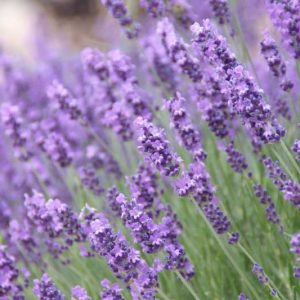
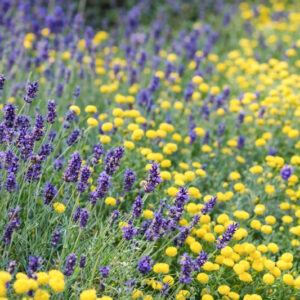
A sunny border offers plenty of opportunities for compact junipers, dwarf pines, selected false cypresses, and evergreen subshrubs such as English lavender. Their contrasting forms can create an attractive planting even when nearby perennials are dormant.
The catch is that full sun doesn’t mean the same thing everywhere. A dwarf spruce that grows beautifully in a cool northern garden may struggle with heat reflected from pavement in the Southwest. Likewise, lavender generally thrives in freely draining soil but may decline in persistently wet or humid conditions.
For dry, sunny sites, choose a species with documented drought and heat tolerance rather than assuming every conifer is suitable. Even drought-tolerant evergreens need consistent moisture while establishing.
Partial shade is ideal for many compact broadleaf evergreens, including suitable Pieris, evergreen azaleas, certain hollies, and Sarcococca. Their foliage provides a permanent background for spring bulbs, ferns, and shade-loving perennials.
Soil chemistry is especially important. Pieris and many azaleas prefer acidic soil and can develop chlorosis when grown in unsuitable alkaline conditions. Dense shade or poor drainage may also reduce flowering and vigor.
Deep shade is difficult, especially beneath established trees. Low light may be only part of the problem: competing roots can leave the soil surprisingly dry, even after rain.
Sweet box (Sarcococca) is worth considering for sheltered shady borders, particularly where its small, fragrant winter flowers can be enjoyed near a pathway. Some yews also tolerate shade, provided the soil and local conditions suit them.
Golden small anise ‘Florida Sunshine’ is another striking foliage choice for appropriate sheltered, moist sites. Its bright leaves can lift a dark planting, but it is not a universal solution for dry shade or cold northern winters.
Worth remembering: Shade tolerance and drought tolerance are separate qualities. A shrub that flourishes in cool, moist shade may fail beneath the thirsty roots of a mature tree. Check both conditions before planting.
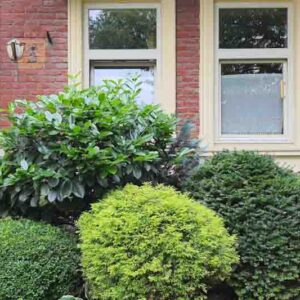
Foundation planting should soften a building without hiding its best features. A pair of naturally rounded shrubs can frame an entrance, while a restrained evergreen border gives windows and pathways a finished appearance throughout the year.
In mild climates, dwarf Japanese mock orange (Pittosporum tobira ‘Nanum’) creates a dense, glossy mound that can look elegant without constant clipping. Fragrant WHITE DAZZLER Mexican orange offers a softer effect with aromatic foliage and white flowers.
Don’t plant shrubs flush against the house. Leave space for air movement, maintenance, and their eventual spread. A foundation bed is usually easier to manage when the plants naturally fit rather than requiring repeated cutting beneath windows.
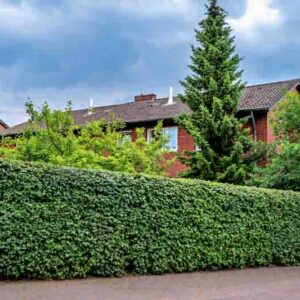
Low hedges work particularly well alongside paths, around terraces, and at the front of mixed borders. Compact boxwoods and Japanese hollies are familiar choices, although they differ in soil preferences, growth habits, and pest susceptibility.
Boxwood blight, boxwood leafminer, and other problems deserve consideration where these pests and diseases occur. Japanese holly is often suggested as an alternative, but it is not a direct replacement in every climate or soil, especially where conditions are alkaline or poorly drained.
For a relaxed garden, a line of naturally mounded evergreens can be just as effective as a clipped hedge. The individual shrubs retain their shape, and maintenance is often reduced.
Vertical evergreens are useful where planting width is limited. Chinese juniper ‘Stricta’ has a narrow, upright silhouette that adds height without the broad crown of a conventional shrub.
Golden English yew ‘Standishii’ offers a contrasting column of golden foliage in suitable climates. However, yews are highly poisonous if ingested, including their seeds and much of the plant, so they may be inappropriate for gardens where children, pets, or grazing animals could chew the foliage.
Remember that columnar doesn’t mean short. Position upright plants where their eventual height won’t crowd eaves, obscure windows, or dominate a small entrance.
Evergreens make excellent container plants because they look attractive even between seasonal displays. A miniature conifer can provide a permanent focal point, while flowers or ornamental grasses change around it.
Choose a container large enough for root development, with unobstructed drainage holes and a potting medium suited to the plant. Containers dry out faster in summer and expose roots to greater temperature extremes in winter.
A shrub hardy in the ground may need protection when grown in an exposed pot. Choose compact plants for their natural proportions, not simply because they can be clipped into shape.
The easiest evergreen to maintain is the one that suits its planting site. A compact juniper in freely draining soil may need almost no shaping, whereas the same shrub in wet clay can struggle despite regular attention.
Plant when the weather is moderate and the soil is workable, usually in spring or autumn, depending on climate. Avoid planting during periods of extreme heat, prolonged drought, or frozen ground.
Set the root flare or upper surface of the root ball at an appropriate level for the species and soil, water thoroughly, and mulch the surrounding soil without covering the stems. Maintain consistent moisture during establishment, then adjust irrigation to the plant’s actual needs.
Evergreen foliage continues losing moisture in winter whenever conditions allow. Cold winds, frozen soil, and bright sun can contribute to winter burn, particularly on exposed broadleaf evergreens and newly planted shrubs.
Many small evergreen shrubs look best with minimal pruning. Remove dead, damaged, or misplaced growth, and allow naturally rounded or spreading plants to keep their individual form.
Some broadleaf evergreens tolerate shaping or clipping, while many conifers respond poorly to cuts into old, bare wood. Yew is an important exception among conifers because it often resprouts from older wood, but even then pruning should suit the plant and the desired form.
Yellowing leaves can indicate several different problems, including unsuitable soil pH, excess moisture, drought, or nutrient imbalance. Brown tips may result from winter burn, heat stress, or root damage rather than disease.
Check the undersides of leaves and the interiors of dense shrubs for pests. Spider mites, scale insects, and other problems vary by species. Good airflow and the correct watering regime help reduce stress, but identification matters before choosing a treatment.
Evergreen doesn’t mean identical every month: Some shrubs bronze or darken in winter, while others shed older leaves during the growing season. Semi-evergreen plants may lose much of their foliage in colder regions. Choose for dependable performance in your climate, not the label alone.
One of the simplest ways to make a border look intentional is to give it a permanent framework. Small evergreens provide that structure, while bulbs, perennials, and ornamental grasses bring movement and seasonal change.
In a mild-climate garden, repeat compact mounds of dwarf Pittosporum along the foundation, then introduce a few upright accents and lower flowering companions. Allow the shapes to overlap visually without crowding the plants at maturity. The effect should feel welcoming rather than rigidly symmetrical.
Pair suitably compact blue-green junipers with drought-adapted perennials, ornamental grasses, and spring bulbs. The fine-textured conifer foliage provides a calm backdrop for changing flowers, while maintaining interest after the perennials fade.
In suitable mild and moist conditions, ‘Florida Sunshine’ small anise can provide a vivid golden accent among deep green shade-loving shrubs, ferns, and woodland perennials. Use its color sparingly rather than repeating it everywhere; one well-positioned golden shrub can brighten an entire corner.
Build the planting around a few evergreen anchors, then choose companions with contrasting seasonal peaks. Spring bulbs appear through the open spaces, flowering perennials carry summer, autumn foliage provides the final burst of color, and the evergreens hold the composition together in winter.
For more inspiration, explore Gardenia’s shrub plant combinations, where you can discover planting ideas built around foliage, flowers, and seasonal contrast.
Which evergreen shrub will actually fit your garden? A photograph can show beautiful foliage, but it cannot tell you whether a plant will outgrow your border, tolerate your soil, or remain evergreen through your winters.
Compare the individual plants featured above, then use Gardenia’s Plant Finder to narrow your options by hardiness, sunlight, soil, and other growing conditions. Save your favorites and use the Garden Design Tool to review how well they suit your garden, explore seasonal interest, and plan planting quantities.
That is where an attractive plant list becomes a practical garden plan. Instead of buying an evergreen because it looks small today, you can choose shrubs that make sense for the garden you want to enjoy for years.
Compact boxwoods, Japanese hollies, dwarf conifers, and suitably sized Pittosporum cultivars can provide attractive year-round structure. Match the exact cultivar to your climate, mature size, light, and drainage requirements.
Some compact boxwoods, Japanese hollies, dwarf junipers, and miniature conifer cultivars remain around three feet tall or less, but their spread can be much greater. Confirm whether listed dimensions represent ten-year size or ultimate maturity.
Depending on climate and soil conditions, suitable Sarcococca, compact Pieris, certain evergreen azaleas, yews, and hollies can grow in shade or partial shade. Adequate moisture and drainage are important, especially under established trees.
Naturally compact shrubs adapted to local conditions generally require the least corrective pruning. Suitable junipers, dwarf conifers, and some broadleaf evergreen cultivars can be low-maintenance when their mature size, sun exposure, soil, and moisture needs match the site.
Yes. Many miniature conifers, compact hollies, and other naturally small evergreens grow well in containers with suitable drainage. Container roots experience greater temperature extremes and drying, so choose an appropriate pot and provide winter protection where needed.
No. Some shrubs are evergreen in mild climates but semi-evergreen or damaged by winter cold farther north. Even reliable evergreens may bronze in winter or shed older foliage. Check the species and cultivar’s performance in your region.
A small evergreen shrub may never be the showiest plant in your garden, but it can be one of the most valuable. Choose the right shape, color, and growing habit, and it will quietly hold the landscape together as the seasons change around it.
Updated and reviewed by Gardenia: November 2026
| Plant Type | Shrubs |
|---|---|
| Genus | Abies, Buxus, Chamaecyparis, Ilex, Lavandula, Loropetalum, Picea, Pieris, Pinus, Rhododendron, Taxus, Thuja |
| Characteristics | Evergreen |
Create a membership account to save your garden designs and to view them on any device.
Becoming a contributing member of Gardenia is easy and can be done in just a few minutes. If you provide us with your name, email address and the payment of a modest $25 annual membership fee, you will become a full member, enabling you to design and save up to 25 of your garden design ideas.
Join now and start creating your dream garden!