Japanese Spikenard 'Sun King'

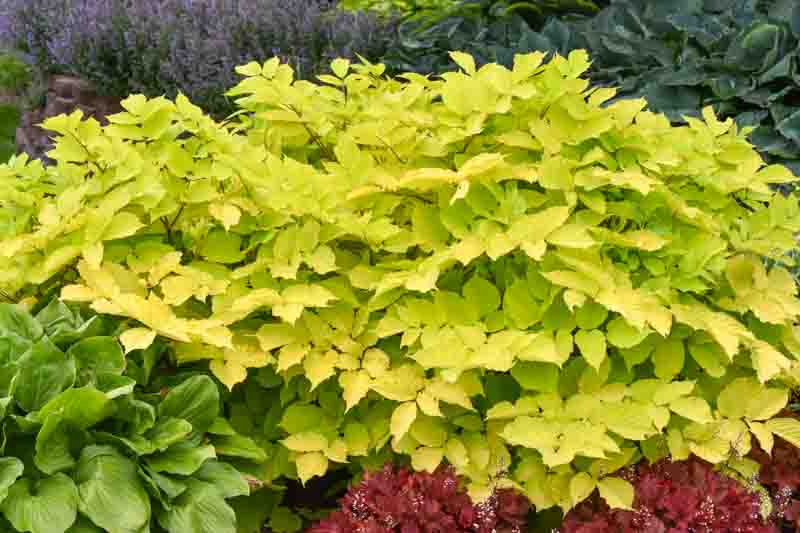
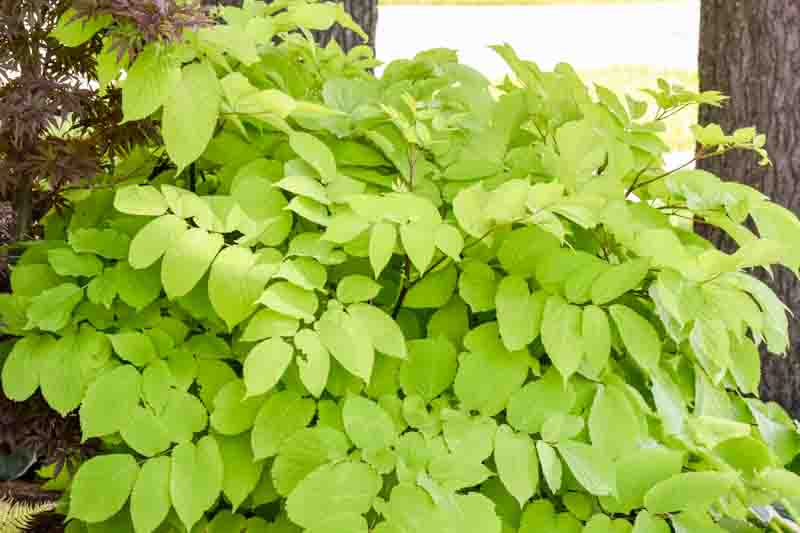
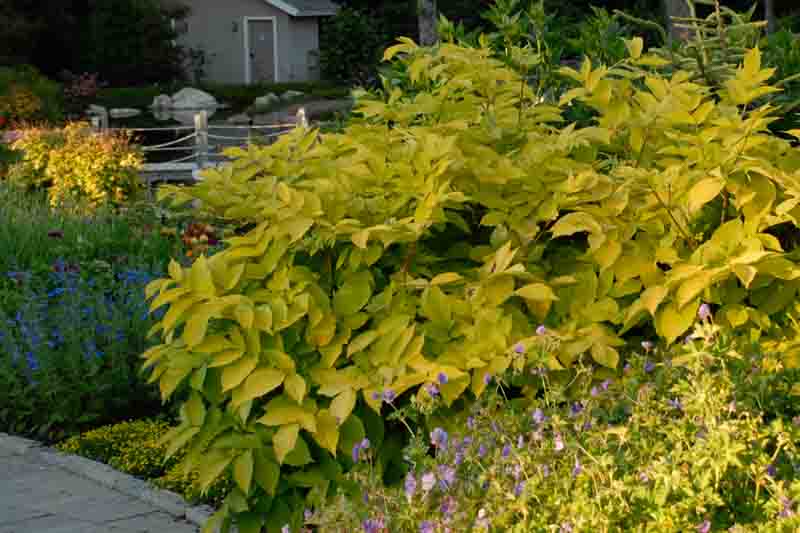
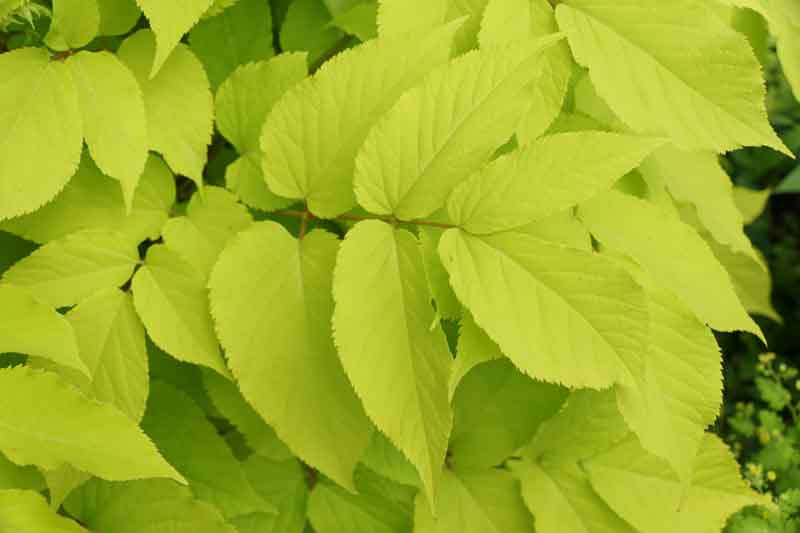


Aralia cordata ‘Sun King’ (Golden Japanese Spikenard) is a bold herbaceous perennial prized for its luminous golden foliage, impressive size, and tropical-looking texture. Emerging bright yellow in spring, its huge compound leaves bring light and structure to shaded borders where colorful foliage can be difficult to achieve.
Despite its almost shrub-like presence, ‘Sun King’ is not woody. It dies completely to the ground in winter and returns from the crown each spring. Once established, it grows vigorously, tolerates considerable shade, attracts bees when in bloom, and remains surprisingly well behaved for such a substantial plant.
Summary: Large, clump-forming herbaceous perennial grown for bold golden-yellow foliage.
Use: Excellent for shade borders, woodland gardens, understory plantings, and dramatic foliage combinations.
Highlight: Provides the visual weight of a small shrub but disappears completely in winter.
Award: Named 2020 Perennial Plant of the Year by the Perennial Plant Association.
| Botanical Name | Aralia cordata ‘Sun King’ |
|---|---|
| Family | Araliaceae |
| Common Name | Golden Japanese Spikenard, Sun King Aralia |
| Plant Type and Habit | Large, upright, clump-forming herbaceous perennial |
| Hardiness | USDA Zones 3-9 |
| Size | Usually 3-6 ft. tall and wide (90-180 cm), depending on climate and growing conditions |
| Exposure | Partial shade; tolerates more sun with reliable moisture |
| Soil | Fertile, humus-rich, moist but well-drained soil |
| Foliage | Large compound leaves, golden-yellow to chartreuse |
| Flowers | Tiny cream-white flowers in summer, followed by dark drupes |
Published dimensions vary considerably. Some references describe mature plants around 3-4 ft. tall and wide, while established specimens can approach 6 ft. Gardenia therefore recommends planning for roughly 5 ft. of eventual width rather than designing around the smallest published measurement. This reduces crowding without assuming every plant will reach its maximum recorded size.
‘Sun King’ is a golden-leaved selection of Japanese spikenard, Aralia cordata, a species native to eastern Asia. The cultivar was introduced to the United States by plantsman Barry Yinger after he encountered it in Japan. Its combination of brilliant foliage, impressive scale, shade tolerance, and reliable garden performance earned it the Perennial Plant Association’s 2020 Perennial Plant of the Year award.
This upright, rounded perennial develops substantial stems topped with enormous compound leaves. Mature plants commonly reach 3-6 ft. tall and nearly as wide. Although it can look like a small shrub by midsummer, frost kills the top growth completely, and new shoots emerge from ground level in spring.
The foliage is the main attraction. Bright golden shoots unfold into large divided leaves that give the plant a lush, almost tropical appearance. A few hours of gentle sun usually intensify the yellow coloring. In deeper shade, the leaves tend to become chartreuse or lime green rather than brilliant gold.
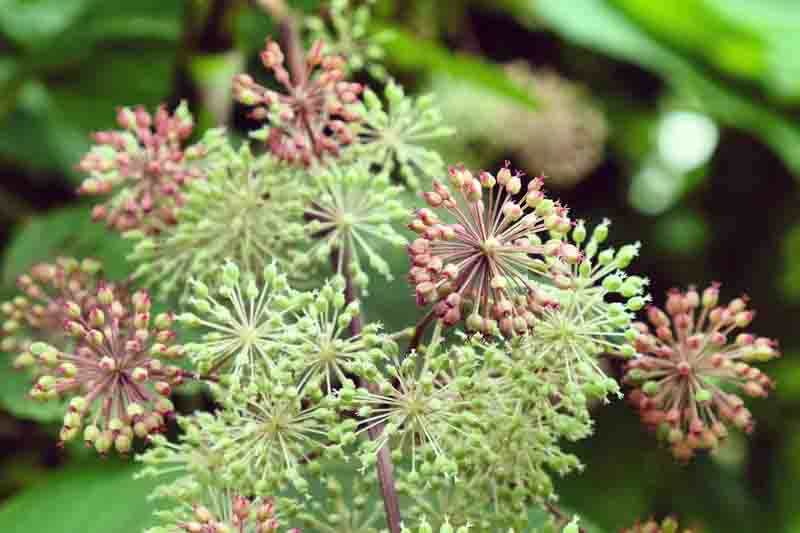
Small cream-white flowers appear in airy clusters in summer. They are modest beside the foliage but attract bees and other pollinating insects. Dark purple to nearly black drupes may follow later in the season.
‘Sun King’ is remarkably cold hardy for such an exotic-looking plant and is commonly grown in USDA Zones 3-9. Its main ornamental season extends from spring through fall, after which the foliage and stems die back for winter.
The summer flowers attract bees and other pollinating insects. Birds may also investigate the dark fruits. For greater wildlife value, combine ‘Sun King’ with flowering woodland plants that provide nectar and pollen across a longer season.
‘Sun King’ is considered deer resistant, and Japanese spikenard is also reported to resist rabbit browsing. No ornamental plant is completely browse-proof, however, particularly where animal pressure is severe.
This is not a true dry-shade perennial. Established plants can tolerate brief dry spells, but prolonged drought may cause wilting, scorched leaf edges, or reduced growth. Consistent moisture produces the largest and best-looking foliage.
The young shoots of the species Aralia cordata, known as udo in Japan, have a long history as a cultivated food and are traditionally blanched or pickled. However, ‘Sun King’ is normally grown as an ornamental, and its small dark fruits are considered inedible. Garden plants should not be harvested unless their identity and appropriate preparation are certain.
Despite its large size, ‘Sun King’ is notably well behaved. It is reported to produce little to no suckering or reseeding, so it generally remains a substantial clump rather than spreading aggressively through the garden.
The defining feature is its foliage color. The species normally bears green leaves, whereas ‘Sun King’ produces chartreuse to brilliant golden foliage that can illuminate shady planting schemes. Its value lies not only in color but also in scale: few shade perennials combine this degree of brightness with such large, architectural foliage.
‘Sun King’ can grow in considerable shade, but the deepest shade does not necessarily produce its best ornamental effect. Gardenia recommends bright shade, dappled light, or gentle morning sun where moisture is reliable – enough light to maintain the golden foliage, but protection from the combination of hot afternoon sun and dry soil.
Partial shade is ideal. Morning sun followed by afternoon shade works particularly well. More sun is possible where summers are moderate and the soil stays consistently moist; very deep shade usually produces greener foliage.
Grow ‘Sun King’ in fertile, humus-rich, moist but well-drained soil. It adapts to clay, loam, or sandy soils provided moisture and drainage are suitable. Water during prolonged dry weather and use organic mulch to conserve soil moisture without burying the crown.
Do not treat light and water as separate decisions with ‘Sun King’. More light can improve golden coloration, but it also increases moisture demand. If you move the plant into a sunnier position for brighter foliage, make sure the soil can remain evenly moist.
Plant in spring or fall and allow ample space for mature growth. Incorporate organic matter into poor soil, position the crown at its original depth, water thoroughly, and keep the root zone consistently moist while the plant establishes.
Maintenance is minimal. Remove dead stems after they collapse in fall or before new shoots emerge in spring. Established plants generally need little shaping, although vigorous growth may be lightly controlled where space is limited.
‘Sun King’ is propagated vegetatively to preserve its distinctive golden foliage. Stem or root cuttings are commonly used. Established clumps may also be divided where practical, although the large crown can make division cumbersome.
‘Sun King’ is notably trouble-free and has no major insect or disease problems when grown in suitable conditions. Persistently wet soil can encourage root problems, while prolonged drought may cause wilting or crispy leaf edges. Slugs or snails may occasionally damage tender spring growth.
Green foliage is usually not a disease or nutrient deficiency. Check the light level first. Plants in heavy shade naturally lose much of their golden coloring, although moving them into stronger light also increases their need for moisture.
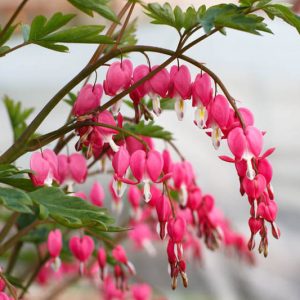
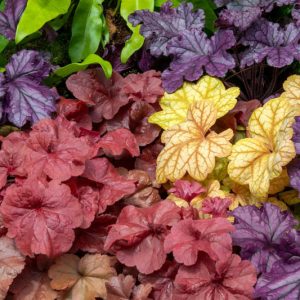
These companions share much of ‘Sun King’s’ preferred range of partial shade and moist but well-drained soil, and their hardiness ranges substantially overlap. Their contrasting foliage also helps the golden aralia stand out rather than disappear into a mass of similar colors.
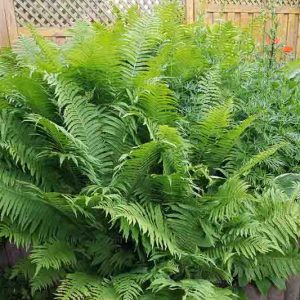
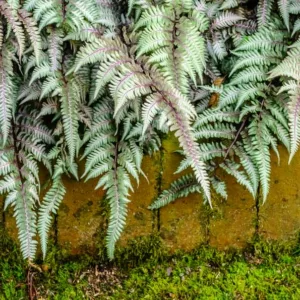
Because ‘Sun King’ can become almost shrub-sized, Gardenia recommends treating it as the upper foliage layer rather than simply another perennial. Place blue hostas, silver brunneras, ferns, or Japanese forest grass in front of it. The result is a clear progression of foliage scale and color, with ‘Sun King’ acting as the architectural anchor.
Finding attractive shade plants is easy. Finding plants that also match your hardiness zone, soil, moisture, mature space, and growing conditions takes more work.
Published dimensions range from roughly 3 to 6 feet tall and wide. Gardenia recommends allowing about 5 feet of working space for a mature plant rather than planning around the smallest published measurement.
Partial shade is ideal. Bright shade or a few hours of gentle morning sun usually produces the best golden color, while deep shade tends to turn the foliage greener.
No. ‘Sun King’ is considered well behaved and produces little to no suckering or reseeding, despite forming a large mature clump.
Yes. ‘Sun King’ is considered deer resistant, and Japanese spikenard is also reported to resist rabbit browsing, although no plant is completely browse-proof.
Yes. ‘Sun King’ is an herbaceous perennial. Its stems and foliage die to the ground after frost, and new golden shoots emerge from the crown in spring.
Perennial Plant Association – Aralia cordata ‘Sun King’, 2020 Perennial Plant of the Year
Royal Horticultural Society – Aralia cordata ‘Sun King’
Missouri Botanical Garden – Aralia cordata ‘Sun King’
Morton Arboretum – Japanese Spikenard
University of Illinois Extension – Aralia cordata ‘Sun King’
Updated: October 2026 • Reviewed by Gardenia Editors
| Hardiness |
3 - 9 |
|---|---|
| Plant Type | Perennials |
| Plant Family | Araliaceae |
| Exposure | Partial Sun |
| Season of Interest | Spring (Mid, Late), Summer (Early, Mid, Late) |
| Height | 3' - 6' (90cm - 180cm) |
| Spread | 3' - 6' (90cm - 180cm) |
| Spacing | 36" - 72" (90cm - 180cm) |
| Maintenance | Low |
| Water Needs | Average |
| Soil Type | Clay, Loam, Sand |
| Soil pH | Acid, Neutral, Alkaline |
| Soil Drainage | Moist but Well-Drained |
| Characteristics | Showy, Plant of Merit |
| Tolerances | Deer, Rabbit, Clay Soil |
| Attracts | Bees |
| Garden Uses | Beds And Borders |
| Garden Styles | Informal and Cottage, Woodland Garden |
| Toxic to Humans | No known toxicity |
| Toxic to Cats | No known toxicity |
| Toxic to Dogs | No known toxicity |
| Toxic to Horses | No known toxicity |


| Hardiness |
3 - 9 |
|---|---|
| Plant Type | Perennials |
| Plant Family | Araliaceae |
| Exposure | Partial Sun |
| Season of Interest | Spring (Mid, Late), Summer (Early, Mid, Late) |
| Height | 3' - 6' (90cm - 180cm) |
| Spread | 3' - 6' (90cm - 180cm) |
| Spacing | 36" - 72" (90cm - 180cm) |
| Maintenance | Low |
| Water Needs | Average |
| Soil Type | Clay, Loam, Sand |
| Soil pH | Acid, Neutral, Alkaline |
| Soil Drainage | Moist but Well-Drained |
| Characteristics | Showy, Plant of Merit |
| Tolerances | Deer, Rabbit, Clay Soil |
| Attracts | Bees |
| Garden Uses | Beds And Borders |
| Garden Styles | Informal and Cottage, Woodland Garden |
| Toxic to Humans | No known toxicity |
| Toxic to Cats | No known toxicity |
| Toxic to Dogs | No known toxicity |
| Toxic to Horses | No known toxicity |
How many Aralia cordata ‘Sun King’ (Japanese Spikenard) do I need for my garden?
| Plant | Quantity | |
|---|---|---|
| Aralia cordata ‘Sun King’ (Japanese Spikenard) | N/A | Buy Plants |
Create a membership account to save your garden designs and to view them on any device.
Becoming a contributing member of Gardenia is easy and can be done in just a few minutes. If you provide us with your name, email address and the payment of a modest $25 annual membership fee, you will become a full member, enabling you to design and save up to 25 of your garden design ideas.
Join now and start creating your dream garden!