Oregon Gumplant, Oregon Gumweed, Coastal Gumplant, Coastal Gum Plant
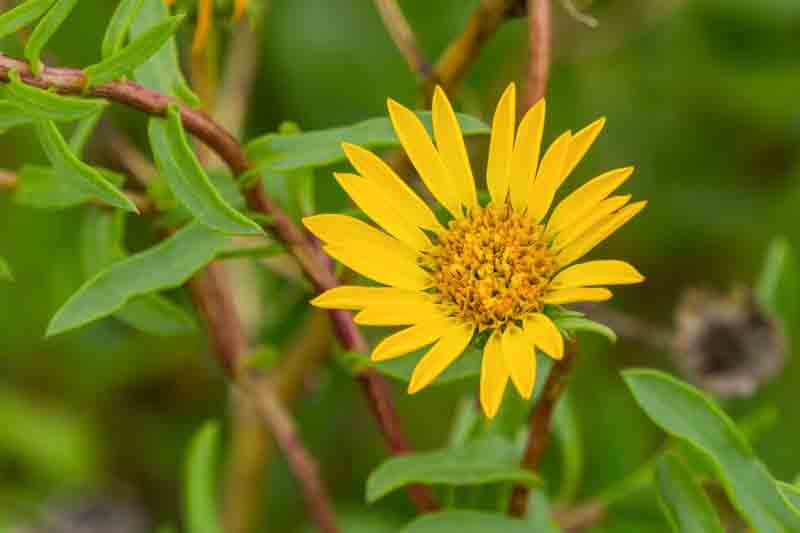
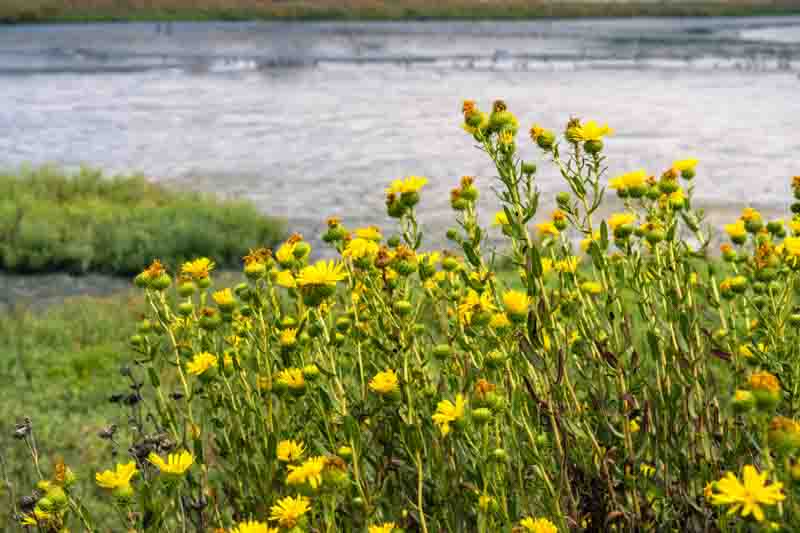


Grindelia stricta (Coastal Gumplant or Oregon Gumweed) is a North American native perennial with bright golden-yellow daisies, resin-coated flower buds, and a remarkable ability to thrive along the Pacific coast. From windswept bluffs and sandy beaches to salt marshes, this adaptable wildflower brings summer color to places where many ornamentals struggle.
Look closely at an unopened flower bud and you’ll discover what makes gumplants so distinctive: a glossy coating of sticky, sometimes milky-white resin. When the buds open, cheerful yellow flowers attract bees and other pollinating insects. With its informal growth habit and long flowering season, Coastal Gumplant is a natural choice for wildlife-friendly coastal landscapes.
Summary: Native perennial or semi-woody subshrub with golden-yellow daisy-like flowers and resinous buds.
Use: Excellent for coastal gardens, native wildflower borders, pollinator plantings, coastal slopes, and appropriate salt-marsh gardens.
Highlight: Tolerates maritime exposure, provides nectar and pollen, and flowers through summer.
Native Range: Pacific coast from Alaska to California.
| Botanical Name | Grindelia stricta DC. |
|---|---|
| Family | Asteraceae (Daisy Family) |
| Common Names | Coastal Gumplant, Coastal Gumweed, Oregon Gumweed |
| Plant Type and Habit | Perennial herb or subshrub; upright, spreading, or prostrate depending on variety |
| Hardiness | Varies by provenance; no dependable USDA zone range established for all varieties |
| Size | Approximately 6 in. to 6 ft. tall (15-180 cm), depending on variety; spreading selections may reach 6 ft. wide (180 cm) |
| Exposure | Full sun to light partial shade |
| Soil | Sandy, loamy, or coastal saline soils; moisture and drainage preferences vary by variety |
| Foliage | Green, sometimes fleshy, oblong to lance-shaped leaves |
| Flowers | Golden-yellow flower heads, typically summer to fall, sometimes longer in mild coastal climates |
A member of the daisy family, Grindelia stricta occurs naturally along the Pacific coast of North America, from Alaska and British Columbia through Washington and Oregon to California. Its habitats include beaches, coastal bluffs, dunes, tidal wetlands, and salt marshes.
Coastal Gumplant is remarkably variable. Some plants form low, spreading mounds; others develop upright, branching stems that become woody near the base. Size depends on the botanical variety and local growing conditions, making identification important when planning garden spacing.
The green leaves may be narrow, broad, or somewhat fleshy, occasionally edged in red. Bright yellow flower heads, sometimes reaching about 2 in. across (5 cm), have a central disk surrounded by yellow rays. Their thick green bracts secrete the characteristic sticky resin, especially around developing buds.
Its extensive coastal range includes areas with very different winter climates. Northern populations experience colder conditions than those from mild California coastal habitats. Flowering generally occurs from summer into fall, with some populations blooming over a longer period.
The flowers attract native bees, flies, and other beneficial insects. Their summer and fall bloom period helps extend the season of available floral resources in wildlife gardens.
The resinous foliage may discourage browsing, and some cultivated selections are described as deer resistant. Rabbit resistance is less well documented. Young plants may still need protection.
The species tolerates coastal salt exposure, but drought tolerance differs among populations. Bluff and dune plants may handle seasonal dryness, while marsh-adapted plants naturally experience greater soil moisture.
Various gumplant species have histories of traditional medicinal use, particularly involving their resinous flowering parts. Such uses should not automatically be attributed to G. stricta. It is best treated as an ornamental rather than a medicinal or edible plant.
Coastal Gumplant is native within its western North American range and is not generally considered an aggressive garden invader. It may self-seed in suitable open ground. For restoration planting, select locally appropriate material.
Botanists recognize three varieties, and their differences help explain why growing recommendations for Coastal Gumplant sometimes seem contradictory.
The most widely distributed variety, ranging from Alaska south into California. It occurs on beaches, coastal bluffs, and in some marsh or slough habitats. Northern plants are often relatively compact, although growth habit varies with location.
A California variety associated particularly with tidal wetlands and marsh habitats. It may grow upright to approximately 6 ft. (180 cm). Its preference for moist coastal environments makes it a poor automatic substitute for a dry-garden gumplant.
A California coastal variety found on coastal bluffs, dunes, and in some salt-marsh habitats. Its growth habit ranges from low and spreading to more upright. The nursery selection ‘Mendocino’, for example, may remain under 8 in. tall (20 cm) while spreading 6 ft. (180 cm) or more, making it useful for sunny coastal borders with suitable drainage.
Dry coastal bluff or sandy border? Look for locally adapted bluff or dune material, including suitable spreading selections.
Moist coastal garden or salt-marsh margin? Consider marsh-associated populations, including appropriate California varieties.
Cold northern coastal garden? Choose material sourced from a comparable northern climate.
The botanical variety alone does not determine performance. Local provenance and the specific growing site remain important.
Both species bear golden daisies and sticky buds, but they occupy different habitats. Grindelia stricta is primarily coastal, occurring in maritime bluffs, dunes, and wetlands. Grindelia camporum (Great Valley Gumweed) is more characteristic of California’s inland valleys, open ground, and dry or seasonally moist disturbed habitats.
For an exposed coastal planting, locally adapted G. stricta may be the better ecological match. For a hot inland California garden, G. camporum is often a more practical choice.
Grow in full sun for the strongest flowering. Light partial shade may be tolerated, particularly near the coast, but deep shade is unsuitable.
Choose soil conditions that resemble the plant’s origin. Coastal bluff selections generally suit open, well-drained planting areas, while marsh-associated forms tolerate wetter environments. Water during establishment, then adjust irrigation to the variety, soil, and seasonal rainfall.
Some Coastal Gumplants grow in saline soils that remain moist for much of the year. Others inhabit comparatively dry beaches or bluffs. A plant’s tolerance of salty conditions tells you little about how often it needs watering.
In Mediterranean climates, fall planting gives roots time to establish during the cooler season. Set container-grown plants at their original depth, water thoroughly, and provide enough space for mature growth. Avoid excessive fertilizer.
Coastal Gumplant is generally low maintenance. Remove spent flowers for a neater appearance or leave seed heads standing. Trim dead stems and lightly shape established plants where needed, avoiding severe pruning into old woody growth.
Plants can be grown from seed. Sow in a suitable seed-starting medium, maintain light moisture during germination, and transplant young plants after sufficient root development. Use nursery-grown or responsibly sourced seed rather than collecting from protected coastal habitats.
Coastal Gumplant usually performs well when its growing conditions are appropriate. The most common problems are associated with unsuitable moisture, insufficient sunlight, or poor air circulation.
The glossy white or translucent coating on young buds is natural plant resin, not mildew or an insect infestation. This unusual feature is one of the easiest ways to recognize a gumplant.
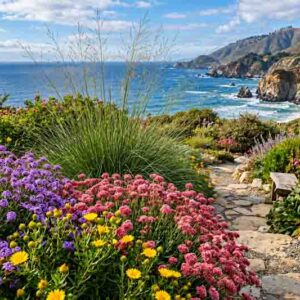
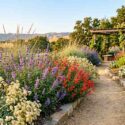
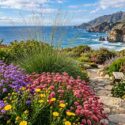
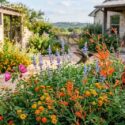
For a sunny California coastal garden with well-drained soil and modest summer watering, a suitable bluff-adapted Coastal Gumplant can be combined with purple flowers, rosy-pink buckwheat, and graceful native grasses. The following companions have overlapping requirements in mild coastal conditions, but are not recommended as a group for wet salt-marsh planting.
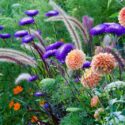
Place pink Eriogonum grande near the front, weave purple Verbena through the middle, and repeat golden gumplant among the drifts. Add Deer Grass toward the back for movement and structure. The combination provides contrasting flower shapes and an informal coastal character. Check mature widths and summer moisture compatibility before finalizing your planting plan.
Yes. Grindelia stricta is native to the Pacific coast from Alaska to California, including Oregon and Washington. It grows in beaches, bluffs, and coastal wetlands.
Size varies greatly. Some spreading selections remain under 8 inches tall, while upright forms can reach approximately 6 feet. Check the botanical variety and nursery source before planting.
Some bluff and dune forms tolerate seasonal dryness once established, but marsh-associated varieties naturally grow in wetter soils. Drought tolerance depends on the plant’s origin.
It is a naturally produced resin found on developing flower heads. The sticky coating is normal and does not indicate a pest or disease problem.
Yes. Its golden-yellow flowers provide nectar and pollen for native bees and other beneficial insects, particularly during the summer flowering season.
Royal Botanic Gardens, Kew – Plants of the World Online: Grindelia stricta.
Calflora – Grindelia stricta: Native Range and Botanical Varieties.
Calflora – Grindelia stricta var. angustifolia.
Calflora – Grindelia stricta var. platyphylla.
E-Flora BC – Grindelia stricta: Morphology, Habitat, and Distribution.
California Flora Nursery – Grindelia stricta var. platyphylla ‘Mendocino’.
Updated: October 2026
| Hardiness |
9 - 10 |
|---|---|
| Climate Zones | 14, 15, 16, 18, 23, 24 |
| Plant Type | Perennials |
| Plant Family | Compositae |
| Exposure | Full Sun, Partial Sun |
| Season of Interest | Summer (Early, Mid, Late), Fall |
| Height | 6" - 6' (15cm - 180cm) |
| Spread | 1' - 6' (30cm - 180cm) |
| Spacing | 24" - 36" (60cm - 90cm) |
| Maintenance | Low |
| Water Needs | Low, Average |
| Soil Type | Loam, Sand |
| Soil pH | Acid, Neutral |
| Soil Drainage | Well-Drained, Moist but Well-Drained |
| Characteristics | Showy |
| Native Plants | California, United States, Oregon, Pacific Northwest, Washington, Alaska |
| Tolerances | Drought, Deer, Salt, Wet Soil, Rocky Soil, Wind |
| Attracts | Bees, Butterflies |
| Garden Uses | Banks And Slopes, Beds And Borders, Ground Covers |
| Garden Styles | Butterfly Garden, Coastal Garden, Informal and Cottage, Pollinator Garden, Prairie and Meadow |
| Toxic to Humans | No known toxicity |
| Toxic to Cats | No known toxicity |
| Toxic to Dogs | No known toxicity |
| Toxic to Horses | No known toxicity |


| Hardiness |
9 - 10 |
|---|---|
| Climate Zones | 14, 15, 16, 18, 23, 24 |
| Plant Type | Perennials |
| Plant Family | Compositae |
| Exposure | Full Sun, Partial Sun |
| Season of Interest | Summer (Early, Mid, Late), Fall |
| Height | 6" - 6' (15cm - 180cm) |
| Spread | 1' - 6' (30cm - 180cm) |
| Spacing | 24" - 36" (60cm - 90cm) |
| Maintenance | Low |
| Water Needs | Low, Average |
| Soil Type | Loam, Sand |
| Soil pH | Acid, Neutral |
| Soil Drainage | Well-Drained, Moist but Well-Drained |
| Characteristics | Showy |
| Native Plants | California, United States, Oregon, Pacific Northwest, Washington, Alaska |
| Tolerances | Drought, Deer, Salt, Wet Soil, Rocky Soil, Wind |
| Attracts | Bees, Butterflies |
| Garden Uses | Banks And Slopes, Beds And Borders, Ground Covers |
| Garden Styles | Butterfly Garden, Coastal Garden, Informal and Cottage, Pollinator Garden, Prairie and Meadow |
| Toxic to Humans | No known toxicity |
| Toxic to Cats | No known toxicity |
| Toxic to Dogs | No known toxicity |
| Toxic to Horses | No known toxicity |
How many Grindelia stricta (Coastal Gum Plant) do I need for my garden?
| Plant | Quantity | |
|---|---|---|
| Grindelia stricta (Coastal Gum Plant) | N/A | Buy Plants |
Create a membership account to save your garden designs and to view them on any device.
Becoming a contributing member of Gardenia is easy and can be done in just a few minutes. If you provide us with your name, email address and the payment of a modest $25 annual membership fee, you will become a full member, enabling you to design and save up to 25 of your garden design ideas.
Join now and start creating your dream garden!