Lindheimer's muhly, Big muhly, Blue muhly, Epicampes gracilis
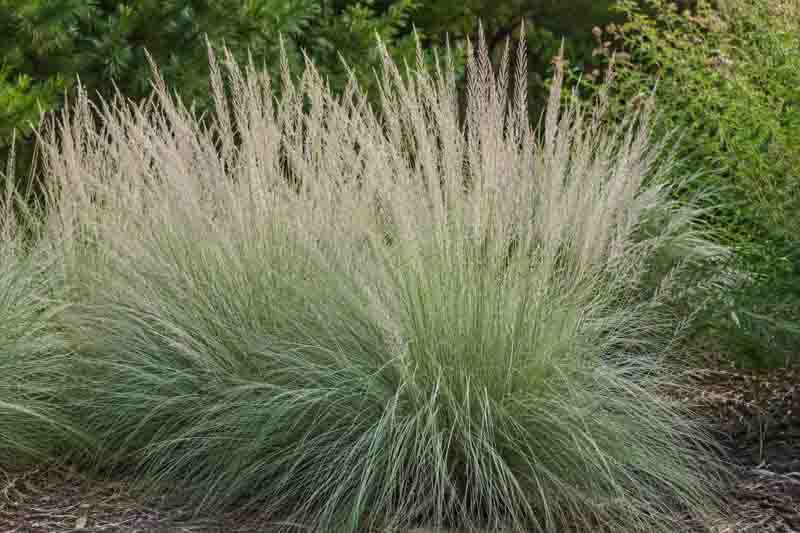
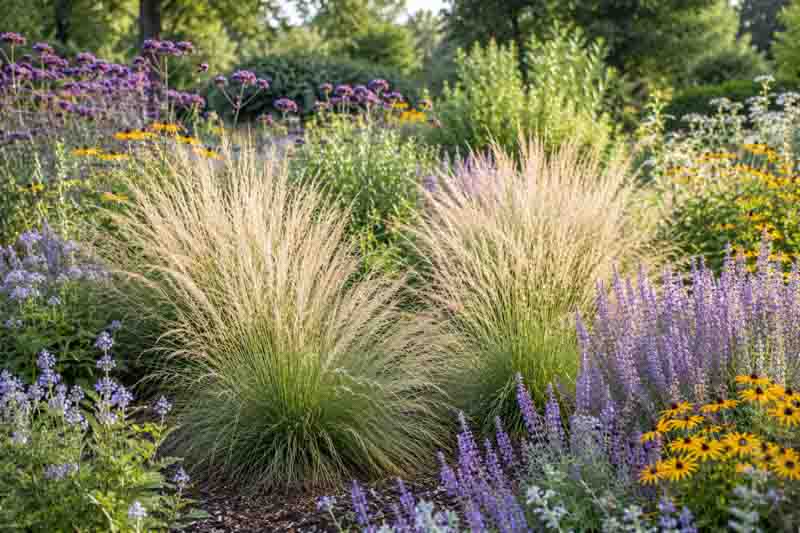


Muhlenbergia lindheimeri, commonly known as Lindheimer’s muhly, Big Muhly, or Blue Muhly Grass, is one of the most graceful native ornamental grasses for hot, sunny, low-water landscapes. With its blue-green foliage, upright fountain-shaped habit, and shimmering silver to purplish-gray flower plumes, this warm-season perennial grass brings structure, softness, and movement to gardens from summer through winter.
Native to Texas and northern Mexico, especially limestone uplands and the Edwards Plateau region, Lindheimer’s muhly is built for heat, drought, alkaline soil, and intense sun. It is a superb choice for xeriscapes, prairie-style borders, native gardens, modern landscapes, rocky slopes, deer-resistant plantings, and waterwise foundation beds. Unlike showier pink muhly grass, Muhlenbergia lindheimeri offers a more architectural presence – taller, bolder, and silvery rather than rosy – making it especially valuable where year-round texture matters.
Garden spotlight: Lindheimer’s muhly is the ornamental grass to choose when you want the soft movement of a prairie grass, the toughness of a Texas native, and the polished look of a modern landscape plant.
Use: Xeriscapes, Texas native gardens, prairie-style borders, gravel gardens, slopes, wildlife gardens, low-water landscapes, foundation plantings, mass plantings, and modern naturalistic designs.
Highlight: Blue-green foliage and tall silver-gray plumes create graceful movement, late-season glow, and strong winter texture.
Design note: Excellent as a specimen grass, repeated architectural accent, soft screen, or massed drift with drought-tolerant perennials and native shrubs.
| Botanical Name | Muhlenbergia lindheimeri |
|---|---|
| Family | Poaceae |
| Common Names | Lindheimer’s Muhly, Big Muhly, Blue Muhly Grass, Lindheimer Muhly |
| Native Range | Edwards Plateau region of central Texas and adjacent northern Mexico; limestone uplands, rocky slopes, open grasslands, and dry streamside habitats |
| Plant Type | Warm-season perennial ornamental grass; clump-forming bunchgrass |
| Hardiness | Generally USDA Zones 6-9 |
| Height | Usually 2-5 ft. tall; flower stems may reach about 6 ft. in ideal sites |
| Spread | Usually 3-4 ft. wide |
| Sun Exposure | Full sun is best; light shade is tolerated but may reduce flowering |
| Soil | Well-drained sandy, gravelly, rocky, loamy, clay, or limestone soil; tolerates alkaline conditions |
| Bloom Time | Late summer to fall; plumes often remain attractive into winter |
| Flower Color | Silver-gray, white-gray, light lavender-gray, or purplish-gray |
| Foliage | Fine-textured blue-green to gray-green blades forming a dense upright clump |
| Drought Tolerant | Yes, once established; best with deep, infrequent watering during prolonged drought |
| Deer Resistant | Often considered deer resistant, though browsing can vary by region and pressure |
| Attracts | Birds and beneficial wildlife; provides cover, seed, and nesting material |
| Pet and Child Safety | Not known as a major toxic ornamental grass; discourage chewing and use gloves if foliage irritates skin |
Muhlenbergia lindheimeri is a native perennial bunchgrass named for Ferdinand Jacob Lindheimer, the famed Texas plant collector often called the father of Texas botany. It forms a dense, upright-to-arching clump of fine-textured blue-green leaves, then sends up tall, lacy plumes that shimmer in late-season light. The effect is elegant rather than loud – more silver mist than pink cloud.
This grass is especially prized in native Texas landscapes because it thrives where many showier perennials struggle: hot exposures, rocky soils, limestone sites, reflected heat, and dry summers. Its strong vertical form makes it more architectural than many ornamental grasses, yet its fine foliage keeps it soft and natural.
Lindheimer’s muhly is native to the Edwards Plateau region of central Texas and adjacent northern Mexico, where it grows in calcareous, rocky, well-drained soils.
This is a clump-forming grass, not a running grass. Mature plants usually grow 2-5 feet tall and 3-4 feet wide, with flowering stems sometimes reaching higher in favorable conditions. The overall shape is fountain-like but more upright than pink muhly, making it useful as a screen, backdrop, or sculptural accent.
The airy flower panicles appear mainly from late summer into fall, with regional variation. They are usually silver-gray, white-gray, or softly lavender-gray, and they catch morning and evening light beautifully. As the season progresses, the plumes dry to tan and remain attractive for months, giving winter gardens texture and movement.
Design magic: Plant Lindheimer’s muhly where low sun can shine through the plumes. Backlighting turns the seed heads into glowing silver smoke.
The narrow leaves are blue-green to gray-green, giving the plant a cool-toned presence even before it blooms. In mild climates, foliage may remain semi-evergreen, although it often looks partly dormant in winter. The dried flower stalks and tan foliage add structure through the cold season and can be left standing for wildlife and texture.
Muhlenbergia lindheimeri is generally grown in USDA Zones 6-9. It performs best in warm, sunny climates with sharp drainage. In colder parts of its range, avoid wet winter soil and heavy mulch over the crown.
Lindheimer’s muhly provides shelter, nesting material, and seasonal cover for birds and small wildlife. Its seeds may be used by birds, while the dense clump adds habitat value in native and naturalistic plantings. For a stronger wildlife garden, combine it with nectar-rich perennials, seed-bearing wildflowers, and other native grasses.
Once established, Muhlenbergia lindheimeri is drought tolerant and well adapted to dry, sunny conditions. It looks best with occasional deep watering during long droughts, especially in very hot gardens, but it resents constantly wet soil. Deep, infrequent irrigation is better than frequent shallow watering.
Lindheimer’s muhly is commonly considered deer resistant, thanks to its tough, narrow foliage and clumping habit. However, deer-resistant does not mean deer-proof. Young plants may need protection until established, especially in drought years or areas with heavy deer pressure.
Not generally listed among toxic landscape grasses, but ornamental grasses can irritate skin or mouths, and pets should not be allowed to chew large amounts.
Lindheimer’s muhly is not considered an aggressive running grass. It forms tidy clumps and may self-seed lightly in suitable sites, but it is generally well behaved in managed gardens. It is often a better ecological choice than invasive ornamental grasses used in hot, dry landscapes.
Full sun is best. Give this grass at least 6 hours of direct sun per day for dense growth, strong flowering, and the best blue-green foliage color. Light shade may be tolerated, but too much shade can reduce plumes and make plants floppy.
Lindheimer’s muhly grows well in well-drained sand, loam, clay, gravel, and limestone soils. It is especially useful in alkaline and calcareous soils where many garden plants struggle. The key requirement is drainage. Avoid soggy, compacted, poorly drained sites.
Water regularly during the first growing season to help roots establish. Once mature, water deeply during extended dry periods, then allow the soil to dry. Overwatering can weaken the plant and increase the risk of crown or root problems.
Skip heavy fertilizer. Rich soil and too much nitrogen can create lush, floppy growth with fewer flowers. A light compost topdressing in spring is enough for most gardens.
Use gravel mulch, decomposed granite, or a thin layer of organic mulch. Keep mulch away from the crown so the base stays dry and airy.
Care tip: If Lindheimer’s muhly flops, the cause is usually too much shade, too much water, or soil that is richer than this prairie grass prefers.
In many gardens, Lindheimer’s muhly does not need a hard annual cutback. The foliage may persist through winter, and harsh winter pruning can make recovery slower in some climates. For a natural look, simply remove brittle old flower stalks and comb through the clump with gloved hands or a leaf rake in late winter.
If the plant looks tired or winter-damaged, cut it back lightly in late winter or early spring before new growth begins. Avoid cutting into the crown, and do not prune heavily during the growing season.
Plant in spring after the soil has warmed, or in early fall where winters are mild. Space plants 3-4 feet apart for individual clumps or 30-36 inches apart for a denser mass planting. Give each plant enough room to show its natural fountain shape.
Muhlenbergia lindheimeri can be propagated by seed or division. Division is best done in spring as new growth begins. Large old clumps can be divided, but avoid chopping them into very small pieces, as strong divisions establish faster.
Weak flowering is usually caused by too much shade, excess fertilizer, young plant age, or overly wet soil. Move plants to full sun and reduce feeding for better plume production.
Flopping often happens in rich soil, irrigated lawns, or shaded beds. Lindheimer’s muhly is naturally adapted to leaner, drier conditions.
Poor drainage is the main threat. If plants decline suddenly, check whether the crown is staying wet. Improve drainage or replant on a mound.
Some browning is normal in winter. Leave dried foliage standing until late winter for texture and crown protection.
Good companion plants for Muhlenbergia lindheimeri share its preference for sun, sharp drainage, heat, and low to moderate water once established. Choose partners that add flower color, wildlife value, or contrasting structure without needing rich, constantly moist soil.
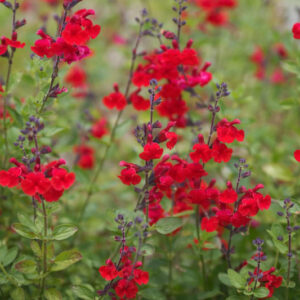
Salvia greggii – Autumn Sage – A colorful, heat-loving partner that brings hummingbirds, bees, and butterflies to dry sunny borders. Its red, pink, purple, or white blooms contrast beautifully with Lindheimer’s muhly’s cool-toned foliage and silver plumes.
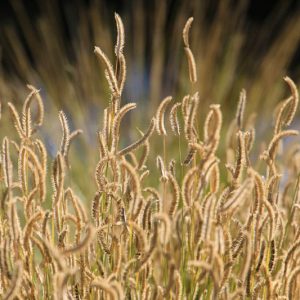
Bouteloua gracilis – Blue Grama – A lower native grass that creates a fine-textured foreground around Lindheimer’s muhly. Its distinctive eyelash-like seed heads add prairie character while letting the taller muhly remain the main vertical accent.
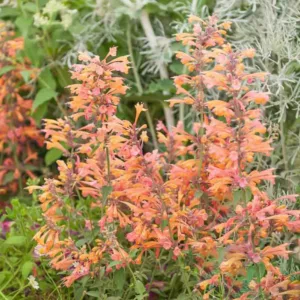
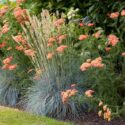
Agastache rupestris – Sunset Hyssop – A warm-toned perennial with orange, coral, and lavender flowers that glow beside the muhly’s silvery plumes. It adds fragrance, pollinator appeal, and a softer flowering layer in gravel gardens and xeric borders.
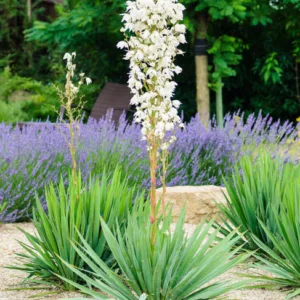
Yucca filamentosa – Adam’s Needle – A bold structural companion whose sword-like evergreen foliage contrasts with the muhly’s fine, airy texture. Use the pair near boulders, paths, walls, or gravel for a strong architectural dry-garden look.
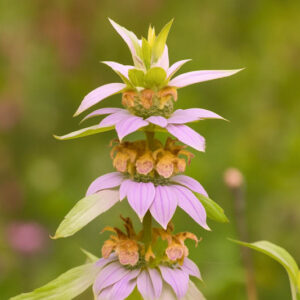
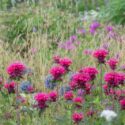
Monarda punctata – Spotted Bee Balm – A native-style pollinator plant with unusual spotted flowers and showy bracts that bring a wildflower meadow feel. It works especially well in naturalistic plantings where Lindheimer’s muhly provides height, movement, and late-season structure.
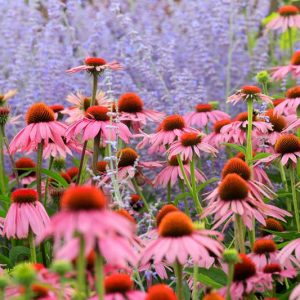
Echinacea purpurea – Purple Coneflower – A classic prairie perennial that adds bold summer daisies before the muhly plumes reach their peak. It is best in well-drained sites with moderate moisture and is most reliable with Lindheimer’s muhly in Zones 6-8, rather than very hot, dry Zone 9 gardens.
For a modern dry garden, repeat clumps of Lindheimer’s muhly among gravel, boulders, yucca, and autumn sage. For a prairie-style planting, combine it with coneflowers, black-eyed Susans, blue grama, little bluestem, and spotted bee balm. For a Texas native garden, use it as the tall grass backbone behind lower flowering perennials.
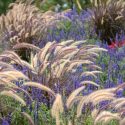
Its silver plumes are especially beautiful beside purple, gold, orange, white, and blue flowers. Try it with violet salvia, golden rudbeckia, orange agastache, white coneflower, or steel-blue yucca foliage for a high-contrast, low-water composition.
Best look: Plant in groups of 3, 5, or 7. A single plant is handsome, but a drift creates the luminous, windblown effect that makes this grass unforgettable.
Muhlenbergia lindheimeri is often compared with other ornamental muhly grasses because they share a graceful, airy texture and strong drought tolerance. The main difference is mood and scale: Lindheimer’s muhly is more upright, architectural, and silvery, while pink muhly is famous for rosy fall clouds and deer grass has a broader, fountain-like habit with tan plumes.
| Muhly Grass | Best Feature | Best Use | Key Difference |
|---|---|---|---|
| Muhlenbergia lindheimeri – Lindheimer’s Muhly | Blue-green foliage and tall silver-gray plumes | Specimen grass, dry gardens, Texas native landscapes, screens, slopes, modern borders | More upright, structural, and architectural than most muhly grasses |
| Muhlenbergia capillaris – Pink Muhly Grass | Spectacular pink to pinkish-red fall plumes | Mass plantings, cottage gardens, coastal gardens, meadow plantings, dramatic fall color | Showier flower color but usually softer and less architectural than Lindheimer’s muhly |
| Muhlenbergia rigens – Deer Grass | Large fountain-shaped clumps and tan flower spikes | Meadows, bioswales, erosion control, wildlife gardens, dry slopes, native western landscapes | Broader, more fountain-like habit with tan plumes rather than silver-gray plumes |
Choose Lindheimer’s muhly when you want a bold, upright, silver-toned grass for hot, dry, limestone, or Texas-style gardens. Choose Pink Muhly Grass when the priority is dazzling fall color. Choose Deer Grass when you need a larger, naturalistic grass for dry slopes, habitat plantings, erosion control, or western native landscapes.
Muhlenbergia lindheimeri, commonly called Lindheimer’s muhly, Big Muhly, or Blue Muhly Grass, is a warm-season perennial bunchgrass native to Texas and northern Mexico. It is valued for blue-green foliage, silver-gray fall plumes, drought tolerance, and strong ornamental structure.
Lindheimer’s muhly usually grows 2 to 5 feet tall and 3 to 4 feet wide. In ideal sunny, well-drained sites, flowering stems may reach about 6 feet.
Yes. Muhlenbergia lindheimeri is drought tolerant once established. It performs best with deep, infrequent watering and well-drained soil, especially in hot, sunny landscapes.
Yes. Full sun is best for dense growth, upright form, and abundant plumes. Light shade may be tolerated, but too much shade can reduce flowering and cause floppy growth.
Lindheimer’s muhly typically blooms from late summer into fall. Its silver-gray to purplish plumes often persist into winter, adding long-lasting texture to the garden.
Muhlenbergia lindheimeri is often considered deer resistant, although no plant is completely deer-proof. Young plants may need protection where deer pressure is heavy.
No. Lindheimer’s muhly is a clump-forming native grass and is not considered an aggressive running grass. It may self-seed lightly in favorable conditions but is generally well behaved in gardens.
In the United States, Muhlenbergia lindheimeri is native to Texas. Its broader native range extends into northern Mexico.
Updated: May 2026 • Reviewed by Gardenia Editors
| Hardiness |
6 - 9 |
|---|---|
| Climate Zones | 6, 7, 8, 9, 10, 11, 12, 13, 14, 15, 16, 17, 18, 19, 20, 21, 22, 23, 24 |
| Plant Type | Ornamental Grasses |
| Plant Family | Poaceae |
| Common names | Muhly Grass |
| Exposure | Full Sun |
| Season of Interest | Spring (Late), Summer (Early, Mid, Late), Fall |
| Height | 2' - 5' (60cm - 150cm) |
| Spread | 3' - 4' (90cm - 120cm) |
| Spacing | 36" - 48" (90cm - 120cm) |
| Maintenance | Low |
| Water Needs | Low |
| Soil Type | Clay, Loam |
| Soil pH | Acid, Alkaline, Neutral |
| Soil Drainage | Well-Drained |
| Characteristics | Dried Arrangements, Cut Flowers, Showy |
| Native Plants | United States, Southwest, Texas |
| Tolerance | Drought, Deer, Rabbit, Dry Soil, Rocky Soil, Clay Soil |
| Attracts | Birds |
| Garden Uses | Banks And Slopes, Beds And Borders |
| Garden Styles | Coastal Garden, Informal and Cottage, Prairie and Meadow |


| Hardiness |
6 - 9 |
|---|---|
| Climate Zones | 6, 7, 8, 9, 10, 11, 12, 13, 14, 15, 16, 17, 18, 19, 20, 21, 22, 23, 24 |
| Plant Type | Ornamental Grasses |
| Plant Family | Poaceae |
| Common names | Muhly Grass |
| Exposure | Full Sun |
| Season of Interest | Spring (Late), Summer (Early, Mid, Late), Fall |
| Height | 2' - 5' (60cm - 150cm) |
| Spread | 3' - 4' (90cm - 120cm) |
| Spacing | 36" - 48" (90cm - 120cm) |
| Maintenance | Low |
| Water Needs | Low |
| Soil Type | Clay, Loam |
| Soil pH | Acid, Alkaline, Neutral |
| Soil Drainage | Well-Drained |
| Characteristics | Dried Arrangements, Cut Flowers, Showy |
| Native Plants | United States, Southwest, Texas |
| Tolerance | Drought, Deer, Rabbit, Dry Soil, Rocky Soil, Clay Soil |
| Attracts | Birds |
| Garden Uses | Banks And Slopes, Beds And Borders |
| Garden Styles | Coastal Garden, Informal and Cottage, Prairie and Meadow |
How many Muhlenbergia lindheimeri (Lindheimer’s Muhly Grass) do I need for my garden?
| Plant | Quantity | |
|---|---|---|
| Muhlenbergia lindheimeri (Lindheimer’s Muhly Grass) | N/A | Buy Plants |
Create a membership account to save your garden designs and to view them on any device.
Becoming a contributing member of Gardenia is easy and can be done in just a few minutes. If you provide us with your name, email address and the payment of a modest $25 annual membership fee, you will become a full member, enabling you to design and save up to 25 of your garden design ideas.
Join now and start creating your dream garden!
Create a membership account to save your garden designs and to view them on any device.
Becoming a contributing member of Gardenia is easy and can be done in just a few minutes. If you provide us with your name, email address and the payment of a modest $25 annual membership fee, you will become a full member, enabling you to design and save up to 25 of your garden design ideas.
Join now and start creating your dream garden!