Common names: Common Purslane, Garden Purslane, Green Purslane, Little Hogweed, Pusley, Pusley Weed, Wild Portulaca, Verdolaga, Portulaca neglecta, Portulaca retusa


Portulaca oleracea, commonly known as Purslane or Common Purslane, is a low-growing edible plant with fleshy leaves, reddish stems, and small yellow flowers. It thrives in heat, strong sun, drought, and disturbed soils, which explains its unusual double identity: gardeners value it as a nutritious summer green, while farmers and homeowners may know it as a persistent weed.
Purslane has been eaten in many cultures for centuries. Its young leaves and stems are crisp, tangy, and slightly salty, and can be enjoyed raw or cooked. It is also notable among leafy vegetables for its content of alpha-linolenic acid (ALA), a plant-based omega-3 fatty acid.
Summary: Low-growing edible semisucculent annual or biennial with fleshy leaves, reddish stems, and small yellow flowers.
Best for: Edible gardens, containers, hot dry sites, summer harvesting.
Light: Full sun for strongest growth.
Water: Drought tolerant once established, but moderate moisture produces more tender edible growth.
Important: Self-seeds readily and can become weedy if allowed to mature seed.
| Botanical Name | Portulaca oleracea |
|---|---|
| Family | Portulacaceae |
| Common Names | Purslane, Common Purslane, Little Hogweed, Pusley, Verdolaga |
| Native Range | Macaronesia, Africa, parts of east-central and southern Europe, the Middle East and Arabian Peninsula, eastward to Pakistan; now widely introduced around the world. |
| Plant Type | Fast-growing semisucculent annual or biennial forming low, spreading mats. |
| Size | Usually only a few inches tall, often spreading 12-18 in. (30-45 cm) or more. |
| Sun | Full sun; tolerates some light shade. |
| Soil | Adaptable, but best in well-drained soil. |
| Bloom | Summer into fall in warm conditions. |
| Primary Uses | Edible green, culinary herb, container plant, informal groundcover. |
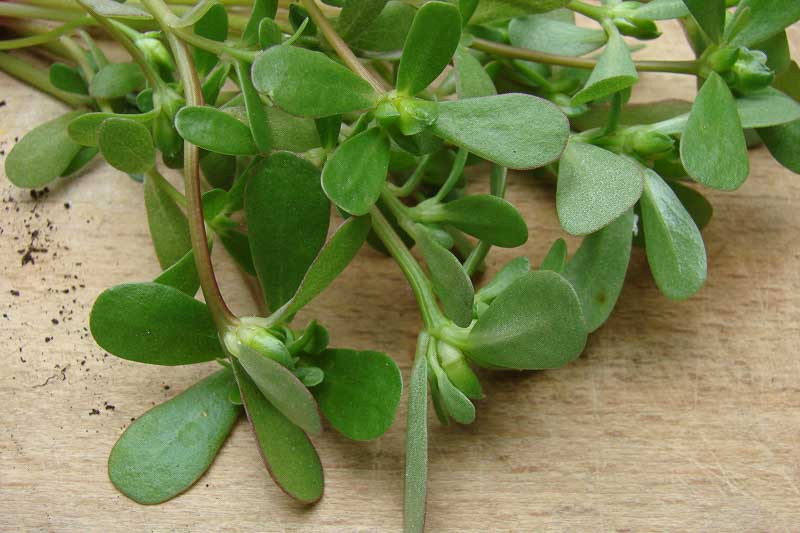
Purslane is a low-growing semisucculent herb with smooth, branching stems that are often reddish or reddish-green. The stems typically spread close to the soil surface, forming mats that can expand rapidly in warm weather.
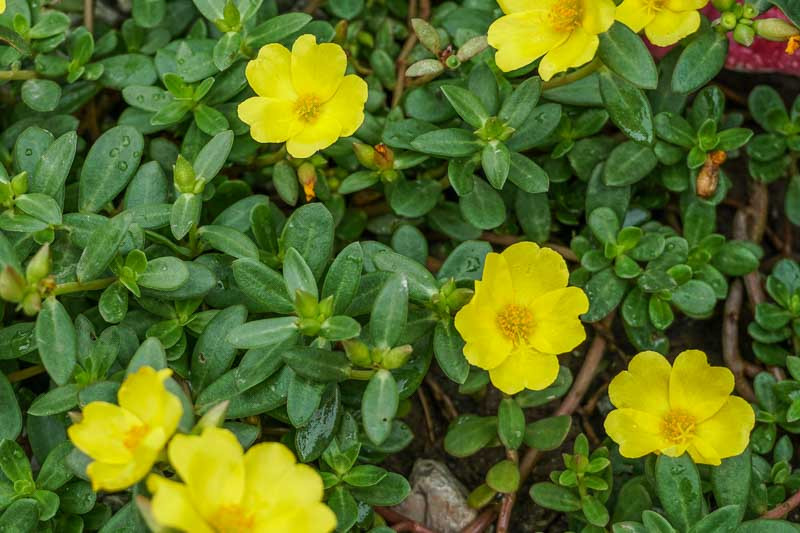
The leaves are thick, fleshy, smooth, and usually rounded to spoon-shaped. Small yellow flowers appear near the stem tips or leaf axils. After flowering, capsules develop and release numerous tiny dark seeds.
That prolific seed production is one reason Purslane can return year after year even though individual plants are usually annual.
Portulaca oleracea has an unusually broad native range, extending across Macaronesia, Africa, parts of east-central and southern Europe, the Middle East and Arabian Peninsula, and eastward to Pakistan. It has also been transported widely by people and is now established across much of the world.
Purslane grows fastest in warm weather. Its stems creep outward close to the ground, creating a dense mat, and stem pieces can sometimes root again where moisture and soil contact are favorable.
Mature plants often spread 12-18 inches (30-45 cm) or more while remaining only a few inches tall.
The glossy, succulent foliage is the plant’s most distinctive feature and helps Purslane tolerate hot, dry conditions.
The yellow flowers are much smaller and less showy than those of many ornamental Portulaca varieties. They are important, however, because they lead to the production of large numbers of seeds.
Correct identification is essential before eating any wild plant.
Common Purslane usually has:
Yes. The leaves, young stems, and tender shoot tips of correctly identified Portulaca oleracea are edible and are eaten in many cuisines around the world.
The texture is crisp and succulent, with a mildly tart, lemony, sometimes slightly salty flavor. Young shoots are generally more tender than older stems.
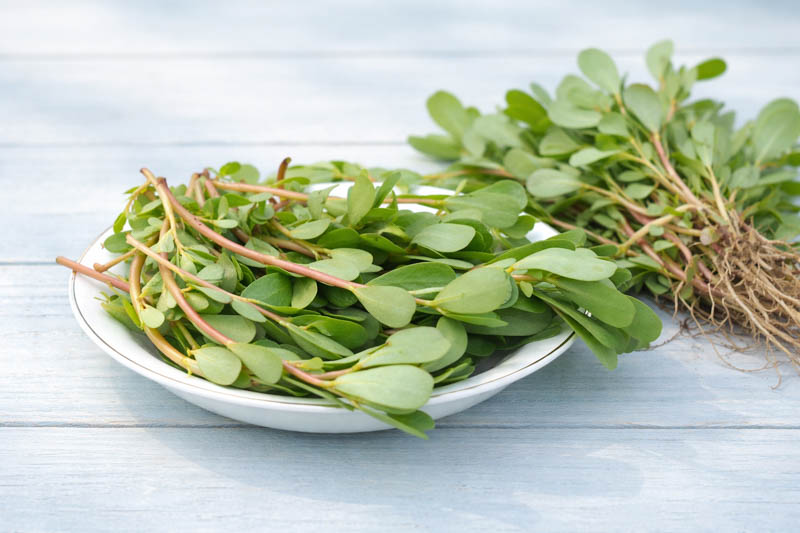
Purslane is a nutrient-dense leafy vegetable containing vitamins, minerals, carotenoids, and other naturally occurring plant compounds. Its most notable nutritional feature is its relatively high content of alpha-linolenic acid (ALA), an essential plant-based omega-3 fatty acid.
Purslane contains more ALA than many commonly eaten leafy vegetables. Reported levels vary substantially according to variety, plant part, growing conditions, and harvest stage.
ALA is an essential fatty acid, meaning it must be obtained through food. It should not, however, be considered nutritionally identical to the longer-chain EPA and DHA omega-3 fatty acids found in oily fish.
Purslane can contribute a range of nutrients to the diet, including:
Nutrient concentrations vary with growing conditions and harvest stage, so Purslane is best regarded as one useful component of a varied diet rather than a nutritional cure-all.
Purslane contains several naturally occurring phytochemicals, including carotenoids, betalains, tocopherols, and other compounds with antioxidant activity.
Although Purslane and its extracts have been studied for a variety of possible health effects, those studies do not justify treating ordinary dietary Purslane as a remedy for specific diseases.
Purslane contains oxalates. People who have been advised by a healthcare professional to limit dietary oxalate, including some individuals prone to calcium-oxalate kidney stones, may need to moderate their intake.
Cooking can reduce some soluble oxalate content, although the amount removed depends on the preparation method.
Purslane’s crisp texture and tangy flavor make it versatile in the kitchen. It can be eaten raw while young or cooked similarly to other leafy greens.
Try it:
Its fresh, tangy flavor pairs especially well with tomatoes, cucumbers, and onions.
Purslane is easy to grow because it naturally excels in conditions that challenge many leafy vegetables: heat, strong sun, and periods of dry soil.
Purslane is highly adaptable and commonly appears in poor or disturbed soils. Cultivated plants grown for eating, however, perform well in well-drained garden soil with modest fertility.
It tolerates sandy, gravelly, and relatively compacted conditions better than many garden vegetables. Avoid persistently waterlogged soil.
Purslane is highly drought tolerant because its succulent leaves and stems store water.
But drought survival and the best edible growth are not the same thing. Plants grown for tender leaves usually produce better-quality growth when watered during prolonged dry spells.
Allow the soil surface to begin drying between waterings rather than keeping the root zone constantly wet.
Heavy feeding is unnecessary. Purslane tolerates low-fertility soils well, and ordinary garden soil is often sufficient.
Where soil is extremely poor, modest fertility can encourage better leaf production. Avoid excessive fertilizer if your goal is compact, manageable growth.
Purslane can also root from stem pieces when they remain in contact with moist soil. That makes propagation easy—but it is also one reason pulled or chopped plants can sometimes re-establish.
Harvest young leaves and stems while they are crisp and tender. Regular cutting encourages branching and supplies repeated harvests during warm weather.
Older stems may become tougher as plants mature and flower heavily, although they can still be used in cooked dishes or pickles.
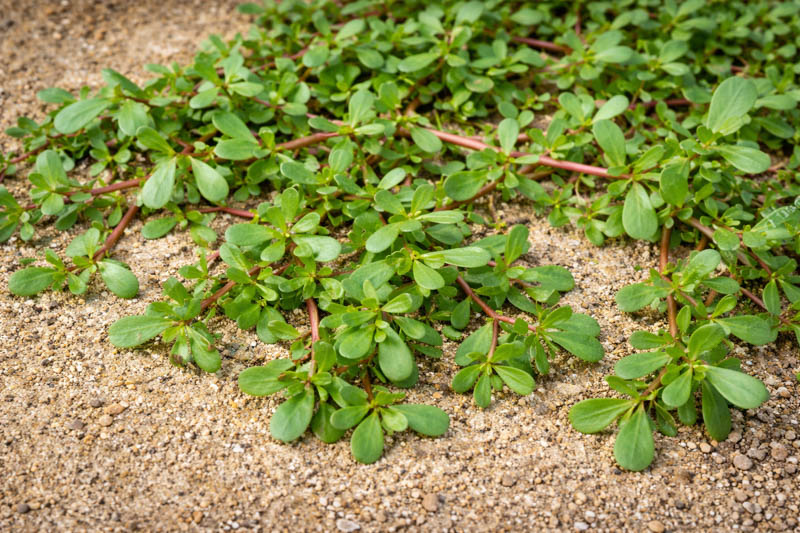
Purslane can form an effective temporary summer mat in hot, sunny areas, but it should be used deliberately because of its prolific seed production.
Possible uses include:
Common Purslane is less suitable as a permanent ornamental groundcover because a large soil seed bank can make it difficult to control later.
Purslane flowers may be visited by small pollinating insects, while seeds and foliage may be eaten by wildlife. Its ecological value varies by region and habitat.
It is not reliably deer or rabbit resistant, so browsing should be expected where those animals are common.
Purslane is a highly successful colonizer of cultivated and disturbed soil and is an important agricultural weed in many regions. Whether it is formally classified as invasive varies by jurisdiction and by the definition being used.
Its persistence comes from a combination of:
If you want to grow Purslane without allowing it to spread, harvest plants before seeds mature and remove unwanted seedlings while they are young.
For regional information, see where this species is reported in the United States.
Purslane is generally resilient, but pests and diseases may appear when plants are crowded, stressed, or kept too wet.
Want Purslane for food?
Grow it from a known source or identify wild plants with complete certainty.
Want a low-water edible?
Purslane is a strong choice, but occasional irrigation produces more tender growth than severe drought.
Want it as groundcover?
Use it only where prolific reseeding will not become a problem.
Want to keep it contained?
Harvest frequently and remove flowers or seed capsules before seeds mature.
Have pets or grazing animals?
Keep Purslane out of reach because of its soluble calcium oxalates.
Portulaca oleracea, or Common Purslane, is a low-growing semisucculent herb with fleshy leaves, reddish stems, and small yellow flowers. It is widely eaten as a vegetable but can also behave as a persistent garden and agricultural weed.
Correctly identified Portulaca oleracea is widely eaten by people. Harvest only from clean, uncontaminated areas and avoid plants exposed to herbicides, roadside pollution, or animal waste.
Purslane is crisp and juicy with a mildly tangy, lemony, sometimes slightly salty flavor. Young stems and leaves are usually the most tender.
It contains vitamins, minerals, carotenoids, and other plant compounds and is particularly notable for its alpha-linolenic acid (ALA), a plant-based omega-3 fatty acid.
Yes. Young leaves and stems can be eaten raw in salads, sandwiches, and salsas, or cooked in soups, stews, egg dishes, and sauces.
It is usually annual, although Kew also recognizes biennial behavior. More commonly, plants seem to return because seeds survive in the soil and germinate again in warm weather.
Purslane can become an aggressive weed in disturbed or cultivated soils because it produces many seeds and may regrow from stem fragments. Formal invasive status varies by region.
Yes. Its succulent leaves and stems allow it to tolerate substantial drought. However, plants grown for eating usually produce more tender growth with occasional water during prolonged dry periods.
Yes. Portulaca oleracea contains soluble calcium oxalates and is listed as toxic to dogs, cats, and horses.
Remove plants before they set seed, pull seedlings while young, and mulch bare soil where appropriate. Remove uprooted plants from moist soil because stem pieces can sometimes root again.
Updated and reviewed by Gardenia: October 2026
| Hardiness |
2 - 12 |
|---|---|
| Climate Zones | 1, 1A, 1B, 2, 2A, 2B, 3, 3A, 3B, 4, 5, 6, 7, 8, 9, 10, 11, 12, 13, 14, 15, 16, 17, 18, 19, 20, 21, 22, 23, 24, A1, A2, A3, H1, H2 |
| Plant Type | Annuals, Cactus & Succulents, Herbs |
| Plant Family | Portulacaceae |
| Genus | Portulaca |
| Common names | Purslane |
| Exposure | Full Sun |
| Season of Interest | Spring (Late), Summer (Early, Mid, Late), Fall |
| Height | 2" - 3" (5cm - 8cm) |
| Spread | 1' - 2' (30cm - 60cm) |
| Spacing | 18" (50cm) |
| Maintenance | Low |
| Water Needs | Average |
| Soil Type | Chalk, Clay, Loam, Sand |
| Soil pH | Acid, Alkaline, Neutral |
| Soil Drainage | Moist but Well-Drained, Well-Drained |
| Tolerances | Drought, Clay Soil, Heat, Poor Soil, Humidity |
| Garden Styles | Informal and Cottage |
| Toxic to Humans | No known toxicity |
| Toxic to Cats | Toxic |
| Toxic to Dogs | Toxic |
| Toxic to Horses | Toxic |


| Hardiness |
2 - 12 |
|---|---|
| Climate Zones | 1, 1A, 1B, 2, 2A, 2B, 3, 3A, 3B, 4, 5, 6, 7, 8, 9, 10, 11, 12, 13, 14, 15, 16, 17, 18, 19, 20, 21, 22, 23, 24, A1, A2, A3, H1, H2 |
| Plant Type | Annuals, Cactus & Succulents, Herbs |
| Plant Family | Portulacaceae |
| Genus | Portulaca |
| Common names | Purslane |
| Exposure | Full Sun |
| Season of Interest | Spring (Late), Summer (Early, Mid, Late), Fall |
| Height | 2" - 3" (5cm - 8cm) |
| Spread | 1' - 2' (30cm - 60cm) |
| Spacing | 18" (50cm) |
| Maintenance | Low |
| Water Needs | Average |
| Soil Type | Chalk, Clay, Loam, Sand |
| Soil pH | Acid, Alkaline, Neutral |
| Soil Drainage | Moist but Well-Drained, Well-Drained |
| Tolerances | Drought, Clay Soil, Heat, Poor Soil, Humidity |
| Garden Styles | Informal and Cottage |
| Toxic to Humans | No known toxicity |
| Toxic to Cats | Toxic |
| Toxic to Dogs | Toxic |
| Toxic to Horses | Toxic |
How many Portulaca oleracea (Purslane) do I need for my garden?
| Plant | Quantity | |
|---|---|---|
| Portulaca oleracea (Purslane) | N/A | Buy Plants |
Create a membership account to save your garden designs and to view them on any device.
Becoming a contributing member of Gardenia is easy and can be done in just a few minutes. If you provide us with your name, email address and the payment of a modest $25 annual membership fee, you will become a full member, enabling you to design and save up to 25 of your garden design ideas.
Join now and start creating your dream garden!