Turn a hot, sunny corner into a Texas wildflower prairie alive with motion, color, and pollinators. Plains coreopsis, lemon beebalm, Mexican feather grass, and little bluestem create a drought-tolerant border that sways in the breeze, feeds bees and butterflies, and looks effortless from spring to fall in any Texas-size yard.
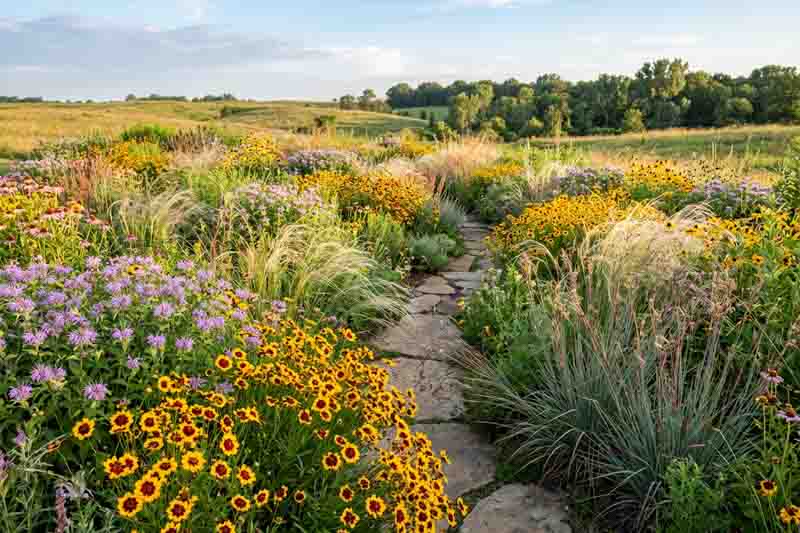


This sunny prairie planting stretches across an open landscape of yellow, burgundy, lavender, straw-gold, and rusty brown. Coreopsis tinctoria provides the broadest sweep of flower color, with yellow daisies marked by deep reddish centers. Among them, Monarda citriodora rises in loose lavender-pink groups, while fine-textured Mexican Feather Grass moves through the planting in pale, billowing patches.
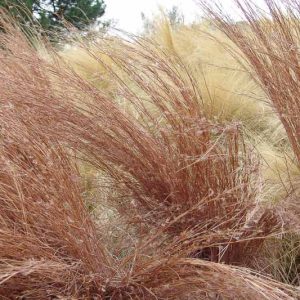
Schizachyrium scoparium adds a different kind of grass structure. Its stems are more upright and substantial, and by late summer they begin taking on the copper and reddish tones visible in the photograph. A ranch fence and weathered barn beyond the planting reinforce the open prairie setting.
Main plants used: Coreopsis tinctoria, Monarda citriodora, Nassella tenuissima, and Schizachyrium scoparium
The strongest contrast is between the flowers and the grasses. Plains Coreopsis creates broad areas of bright yellow, while Lemon Beebalm adds taller lavender flower tiers. Neither forms a heavy mass, so the grasses remain visible through and around them.
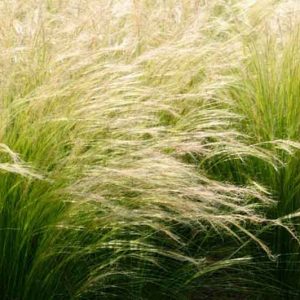
Mexican Feather Grass has very fine leaves and pale, silky flower stems that bend easily in the wind. Little Bluestem is more upright and changes color later in the season, gradually shifting from blue-green to copper, orange, and reddish brown.
The photograph also shows why this type of planting should not be divided into tidy blocks. Coreopsis spreads across large portions of the meadow, Beebalm appears in repeated pockets, and both grasses move in and out of the flowering areas. The slight irregularity is what gives the border its prairie character.
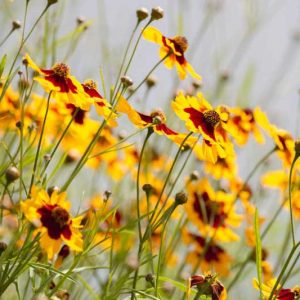
Coreopsis tinctoria, or Plains Coreopsis, is usually grown as an annual and often maintains itself by reseeding. Its yellow flowers, typically marked with red or maroon near the center, can bloom for an extended period in sunny sites. It performs especially well in relatively lean, well-drained soil.
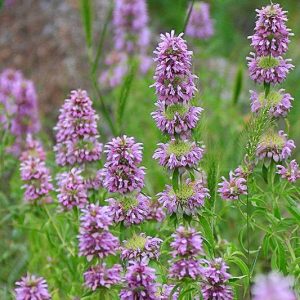
Monarda citriodora, or Lemon Beebalm, is typically an annual or biennial that readily reseeds. The distinctive flower heads are arranged in stacked whorls around the stems, producing the lavender-pink vertical accents visible throughout the meadow. The flowers are attractive to bees, butterflies, and other pollinators.
Nassella tenuissima, or Mexican Feather Grass, contributes the finest texture in the planting. Its narrow leaves and pale flowering stems respond to even a light breeze and contrast well with the stronger stems of Little Bluestem.
Important: Mexican Feather Grass can self-seed aggressively and is invasive or restricted in some regions. Check local recommendations before planting it and substitute an appropriate non-invasive grass where necessary.
Schizachyrium scoparium, or Little Bluestem, is a warm-season native prairie grass with upright blue-green summer foliage that develops rich copper, orange, and reddish tones in fall. Leave the stems standing through winter for texture and wildlife cover, then cut them back before new spring growth begins.
Create an open prairie where colorful reseeding wildflowers move through substantial groups of fine and upright warm-season grasses.
These percentages describe the overall balance of the four featured plants rather than four separate blocks or equal numbers of individual plants.
Establish repeated groups of Little Bluestem across the planting rather than restricting it to the back. Add Mexican Feather Grass in broader, irregular pockets where its pale stems can move freely.
Sow or plant Plains Coreopsis through the open areas, allowing it to form generous drifts. Repeat Lemon Beebalm in smaller groups so its taller lavender flower heads rise through both the Coreopsis and grasses.
Allow some reseeding from year to year, but thin seedlings where necessary so the grasses are not gradually crowded out.
This combination is well adapted to sun and periodic dryness, but a newly planted meadow still needs regular moisture while roots establish. Avoid calling it a no-water planting, particularly during its first growing season.
The composition will also change from year to year. Plains Coreopsis and Lemon Beebalm depend heavily on reseeding, while the perennial grasses become larger and more permanent with age. Some editing—thinning seedlings, opening crowded patches, and preserving space around the grasses—helps maintain the intended balance.
Finally, although this planting has a distinctly Texas prairie appearance, Mexican Feather Grass deserves special attention. Where it is invasive or discouraged, replace it with a locally appropriate fine-textured grass rather than allowing it to escape into surrounding natural areas.
| Hardiness |
7 - 9 |
|---|---|
| Exposure | Full Sun |
| Season of Interest | Spring (Late), Summer (Early, Mid, Late), Fall |
| Maintenance | Low |
| Water Needs | Low, Average |
| Soil Type | Loam, Sand |
| Soil pH | Acid, Neutral, Alkaline |
| Soil Drainage | Well-Drained |
| Characteristics | Cut Flowers, Dried Arrangements, Showy |
| Native Plants | New Mexico, Southwest, Texas, United States |
| Tolerances | Drought, Deer, Dry Soil |
| Attracts | Bees, Butterflies, Hummingbirds, Birds |
| Landscaping Ideas | Beds And Borders |
| Garden Styles | Butterfly Garden, Informal and Cottage, Pollinator Garden, Prairie and Meadow |

| Hardiness |
7 - 9 |
|---|---|
| Exposure | Full Sun |
| Season of Interest | Spring (Late), Summer (Early, Mid, Late), Fall |
| Maintenance | Low |
| Water Needs | Low, Average |
| Soil Type | Loam, Sand |
| Soil pH | Acid, Neutral, Alkaline |
| Soil Drainage | Well-Drained |
| Characteristics | Cut Flowers, Dried Arrangements, Showy |
| Native Plants | New Mexico, Southwest, Texas, United States |
| Tolerances | Drought, Deer, Dry Soil |
| Attracts | Bees, Butterflies, Hummingbirds, Birds |
| Landscaping Ideas | Beds And Borders |
| Garden Styles | Butterfly Garden, Informal and Cottage, Pollinator Garden, Prairie and Meadow |
Recreate this garden. Specify the percentages you would like to have of each plant and input the dimensions of your garden space.We'll give you a shopping list so you know how many plants you need.
| Plant | Quantity | |
|---|---|---|
| Monarda citriodora (Lemon Bee Balm) | N/A | Buy Plants |
| Coreopsis tinctoria (Tickseed) | N/A | Buy Plants |
| Stipa tenuissima (Mexican Feather Grass) | N/A | Buy Plants |
| Schizachyrium scoparium (Little Bluestem) | N/A | Buy Plants |
Create a membership account to save your garden designs and to view them on any device.
Becoming a contributing member of Gardenia is easy and can be done in just a few minutes. If you provide us with your name, email address and the payment of a modest $25 annual membership fee, you will become a full member, enabling you to design and save up to 25 of your garden design ideas.
Join now and start creating your dream garden!