Butcher’s Broom, Butcher’s-broom, Knee Holly, Kneeholm, Box Holly, Jew’s Myrtle, Wild Myrtle, Shepherd’s Myrtle, Sweet Broom, Pettigree, Piaranthus
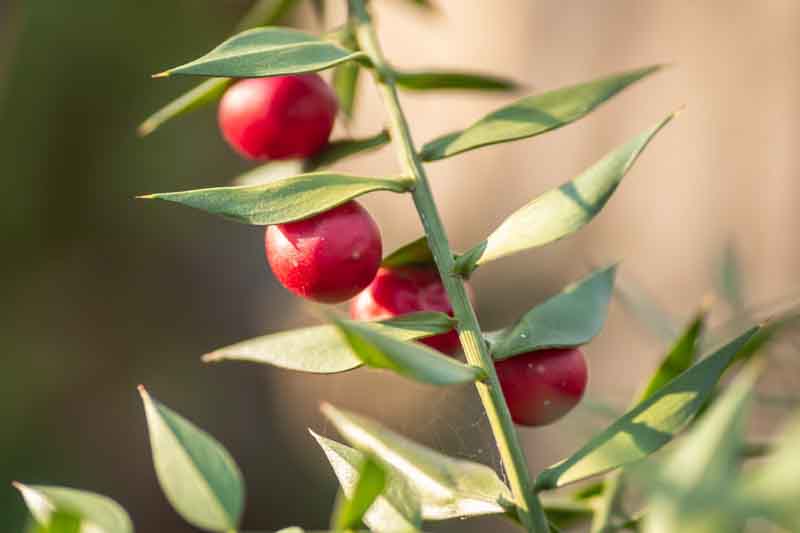
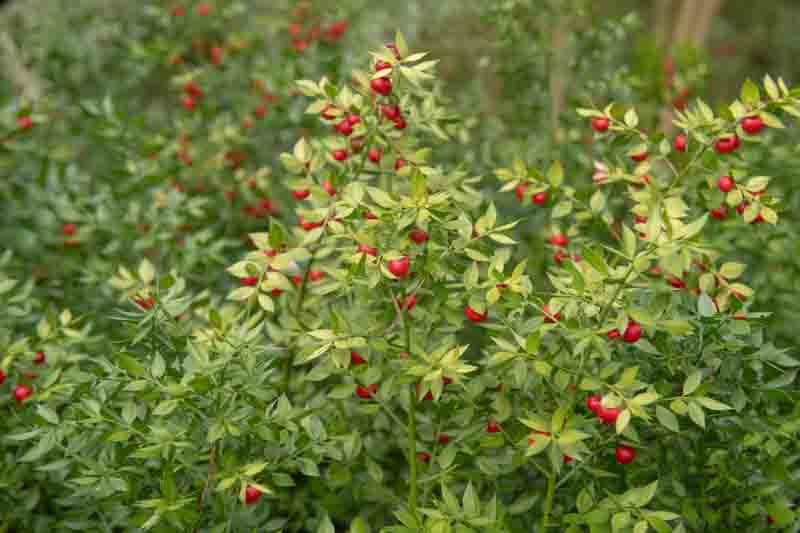


Butcher’s Broom (Ruscus aculeatus) is a slow-growing evergreen subshrub prized for glossy, spine-tipped cladodes, remarkable shade tolerance, and bright red berries on pollinated female plants. Tough, architectural, and long-lived, it is especially valuable in dry shade, beneath mature trees, beside shaded foundations, along woodland paths, and in low-maintenance gardens where many evergreen shrubs struggle.
Despite its common name, Butcher’s Broom is not a true broom, not a holly, and not a typical leafy shrub. The dark green “leaves” are actually flattened stems called cladodes, and the tiny flowers appear directly in the center of these cladodes, creating one of the plant’s most distinctive botanical features.
Ruscus aculeatus is a tough, evergreen, rhizomatous subshrub for part shade to full shade, average to well-drained soil, and low to moderate water once established. It is valued for glossy spine-tipped cladodes, small spring flowers, red berries on well-pollinated female plants, deer resistance, drought tolerance, and exceptional usefulness in dry shade gardens.
Use: Excellent for dry shade, woodland gardens, foundation planting, shaded courtyards, low hedges, winter-interest gardens, under-tree planting, containers, and evergreen structure.
Highlight: Glossy dark green cladodes, small greenish spring flowers, and bright red berries on pollinated female plants from late summer into winter.
Design note: Use it where ordinary shade plants fade – beneath mature trees, beside north-facing walls, near shaded entries, or as a polished evergreen filler in difficult sites.
| Botanical Name | Ruscus aculeatus |
|---|---|
| Family | Asparagus family (Asparagaceae) |
| Common Names | Butcher’s Broom, butcher’s-broom, knee holly, box holly, prickly box, shepherd’s myrtle, wild myrtle |
| Native Range | Macaronesia, the Mediterranean region, western and south-central Europe, North Africa, western Asia, and the Caucasus |
| Native U.S. States | None. Ruscus aculeatus is not native to the United States. |
| Plant Type | Evergreen rhizomatous subshrub; slow-spreading, clump-forming, architectural |
| Hardiness | Commonly grown in USDA Zones 7-9; best with shelter from severe winter exposure |
| Height | Usually 2-3 ft. tall; sometimes shorter or taller depending on climate and cultivar |
| Spread | About 2-3 ft. wide, slowly expanding by rhizomes |
| Sun Exposure | Part shade to full shade; tolerates deep shade better than many evergreen shrubs |
| Soil | Average, well-drained soil; tolerates dry, alkaline, rocky, clay, and root-filled soils once established |
| Bloom Time | Spring, often April-May in temperate gardens |
| Flower Color | Small greenish-white to pale green flowers, usually not showy |
| Fruit | Glossy red berries, most reliable on pollinated female plants; ornamental, not edible |
| Foliage | Evergreen, dark green, glossy, stiff, spine-tipped cladodes that look like leaves |
| Drought Tolerant | Yes, once established, especially in shade |
| Deer Resistant | Generally good due to stiff, prickly growth, though browsing can vary locally |
| Attracts | Small pollinating insects; birds may take berries in some regions |
| Pet and Child Safety | Berries are ornamental and should not be eaten. Wear gloves when handling prickly stems. |
Butcher’s Broom is a compact, holly-like evergreen with a botanical surprise: its apparent leaves are actually flattened stems called cladodes. True leaves are tiny and scale-like, while the cladodes carry the plant’s flowers and fruit. On close inspection, the tiny greenish flowers appear in the middle of the cladodes, and on pollinated female plants they may develop into glossy red berries that seem to sit directly on the “leaf” surface.
The common name comes from historical use. The rigid stems were once bundled into small brooms used by butchers to sweep cutting blocks. In the garden, that toughness makes the plant valuable in shade, root competition, dry soil after establishment, and low-maintenance landscapes.
Good to know: For the best berry display, grow a known female plant with a male nearby for pollination. Some plants may produce self-fertile flowers, but fruiting is usually more reliable when both sexes are present.
Ruscus aculeatus forms a dense, upright to arching mound of glossy, dark green cladodes. Each cladode is stiff, flattened, and spine-tipped, giving the plant its polished but prickly texture. Spring flowers are small and easily missed, but the berries on pollinated female plants are conspicuous, round, and bright red. The overall effect is refined, architectural, and slightly unusual.
Butcher’s Broom is native across a broad Old World range, including Macaronesia, the Mediterranean region, western and south-central Europe, parts of North Africa and western Asia, and the Caucasus. In the wild, it is associated with dry woods, hedgerows, scrub, rocky ground, and shaded coastal habitats.
The small flowers usually appear in spring, commonly April to May in many temperate gardens. They are not showy from a distance, but they are fascinating up close because they emerge from the cladodes. When pollination succeeds, berries may follow from late summer through fall and winter.
The evergreen structure is the main attraction. Butcher’s Broom stays dark, glossy, and architectural through winter, making pale hellebores, variegated sedges, ferns, snowdrops, cyclamen, and woodland bulbs look brighter by contrast. Female plants add extra seasonal interest when berries color up.
Most garden plants reach about 2-3 ft. tall and wide. Growth is slow, especially in dry shade, but established clumps may gradually broaden by rhizomes. Dwarf or heavy-fruiting selections may stay lower and denser.
Ruscus aculeatus is commonly recommended for USDA Zones 7-9. It appreciates shelter from severe winter wind, especially near the colder end of its range. In warm climates, provide shade and avoid hot reflected sun. In colder gardens, choose a protected courtyard, woodland edge, or north- or east-facing foundation bed.
Flowers can support small pollinating insects, while the red berries may be taken by birds in some settings. In mixed gardens, Butcher’s Broom is most valuable as evergreen cover and winter structure. For broader wildlife planting ideas, see Wildlife-Friendly Plants: Attract Bees, Butterflies & Birds.
Butcher’s Broom is generally considered resistant to browsing because the stems are stiff and prickly. Deer and rabbit behavior varies by region and hunger pressure, so protect new plants where browsing is severe. For more options, explore deer-resistant plants and rabbit-resistant plants.
Once established, Ruscus aculeatus is notably drought tolerant in shade. It is not a desert plant, but it handles dry woodland conditions better than many broadleaf evergreens. Water deeply during establishment, then reduce irrigation. For more choices, see drought-tolerant plants.
The berries are ornamental and should not be eaten. Keep them away from young children and pets, and wear gloves when pruning or arranging stems because the cladodes end in sharp points. Although Butcher’s Broom has a history of herbal use, this garden profile does not recommend ingesting berries, roots, or extracts without qualified medical guidance.
Butcher’s Broom is slow-growing, but it can spread gradually by rhizomes and may form colonies in favorable shaded conditions. Monitor plantings in mild climates, remove unwanted suckers, and avoid dumping garden waste near natural areas. Check local invasive-plant guidance before planting near wildlands or sensitive habitats.
Butcher’s Broom does not need heavy fertilizer. A light top-dressing of compost or leaf mold in spring is enough for most garden soils. Too much nitrogen may produce softer growth and reduce the plant’s naturally compact character.
Mulch with leaf mold, fine bark, or composted organic matter to conserve moisture and mimic woodland conditions. Keep mulch loose around the crown and do not bury new shoots.
Design tip:
Use Ruscus aculeatus as a dark evergreen backbone in shade. Its glossy structure makes pale hellebores, ferns, snowdrops, cyclamen, epimediums, and variegated sedges look richer and more intentional.
Prune lightly in spring. Remove dead, damaged, or old stems at the base rather than shearing the whole plant. Wear gloves, as the stiff cladode tips can scratch skin.
Established clumps may be divided in early spring or fall. Lift a section with healthy rhizomes, replant at the same depth, and water deeply while the division settles in. Division is also the best way to preserve named selections.
Ruscus aculeatus works well in shaded containers because it is evergreen, slow, and tidy. Choose a deep pot, provide drainage, and water when the upper potting mix begins to dry. Container plants need more regular water than in-ground plants, especially during warm weather.
Care tip:
Patience is the secret. Butcher’s Broom grows slowly, but once established, it becomes one of the most dependable evergreen plants for shade, tree roots, drought, and low-maintenance gardens.
Butcher’s Broom struggles in intense sun, waterlogged soil, exposed winter wind, and sites where quick coverage is expected. It is a long-term structure plant, not an instant filler. If stems yellow, check drainage and winter stress. If tips scorch, increase shade, reduce reflected heat, or provide deeper watering while plants establish.
| Task | Best Time |
|---|---|
| Planting | Fall or spring. |
| Flowering | Spring, often April-May. |
| Berries | Late summer through winter on pollinated female plants. |
| Pruning | Spring, removing old stems at the base. |
| Division | Early spring or fall. |
Ruscus aculeatus can be propagated by division, rhizome sections, or seed. Division is easiest for gardeners and preserves named selections. Seed can be slow and variable, and seedlings may not match the parent plant exactly. If fruiting is important, buy a known female selection and grow it with a suitable male pollinator nearby.
No berries usually means the plant is male, the female plant was not pollinated, flowers were damaged, or the plant is too young. For reliable fruiting, plant a known female selection with a male nearby; one male can usually support several female plants.
Scorch on the cladodes usually points to too much sun, reflected heat, dry wind, or drought before establishment. Move container plants into deeper shade or provide steadier moisture while roots develop.
Slow growth is normal. Butcher’s Broom builds gradually and should not be pushed hard with fertilizer. Overfeeding can produce softer, less compact growth.
Yellowing may indicate wet soil, poor drainage, winter stress, root disturbance, or old stems aging naturally. Remove old stems at the base in spring and improve drainage if soil remains soggy.
Fast diagnostic: No berries usually means a pollination or plant-sex issue. Brown tips usually mean sun, heat, wind, or drought stress. Yellow stems often mean old growth, wet soil, winter damage, or root disturbance.
Butcher’s Broom is generally pest-resistant and low-maintenance. Watch for scale insects, mealybugs, or spider mites in stressed container plants, and avoid waterlogged soil that can encourage root problems. Good drainage, shade, and moderate watering prevent most issues.
Use Ruscus aculeatus where shade needs structure rather than softness. Its dark, glossy form works especially well with plants that provide contrast in color, texture, or seasonal timing.
Choose companion plants that match Ruscus aculeatus in hardiness, part shade to full shade exposure, average to well-drained soil, and low to moderate moisture once established.
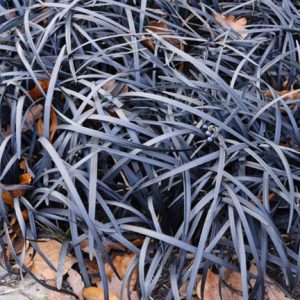
Companion plants: Helleborus orientalis (Lenten Rose), Epimedium x versicolor (Barrenwort), Polystichum setiferum (Soft Shield Fern), Dryopteris erythrosora (Autumn Fern), Carex oshimensis (Japanese Sedge), Ophiopogon planiscapus (Black Mondo Grass), Cyclamen hederifolium (Hardy Cyclamen), Galanthus nivalis (Snowdrop), Sarcococca confusa (Sweet Box), Aucuba japonica (Japanese Aucuba), Mahonia repens (Creeping Oregon Grape), and Pachysandra terminalis (Japanese Spurge) where it is appropriate and non-invasive locally.
No. Ruscus aculeatus is not native to any U.S. state. It is native to parts of Europe, the Mediterranean region, North Africa, western Asia, Macaronesia, and the Caucasus.
Yes. Butcher’s Broom is one of the better evergreen shrubs for part shade to full shade and can tolerate deep shade once established.
Ruscus aculeatus usually grows about 2 to 3 feet tall and wide, slowly expanding by rhizomes into a dense evergreen clump.
No berries usually means the plant is male, the female plant was not pollinated, flowers were damaged, or the plant is too young. Some plants may be self-fertile, but fruiting is most reliable when a female plant has a male pollinator nearby.
No. The red berries are ornamental and should not be eaten. Keep them away from children and pets.
Yes, once established, especially in shade. Water regularly during establishment, then provide occasional deep watering during long dry periods.
Butcher’s Broom is generally deer resistant because of its stiff, prickly cladodes, but browsing can vary depending on local deer pressure.
Yes. Ruscus aculeatus grows well in shaded containers if the pot has drainage holes and the soil is allowed to dry slightly between waterings.
Updated: April 2026 • Reviewed by Gardenia Editors
| Hardiness |
7 - 9 |
|---|---|
| Heat Zones |
7 - 9 |
| Climate Zones | 4, 5, 6, 7, 8, 9, 10, 11, 12, 13, 14, 15, 16, 17, 18, 19, 20, 21, 22, 23, 24, H1 |
| Plant Type | Shrubs |
| Plant Family | Asparagaceae |
| Exposure | Partial Sun, Shade |
| Season of Interest | Spring (Early, Mid, Late), Summer (Early, Mid, Late), Fall, Winter |
| Height | 2' - 3' (60cm - 90cm) |
| Spread | 2' - 3' (60cm - 90cm) |
| Spacing | 24" - 36" (60cm - 90cm) |
| Maintenance | Low |
| Water Needs | Average |
| Soil Type | Chalk, Clay, Loam, Sand |
| Soil pH | Acid, Alkaline, Neutral |
| Soil Drainage | Moist but Well-Drained, Well-Drained |
| Characteristics | Showy, Evergreen, Fruit & Berries, Cut Flowers |
| Tolerance | Drought, Clay Soil, Dry Soil, Salt, Full Shade, Deer |
| Garden Uses | Beds And Borders, Hedges And Screens, Patio And Containers |
| Garden Styles | Coastal Garden, Informal and Cottage, Woodland Garden |


| Hardiness |
7 - 9 |
|---|---|
| Heat Zones |
7 - 9 |
| Climate Zones | 4, 5, 6, 7, 8, 9, 10, 11, 12, 13, 14, 15, 16, 17, 18, 19, 20, 21, 22, 23, 24, H1 |
| Plant Type | Shrubs |
| Plant Family | Asparagaceae |
| Exposure | Partial Sun, Shade |
| Season of Interest | Spring (Early, Mid, Late), Summer (Early, Mid, Late), Fall, Winter |
| Height | 2' - 3' (60cm - 90cm) |
| Spread | 2' - 3' (60cm - 90cm) |
| Spacing | 24" - 36" (60cm - 90cm) |
| Maintenance | Low |
| Water Needs | Average |
| Soil Type | Chalk, Clay, Loam, Sand |
| Soil pH | Acid, Alkaline, Neutral |
| Soil Drainage | Moist but Well-Drained, Well-Drained |
| Characteristics | Showy, Evergreen, Fruit & Berries, Cut Flowers |
| Tolerance | Drought, Clay Soil, Dry Soil, Salt, Full Shade, Deer |
| Garden Uses | Beds And Borders, Hedges And Screens, Patio And Containers |
| Garden Styles | Coastal Garden, Informal and Cottage, Woodland Garden |
How many Ruscus aculeatus (Butcher’s broom) do I need for my garden?
| Plant | Quantity | |
|---|---|---|
| Ruscus aculeatus (Butcher’s broom) | N/A | Buy Plants |
Create a membership account to save your garden designs and to view them on any device.
Becoming a contributing member of Gardenia is easy and can be done in just a few minutes. If you provide us with your name, email address and the payment of a modest $25 annual membership fee, you will become a full member, enabling you to design and save up to 25 of your garden design ideas.
Join now and start creating your dream garden!
Create a membership account to save your garden designs and to view them on any device.
Becoming a contributing member of Gardenia is easy and can be done in just a few minutes. If you provide us with your name, email address and the payment of a modest $25 annual membership fee, you will become a full member, enabling you to design and save up to 25 of your garden design ideas.
Join now and start creating your dream garden!