Dry shade is one of the hardest conditions in California gardens, but the right plants can make it beautiful. This guide covers the best native and climate-adapted choices for under oaks, shady side yards, and lower-water understory planting, with smart design tips and Gardenia tools to refine your plan.
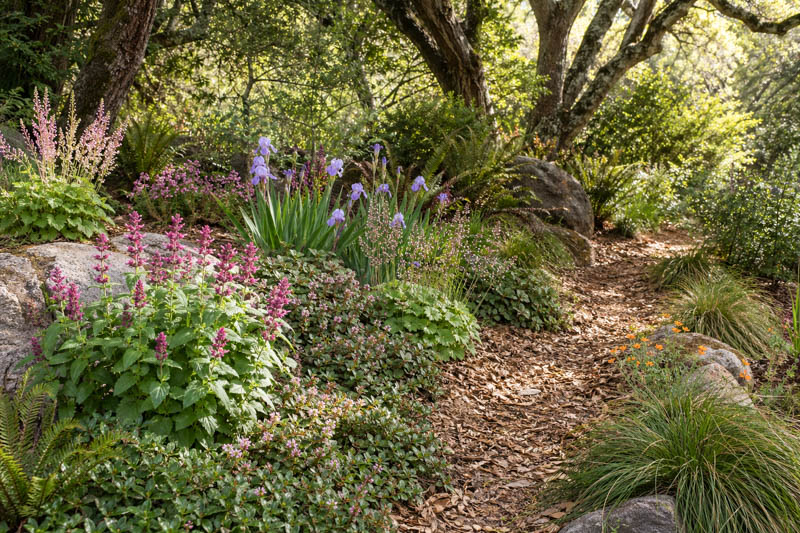


Dry shade is one of the hardest planting conditions in California. It is also one of the most overlooked opportunities in a garden.
You find it under mature trees, along north-facing walls, beneath large shrubs, beside foundations, in narrow side yards, and in established landscapes where roots take moisture before smaller plants can use it. Many gardeners assume nothing attractive will grow there. Usually, the problem is not the shade itself. The problem is choosing ordinary shade plants for a dry, root-filled California site.
The key distinction
A plant that tolerates shade is not automatically a good dry-shade plant. In California, the best choices must handle lower light, summer-dry conditions, root competition, and periodic heat.
This guide focuses on the best plants for dry shade in California, especially plants that can perform in real gardens with limited irrigation. You will find dependable California native dry-shade plants, climate-adapted companion plants, oak-understory guidance, design strategies, and practical planting advice for making dry shade look intentional instead of bare.
If you are trying to solve a shady side yard, plant beneath mature trees, create a low-water understory, or build a California-appropriate shade garden, start here.
Quick answer: The best plants for dry shade in California include hummingbird sage, Catalina currant, California polypody, Douglas iris, island alum root, foothill sedge, sticky monkey flower, fuchsia-flowered gooseberry, and selected native shrubs such as toyon and bush anemone for larger or brighter sites. For designed dryish shade, climate-adapted companions such as lomandra, cast iron plant, butcher’s broom, liriope, clivia, and fragrant sweet box can add structure and polish where occasional water is available.
Find plants for your exact dry-shade site
Use the Gardenia Plant Finder to filter dry-shade plants by light, water needs, size, bloom season, native status, and garden use. Then use the Gardenia Design Tool to turn your shortlist into a planting layout before you buy.
Dry shade is not just shade with less water. In California, it usually means a combination of four pressures:
This is why many classic woodland plants struggle. They may tolerate shade, but they often expect the steady moisture of cooler, more humid climates. California dry shade asks more of a plant.
A true dry-shade plant for California should tolerate reduced irrigation after establishment, compete with mature roots, and still look good outside its short bloom season. The strongest choices often rely on durable foliage, seasonal dormancy, evergreen structure, or a naturally summer-dry growth rhythm.
Dry shade also changes by region. Coastal gardens are generally more forgiving because of cooler temperatures and marine influence. Inland valleys and foothills are harder because soil dries faster and reflected heat can be intense. Under native oaks, the challenge is even more specific: established California oaks can be harmed by frequent summer irrigation near the trunk or root crown, so planting should be restrained and compatible with a summer-dry rhythm.
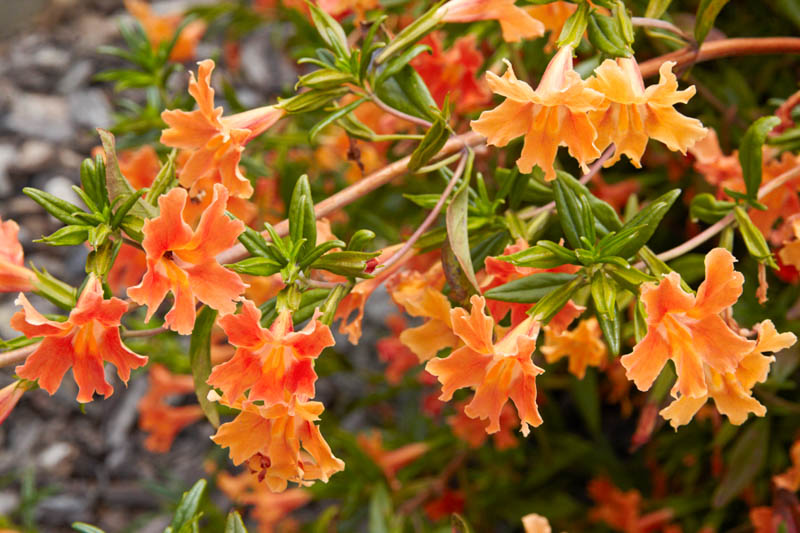
Use this quick list as a starting point, then refine by region, shade density, soil, and irrigation.
| Garden Situation | Best Plant Choices | Notes |
|---|---|---|
| Oak understory | Hummingbird sage, Catalina currant, California polypody, Douglas iris, island alum root, foothill sedge, fuchsia-flowered gooseberry | Plant lightly, avoid heavy digging, and keep frequent summer water away from the trunk. |
| Dappled dry shade | Hummingbird sage, Douglas iris, coyote mint, foothill sedge, island alum root, California polypody | Best where shade is bright, filtered, or seasonal rather than dense. |
| Bright dry shade or afternoon shade | Sticky monkey flower, coyote mint, toyon, bush anemone, native bulbs, dudleya in coastal rocky sites | Good for open woodland edges, slope edges, and inland sites where afternoon shade reduces stress. |
| Deep urban shade | Cast iron plant, ruscus, fragrant sweet box, Catalina currant, clivia in sheltered gardens | Deep shade usually needs careful plant selection and occasional support water, especially inland. |
| Coastal dry shade | Island alum root, dudleya, California polypody, Catalina currant, Ceanothus, red flowering currant | Coastal fog and cooler air expand the plant palette. |
| Designed dryish shade | Lomandra, liriope, cast iron plant, clivia, ruscus, fragrant sweet box, Biokovo cranesbill, Corsican hellebore | Use climate-adapted companions selectively where occasional deep irrigation is available. |
Best overall starting points
For most California dry-shade gardens, start with hummingbird sage, Catalina currant, California polypody, Douglas iris, island alum root, and carefully placed foothill sedge. These plants offer the best mix of regional fit, shade tolerance, lower water needs, and design usefulness.
Before choosing plants, study the site honestly. Dry shade is not one condition. It is a spectrum.
Ask these questions:
The best California dry-shade plants usually share several traits. They tolerate competition. They do not collapse when summer water is reduced. They provide foliage or structure beyond bloom. They can be repeated in a design without creating a maintenance problem. And ideally, they support pollinators, birds, or a regionally appropriate California garden style.
This is where the Gardenia Plant Finder is useful. Instead of choosing from a generic shade list, filter plants by shade tolerance, water needs, mature size, bloom season, native status, and planting use. Then use the Gardenia Design Tool to check whether your shortlist works as a real planting plan.
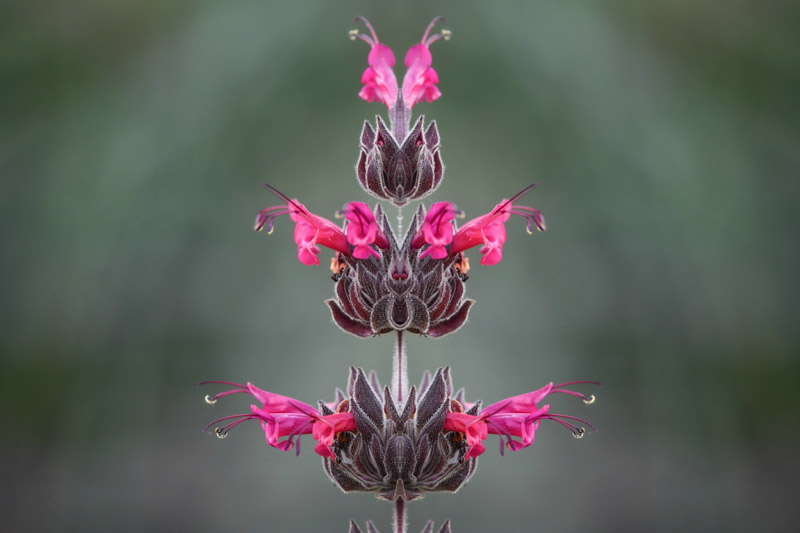
California natives are often the smartest starting point for dry shade. Many are adapted to seasonal rainfall, lean soils, summer drought, and the broken light found under trees and chaparral shrubs. They also make a garden feel more regionally grounded.
That said, “native” does not mean “plant anywhere.” Some native plants are excellent in coastal dry shade but need more help inland. Others are best in bright shade, not deep shade. Use the table below as a practical guide, not a one-size-fits-all prescription.
| Plant | Type | Typical Size | Why It Belongs | Best Garden Use |
|---|---|---|---|---|
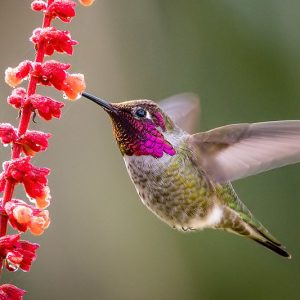
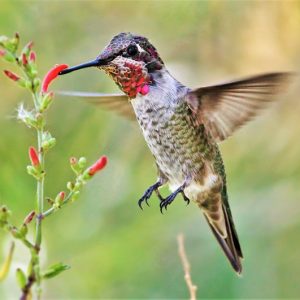
| Salvia spathacea – Hummingbird Sage | Rhizomatous perennial | 1–3 ft tall, spreading | One of the clearest native choices for dry, shady, tree-root conditions. It brings bold flower spikes, aromatic foliage, and hummingbird value. | Oak understories, mass plantings, habitat gardens, dappled shade |
| Ribes viburnifolium – Catalina Currant | Evergreen shrub | 2–3 ft tall, 4–8 ft wide | A valuable evergreen understory shrub for part shade to shade. It gives structure where many perennials look too seasonal. | Under trees, shady slopes, dry woodland edges, low shrub layer |
| Heuchera maxima – Island Alum Root | Evergreen perennial | 1–2 ft foliage, taller bloom stems | Excellent foliage texture for shade, especially in coastal and mild gardens. Inland, it usually needs deeper shade and careful establishment. | Shady borders, oak-edge plantings, coastal dry shade, foliage accents |
| Carex tumulicola – Foothill Sedge | Evergreen sedge | 1–2 ft tall and wide | A graceful grass-like native for part shade and open woodland effects. Best with establishment water and occasional support in very dry inland sites. | Woodland edges, informal ground layer, shade texture, erosion control in mild sites |
| Diplacus aurantiacus – Sticky Monkey Flower | Evergreen to semi-evergreen subshrub | 3–4 ft tall and wide, depending on form | A colorful native for bright shade, dry part shade, and inland gardens where afternoon shade helps. Excellent for hummingbirds and informal native plantings. | Bright dry shade, inland part shade, slopes, habitat gardens, shrub edges |
| Carpenteria californica – Bush Anemone | Evergreen shrub | 4–8 ft tall and wide | A handsome native shrub for sheltered, dappled shade or filtered sun. It tolerates some dryness once established but looks best with occasional deep summer water. | Shaded entries, woodland edges, protected slopes, refined native shrub plantings |
| Heteromeles arbutifolia – Toyon | Evergreen shrub or small tree | 6–15 ft tall and wide, often larger with age | A drought-tolerant native for sun to part shade, valuable for evergreen structure, flowers, berries, and wildlife. Better for light shade than dense understory shade. | Background structure, large dry-shade edges, screens, habitat gardens |
| Ribes sanguineum – Red Flowering Currant | Deciduous shrub | 5–12 ft tall and wide | A beautiful flowering shrub for coastal or cooler shade, with strong hummingbird value. Inland, it usually needs more shade and more summer support. | Cooler shade gardens, coastal dry shade, woodland edges, pollinator plantings |
| Ribes speciosum – Fuchsia-Flowered Gooseberry | Deciduous shrub | 3-10 ft tall | A strong winter-to-spring flowering shrub with excellent hummingbird value. Best where its thorny, informal character fits the design. | Wildlife gardens, native shrub layers, dry woodland edges |
| Polypodium californicum – California Polypody | Fern | 1–2 ft tall, spreading slowly | A native fern that fits California’s seasonal rhythm better than many lush woodland ferns. It may go summer dormant, then return with fall and winter moisture. | Rocky shade, oak understories, shaded banks, wall pockets |
| Iris douglasiana and Pacific Coast Iris hybrids | Perennial | 1–2 ft tall | Useful for evergreen texture and spring bloom in part shade. Best in milder climates or sites with enough establishment moisture. | Shady borders, repeated accents, oak-edge plantings, mixed native gardens |
| Monardella villosa – Coyote Mint | Perennial | 1–2 ft tall | Best in bright shade or dappled shade rather than deep shade. Adds fragrance, pollinator value, and a soft native-garden look. | Woodland edges, smaller gardens, pollinator plantings, dry mixed borders |
| Clematis lasiantha – Chaparral Clematis | Vine | 8–20 ft or more | A useful native vine for dry, dappled shade where vertical or scrambling growth is welcome. | Woodland edges, native fences, informal shrub layers, habitat gardens |
| Ceanothus thyrsiflorus var. griseus – Carmel Ceanothus | Evergreen shrub | 3–15 ft, depending on form | Best for coastal or mild-climate part shade, not dense inland shade. Use where a sprawling evergreen native shrub is appropriate. | Coastal shade gardens, mild slopes, informal native shrub plantings |
| Mahonia nervosa – Cascade Mahonia | Evergreen groundcovering shrub | 1–2 ft tall, slowly spreading | Useful in cooler, woodland-style plantings where evergreen foliage matters more than showy bloom. | Cooler gardens, shaded borders, woodland understories |
| Triteleia laxa – Ithuriel’s Spear | Bulb | 1–3 ft in bloom | Adds seasonal spring color without needing to dominate the garden year-round. | Dappled shade, seasonal native displays, bulb layers between structural plants |
| Dichelostemma ida-maia – Firecracker Flower | Bulb | 1–2 ft in bloom | A seasonal accent for bright shade or open woodland conditions, especially where hummingbird appeal is desired. | Open woodland, dappled shade, seasonal native accents |
| Dudleya caespitosa and Dudleya farinosa | Succulents | 6–12 in. rosettes, taller flower stems | Specialist choices for coastal bright shade, rocky pockets, walls, and containers. Not ideal for dense tree-root shade. | Coastal rock gardens, wall plantings, bright shade, containers |
How to use this list well
Start with dependable backbone plants such as hummingbird sage, Catalina currant, California polypody, island alum root, and Douglas iris. Add larger shrubs, bright-shade specialists, and seasonal bulbs only when the site truly fits them.
Conditional native choices
Some native plants often listed for dry shade or oak understories, such as native strawberries and blue-eyed grass, can work where shade is bright and occasional water is available. They are best treated as site-specific accents rather than primary dry-shade backbone plants.
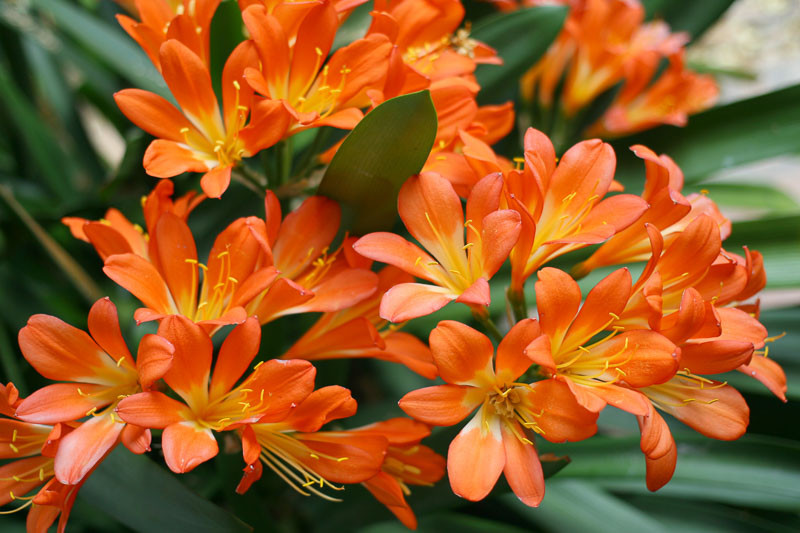
Not every California garden needs to be all-native. In urban gardens, courtyards, entries, and more designed landscapes, a few climate-adapted companion plants can add evergreen polish, clean repetition, and a more formal finish.
These are not all true drought plants. Use them where the garden can provide occasional deep irrigation, especially in inland areas, containers, courtyards, and protected shade. They are best used as supporting players, not as replacements for the native backbone plants.
| Plant | Type | Why It Works | Best Use |
|---|---|---|---|
| Lomandra longifolia | Grass-like perennial | Architectural, durable, and useful for repetition in modern dry-shade designs. Best in part shade or bright shade rather than dense, root-filled darkness. | Modern side yards, path edges, simple massing, designed low-water shade |
| Liriope muscari – Blue Lily Turf | Evergreen perennial | Tidy, familiar, and effective as a repeated edging plant where occasional water is available. More “dryish shade” than truly dry shade. | Borders, pathway edges, urban shade, small designed gardens |
| Aspidistra elatior – Cast Iron Plant | Evergreen perennial | Excellent for deep urban shade, especially in sheltered sites. It tolerates neglect well but looks better with occasional support water. | Dark side yards, courtyards, foundation shade, protected urban gardens |
| Clivia miniata – Natal Lily | Evergreen perennial | Bold leaves and dramatic bloom in dryish, sheltered shade. Useful for design impact, but not a no-water plant. | Entry gardens, patios, protected shade, accent clumps |
| Ruscus aculeatus – Butcher’s Broom | Evergreen shrub-like perennial | Extremely tough in dry shade once established, with dark evergreen structure and good performance in difficult urban shade. | Deep dry shade, foundation plantings, low-maintenance urban gardens |
| Sarcococca ruscifolia – Fragrant Sweet Box | Evergreen shrub | Useful for sheltered shade, fragrance, and evergreen polish, though it performs best with occasional irrigation. | Entries, courtyards, shaded paths, small urban gardens |
| Pittosporum tobira – Japanese Mock Orange | Evergreen shrub | A polished shrub for part shade with good drought tolerance once established in mild California gardens. Dwarf forms are usually easiest to place in designed shade gardens. | Foundation shade, formal edges, modern low-water gardens, background structure |
| Viburnum tinus – Laurustinus | Evergreen shrub | A reliable evergreen shrub for part shade, especially where a denser, more traditional garden look is desired. Best with occasional deep water in dry inland sites. | Screens, background structure, shaded borders, traditional mixed gardens |
| Geranium × cantabrigiense ‘Biokovo’ – Biokovo Cranesbill | Evergreen to semi-evergreen perennial groundcover | A refined groundcover for dryish part shade, with aromatic foliage and pale flowers. Best with occasional water in California gardens. | Path edges, small shade gardens, designed borders, under shrubs with support water |
| Helleborus argutifolius – Corsican Hellebore | Evergreen perennial | Excellent winter foliage and pale green flowers for sheltered shade. More dry-tolerant than many lush shade perennials, but not a no-water plant. | Entries, courtyards, winter-interest shade borders, protected dryish shade |
| Cotoneaster dammeri – Bearberry Cotoneaster | Evergreen groundcovering shrub | A tough, spreading groundcover for sun to part shade, banks, and walls. Drought tolerant once established, though fruiting and density improve with occasional water. | Slopes, retaining walls, large banks, informal groundcover areas |
A reliable design formula
Use California natives for ecological fit and long-term resilience. Add a few climate-adapted companions where they improve structure, rhythm, fragrance, winter interest, or evergreen polish.
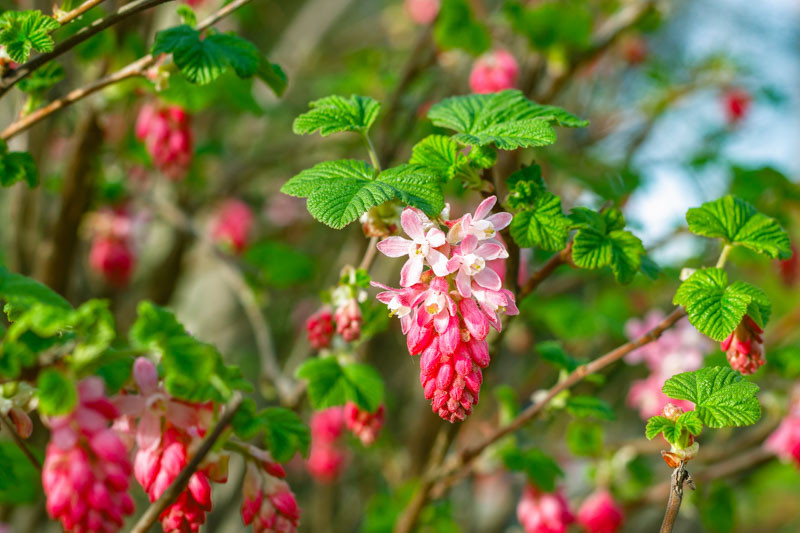
Oak understories require special care. A mature native oak is not just another shade tree. Its root zone is a living system adapted to California’s seasonal rainfall pattern. Frequent summer irrigation near the trunk, heavy digging, grade changes, or dense thirsty plantings can create long-term problems.
The safest oak-understory approach is restrained, open, and summer-dry. Plant lightly, keep irrigation away from the trunk, avoid soil disturbance, and choose plants that can live with limited summer water after establishment.
Oak-tree rule to remember
Under mature California oaks, less is usually better. The goal is to complement the tree, not compete with it.
Catalina currant, island alum root, Douglas iris, foothill sedge, lomandra, cast iron plant, butcher’s broom, liriope, and fragrant sweet box can all work in side yards, depending on light level and irrigation. In deep, dry, urban shade, climate-adapted companions may outperform some natives.
Hummingbird sage, Catalina currant, California polypody, Douglas iris, island alum root, foothill sedge, and fuchsia-flowered gooseberry are among the most useful choices for dry, dappled tree shade. Under native oaks, keep planting open and irrigation minimal.
Catalina currant, foothill sedge, coyote mint, Douglas iris, sticky monkey flower, toyon, and selected native shrubs can help create a natural, drought-aware slope planting. Match plants carefully to slope exposure, soil depth, and erosion pressure.
Island alum root, Douglas iris, coyote mint, California polypody, compact forms of Catalina currant, Biokovo cranesbill, cast iron plant, and fragrant sweet box can make small spaces feel layered without overwhelming them.
Hummingbird sage, sticky monkey flower, coyote mint, fuchsia-flowered gooseberry, red flowering currant, chaparral clematis, island alum root, and native bulbs can bring flowers and wildlife value to dry-shade gardens without forcing a high-water planting style.
A successful dry-shade garden does not depend on nonstop bloom. It depends on foliage, repetition, contrast, seasonal rhythm, and restraint.
The best dry-shade plantings usually use fewer species in larger groups. A planting with twelve different plants in tiny numbers often looks restless. A planting with four to six strong performers repeated confidently looks calmer, more mature, and easier to maintain.
| Layer | Purpose | Good Choices |
|---|---|---|
| Anchor layer | Provides structure and year-round presence | Catalina currant, toyon, bush anemone, Ceanothus in coastal part shade, Mahonia in cooler gardens |
| Ground and foliage layer | Softens bare soil and links the design together | Hummingbird sage, California polypody, foothill sedge, island alum root, Douglas iris |
| Accent layer | Adds bloom, texture, or seasonal drama | Sticky monkey flower, coyote mint, native bulbs, fuchsia-flowered gooseberry, red flowering currant |
| Polish layer | Adds designed rhythm, evergreen neatness, fragrance, or winter interest | Lomandra, liriope, cast iron plant, clivia, ruscus, fragrant sweet box, Biokovo cranesbill, Corsican hellebore |
If you want to compare spreads, heights, bloom periods, and design compatibility before planting, use the Gardenia Design Tool to turn a plant list into an actual layout.
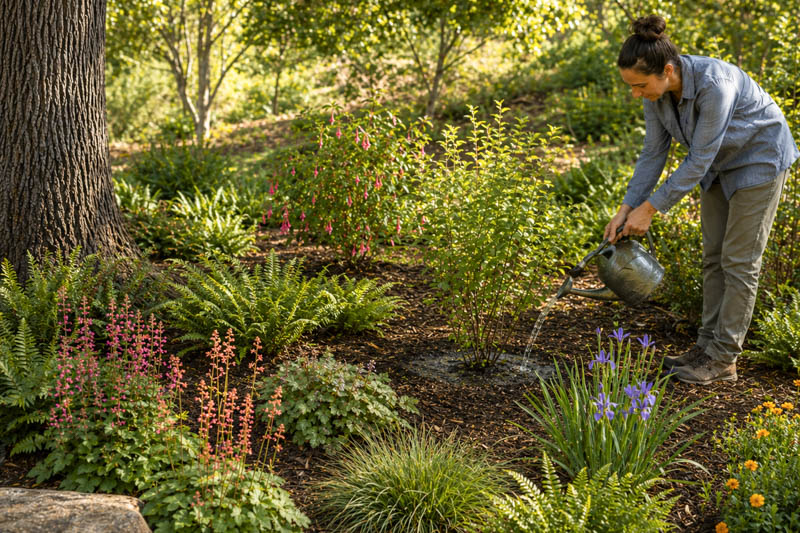
Even drought-tolerant plants usually need help at the beginning. “Low-water after establishment” does not mean “no water on planting day.”
For most dry-shade plantings:
California polypody, for example, naturally follows a seasonal rhythm and may look its best from fall through spring before going summer dormant. That is not failure. It is adaptation. Summer-dry gardens often look different through the year, and good design works with that rhythm rather than fighting it.
The best plant list is only the beginning. Dry shade succeeds when the plants fit the site and fit each other.
Use the Gardenia Plant Finder to narrow choices by shade tolerance, water needs, mature size, bloom season, native status, and garden use. That helps you avoid the common mistake of choosing a plant because it is attractive rather than because it belongs in your specific conditions.
Then use the Gardenia Design Tool to build a complete dry-shade garden plan. This is especially useful for planting under trees, designing a side yard, or creating a layered understory where mature size and spacing matter as much as beauty.
Best next step
Shortlist plants for your exact site, filter them by water and shade needs, then build a layout before buying. Dry shade rewards planning.
The best plants for dry shade in California are not simply shade tolerant. They must handle lower light, reduced summer moisture, root competition, and regional climate pressure while still contributing beauty, structure, or habitat value.
For many gardens, the strongest starting points are hummingbird sage, Catalina currant, California polypody, Douglas iris, island alum root, foothill sedge, coyote mint, and selected native bulbs or shrubs. In larger or brighter dry-shade sites, toyon, bush anemone, sticky monkey flower, and selected Ribes species can expand the planting palette.
In more designed spaces, climate-adapted companions such as lomandra, cast iron plant, ruscus, liriope, fragrant sweet box, clivia, Biokovo cranesbill, and Corsican hellebore can help add polish when used carefully and watered appropriately.
Dry shade is not a lost cause. Planted well, it can become one of the most elegant, low-water, and regionally appropriate parts of a California garden.
Some of the best plants for dry shade in California are hummingbird sage, Catalina currant, California polypody, Douglas iris, island alum root, foothill sedge, coyote mint, fuchsia-flowered gooseberry, and selected native bulbs. Larger or brighter dry-shade sites can also support plants such as sticky monkey flower, toyon, bush anemone, and red flowering currant when the site conditions are right.
Good plants under mature California oaks include hummingbird sage, Catalina currant, California polypody, Douglas iris, island alum root, foothill sedge, and fuchsia-flowered gooseberry. At brighter oak edges, sticky monkey flower or bush anemone may also work. Keep plantings open, avoid digging heavily into the root zone, and do not use plants that need frequent summer irrigation near the trunk or root crown.
Yes, Heuchera maxima, or island alum root, can be excellent in dry shade, especially in coastal and mild California gardens. Inland, it usually needs deeper shade and more careful establishment watering. It is best used as a foliage accent rather than as a rugged, no-water groundcover.
Carex tumulicola, or foothill sedge, is useful in part shade, open woodland, and mild dry-shade situations. It is best with establishment water and may need occasional support in very dry inland gardens. It should also be sourced carefully because it has sometimes been confused in the nursery trade with non-native Carex divulsa.
Often, yes. California native plants are usually the best starting point because many are adapted to seasonal rainfall, summer-dry conditions, and local wildlife. However, the right plant still depends on the exact site. Some natives prefer bright shade, coastal conditions, or occasional water.
Yes. Dry shade can look lush when the design relies on layered foliage, repeated forms, evergreen structure, and seasonal accents instead of thirsty woodland plants. A restrained palette often looks better than a crowded mix of many species.
Useful climate-adapted companion plants for dryish California shade include lomandra, cast iron plant, ruscus, liriope, clivia, fragrant sweet box, Biokovo cranesbill, Corsican hellebore, Pittosporum tobira, Viburnum tinus, and bearberry cotoneaster. Many of these perform best with occasional deep irrigation, especially inland.
Avoid high-water woodland plants, plants that require constantly moist soil, and dense plantings under mature trees. Under native oaks, avoid frequent summer irrigation, heavy digging, and plants that need regular water near the trunk or root crown.
Start by evaluating shade density, root competition, soil type, region, and irrigation limits. Then use the Gardenia Plant Finder to filter plants by shade tolerance, water needs, native status, mature size, and use. After that, use the Gardenia Design Tool to build a planting plan where the selected plants work together.
Updated: April 2026 • Reviewed by Gardenia Editors
Create a membership account to save your garden designs and to view them on any device.
Becoming a contributing member of Gardenia is easy and can be done in just a few minutes. If you provide us with your name, email address and the payment of a modest $25 annual membership fee, you will become a full member, enabling you to design and save up to 25 of your garden design ideas.
Join now and start creating your dream garden!
Create a membership account to save your garden designs and to view them on any device.
Becoming a contributing member of Gardenia is easy and can be done in just a few minutes. If you provide us with your name, email address and the payment of a modest $25 annual membership fee, you will become a full member, enabling you to design and save up to 25 of your garden design ideas.
Join now and start creating your dream garden!