A sun-loving perennial border starring Salvia yangii (Russian sage), Allium sphaerocephalon (drumstick allium), and Gaura lindheimeri. Expect blue-violet haze, floating purple drumsticks, and fluttering white-pink blooms from early summer into fall. Drought tolerant once established and a magnet for bees and butterflies.
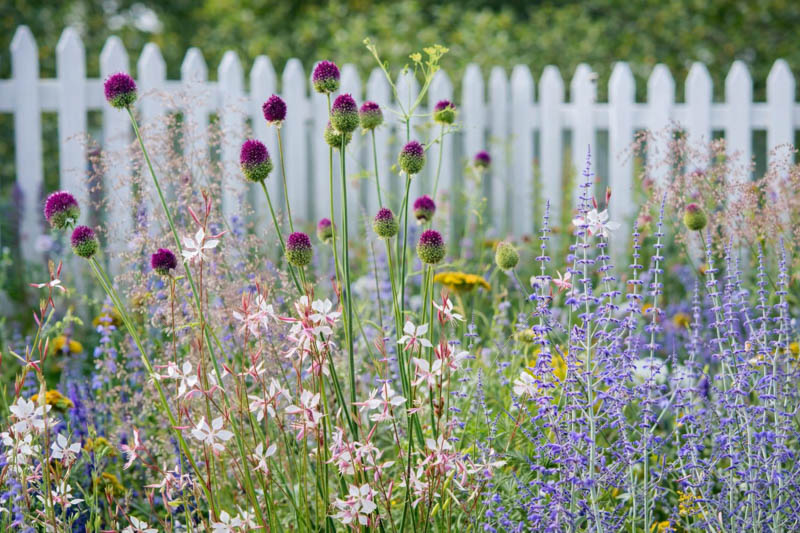


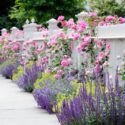
This sunny perennial border keeps the plant palette deliberately simple: Russian sage for broad blue-violet color, drumstick allium for small dark flower heads held above the planting, and Gaura for lighter flowers on wiry stems. Set against a white picket fence, the combination feels informal without looking untidy.
The three plants occupy different levels. Salvia yangii forms the main body of the border, Allium sphaerocephalon rises above it on slender stems, and Gaura moves through the front and middle with looser growth. Because the plants differ so much in shape, the border can remain visually interesting even with such a limited palette.
Main plants used: Salvia yangii (Russian Sage), Allium sphaerocephalon (Drumstick Allium), and Gaura lindheimeri (Gaura / Wandflower)
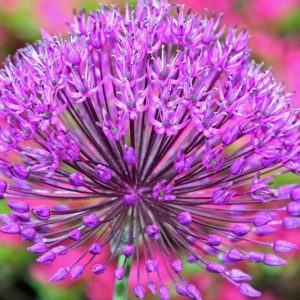
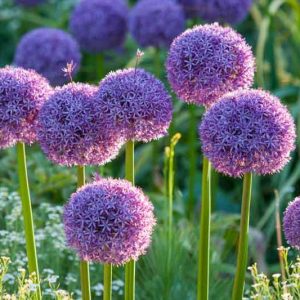
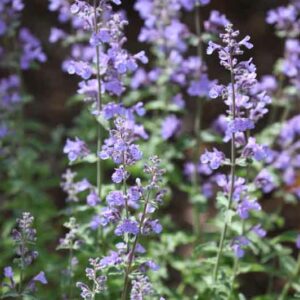
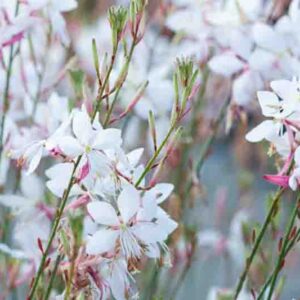
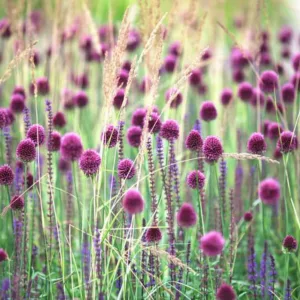
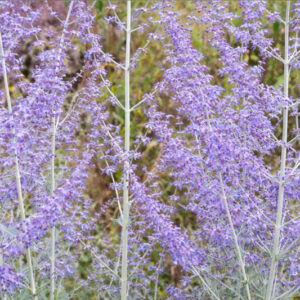
The strongest contrast is between the flower forms. Russian sage produces many small blue-violet flowers along branching stems, creating broad areas of color. Drumstick allium is much more defined, with compact oval flower heads held above the border. Gaura has a looser habit, with individual flowers appearing along thin stems rather than in dense clusters.
The white fence provides a useful background. Pale stems and lighter Gaura flowers remain visible against it, while the deeper purple alliums and blue-violet sage stand out clearly from a distance.
The planting also benefits from repetition. Russian sage appears in substantial groups, while alliums and Gaura recur more lightly through the same area. This gives the border continuity without requiring the plants to be arranged in a repeated sequence.
Salvia yangii provides most of the volume and long-season color. It performs best in full sun and free-draining soil, where the stems remain sturdier and flowering is strongest. Give mature plants enough space rather than crowding them tightly together.
Allium sphaerocephalon is best planted in clusters. The bulbs take up little room at ground level, so they can be tucked between established perennials and allowed to rise through them. Groups are more effective than isolated bulbs, especially when viewed from a distance.
Gaura lindheimeri is useful where the border needs height without a dense block of foliage. Its stems move easily and allow neighboring plants to remain visible through them. In fertile or overly moist soil, growth may become looser, so avoid overfeeding.

Create a full-sun perennial border with a soft blue-violet base, darker flower heads held above it, and lighter flowering stems moving through the front and middle.
Use these percentages as a guide rather than a fixed formula. Mature size and the width of the border matter more than keeping the proportions exact.
Begin with Russian sage in several substantial groups through the middle and rear.
Add Gaura in looser groups toward the front and between the sage plants, allowing some stems to rise through neighboring foliage.
Plant drumstick alliums in clusters between the established perennials rather than forming a separate row. Their flower heads should appear at different points through the planting.
This combination performs best where drainage is good. Rich soil, frequent irrigation, or too much shade can produce softer growth and reduce the upright character of Russian sage and Gaura.
The border also does not need to be perfectly filled from the first season. Russian sage broadens with age, Gaura can become substantial, and the alliums return from bulbs below ground. Leaving a little space at planting time usually produces a better mature result.
| Hardiness |
5 - 8 |
|---|---|
| Heat Zones |
6 - 8 |
| Climate Zones | 2, 3, 4, 5, 6, 7, 8, 9, 10, 11, 12, 13, 14, 15, 16, 17, 18, 19, 20, 21, 22, 23, 24 |
| Exposure | Full Sun |
| Season of Interest | Summer (Early, Mid, Late), Fall |
| Maintenance | Low |
| Water Needs | Low |
| Soil Type | Chalk, Loam, Sand |
| Soil pH | Acid, Alkaline, Neutral |
| Soil Drainage | Well-Drained |
| Characteristics | Showy, Cut Flowers |
| Tolerances | Drought, Deer, Rabbit |
| Attracts | Bees, Butterflies |
| Landscaping Ideas | Beds And Borders, Pathways |
| Garden Styles | Butterfly Garden, Informal and Cottage, Pollinator Garden |


| Hardiness |
5 - 8 |
|---|---|
| Heat Zones |
6 - 8 |
| Climate Zones | 2, 3, 4, 5, 6, 7, 8, 9, 10, 11, 12, 13, 14, 15, 16, 17, 18, 19, 20, 21, 22, 23, 24 |
| Exposure | Full Sun |
| Season of Interest | Summer (Early, Mid, Late), Fall |
| Maintenance | Low |
| Water Needs | Low |
| Soil Type | Chalk, Loam, Sand |
| Soil pH | Acid, Alkaline, Neutral |
| Soil Drainage | Well-Drained |
| Characteristics | Showy, Cut Flowers |
| Tolerances | Drought, Deer, Rabbit |
| Attracts | Bees, Butterflies |
| Landscaping Ideas | Beds And Borders, Pathways |
| Garden Styles | Butterfly Garden, Informal and Cottage, Pollinator Garden |
Recreate this garden. Specify the percentages you would like to have of each plant and input the dimensions of your garden space.We'll give you a shopping list so you know how many plants you need.
| Plant | Quantity | |
|---|---|---|
| Gaura lindheimeri (White Gaura) | N/A | Buy Plants |
| Allium sphaerocephalon (Drumstick Allium) | N/A | Buy Plants |
| Salvia yangii (Russian Sage) | N/A | Buy Plants |
Create a membership account to save your garden designs and to view them on any device.
Becoming a contributing member of Gardenia is easy and can be done in just a few minutes. If you provide us with your name, email address and the payment of a modest $25 annual membership fee, you will become a full member, enabling you to design and save up to 25 of your garden design ideas.
Join now and start creating your dream garden!