Bring seaside charm to your garden with three beautiful flowering perennials. Erigeron glaucus produces lavender-pink daisies from spring into summer, Delosperma 'Fire Wonder' adds fiery orange-red blooms from late spring through summer, and Armeria maritima provides cheerful pink pompons in spring. A colorful, low-growing planting for sunny coastal gardens.
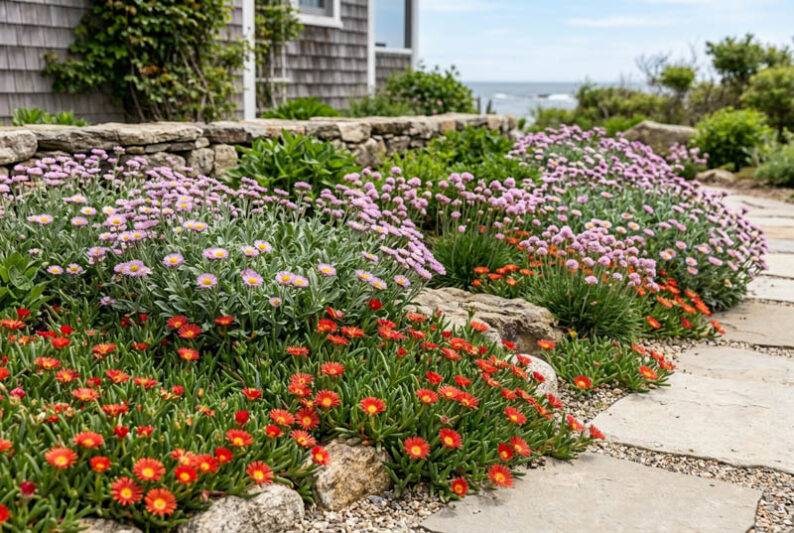


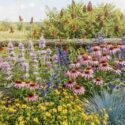
Imagine a garden that captures the carefree beauty of the seaside, with soft pink daisies dancing above silvery foliage, cheerful sea thrift pompons, and brilliant orange-red flowers spilling between weathered stones. This colorful coastal planting brings that relaxed atmosphere right to your doorstep.
Three low-growing perennials create the magic: Erigeron glaucus (Seaside Daisy), Delosperma ‘Wheels of Wonder – Fire Wonder’ (Ice Plant), and Armeria maritima (Sea Thrift). Together, they offer an irresistible mixture of flower shapes, colors, and foliage textures.
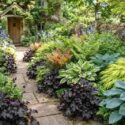
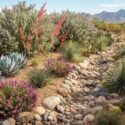
The natural stone wall and pale flagstone path provide the perfect setting. Instead of formal rows, the plants grow in generous, irregular drifts, giving the garden a wonderfully established, windswept character.
Main plants used: Erigeron glaucus, Delosperma ‘Wheels of Wonder – Fire Wonder’, and Armeria maritima.
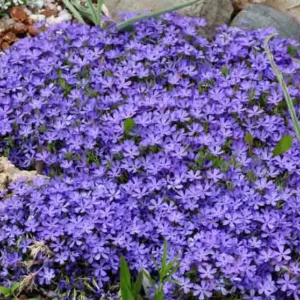
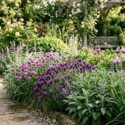
The beauty of this combination lies in its contrasts. Seaside Daisy creates soft, loose mounds of lavender-pink flowers with cheerful yellow centers. Its gray-green foliage provides an attractive, subdued background, while the flowers give the garden a light, informal appearance.
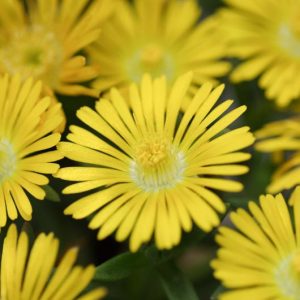
Delosperma ‘Fire Wonder’ introduces a completely different energy. Its brilliant orange-red, daisy-like flowers glow above fleshy green leaves. Positioned near the pathway, they create vibrant pools of color against the pale stone.
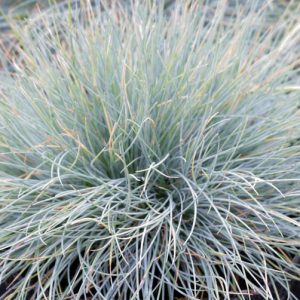
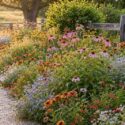
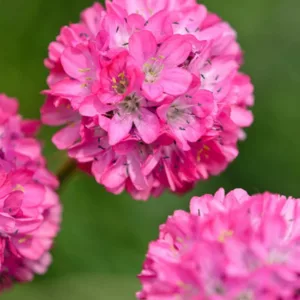
Sea Thrift adds the finishing touch. Its rounded pink flowerheads rise on slender stems above neat, grass-like cushions of evergreen foliage. Their distinctive shape contrasts beautifully with the open daisies surrounding them.
The restrained planting height is another advantage. All three plants remain relatively low, so the garden feels abundant without hiding the stonework or surrounding landscape.
Erigeron glaucus (Seaside Daisy) is a compact perennial native to the Pacific coast of North America. It produces masses of lavender-pink daisies, often flowering from spring through summer in favorable conditions. Its attractive gray-green foliage makes it particularly effective in seaside borders. Unlike many drought-loving rock garden plants, it appreciates some summer moisture.
Delosperma ‘Wheels of Wonder – Fire Wonder’ is a low-growing succulent perennial prized for its brilliant orange-red flowers with contrasting yellow centers. Flowering begins in late spring or early summer and continues through summer when conditions are favorable. It thrives in sunshine and exceptionally well-drained soil.
Armeria maritima (Sea Thrift) is a charming evergreen perennial that forms compact tufts of narrow, grass-like foliage. In spring and early summer, slender stems carry rounded clusters of pink flowers. Naturally adapted to exposed coastal conditions, it tolerates wind and salt spray.
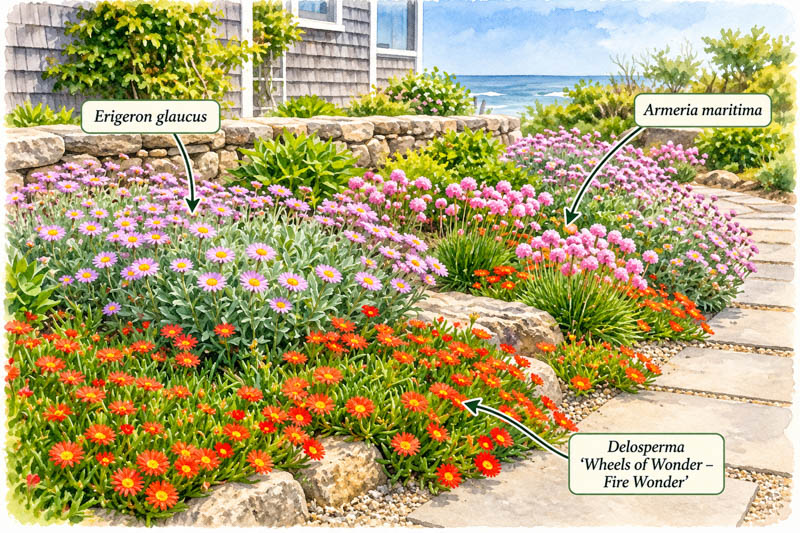
Create a colorful, naturalistic coastal groundcover garden with soft pink daisies, dramatic orange-red flowers, and charming sea thrift pompons.
Begin with a gently curving flagstone path or low stone wall. Position generous groups of Seaside Daisy through the middle of the planting, allowing their lavender-pink flowers to form broad, informal drifts. Tuck Sea Thrift between the daisies in repeated clusters. Place Delosperma at the front, especially along warm, well-drained stone edges, where its brilliant flowers can spread outward. Give Erigeron separate moisture-retentive planting pockets so its watering needs do not compromise the excellent drainage required by Delosperma.
Spring: Sea Thrift begins producing its charming pink pompons, while Seaside Daisy brings soft lavender-pink flowers to the border.
Summer: Delosperma provides the strongest orange-red display, often overlapping with continuing Erigeron flowers. Sea Thrift may produce occasional additional blooms after deadheading.
Autumn and winter: The garden becomes quieter, with low green and gray-green foliage providing texture. Winter foliage persistence depends on temperatures, drainage, and exposure.
Coastal plants are often associated with drought tolerance, but their needs are not identical. Sea Thrift prefers lean soil, Delosperma needs excellent drainage, and Seaside Daisy appreciates more moisture during hot weather.
Their flowering seasons also overlap imperfectly. A garden photograph showing every plant in peak bloom is best understood as an inspiring design concept rather than a guaranteed display throughout the season.
For the most beautiful result, keep the planting informal, leave some natural stone visible, and repeat the three plants in confident groups. The contrast between soft lavender daisies, pink pompons, and fiery flowers is what makes this seaside garden so memorable.
| Hardiness |
8 - 9 |
|---|---|
| Heat Zones |
5 - 8 |
| Climate Zones | 4, 5, 6, 15, 16, 17, 21, 22, 23, 24 |
| Exposure | Full Sun |
| Season of Interest | Spring (Mid, Late), Summer (Early, Mid, Late) |
| Maintenance | Low |
| Water Needs | Low, Average |
| Soil Type | Loam, Sand |
| Soil pH | Acid, Neutral, Alkaline |
| Soil Drainage | Well-Drained |
| Characteristics | Showy, Evergreen |
| Tolerances | Drought, Deer |
| Attracts | Bees, Butterflies |
| Landscaping Ideas | Beds And Borders, Ground Covers |
| Garden Styles | Butterfly Garden, Coastal Garden, Informal and Cottage, Pollinator Garden |


| Hardiness |
8 - 9 |
|---|---|
| Heat Zones |
5 - 8 |
| Climate Zones | 4, 5, 6, 15, 16, 17, 21, 22, 23, 24 |
| Exposure | Full Sun |
| Season of Interest | Spring (Mid, Late), Summer (Early, Mid, Late) |
| Maintenance | Low |
| Water Needs | Low, Average |
| Soil Type | Loam, Sand |
| Soil pH | Acid, Neutral, Alkaline |
| Soil Drainage | Well-Drained |
| Characteristics | Showy, Evergreen |
| Tolerances | Drought, Deer |
| Attracts | Bees, Butterflies |
| Landscaping Ideas | Beds And Borders, Ground Covers |
| Garden Styles | Butterfly Garden, Coastal Garden, Informal and Cottage, Pollinator Garden |
Recreate this garden. Specify the percentages you would like to have of each plant and input the dimensions of your garden space.We'll give you a shopping list so you know how many plants you need.
| Plant | Quantity | |
|---|---|---|
| Erigeron glaucus (Seaside Daisy) | N/A | Buy Plants |
| Delosperma 'Wheels of Wonder - Fire Wonder' (Ice Plant) | N/A | Buy Plants |
| Armeria maritima (Sea Thrift) | N/A | Buy Plants |
Create a membership account to save your garden designs and to view them on any device.
Becoming a contributing member of Gardenia is easy and can be done in just a few minutes. If you provide us with your name, email address and the payment of a modest $25 annual membership fee, you will become a full member, enabling you to design and save up to 25 of your garden design ideas.
Join now and start creating your dream garden!