Breeze, light, and color define this flowing prairie border. orange milkweed and lavender hyssop glow among feathery Stipa, while sturdy Switchgrass anchors the back.
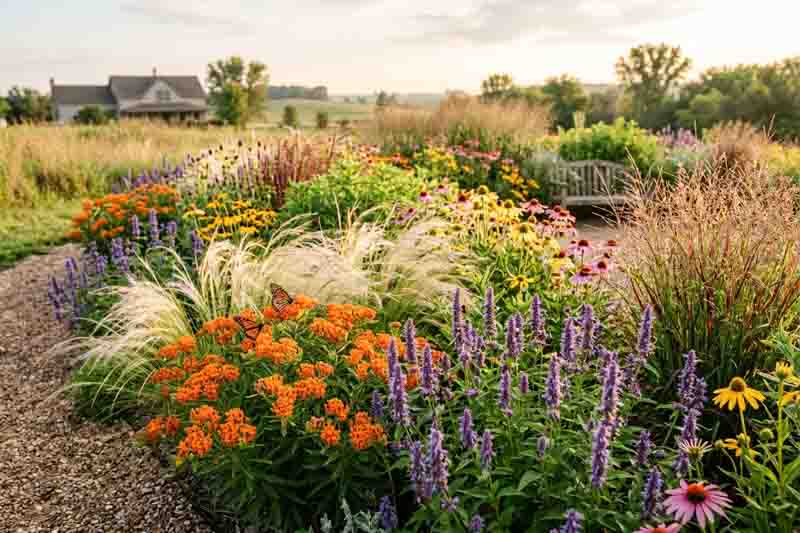


This sunny prairie-style planting combines bright orange flowers, lavender-blue spikes, and two very different grasses. Asclepias tuberosa forms vivid orange groups through the foreground, while Agastache foeniculum rises among them with upright lavender flower spikes. Pale clumps of Nassella tenuissima move through the planting, and taller Panicum virgatum provides a more upright grass structure farther back.
Main plants used: Asclepias tuberosa, Agastache foeniculum, Nassella tenuissima, and Panicum virgatum
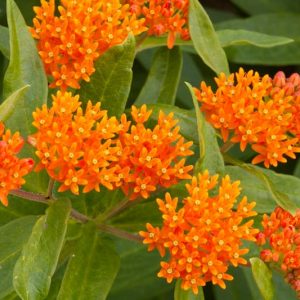
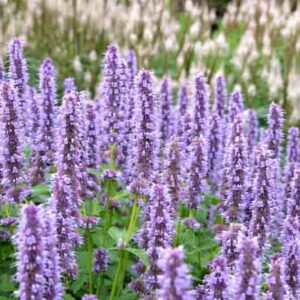
The strongest contrast comes from the flowers. Butterfly Milkweed forms dense, flat-topped orange clusters, while Anise Hyssop carries narrow lavender-blue spikes. The difference in both color and shape keeps the flowering layer varied without making it visually busy.
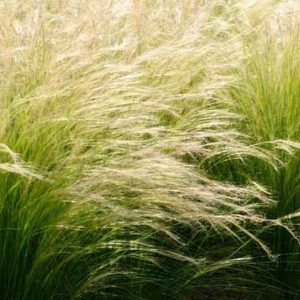
The two grasses are equally different. Mexican Feather Grass has extremely fine leaves and pale flower stems that bend easily in the wind. Switchgrass is taller and more upright, with a stronger vertical habit and airy flowering panicles later in the season.
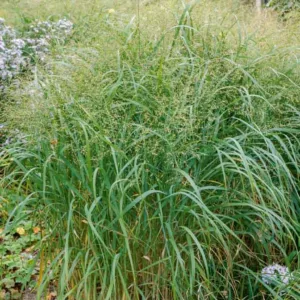
The photograph also shows why the grasses should not be arranged as simple front-and-back layers. Mexican Feather Grass appears in repeated clumps throughout the garden, while Switchgrass rises in several taller groups. That irregular repetition gives the planting depth and makes it feel more like a prairie than a conventional border.
Asclepias tuberosa, or Butterfly Milkweed, provides the strongest warm color. Its orange flower clusters appear above narrow foliage in summer and attract a wide range of pollinators. It is also a larval host plant for monarch butterflies. Give it full sun and well-drained soil, and avoid disturbing established plants unnecessarily because of their deep taproots.
Agastache foeniculum, or Anise Hyssop, produces upright lavender-blue flower spikes over aromatic foliage. It flowers for an extended period and is especially useful to bees. It prefers sun and good drainage, although it generally appreciates more regular moisture than Butterfly Milkweed in prolonged dry conditions.
Nassella tenuissima, or Mexican Feather Grass, supplies the palest and finest texture. Its narrow leaves and silky flowering stems create the light, windblown clumps visible throughout the photograph.
Important: Mexican Feather Grass can reseed aggressively and is invasive or restricted in some regions. Check local guidance before planting it and use a non-invasive fine-textured grass where it is unsuitable.
Panicum virgatum, or Switchgrass, provides the taller grass framework. Its upright clumps remain attractive through summer, then often develop yellow, orange, red, or burgundy tones in fall depending on the plant and conditions. The stems and seedheads can remain standing through winter for structure and wildlife cover.
Create an open prairie border where orange and lavender flowers repeat through a framework of fine, flowing grass and taller upright Switchgrass.
These percentages describe the overall balance of the four featured plants rather than four equal blocks or equal numbers of individual plants.
Repeat Butterfly Milkweed and Anise Hyssop in irregular groups through the front and middle rather than placing all of one species together.
Use Mexican Feather Grass in broader flowing clumps through several parts of the border. Repeat Switchgrass farther back and through the middle where its taller stems can rise above the flowering plants.
Keep the path open enough for easy access, but allow some grasses and flower stems to lean naturally toward its edges.
This is a drought-tolerant combination once established, but it should not be treated as a no-water garden. New plants need regular irrigation, and Anise Hyssop generally flowers better when it is not subjected to prolonged severe drought.
The planting will also change with age. Switchgrass clumps become larger and more permanent, while Anise Hyssop may reseed and Mexican Feather Grass can spread far more freely than intended. Some thinning and editing will be needed to preserve the original balance.
Finally, Mexican Feather Grass is the plant that requires the most caution. Where it is invasive, restricted, or discouraged, replace it with a locally appropriate fine-textured grass rather than allowing it to escape into nearby natural areas.
| Hardiness |
7 - 8 |
|---|---|
| Climate Zones | 2B, 3, 3A, 3B, 4, 5, 6, 7, 8, 9, 10, 11, 14, 15, 16, 17, 18, 19, 20, 21, 22, 23 |
| Exposure | Full Sun |
| Season of Interest | Spring (Late), Summer (Early, Mid, Late), Fall |
| Maintenance | Low |
| Water Needs | Low |
| Soil Type | Loam, Sand |
| Soil pH | Acid, Neutral |
| Soil Drainage | Well-Drained |
| Characteristics | Cut Flowers, Dried Arrangements, Showy |
| Native Plants | Colorado, Kansas, Midwest, Nebraska, New Mexico, Oklahoma, Rocky Mountains, South Dakota, Southwest, Texas, United States |
| Tolerances | Drought, Deer, Dry Soil |
| Attracts | Bees, Butterflies, Birds |
| Landscaping Ideas | Beds And Borders |
| Garden Styles | Butterfly Garden, Informal and Cottage, Pollinator Garden, Prairie and Meadow |

| Hardiness |
7 - 8 |
|---|---|
| Climate Zones | 2B, 3, 3A, 3B, 4, 5, 6, 7, 8, 9, 10, 11, 14, 15, 16, 17, 18, 19, 20, 21, 22, 23 |
| Exposure | Full Sun |
| Season of Interest | Spring (Late), Summer (Early, Mid, Late), Fall |
| Maintenance | Low |
| Water Needs | Low |
| Soil Type | Loam, Sand |
| Soil pH | Acid, Neutral |
| Soil Drainage | Well-Drained |
| Characteristics | Cut Flowers, Dried Arrangements, Showy |
| Native Plants | Colorado, Kansas, Midwest, Nebraska, New Mexico, Oklahoma, Rocky Mountains, South Dakota, Southwest, Texas, United States |
| Tolerances | Drought, Deer, Dry Soil |
| Attracts | Bees, Butterflies, Birds |
| Landscaping Ideas | Beds And Borders |
| Garden Styles | Butterfly Garden, Informal and Cottage, Pollinator Garden, Prairie and Meadow |
Recreate this garden. Specify the percentages you would like to have of each plant and input the dimensions of your garden space.We'll give you a shopping list so you know how many plants you need.
| Plant | Quantity | |
|---|---|---|
| Asclepias tuberosa (Butterfly Milkweed) | N/A | Buy Plants |
| Agastache foeniculum (Anise Hyssop) | N/A | Buy Plants |
| Stipa tenuissima (Mexican Feather Grass) | N/A | Buy Plants |
| Panicum virgatum (Switchgrass) | N/A | Buy Plants |
Create a membership account to save your garden designs and to view them on any device.
Becoming a contributing member of Gardenia is easy and can be done in just a few minutes. If you provide us with your name, email address and the payment of a modest $25 annual membership fee, you will become a full member, enabling you to design and save up to 25 of your garden design ideas.
Join now and start creating your dream garden!
Create a membership account to save your garden designs and to view them on any device.
Becoming a contributing member of Gardenia is easy and can be done in just a few minutes. If you provide us with your name, email address and the payment of a modest $25 annual membership fee, you will become a full member, enabling you to design and save up to 25 of your garden design ideas.
Join now and start creating your dream garden!