Tomato 'Sungold', Tomato 'Sun Gold', Solanum lycopersicum 'Sun Gold', Lycopersicon esculentum 'Sungold', Lycopersicon esculentum 'Sun Gold'

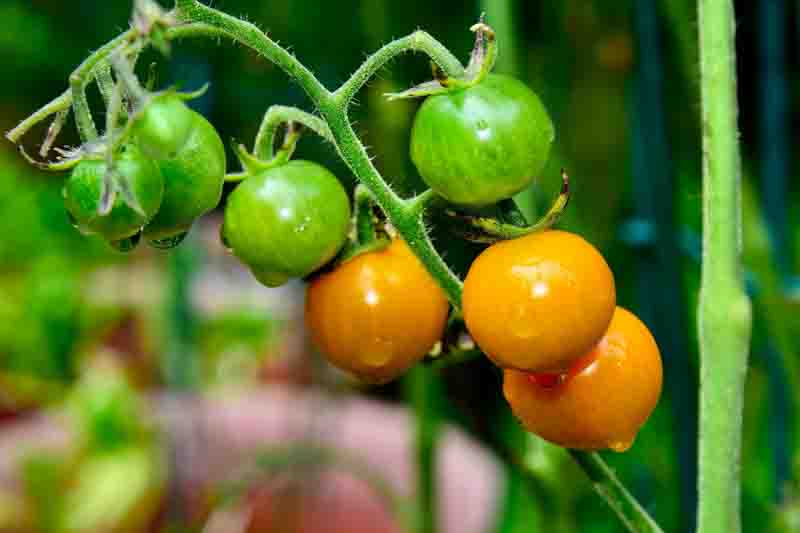


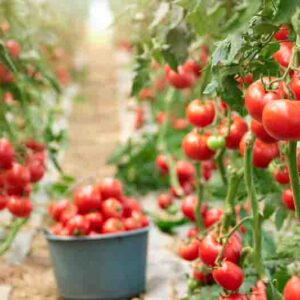
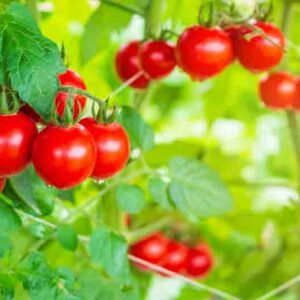
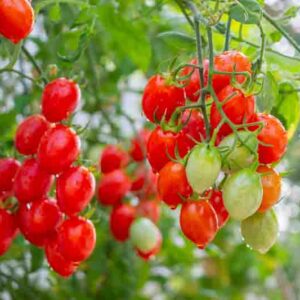
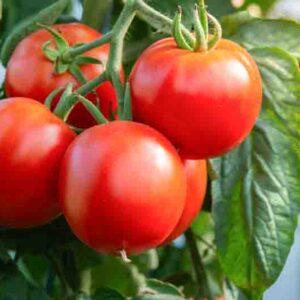
Solanum lycopersicum ‘Sungold’, also widely sold as ‘Sun Gold’, is an exceptionally popular F1 hybrid cherry tomato celebrated for its intensely sweet, fruity flavor and brilliant tangerine-orange fruits. Early, vigorous, and highly productive, its indeterminate vines begin cropping well before many larger-fruited tomatoes and continue producing clusters of bite-sized fruit through the growing season.
‘Sungold’ is especially valuable to gardeners who want a cherry tomato that combines earliness, sweetness, and sustained production. Its outstanding flavor is the main attraction, but there is a practical tradeoff: ripe fruits can be prone to splitting, particularly when moisture conditions change suddenly.
Gardenia cultivar insight: ‘Sungold’ is an F1 hybrid, not an open-pollinated heirloom. Seeds saved from ripe fruit may germinate, but the next generation will not reliably reproduce the original cultivar. Gardeners who want the characteristic Sungold combination of orange color, intense sweetness, early maturity, and vigorous production should start with genuine F1 seed.
| Botanical Name | Solanum lycopersicum ‘Sungold’ |
|---|---|
| Family | Solanaceae |
| Common Names | Sungold tomato, Sun Gold tomato, Sungold cherry tomato |
| Origin | F1 hybrid developed by Tokita Seed Company in Japan; released in Japan in 1989 and introduced internationally in the early 1990s |
| Plant Type and Habit | Warm-season fruiting annual; vigorous, indeterminate vine requiring support |
| Size | Typically about 3-5 ft. tall (90-150 cm), potentially taller when strongly supported in a long growing season |
| Growth Habit | Indeterminate; continues producing new stems, flower clusters, and fruit until frost, disease, or unfavorable weather ends growth |
| Tomato Type | F1 hybrid orange cherry tomato |
| Fruit | Small, round to slightly oval, tangerine-orange cherry tomatoes, typically about 12-15 g each according to the breeder; some commercial sources list fruits around 15-20 g |
| Flavor | Exceptionally sweet, fruity, and tropical, balanced by enough acidity to keep the flavor bright and complex |
| Days to Maturity | Approximately 57-60 days from transplanting under favorable conditions |
| Sun and Exposure | Full sun; at least 6 hours of direct sunlight, with 8 or more hours preferable |
| Soil | Fertile, organically rich, moist but well-drained clay, loam, or sandy soil; slightly acidic to neutral, ideally around pH 6.0-6.8 |
| Spacing | 24-36 in. (60-90 cm); give large-caged or multi-stem plants additional room where possible |
| Harvest | Early and continuous; harvest when fruits reach their characteristic deep golden-orange to tangerine color |
| Best Uses | Fresh snacking, salads, lunchboxes, appetizers, roasting, fresh sauces, and colorful tomato mixtures |
| Disease Resistance | Tokita lists high resistance to Tomato mosaic virus races 0-2 (ToMV 0-2) and Fusarium wilt race 1 / Fol 0; some U.S. seed sources instead describe resistance using TMV and Fusarium wilt race 1 terminology |
| Container Suitability | Good in a large container with strong support, but this remains a vigorous indeterminate vine rather than a compact patio tomato |
‘Sungold’ has built its reputation on flavor. The small fruits ripen from yellow-orange to glowing tangerine-orange and combine intense sweetness with a fruity, almost tropical character. Unlike a tomato that tastes simply sugary, ripe Sungold fruit retains enough acidity to give the flavor brightness and complexity.
The vines are also highly productive. Once harvest begins, healthy plants continue setting clusters of fruit through the season, providing a steady supply rather than a short, concentrated crop.
Earliness adds to its appeal. At roughly 57-60 days from transplanting under favorable conditions, ‘Sungold’ can begin producing well before many large slicing tomatoes.
Best reason to grow ‘Sungold’: Choose it for flavor plus earliness. It combines exceptionally sweet orange fruit, an early first harvest, and vigorous season-long production – a combination that helps explain why it remains a benchmark among cherry tomatoes.
‘Sungold’ was developed by Japan’s Tokita Seed Company and released in Japan in 1989, reaching international markets in the early 1990s. It is an F1 hybrid, produced from controlled parent lines rather than an open-pollinated cultivar.
That distinction matters to home gardeners. Seeds collected from ripe Sungold tomatoes may germinate, but the resulting plants can segregate genetically and are not expected to reproduce the original hybrid reliably.
Gardenia seed-saving rule: Saving seed and reproducing a cultivar are not the same thing. Seeds taken from a Sungold fruit may grow, but because ‘Sungold’ is an F1 hybrid, the next generation is not genetically equivalent to genuine Sungold F1. Start with true F1 seed when you want the cultivar’s documented traits.
‘Sungold’ is a vigorous indeterminate tomato. It continues extending, flowering, and producing fruit through the growing season rather than terminating after one concentrated crop.
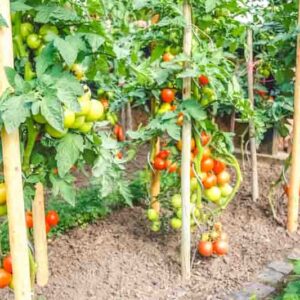
Plants typically reach about 3-5 ft. (90-150 cm) according to cultivar references, but strongly supported vines can become taller where the growing season is long. Install support early rather than attempting to control a mature, fruit-laden vine later.
For help understanding tomato growth habits, see Gardenia’s Determinate vs. Indeterminate Tomatoes.
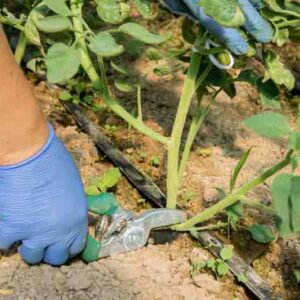
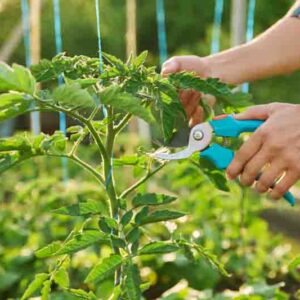
Pruning rule: Do not remove every sucker automatically. On an indeterminate tomato, each retained sucker can become another flowering and fruiting stem. Prune according to the support system, spacing, airflow, and number of stems you can manage.
For detailed pruning guidance, see Gardenia’s How and When to Prune Tomatoes.
Grow ‘Sungold’ in full sun, with at least 6 hours of direct sunlight and preferably 8 or more for strong flowering, fruit production, and flavor development.
Plant in fertile, organically rich, moist but well-drained soil. Clay, loam, or sandy soil can work when fertility and drainage are suitable. Aim for a slightly acidic to neutral pH around 6.0-6.8.
Allow about 24-36 inches (60-90 cm) between plants. Use additional room for large cages, multi-stem vines, or humid conditions where greater airflow is useful.
Maintain reasonably even root-zone moisture. Sudden changes in water availability while ripe fruit is developing can contribute to splitting.
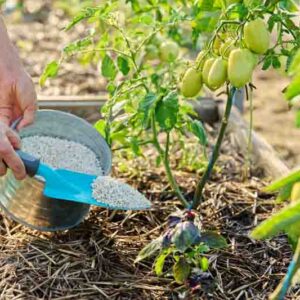
Use balanced fertility and avoid excessive nitrogen. Vigorous vines already have strong vegetative potential, and excessive nitrogen can encourage foliage at the expense of balanced fruit production.
For the best crop: Give ‘Sungold’ strong support, full sun, steady moisture, and regular harvesting. The cultivar is naturally vigorous and productive; the gardener’s job is mainly to keep growth supported and moisture reasonably stable.
For complete tomato care, see Gardenia’s Tomato (Solanum lycopersicum) profile.
One of Sungold’s most important practical weaknesses is fruit splitting. Very ripe fruit can crack, particularly after sudden increases in water availability. Maintaining steadier moisture and harvesting regularly can reduce losses.
Gardenia reality check: Some older cultivar descriptions characterize Sungold as crack-free or highly crack resistant, while current commercial sources identify splitting of ripe fruit as a recognizable weakness. Do not choose ‘Sungold’ specifically for crack resistance – choose it for flavor, earliness, and productivity.
Disease-resistance descriptions also vary slightly among sources. Tokita currently lists high resistance to Tomato mosaic virus races 0-2 (ToMV 0-2) and Fusarium wilt race 1 / Fol 0. Some U.S. seed suppliers instead describe the virus resistance using TMV terminology. The safest approach is to retain the breeder’s current resistance coding while recognizing that commercial descriptions may use different abbreviations.
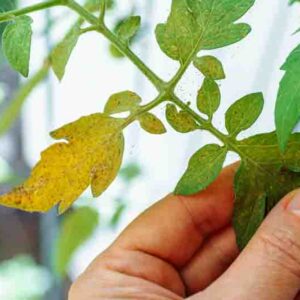
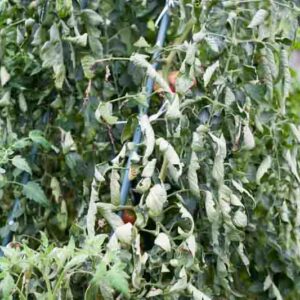
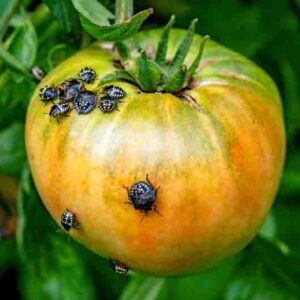
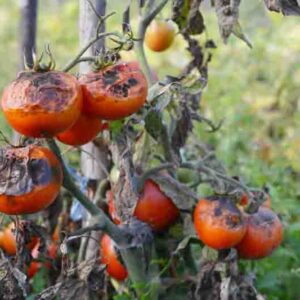
These resistances do not protect ‘Sungold’ from every tomato problem. Plants may still encounter early blight, late blight, Septoria leaf spot, blossom-end rot, and pests such as tomato hornworms.
If symptoms are unclear, use Gardenia’s Tomato Problems: What Is Wrong With My Plant?. For infectious diseases, see Tomato Diseases: Identification, Treatment & Prevention.
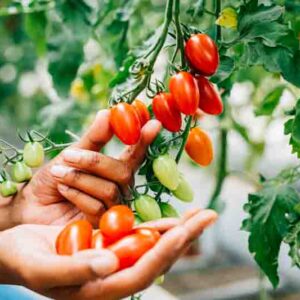
Harvest when the fruits have deepened from yellow-orange to their characteristic glowing tangerine-orange color. Flavor becomes richer as fruits reach full color, but very ripe fruit is also more vulnerable to splitting.
Pick frequently during peak production. If heavy rain is forecast and fruits are already mature and strongly colored, harvesting them slightly earlier can help reduce losses; they can finish coloring indoors.
Gardenia harvest cue: With ‘Sungold’, maximum vine-ripened flavor and minimum cracking do not always occur at exactly the same moment. In stable weather, let fruits reach deep orange. Before heavy rain, harvesting mature orange fruit a little earlier may be the better tradeoff.
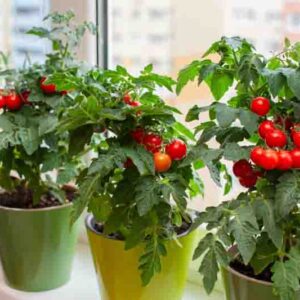
‘Sungold’ grows well in containers when given sufficient root volume, but its small fruit should not be mistaken for a small plant. This is a vigorous indeterminate tomato.
Use a large container, preferably around 10 gallons or more, and provide strong vertical support. Larger pots hold moisture more steadily than small containers, an important advantage for a cultivar whose ripe fruits can split following moisture fluctuations.
Container-grown plants may need frequent moisture checks during hot or windy weather. Pruning can help fit the vine to its support, but pruning cannot compensate for inadequate root volume.
Container reality: Cherry-sized fruit does not mean patio-sized growth. ‘Sungold’ can be excellent in a container, but plan for a substantial root system, strong support, and a vigorous vine.
Choose companion plants that share the same full sun, fertile soil, good drainage, and regular moisture without crowding Sungold’s vigorous canopy or root zone.
Basil (Ocimum basilicum) enjoys full sun, well-drained soil, and regular moisture and fits naturally into an edible tomato bed.
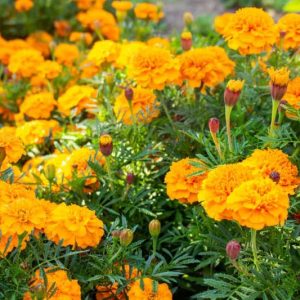
French Marigold (Tagetes patula) thrives in full sun and well-drained soil while adding long-season flowers around vegetable beds.
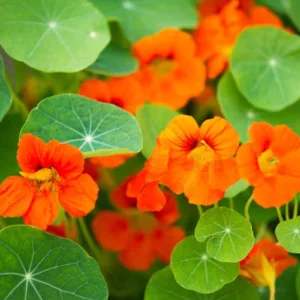
Nasturtium (Tropaeolum majus) can trail along the edge of the planting without competing for vertical canopy space.
Garlic (Allium sativum) shares a preference for sun and good drainage and can occupy garden space before the tomato reaches full summer size.
For more ideas based on compatible growing conditions and practical garden functions rather than folklore, see Gardenia’s Companion Plants for Tomatoes.
‘Sungold’ is indeterminate. Its vigorous vines continue producing new flowers and fruit through the growing season and require sturdy support.
No. ‘Sungold’ is an F1 hybrid developed by Tokita Seed Company. Seed saved from its fruit will not reliably reproduce the original cultivar.
‘Sungold’ typically reaches about 3-5 feet (90-150 cm) according to cultivar references, but strongly supported plants can grow taller during a long season.
‘Sungold’ is an early cherry tomato and generally reaches maturity about 57-60 days after transplanting under favorable conditions.
Tokita lists Sungold fruit at about 12-15 grams each, while some commercial seed sources describe fruits around 15-20 grams. Fruit size varies somewhat with growing conditions.
Ripe Sungold fruit can split when water uptake changes rapidly, particularly after dry soil is followed by heavy rain or watering. Consistent moisture and frequent harvesting help reduce losses.
‘Sungold’ is exceptionally sweet with a bright, fruity, almost tropical flavor balanced by enough acidity to keep the taste lively rather than simply sugary.
Yes. Use a large container, preferably around 10 gallons or more, with full sun, consistent moisture, and strong support for the vigorous indeterminate vine.
Yes. Both spellings are widely used for the same orange F1 cherry tomato. Tokita uses “Sungold F1”, while some seed suppliers market the cultivar as “Sun Gold”.
Tokita currently lists high resistance to Tomato mosaic virus races 0-2 and Fusarium wilt race 1 / Fol 0. Some U.S. seed sources describe the virus resistance using TMV terminology, so resistance labels may differ slightly by source.
| Hardiness |
2 - 11 |
|---|---|
| Climate Zones | 1, 1A, 1B, 2, 2A, 2B, 3, 3A, 3B, 4, 5, 6, 7, 8, 9, 10, 11, 12, 13, 14, 15, 16, 17, 18, 19, 20, 21, 22, 23, 24, A1, A2, A3, H1, H2 |
| Plant Type | Annuals, Fruits, Perennials |
| Plant Family | Solanaceae |
| Genus | Solanum, Tomatoes |
| Common names | Tomato |
| Exposure | Full Sun |
| Season of Interest | Summer (Early, Mid, Late), Fall |
| Height | 3' - 5' (90cm - 150cm) |
| Spread | 2' - 3' (60cm - 90cm) |
| Spacing | 24" - 36" (60cm - 90cm) |
| Maintenance | High |
| Water Needs | Average |
| Soil Type | Clay, Loam, Sand |
| Soil pH | Acid, Neutral |
| Soil Drainage | Moist but Well-Drained |
| Characteristics | Plant of Merit |
| Tolerance | Rabbit, Clay Soil |
| Attracts | Bees |
| Garden Uses | Beds And Borders, Patio And Containers, Wall-Side Borders |
| Garden Styles | City and Courtyard, Informal and Cottage, Pollinator Garden |


| Hardiness |
2 - 11 |
|---|---|
| Climate Zones | 1, 1A, 1B, 2, 2A, 2B, 3, 3A, 3B, 4, 5, 6, 7, 8, 9, 10, 11, 12, 13, 14, 15, 16, 17, 18, 19, 20, 21, 22, 23, 24, A1, A2, A3, H1, H2 |
| Plant Type | Annuals, Fruits, Perennials |
| Plant Family | Solanaceae |
| Genus | Solanum, Tomatoes |
| Common names | Tomato |
| Exposure | Full Sun |
| Season of Interest | Summer (Early, Mid, Late), Fall |
| Height | 3' - 5' (90cm - 150cm) |
| Spread | 2' - 3' (60cm - 90cm) |
| Spacing | 24" - 36" (60cm - 90cm) |
| Maintenance | High |
| Water Needs | Average |
| Soil Type | Clay, Loam, Sand |
| Soil pH | Acid, Neutral |
| Soil Drainage | Moist but Well-Drained |
| Characteristics | Plant of Merit |
| Tolerance | Rabbit, Clay Soil |
| Attracts | Bees |
| Garden Uses | Beds And Borders, Patio And Containers, Wall-Side Borders |
| Garden Styles | City and Courtyard, Informal and Cottage, Pollinator Garden |
How many Solanum lycopersicum ‘Sungold’ (Tomato) do I need for my garden?
| Plant | Quantity | |
|---|---|---|
| Solanum lycopersicum ‘Sungold’ (Tomato) | N/A | Buy Plants |
Create a membership account to save your garden designs and to view them on any device.
Becoming a contributing member of Gardenia is easy and can be done in just a few minutes. If you provide us with your name, email address and the payment of a modest $25 annual membership fee, you will become a full member, enabling you to design and save up to 25 of your garden design ideas.
Join now and start creating your dream garden!
Create a membership account to save your garden designs and to view them on any device.
Becoming a contributing member of Gardenia is easy and can be done in just a few minutes. If you provide us with your name, email address and the payment of a modest $25 annual membership fee, you will become a full member, enabling you to design and save up to 25 of your garden design ideas.
Join now and start creating your dream garden!