Discover which vegetables, flowers, and herbs grow best alongside onions, and which combinations deserve caution. Learn what research reveals about carrots, cabbage, beans, and peas, separate pest-control myths from practical benefits, and explore Gardenia's original 48-onion planting plan to make your vegetable garden more productive and beautiful.


What should you plant next to onions? Carrots, lettuce, cabbage, tomatoes, and strawberries regularly appear on lists of good onion companions. Beans and peas, meanwhile, are often described as plants you should never grow nearby. But how much of that advice is supported by evidence?
Successful onion companion planting depends on more than neighboring plants. Onions have relatively shallow roots, need plenty of sunlight, and require time and space to develop full-sized bulbs. The best companions fit their growing season without competing heavily for water, nutrients, or light.
Some provide an early harvest. Others bring beneficial insects to nearby borders. A few combinations have been investigated in field studies, although their results are often more nuanced than traditional gardening advice suggests.
Discover the best and worst companion plants for onions, which popular claims are supported by research, and how to create a productive onion garden using Gardenia’s original planting plan.
Quick Answer: Good onion companions include carrots, lettuce, spinach, radishes, beets, and carefully spaced cabbage. Sweet alyssum, calendula, and flowering herbs add color and resources for beneficial insects. Beans and peas are not universally incompatible, although separate rows are often more practical. Avoid crowding onions with tall, sprawling crops or plants that interfere with bulb development and harvesting.
Onions (Allium cepa) belong to the amaryllis family, alongside garlic, leeks, and chives. They thrive in full sun, fertile, well-drained soil, and consistent moisture during active growth. Their shallow roots make them particularly sensitive to weeds and competition.
Gardenia’s Onion Companion Decision Matrix evaluates potential neighbors by growing compatibility, seasonal timing, physical competition, and research evidence.
| Plant | Gardenia’s Assessment | Best Placement | Why It Matters |
|---|---|---|---|
| Carrots | Promising researched intercrop | Accessible neighboring rows | Can attract onion thrips away from onions |
| Lettuce | Excellent early companion | Adjacent short-season strip | Harvest before bulbs enlarge |
| Spinach | Good cool-season crop | Separate neighboring row | Early leafy harvest |
| Radishes | Excellent quick crop | Accessible outside row | Short growing period |
| Beets and Swiss chard | Compatible with spacing | Neighboring rows | Manage root space and foliage |
| Cabbage | Research-supported conditional intercrop | Well-spaced strips | Some field studies report reduced cabbage pests |
| Tomatoes | Good nearby with planning | Outside mature tomato canopy | Summer shade and water competition |
| Peppers | Compatible seasonal neighbor | Separate sunny row | Manage sunlight and irrigation |
| Strawberries | Conditional | Outside permanent strawberry rows | Protect crowns and runners |
| Sweet alyssum | Useful flowering border | Outside bulb rows | Nectar for beneficial insects |
| Calendula | Good ornamental neighbor | Sunny outside border | Seasonal flowers and insect resources |
| Peas | Conditional | Separate row or trellis | Competition and shading |
| Beans | Conditional; useful following crop | Separate bed or after harvest | No universal incompatibility established |
| Garlic, leeks and shallots | Compatible; disease caution | Separate managed rows | Shared allium pests and pathogens |
| Potatoes, corn and sprawling squash | Separate areas preferred | Away from bulb rows | Shade, competition or harvest disturbance |
How Gardenia evaluates onion companions: “Good” means plants can grow successfully near onions under suitable conditions. It does not mean they have been proven to increase bulb yield. “Conditional” indicates that spacing, season, or disease management matters. These are editorial assessments, not experimental yield scores.
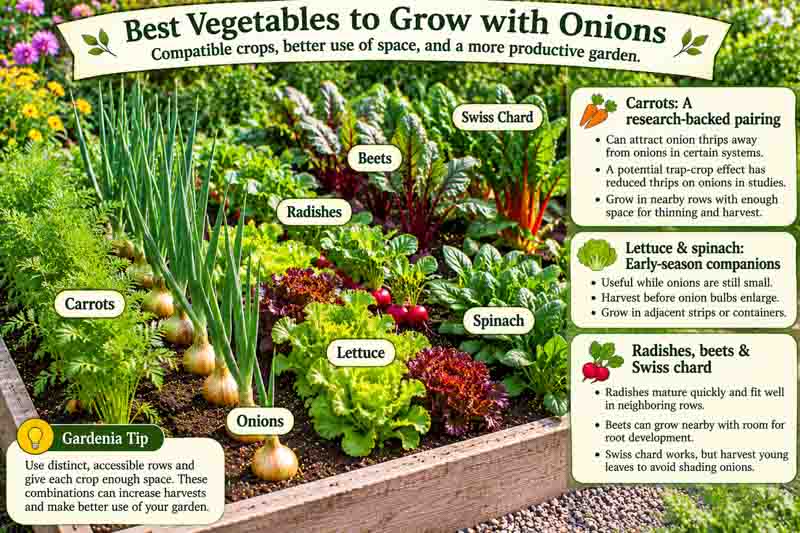
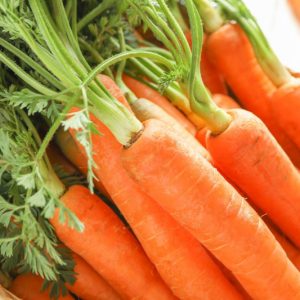
Onions and carrots are a classic vegetable-garden combination. Their contrasting foliage and compatible seasonal requirements make alternating rows practical when each crop has enough space.
There is also a fascinating pest-management connection. Utah State University Extension reports that carrots can attract onion thrips away from onions in certain mixed-cropping systems. This potential trap-crop effect has reduced thrips populations on onions under tested conditions.
That does not mean carrots repel thrips or eliminate the need for pest management. Results depend on planting arrangement and local pest pressure. Likewise, onions are not guaranteed to protect carrots from carrot flies.
Best approach: Grow both crops in distinct, accessible rows, allowing room for carrot thinning and harvest. Explore Gardenia’s Carrot Companion Planting Guide.
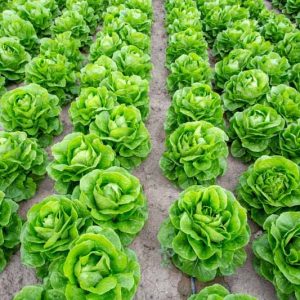
Lettuce and spinach are useful cool-season neighbors while onions are still small. Grow them in adjacent strips or containers, harvesting before onion bulbs need their full growing space.
The benefit is an additional crop rather than permanent groundcover. Dense leafy growth can eventually compete with onions for moisture and nutrients. See Gardenia’s Lettuce Companion Planting Guide.
Radishes mature quickly, making them particularly convenient in neighboring rows. Harvest carefully to avoid disturbing onion roots.
Beets and Swiss chard can also grow nearby. Beets need room for their roots, while mature chard develops broad leaves that may shade onions. Harvest young chard leaves where appropriate.
These are useful space-sharing combinations, although claims that they automatically produce sweeter or larger onions are not established.
| Hardiness |
5 - 10 |
|---|---|
| Climate Zones | 1, 1A, 1B, 2, 2A, 2B, 3, 3A, 3B, 4, 5, 6, 7, 8, 9, 10, 11, 12, 13, 14, 15, 16, 17, 18, 19, 20, 21, 22, 23, 24, A2, A3, H1, H2 |
| Plant Type | Annuals, Bulbs, Herbs |
| Plant Family | Amaryllidaceae |
| Genus | Allium |
| Exposure | Full Sun |
| Season of Interest | Spring (Mid, Late), Summer (Early, Mid, Late) |
| Height | 1' - 2' (30cm - 60cm) |
| Spread | 6" - 1' (15cm - 30cm) |
| Spacing | 6" (15cm) |
| Maintenance | Low |
| Water Needs | Average |
| Soil Type | Chalk, Loam, Sand |
| Soil pH | Acid, Neutral, Alkaline |
| Soil Drainage | Moist but Well-Drained |
| Characteristics | Fragrant |
| Tolerances | Deer, Rabbit |
| Attracts | Bees, Butterflies |
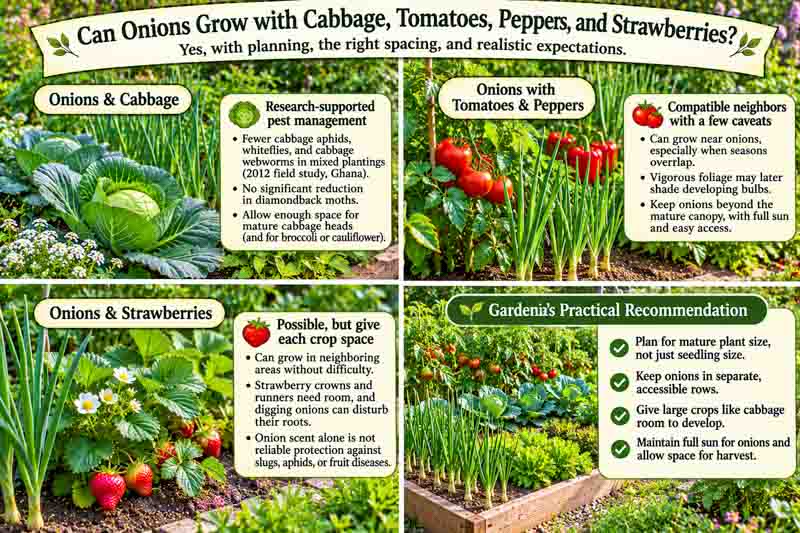
Onions and cabbage can grow in carefully planned strips, with onion leaves occupying relatively little horizontal space. The challenge is allowing for cabbage’s substantial mature size.
A 2012 field study in Ghana found fewer cabbage aphids, whiteflies, and cabbage webworms in cabbage-onion intercrops than in cabbage grown alone. However, diamondback moth populations were not significantly reduced.
This illustrates an important principle: a companion planting arrangement may affect some pests without controlling others. Leave sufficient room for cabbage heads, and apply the same spacing caution to broccoli and cauliflower.
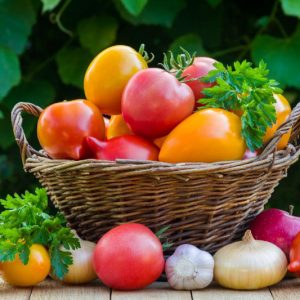
Tomatoes and peppers can grow near onions, particularly where their seasons overlap. But vigorous summer foliage may eventually shade developing bulbs.
Keep onions beyond the mature canopy, with sufficient sunlight and access for harvesting. Their strong aroma does not guarantee protection from tomato pests or improved pepper flavor. For more combinations, consult Gardenia’s Tomato Companion Planting Guide.
Onions and strawberries can occupy neighboring growing areas. However, perennial strawberry crowns and runners need space, and digging onions among established plants can disturb their roots.
A separate outside row is usually easier to manage than inserting bulbs throughout a strawberry patch. Onion scent alone should not be considered reliable protection against slugs, aphids, or fruit diseases.
Gardenia’s practical recommendation: Plan for mature plant size, not just seedling size. Cabbage, tomatoes, and peppers can begin as compact neighbors but eventually overshadow onions. Separate rows protect sunlight and harvesting access.
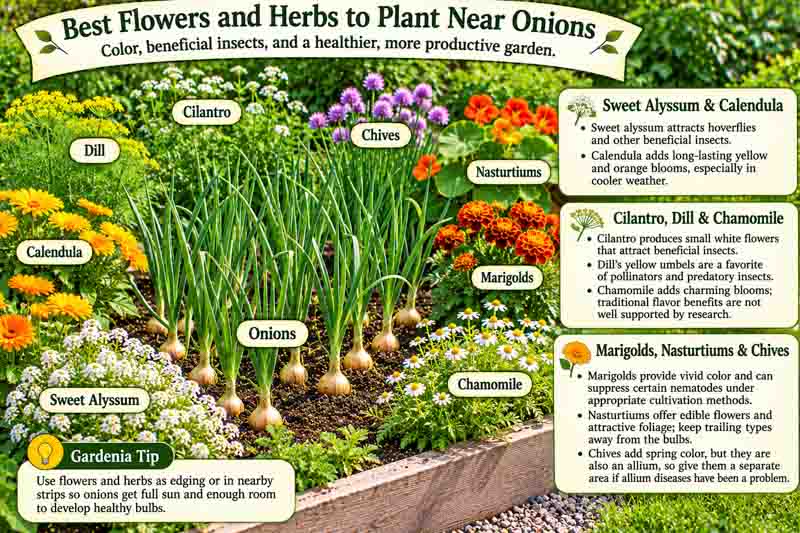
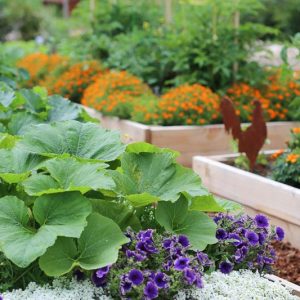
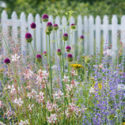
A flowering border can make an onion bed both productive and attractive. Small, nectar-rich flowers provide resources for visiting insects while leaving the bulb rows undisturbed.
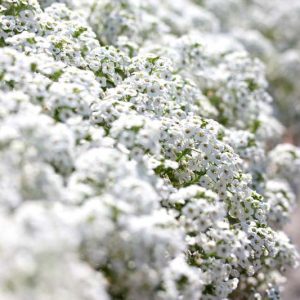
Sweet alyssum produces clusters of tiny flowers visited by hoverflies and other beneficial insects. Its low habit makes it an attractive edging plant.
Calendula brings cheerful yellow and orange flowers. It often performs particularly well in cooler weather, blooming through mild winters or during the frost-free season in colder climates.
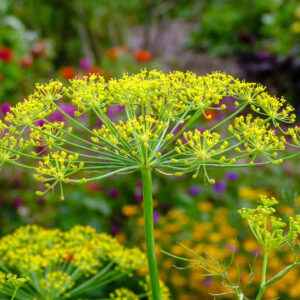
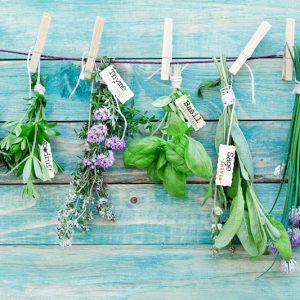
Cilantro develops delicate white flowers as it bolts, while dill produces yellow flower umbels visited by beneficial insects. Keep flowering stems beyond the onion rows.
Chamomile adds charming daisy-like blooms. Although traditionally said to improve onion flavor, reliable field evidence for this claim is lacking. Grow it for its flowers rather than expecting larger or sweeter bulbs.
Marigolds provide vivid summer color. Certain species can suppress particular nematodes under appropriate cultivation methods, but planting a few beside onions does not guarantee pest control.
Nasturtiums offer edible flowers and attractive foliage. Keep trailing varieties away from the bulbs.
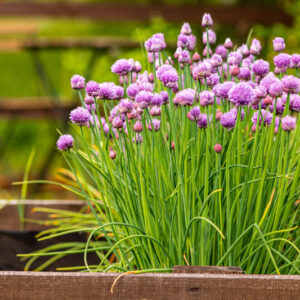
Chives produce pretty purple flowers but share certain pests and diseases with onions. Where allium diseases have occurred, a separate perennial herb area is preferable.
Explore Gardenia’s Companion Planting with Herbs for additional combinations.
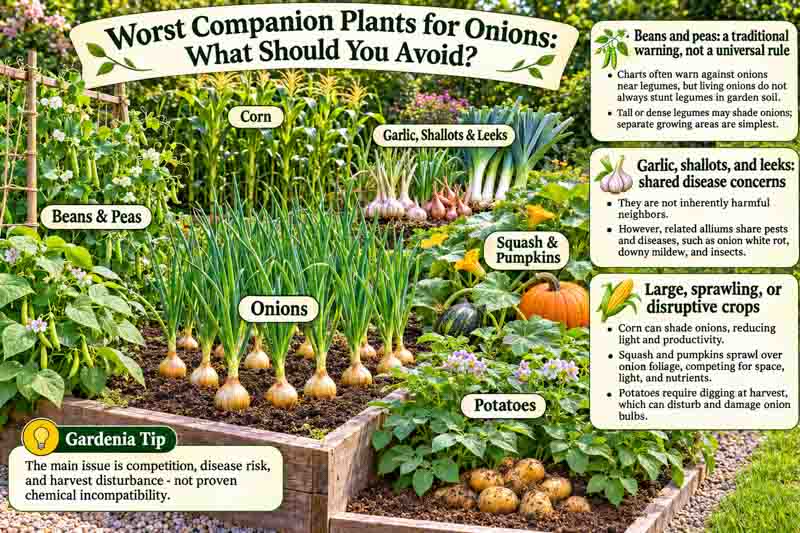
Companion planting charts frequently warn against onions near beans and peas. Some experiments involving allium extracts or particular cropping systems have reported adverse plant interactions, but they do not establish that living onions invariably stunt legumes in ordinary garden soil.
Legumes also vary. Bush beans, pole beans, garden peas, and fava beans differ in size, growing season, and growth habit. Tall varieties may shade onions, while dense planting can create competition.
For predictable onion production, use separate growing areas. Where the season permits, short-season bush beans may be planted after onions are harvested.
Garlic, leeks, and shallots have similar growing requirements and are not inherently harmful neighbors.
However, related alliums share pests and pathogens, including onion white rot, downy mildew, and certain insects. Growing them together requires careful disease management, particularly where contaminated soil is a concern.
Sweet corn can shade onions and compete for water and nutrients. Vigorous squash and pumpkins spread over their foliage, while potatoes require digging that may damage bulbs.
These combinations are better separated in small gardens. The principal concern is competition and harvesting disturbance, not proven chemical incompatibility.
What about asparagus, sage, and dill? These plants also appear on lists of poor onion companions, but categorical warnings are poorly supported. Asparagus has a permanent root system, sage often prefers drier conditions, and tall flowering dill can create shade. Growing requirements and placement matter more than absolute companion planting rules.
Onions produce sulfur-containing compounds that contribute to their distinctive aroma. Some allium compounds influence insect behavior, but growing onions beside another crop is not equivalent to applying concentrated extracts or pesticides.
Research demonstrates that particular intercropping systems can affect pest populations. Carrots have attracted onion thrips away from onions in some studies, while cabbage-onion intercropping has reduced certain cabbage pests.
However, results are specific to the pest, crops, and planting arrangement. The cabbage study discussed earlier did not significantly reduce diamondback moth populations, and onions cannot guarantee carrot-fly protection.
Onions themselves can suffer from thrips, allium leafminers, onion maggots, downy mildew, onion white rot, and bulb rots.
Companion planting is one part of integrated pest management, not a replacement for inspection, healthy planting material, sanitation, or appropriate control methods. Learn more in Gardenia’s Complete Companion Planting Guide.
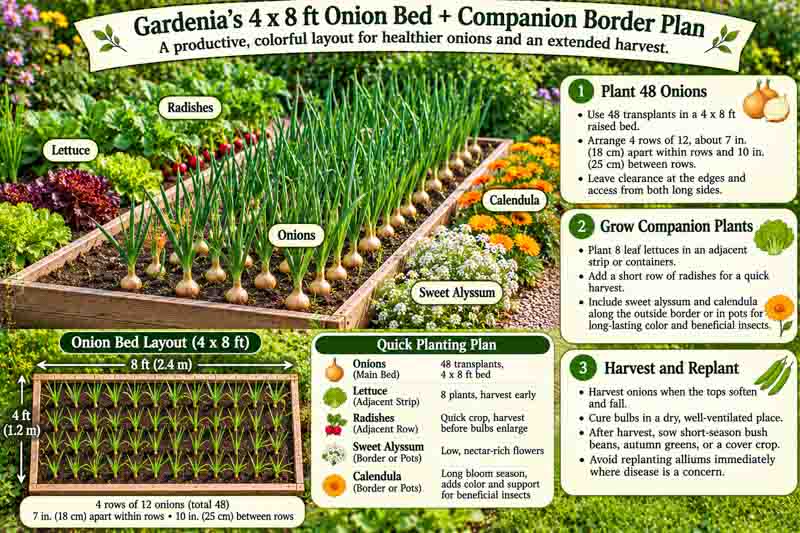
What would a productive onion companion garden actually look like? Gardenia’s original 48-Onion Companion Garden combines a dedicated raised bed with neighboring vegetables, flowering borders, and a possible second harvest.
The 4 x 8 ft dimensions apply to the main onion bed only. Lettuce, radishes, and flowering companions occupy separate adjacent strips or containers. They are not squeezed between the 48 onion plants.
48 onion transplants: Arrange four rows of twelve in a sunny 4 x 8 ft raised bed, approximately 7 inches apart within rows and 10 inches between rows. Leave clearance at the edges and access from both long sides.
This is a practical example for moderately sized bulbs, not a scientifically established yield-maximizing layout. For larger onions, increase spacing and reduce the number of plants. Adapt the arrangement to your variety, local recommendations, and bed dimensions.
8 leaf lettuces: Grow in an adjacent strip or containers. Add a short row of radishes in another accessible space, harvesting both crops before the onion bulbs reach maturity.
Sweet alyssum and calendula: Plant small groups along the outside border or in pots. They add color and resources for visiting insects without competing directly with the onion rows.
As onions mature, their tops naturally soften and fall. Harvest according to variety and local conditions, then cure storage onions in a dry, sheltered, well-ventilated location.
After harvest: If enough warm weather remains, sow short-season bush beans. Otherwise, choose autumn greens or a suitable cover crop. Avoid immediately repeating alliums where disease is a concern.
Adapt the plan to your climate: Short-day onions generally suit lower latitudes and often mature earlier in warm-winter regions. Intermediate-day varieties suit transitional areas, while long-day onions are generally grown farther north. Planting and harvest dates therefore vary considerably. Choose a locally adapted variety before scheduling companion crops or succession planting.
Why this plan works: The onion bed has dedicated growing space, nearby lettuce and radishes provide early harvests, flowers enrich the border, and the cleared bed may support another crop.
Make this Gardenia plan your own: Start with the Onion Plant Profile, explore suitable neighbors in the Plant Finder, and organize your choices using the Garden Design Tool. Check growing conditions, seasonal interest, and quantities before planting.
1. Choosing the wrong day-length variety. Short-day, intermediate-day, and long-day onions initiate bulb development at different day lengths. Select varieties appropriate to your latitude. No companion plant can compensate for an unsuitable variety.
2. Crowding seedlings or sets. Bulb onions need room to expand. Approximately 4-6 inches between plants is common for moderate-sized bulbs, with wider spacing for larger varieties. Green onions can grow closer because they are harvested before full maturity.
3. Allowing weeds to establish. Onion roots are shallow and compete poorly with weeds. Remove unwanted plants early and cultivate gently to avoid root damage.
4. Inconsistent watering or excess fertilizer. Onions need adequate moisture and nutrition during active growth. Severe drying can restrict bulb development, while excessive nitrogen late in the season may delay maturity and reduce storage quality.
5. Repeatedly planting alliums in diseased soil. Onions, garlic, leeks, and shallots share important pathogens. Rotation helps manage some diseases, but onion white rot can persist for many years and requires additional precautions. Explore Gardenia’s Crop Rotation Guide.
Useful onion companions include carrots, lettuce, spinach, radishes, beets, and carefully spaced cabbage. Sweet alyssum, calendula, and flowering herbs also work well nearby. Choose plants that fit onion growing conditions without competing heavily for sunlight, moisture, or root space.
Avoid crowding bulb onions with tall, sprawling crops or vegetables whose harvest disturbs their roots. Corn, vigorous squash, and potatoes are often easier to manage separately. Beans and peas are traditionally discouraged, but universal incompatibility is not established.
Yes. Onions and carrots can grow in neighboring rows with appropriate spacing. Some research has found that carrots attract onion thrips away from onions in mixed-cropping systems. This potential trap-crop effect does not guarantee pest control or protection from carrot flies.
Not necessarily. Traditional gardening advice warns against onions near legumes, but evidence from specific experiments does not establish that living onion plants universally stunt every bean or pea variety. Separate growing areas are a practical choice when bulb production is the priority.
Some onion intercropping arrangements have reduced particular pests in field studies. However, growing onions beside another crop does not guarantee protection against aphids, carrot flies, cabbage pests, or diseases. Appropriate pest monitoring and management remain essential.
Yes. Green onions are harvested young and can grow more closely, allowing flexible short-season combinations. Bulb onions require more growing time, sunlight, and spacing to develop mature bulbs. Companion planting should reflect the intended harvest.
Continue exploring Gardenia: Start with the Onion Plant Profile, explore Carrot Companion Planting, learn more in Gardenia’s Complete Companion Planting Guide, and use the Garden Design Tool to organize your planting plan.
Gardenia editorial guide – November 2026
| Hardiness |
5 - 10 |
|---|---|
| Climate Zones | 1, 1A, 1B, 2, 2A, 2B, 3, 3A, 3B, 4, 5, 6, 7, 8, 9, 10, 11, 12, 13, 14, 15, 16, 17, 18, 19, 20, 21, 22, 23, 24, A2, A3, H1, H2 |
| Plant Type | Annuals, Bulbs, Herbs |
| Plant Family | Amaryllidaceae |
| Genus | Allium |
| Exposure | Full Sun |
| Season of Interest | Spring (Mid, Late), Summer (Early, Mid, Late) |
| Height | 1' - 2' (30cm - 60cm) |
| Spread | 6" - 1' (15cm - 30cm) |
| Spacing | 6" (15cm) |
| Maintenance | Low |
| Water Needs | Average |
| Soil Type | Chalk, Loam, Sand |
| Soil pH | Acid, Neutral, Alkaline |
| Soil Drainage | Moist but Well-Drained |
| Characteristics | Fragrant |
| Tolerances | Deer, Rabbit |
| Attracts | Bees, Butterflies |
Create a membership account to save your garden designs and to view them on any device.
Becoming a contributing member of Gardenia is easy and can be done in just a few minutes. If you provide us with your name, email address and the payment of a modest $25 annual membership fee, you will become a full member, enabling you to design and save up to 25 of your garden design ideas.
Join now and start creating your dream garden!