Sea Buckthorn, Seaberry, Sandthorn, Sallowthorn, Siberian Pineapple, Sea Berry, Swallowthorn, Hippophae rhamnoides subsp. carpatica, Hippophae rhamnoides subsp. mongolica, Hippophae rhamnoides subsp. sinensis
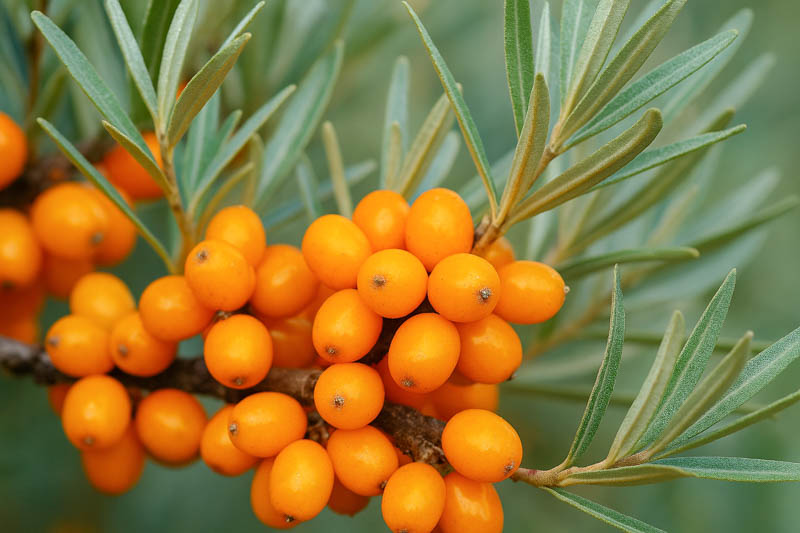
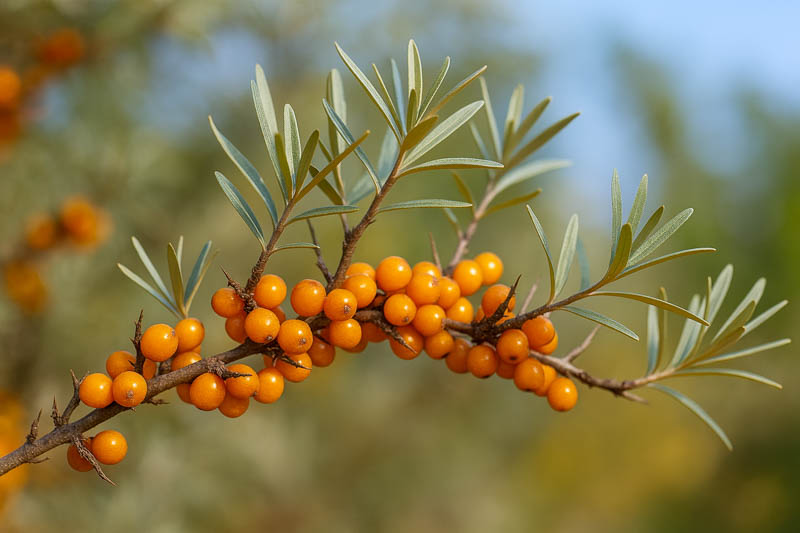
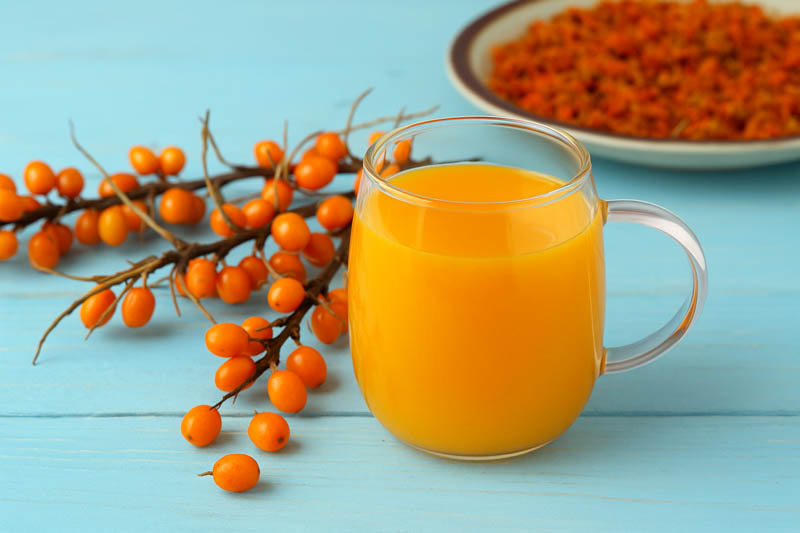
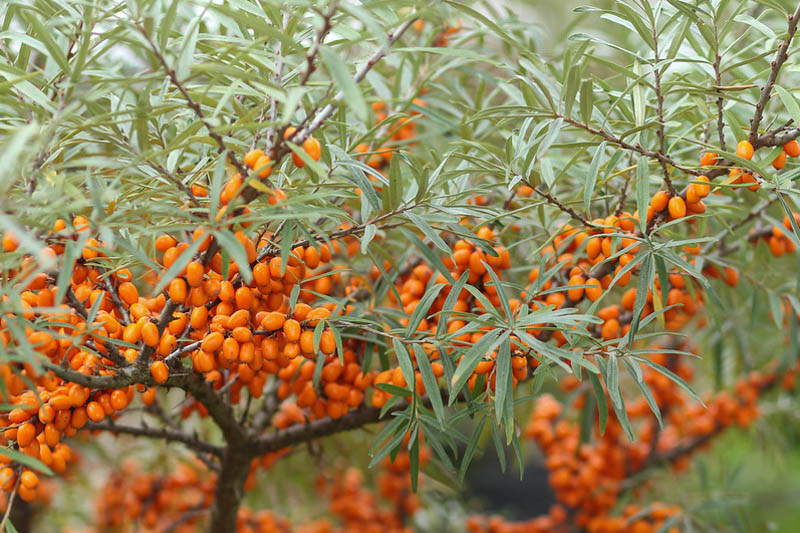


If sunshine could grow on shrubs, Hippophae rhamnoides would be it. Commonly known as sea buckthorn, this hardy, silvery plant lines coastal dunes and mountain slopes, thriving where few others dare. In late summer and fall, its slender branches ignite with clusters of bright orange berries so vivid they look almost metallic in the low sun. The fruit is legendary – tangy, vitamin rich, and adored by both health enthusiasts and hungry birds. Whether you grow it for its berries, its wildlife value, or its rugged beauty, sea buckthorn brings wild charm and golden glow to any garden.
Summary: Hardy, sun loving shrub with silver green foliage and glowing orange berries rich in vitamins. Exceptionally tough in wind, salt, and poor soil.
Use: Wildlife gardens, edible landscapes, erosion control, coastal plantings, hedges, and soil stabilization.
Highlight: The orange berries shine against the silver leaves and are packed with antioxidants and oils used in health and beauty products.
Note: Plants are usually male or female; you need one of each for berries. Male pollinizers (‘Pollmix’, ‘Lord’), females (‘Leikora’, ‘Hergo’, ‘Askola’). 1 male : 6–8 females
| Botanical Name | Hippophae rhamnoides |
|---|---|
| Family | Elaeagnaceae (oleaster family) |
| Common Names | Sea buckthorn, seaberry, sandthorn, Siberian pineapple |
| Native Range | Europe, Central Asia, and parts of China; naturalized in many cold temperate regions |
| Plant Type & Habit | Deciduous shrub or small tree, often multi stemmed with thorny branches |
| Hardiness (USDA) | Zones 3 to 8; extremely cold hardy and salt tolerant |
| Size | 8 to 12 ft tall (2.4 to 3.6 m), spreading by suckers to form dense colonies |
| Sun & Exposure | Full sun; thrives in open, exposed sites |
| Soil | Poor, sandy, or gravelly soil; tolerates salt and drought once established |
| Bloom & Fruit | Tiny yellowish spring flowers before leaves; orange berries ripen late summer to early winter |
| Primary Uses | Erosion control, edible fruit, wildlife support, hedging, and coastal defense plantings |
Sea buckthorn is a sun worshipper through and through. It grows naturally along windy coasts, dry riverbanks, and alpine slopes, thriving where salt spray, wind, and drought defeat most shrubs. The plant’s silvery green foliage shimmers in sunlight, and its thorny branches make it an excellent natural barrier. In late summer, female plants load up with masses of small, bright orange berries that hug the stems so tightly they almost look woven in. Each fruit is a powerhouse of vitamin C, carotenoids, and omega fatty acids, which explains its long history as both a medicinal and cosmetic crop.
Hippophae rhamnoides is native to coastal and mountainous regions of Europe and Asia, stretching from the Atlantic shores of Norway and Britain to the Himalayas and China. It is especially abundant in sandy soils and along river valleys, where its roots stabilize shifting ground. In modern landscapes, it is cultivated worldwide for its resilience, fruit, and beauty.
This deciduous shrub has a dense, upright to spreading habit, forming thickets through root suckers. It can be pruned into a hedge or left to grow naturally into a graceful mound with arching branches. The silver gray leaves catch the light, creating a luminous effect that pairs beautifully with blue skies and coastal grasses.
Moderate to fast, depending on soil fertility and moisture. Once roots are settled, it can add 12 to 24 inches (30 to 60 cm) of growth per year, quickly forming a substantial hedge or windbreak.
Sea buckthorn is long lived and durable. Individual shrubs can thrive for 30 years or more, particularly when periodically rejuvenated by pruning or natural sucker replacement. Old stems can be cut to ground level to encourage fresh growth.
Typical height ranges from 8 to 12 feet (2.4 to 3.6 m), depending on variety and conditions. Coastal forms tend to stay low and spreading, while inland or cultivated selections can form small trees.
Flowers appear in early spring before the leaves. They are small and yellowish green but important for pollination. Sea buckthorn is dioecious – that means male and female flowers occur on separate plants. Wind does the pollinating work, so proximity between the sexes matters if you want berries.
The berries are small, round, and intensely orange, about 0.25 inch (6 mm) in diameter. Their flavor is famously tart, sometimes compared to passion fruit mixed with citrus. Each fruit is packed with vitamin C – several times that of oranges (typically ~250–400 mg/100 g, far above orange’s ~50–53 mg/100 g) – along with E and K vitamins, carotenoids, and fatty acids rare in other fruits. The berries cling stubbornly to the stems, making harvest a bit of an adventure, but the visual payoff is stunning through fall and even into early winter.
Narrow and lance shaped, the leaves are green above and silvery white beneath, giving the plant its shimmering, sea breeze look. They provide texture and movement in windswept plantings and contrast well with darker evergreens.
Exceptionally hardy from USDA Zones 3 to 8. Tolerates temperatures as low as -40°F (-40°C). Wind, salt, and drought tolerance make it ideal for exposed landscapes.
Few shrubs can rival sea buckthorn for wildlife value. Its dense, thorny growth offers nesting sites for birds and protection for small mammals. Pollinators visit the early flowers, while the berries sustain birds such as thrushes and waxwings deep into winter. The plant is a linchpin in natural dunes and riverbanks for stabilizing soils and supporting biodiversity. Small Trees and Shrubs Birds Can’t Resist.
The berries are edible and safe, though very sour when raw. Leaves and bark have traditional medicinal uses but should not be consumed in large quantities without expert guidance. Always verify plant parts before use.
In ideal conditions, sea buckthorn can spread aggressively through root suckers. Contain it by mowing or installing root barriers, or choose grafted, less spreading varieties for small gardens. It is listed or flagged as invasive in some regions (e.g., UK/Ireland dune systems; some U.S. listings). Check local rules before planting. Find where it is invasive in the United States.
Full sun is essential for dense growth and good berry set. Even light shade reduces flowering and fruiting dramatically.
Adaptable to many soil types, including poor sands and gravels. It prefers well drained sites and will even thrive in alkaline soils (tolerates ~pH 5.5–7.5) where few others grow. Avoid heavy, waterlogged clay.
Moderate watering during establishment. Once roots are deep, it survives extended droughts easily. Mulch young plants to conserve soil moisture and suppress weeds.
No fertilizer is needed. As a nitrogen fixer, sea buckthorn actually enriches its soil through nodules on its roots that house beneficial bacteria. Overfeeding can reduce berry production.
Minimal pruning is required. Remove dead, crossing, or weak stems in late winter. To rejuvenate old plants, cut one third of the oldest stems to the base. Avoid midsummer pruning as it can reduce the next season’s flowering wood.
Sea buckthorn can be shaped into a dense hedge or allowed to form a free growing screen. For small gardens, prune suckers annually to control spread. When trained as a small tree, remove lower limbs gradually over several seasons.
A hardy, deciduous shrub known for silvery leaves and bright orange berries. It thrives in poor soils, coastal wind, and cold climates.
No. Sea buckthorn is Hippophae rhamnoides in the oleaster family. Invasive buckthorns are Rhamnus or Frangula. They are unrelated.
Once established, yes. Water regularly the first year, then only during extended dry spells.
Yes. Sea buckthorn is dioecious. Plant at least one male for every 6 to 8 females.
Within about 50 ft or 15 m is a safe rule. Closer is better in windy sites.
Small yellowish flowers in early spring before leaves. Berries ripen late summer through fall and can hang into early winter.
Usually 2 to 4 years from planting, faster for established cuttings or grafted stock.
It suckers freely. Use root barriers, regular mowing, or choose grafted selections in small gardens. Check local guidance in sensitive areas.
Tart and aromatic with citrus and tropical notes. Most people process them into juice, syrups, jams, or fermented drinks rather than eating raw.
Yes. They are rich in vitamin C, carotenoids, and other antioxidants. For medical uses, consult reliable sources and professionals.
Ripe berries are edible. As with any new food, introduce slowly. Keep pets away from thorny branches. If in doubt, ask your vet.
Yields vary widely with age, variety, and climate. Mature females can produce several kilograms per season under good conditions.
Yes. Deep, fibrous roots and suckering habit make it excellent for erosion control where it is appropriate and permitted.
Updated: November 2025 • Reviewed by Gardenia Editors
| Hardiness |
3 - 8 |
|---|---|
| Plant Type | Shrubs |
| Plant Family | Elaeagnaceae |
| Exposure | Full Sun |
| Season of Interest | Spring (Early, Mid), Summer (Late), Fall, Winter |
| Height | 8' - 12' (240cm - 3.7m) |
| Spread | 8' - 12' (240cm - 3.7m) |
| Spacing | 96" (240cm) |
| Maintenance | Low |
| Water Needs | Average |
| Soil Type | Loam, Sand |
| Soil pH | Alkaline, Neutral |
| Soil Drainage | Moist but Well-Drained, Well-Drained |
| Characteristics | Showy, Fruit & Berries |
| Native Plants | United Kingdom |
| Tolerance | Salt |
| Garden Uses | Beds And Borders, Hedges And Screens |
| Garden Styles | Coastal Garden, Informal and Cottage |


| Hardiness |
3 - 8 |
|---|---|
| Plant Type | Shrubs |
| Plant Family | Elaeagnaceae |
| Exposure | Full Sun |
| Season of Interest | Spring (Early, Mid), Summer (Late), Fall, Winter |
| Height | 8' - 12' (240cm - 3.7m) |
| Spread | 8' - 12' (240cm - 3.7m) |
| Spacing | 96" (240cm) |
| Maintenance | Low |
| Water Needs | Average |
| Soil Type | Loam, Sand |
| Soil pH | Alkaline, Neutral |
| Soil Drainage | Moist but Well-Drained, Well-Drained |
| Characteristics | Showy, Fruit & Berries |
| Native Plants | United Kingdom |
| Tolerance | Salt |
| Garden Uses | Beds And Borders, Hedges And Screens |
| Garden Styles | Coastal Garden, Informal and Cottage |
How many Hippophae rhamnoides (Sea Buckthorn) do I need for my garden?
| Plant | Quantity | |
|---|---|---|
| Hippophae rhamnoides (Sea Buckthorn) | N/A | Buy Plants |
Create a membership account to save your garden designs and to view them on any device.
Becoming a contributing member of Gardenia is easy and can be done in just a few minutes. If you provide us with your name, email address and the payment of a modest $25 annual membership fee, you will become a full member, enabling you to design and save up to 25 of your garden design ideas.
Join now and start creating your dream garden!
Create a membership account to save your garden designs and to view them on any device.
Becoming a contributing member of Gardenia is easy and can be done in just a few minutes. If you provide us with your name, email address and the payment of a modest $25 annual membership fee, you will become a full member, enabling you to design and save up to 25 of your garden design ideas.
Join now and start creating your dream garden!