Ground Cherry, Husk Tomato, Strawberry Tomato, Husk Cherry, Strawberry Ground Cherry, Physalis maxima, Physalis cordifolia
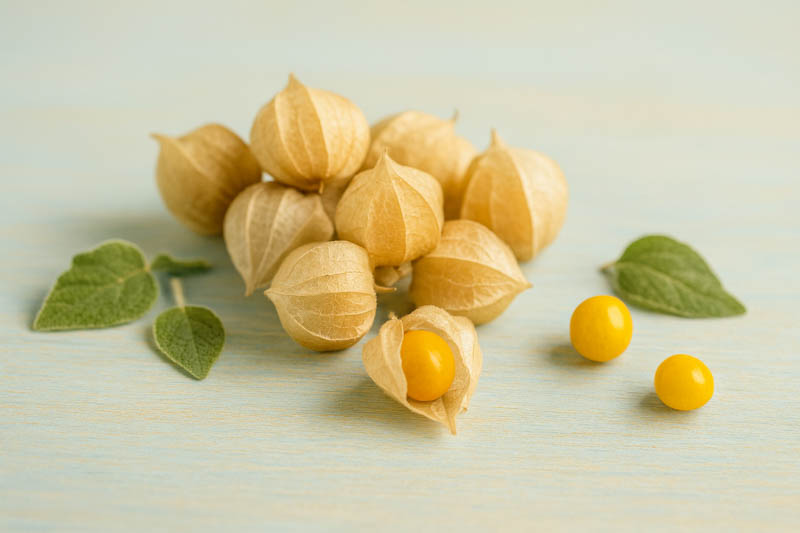
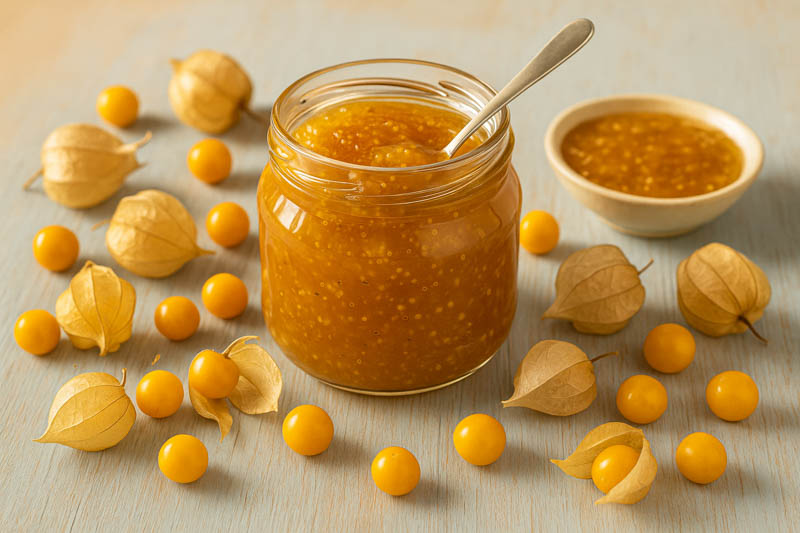


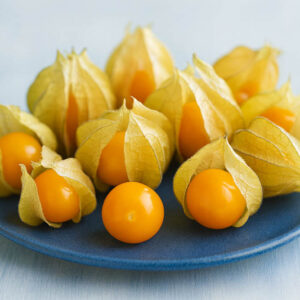
Summary: Ground cherry (Physalis pruinosa), also called husk cherry or strawberry groundcherry, is a compact, early fruiting nightshade that hides sweet, golden berries in papery husks. Easy, prolific, kid-approved.
Taste: Sweet with pineapple-vanilla, honey, and caramel notes; lower acidity than cape gooseberry.
Use: Fresh snacking, salads, salsas, tarts, jams, chutneys, dehydrated “raisins.”
Safety: Eat fully ripe berries only. Husks, leaves, and green unripe fruit are not edible.
| Botanical Name | Physalis pruinosa |
|---|---|
| Family | Solanaceae – nightshade family |
| Common Names | Ground cherry, husk cherry, strawberry groundcherry, “Aunt Molly’s” ground cherry |
| Native Range | Native to Mexico and Central America; grown in temperate gardens worldwide. |
| Plant Type & Habit | Warm-season annual (tender perennial in frost-free zones); low, mounding, and spreading |
| Hardiness (USDA) | Grown as an annual in Zones 3–8; tender perennial in 9–11 (killed by frost) |
| Size | 1–2 ft tall (30–60 cm) and 2–3 ft wide (60–90 cm); branches sprawl with fruit |
| Sun & Exposure | Full sun (6–8 hours); light afternoon shade in very hot summers |
| Soil | Well-drained loam or sandy loam with compost; pH 6.0–7.0 |
| Bloom & Fruit | Pale yellow flowers with brownish spots in early summer; lantern husks tan as berries ripen |
| Days to Maturity | ~65–80 days from transplant to first harvest; fruits steadily until frost |
| Yield | Often 1–3 lb (0.5–1.5 kg) per plant; dozens to hundreds of berries |
| Primary Uses | Snacking, baking, preserves, salsas, chutneys, drying, garnishes |
Imagine a candy jar that refills itself. Ground cherries ripen inside paper lanterns, then let go and dot the mulch with caramel-sweet, golden berries. They’re easy, generous, and the garden snack that never makes it to the kitchen—unless you guard them.
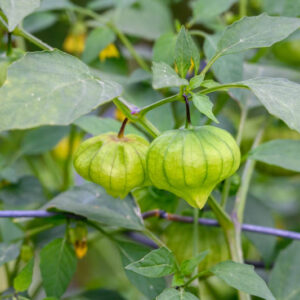
Physalis pruinosa is a compact, branching annual (tender perennial in frost-free zones) with soft, slightly hairy stems and heart-ovate leaves. Nodding, pale yellow flowers—each with a ring of chocolate-brown spots at the throat—appear in early summer. After pollination, the calyx inflates into a papery lantern that shelters the developing berry. When the fruit is fully ripe, the husk turns buff-tan and the berry often drops free like a tiny gift.
Ground Cherry is native to Mexico and Central America, thriving in open, sandy or loamy sites and along field edges. It’s well adapted to warm summers and moderate rainfall—perfect for home gardens across temperate regions.
Expect a low, mounded plant about 1–2 ft tall (30–60 cm) with a 2–3 ft (60–90 cm) spread. Stems tend to arch and sprawl as fruit weight increases. A small tomato cage, short stakes, or twine guides keep fruit off the soil and make daily picking a breeze.
Timing you can plan around: blossoms begin ~4–6 weeks after transplant and continue in waves until frost. Flowers are ~0.4–0.8 in (1–2 cm) across, with five dusky spots around the throat. The lantern (husk) inflates to ~1–1.6 in (2.5–4 cm) long. Berries are typically 0.5–0.8 in (1.3–2 cm) across and turn golden to amber at ripeness. From flower to ripe fruit takes roughly 6–8 weeks under warm, steady conditions.
Groundcherries are sweeter and less tart than cape gooseberries, with pineapple–vanilla and honey notes that lean dessert-friendly. Toss them into green salads, corn salads, and grain bowls; bake into muffins, galettes, and upside-down cakes; blitz for jam or chutney; or dehydrate halves to make tangy “ground cherry raisins.”
| Edibility | Eat only fully ripe, de-husked berries. Husks, leaves, and green unripe fruit are not edible. |
|---|---|
| Toxic Principle | Glycoalkaloids occur in green tissues and unripe fruit. |
| If non-edible parts are eaten | May cause GI upset and related symptoms. Treat as you would green potatoes or unripe tomatoes—use caution. |
| Handling | Peel husks; rinse off any sticky husk residue before eating or cooking. |
Educational only—seek professional advice if ingestion of non-edible parts is suspected.
Ground Cherry is self-fertile, but bee visits boost fruit set and size. Plant bee-friendly flowers nearby and avoid broad-spectrum sprays during bloom.
Husk and rinse 4 cups groundcherries. Halve larger ones. Add to a saucepan with 1.25 cups sugar and zest of 1 lemon.
Cook 12–18 minutes, stirring often, until thick, glossy bubbles and a light sheet off the spoon.
Stir in 2 Tbsp lemon juice and a pinch of salt; cook 1–2 minutes more. Jar and chill.
Spoon onto yogurt, buttered toast, cheese boards, or thumbprint cookies.
| Issue | Likely Cause | Quick Fix |
|---|---|---|
| Green, sticky film on berries | Natural husk residue | Rinse in warm water; pat dry |
| Plants sprawl into paths | Soft stems + fruit weight | Add a low cage; tie gently |
| Slow ripening | Cool weather / too much shade | Choose the sunniest spot; warm soil with black mulch |
It’s a fruit from the genus Physalis, related to tomatoes, not cherries. The ripe berry drops to the ground when ready to harvest.
Yes, only the ripe fruit is edible; leaves, stems, flowers, and husks are toxic.
Fruity, sweet, sometimes with notes of pineapple or tomato.
Start seeds indoors before frost, transplant after danger of frost—full sun, well-drained soil, 18–24 in apart.
August–October; pick up fruit after it falls to the ground
Cape gooseberry is P. peruviana (larger plant, bigger fruit, longer season). Tomatillo is P. philadelphica (savory, green/purple fruit, used for salsa verde). Ground cherry (P. pruinosa) stays compact with bite-size golden fruit.
Grown as a warm-season annual in most climates; technically a tender perennial only in frost-free zones (about USDA 10–12).
No. They’re self-fertile, but multiple plants and good pollinator activity can boost yield.
Updated: October 2025 • Reviewed by Garden Editors
| Hardiness |
3 - 11 |
|---|---|
| Plant Type | Perennials |
| Plant Family | Solanaceae |
| Genus | Physalis |
| Common names | Ground Cherry |
| Exposure | Full Sun |
| Season of Interest | Summer (Early, Mid, Late), Fall |
| Height | 1' - 2' (30cm - 60cm) |
| Spread | 2' - 3' (60cm - 90cm) |
| Spacing | 36" (90cm) |
| Maintenance | Low, Average |
| Water Needs | Average |
| Soil Type | Loam, Sand |
| Soil pH | Acid, Alkaline, Neutral |
| Soil Drainage | Moist but Well-Drained, Well-Drained |
| Characteristics | Showy, Fruit & Berries |
| Attracts | Bees |
| Garden Uses | Patio And Containers |
| Garden Styles | Informal and Cottage |


| Hardiness |
3 - 11 |
|---|---|
| Plant Type | Perennials |
| Plant Family | Solanaceae |
| Genus | Physalis |
| Common names | Ground Cherry |
| Exposure | Full Sun |
| Season of Interest | Summer (Early, Mid, Late), Fall |
| Height | 1' - 2' (30cm - 60cm) |
| Spread | 2' - 3' (60cm - 90cm) |
| Spacing | 36" (90cm) |
| Maintenance | Low, Average |
| Water Needs | Average |
| Soil Type | Loam, Sand |
| Soil pH | Acid, Alkaline, Neutral |
| Soil Drainage | Moist but Well-Drained, Well-Drained |
| Characteristics | Showy, Fruit & Berries |
| Attracts | Bees |
| Garden Uses | Patio And Containers |
| Garden Styles | Informal and Cottage |
How many Physalis pruinosa (Ground Cherry) do I need for my garden?
| Plant | Quantity | |
|---|---|---|
| Physalis pruinosa (Ground Cherry) | N/A | Buy Plants |
Create a membership account to save your garden designs and to view them on any device.
Becoming a contributing member of Gardenia is easy and can be done in just a few minutes. If you provide us with your name, email address and the payment of a modest $25 annual membership fee, you will become a full member, enabling you to design and save up to 25 of your garden design ideas.
Join now and start creating your dream garden!
Create a membership account to save your garden designs and to view them on any device.
Becoming a contributing member of Gardenia is easy and can be done in just a few minutes. If you provide us with your name, email address and the payment of a modest $25 annual membership fee, you will become a full member, enabling you to design and save up to 25 of your garden design ideas.
Join now and start creating your dream garden!