This lively late-season border combines asters in shades of lavender, violet, and pink with the cerise spires of Penstemon 'George Home' and the upright blond plumes of Karl Foerster grass. The result is colorful, graceful, and easy to recreate - a brilliant way to keep the garden glowing into fall.
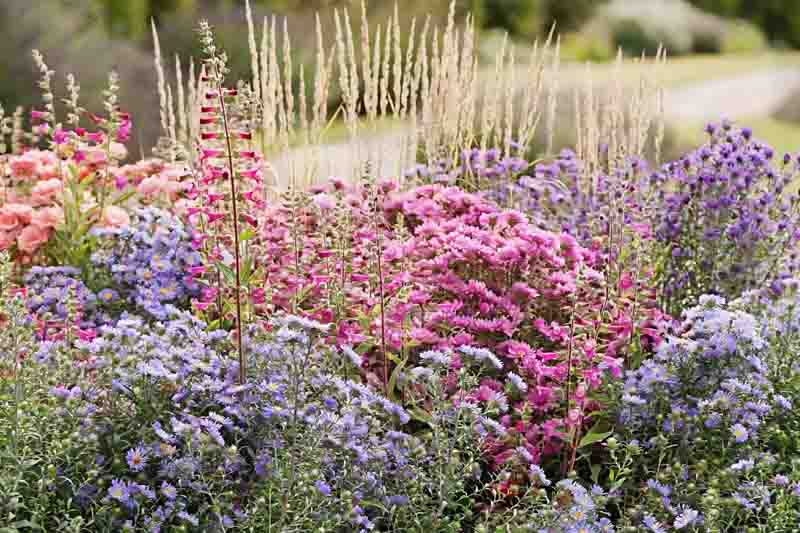


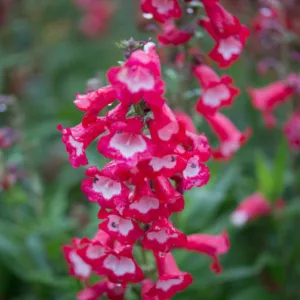
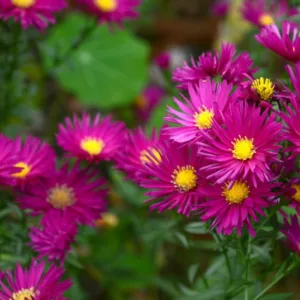
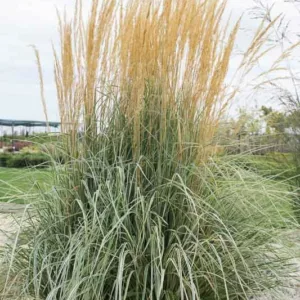
This colorful border shows how richly a late-season planting can perform. Masses of asters in lavender-blue, violet, and pink fill the foreground and middle of the border, while the cerise flower spikes of Penstemon ‘George Home’ weave through them. Behind and between the flowers, the upright blond plumes of Calamagrostis × acutiflora ‘Karl Foerster’ bring structure and lightness.
The planting relies on repetition rather than strict formality. Lower, mounding asters create broad drifts near the front, medium-height selections fill the middle, and taller asters and grasses rise above them. The result feels abundant and relaxed, yet still coherent because the same few plants are repeated throughout.
Main plants used: Aster × frikartii ‘Mönch’, Aster novae-angliae ‘Rosa Sieger’, Aster novae-angliae ‘Violetta’, Aster novae-angliae ‘Lou Williams’, Penstemon ‘George Home’, and Calamagrostis × acutiflora ‘Karl Foerster’
Use several asters of different heights, then repeat them across the border. That is what gives the planting both depth and continuity.
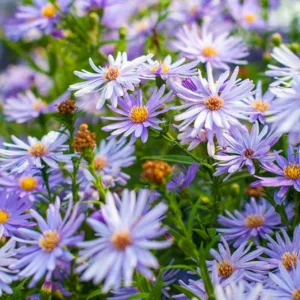
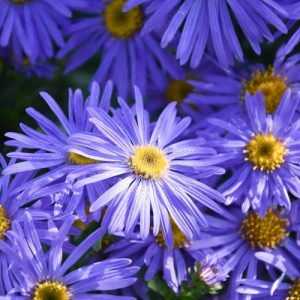
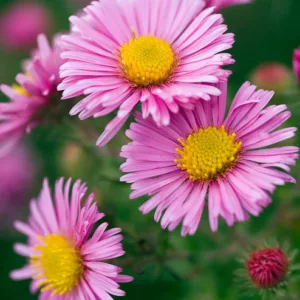
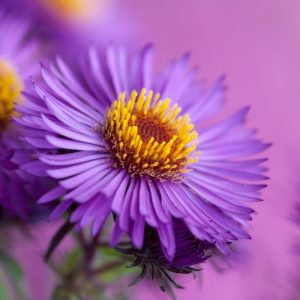
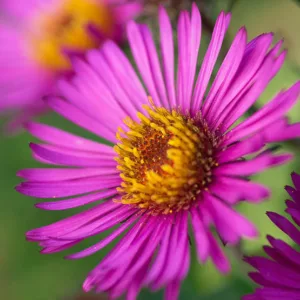
The asters do most of the heavy lifting, but not all in the same way. Aster × frikartii ‘Mönch’ forms soft, spreading mounds toward the front, while ‘Rosa Sieger’ and ‘Violetta’ add fuller color through the middle. Taller still, ‘Lou Williams’ gives the border height and a looser, more architectural feel.
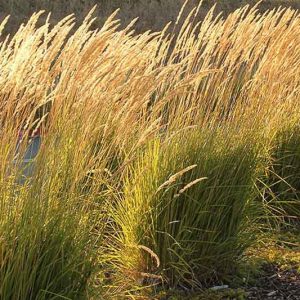
Penstemon ‘George Home’ changes the rhythm of the planting. Its upright cerise flower spikes cut through the rounded masses of aster flowers and stop the border from becoming too uniform. The grass does something similar in a quieter way. The upright straw-colored plumes of Calamagrostis ‘Karl Foerster’ add a vertical accent and keep the border attractive even as some flowers begin to fade.
The color combination is bold, but it works because the forms are varied. The asters bring a cloud of starry flowers, Penstemon adds vertical punctuation, and the grass introduces a calm neutral note that balances the brighter pinks and purples.
Aster × frikartii ‘Mönch’ is the best choice near the front, where its relaxed habit and lavender-blue flowers can spill slightly into the border edge.
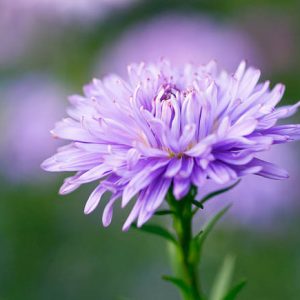
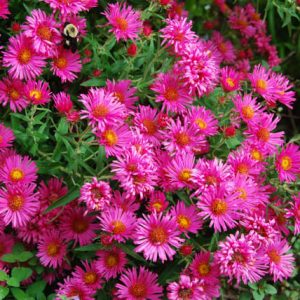
Aster novae-angliae ‘Rosa Sieger’ and ‘Violetta’ form the middle body of the planting. Their fuller growth and stronger pink and violet tones help carry the display across the border.
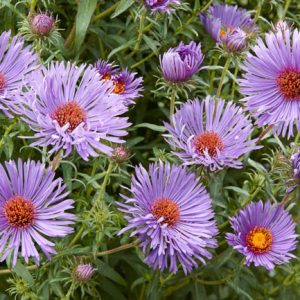
Aster novae-angliae ‘Lou Williams’ should be used more sparingly, in small groups or repeated clumps, so that it rises above the others without forming a solid wall.
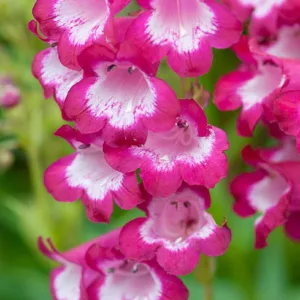
Penstemon ‘George Home’ adds bright cerise spires and a very different flower shape. Repeat it in smaller groups so those vertical notes appear in several places.
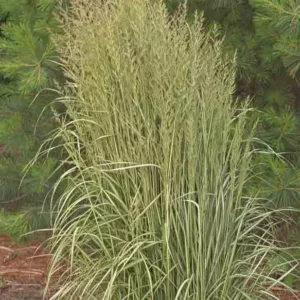
Calamagrostis ‘Karl Foerster’ provides the upright framework. Use it behind and among the flowering plants so the pale plumes emerge through the border rather than sitting in a separate row.
Create a lively late-season border with broad drifts of asters, a few brighter vertical accents, and upright grasses for structure.
Use the asters generously, but do not let them smother the Penstemon and grass. Those contrasting shapes are essential to the design.
Place ‘Mönch’ toward the front in broad, loose drifts.
Use ‘Rosa Sieger’ and ‘Violetta’ through the middle in larger groups, allowing the colors to mingle rather than separating them rigidly.
Set ‘Lou Williams’ farther back and in a few places through the middle so taller stems rise above the main flowering layer.
Thread Penstemon through the border in smaller clusters, and repeat Karl Foerster behind and among the flowers so its vertical plumes provide rhythm throughout.
This is a sunny border for the second half of the season. It is most effective when planted in generous drifts rather than in small isolated clumps. It is also better described as relatively low maintenance rather than maintenance-free, since asters can benefit from pinching or staking in richer soils.
Most of these plants are often passed over by deer and rabbits, but no planting is completely browse-proof. Even so, the combination is practical, colorful, and easy to adapt – a very good model for a cheerful late-summer to fall border.
| Hardiness |
6 - 8 |
|---|---|
| Heat Zones |
1 - 8 |
| Climate Zones | 6, 7, 8, 9, 14, 15, 16, 17, 18, 19, 20, 21, 22, 23, 24 |
| Exposure | Full Sun, Partial Sun |
| Season of Interest | Summer (Late), Fall |
| Maintenance | Average |
| Water Needs | Average |
| Soil Type | Chalk, Loam, Sand |
| Soil pH | Acid, Alkaline, Neutral |
| Soil Drainage | Moist but Well-Drained, Well-Drained |
| Characteristics | Cut Flowers, Plant of Merit, Showy |
| Tolerances | Drought, Deer, Rabbit |
| Attracts | Bees, Butterflies, Hummingbirds, Birds |
| Landscaping Ideas | Beds And Borders |
| Garden Styles | Butterfly Garden, Informal and Cottage, Pollinator Garden, Prairie and Meadow, Traditional Garden |

| Hardiness |
6 - 8 |
|---|---|
| Heat Zones |
1 - 8 |
| Climate Zones | 6, 7, 8, 9, 14, 15, 16, 17, 18, 19, 20, 21, 22, 23, 24 |
| Exposure | Full Sun, Partial Sun |
| Season of Interest | Summer (Late), Fall |
| Maintenance | Average |
| Water Needs | Average |
| Soil Type | Chalk, Loam, Sand |
| Soil pH | Acid, Alkaline, Neutral |
| Soil Drainage | Moist but Well-Drained, Well-Drained |
| Characteristics | Cut Flowers, Plant of Merit, Showy |
| Tolerances | Drought, Deer, Rabbit |
| Attracts | Bees, Butterflies, Hummingbirds, Birds |
| Landscaping Ideas | Beds And Borders |
| Garden Styles | Butterfly Garden, Informal and Cottage, Pollinator Garden, Prairie and Meadow, Traditional Garden |
Recreate this garden. Specify the percentages you would like to have of each plant and input the dimensions of your garden space.We'll give you a shopping list so you know how many plants you need.
| Plant | Quantity | |
|---|---|---|
| Penstemon 'George Home' (Beardtongue) | N/A | Buy Plants |
| Aster x frikartii 'Monch' (Frikart's Aster) | N/A | Buy Plants |
| Aster novae-angliae 'Rosa Sieger' (New England Aster) | N/A | Buy Plants |
| Aster novae-angliae 'Violetta' (New England Aster) | N/A | Buy Plants |
| Aster novae-angliae 'Lou Williams' (New England Aster) | N/A | Buy Plants |
| Calamagrostis x acutiflora 'Karl Foerster' (Feather Reed Grass) | N/A | Buy Plants |
Create a membership account to save your garden designs and to view them on any device.
Becoming a contributing member of Gardenia is easy and can be done in just a few minutes. If you provide us with your name, email address and the payment of a modest $25 annual membership fee, you will become a full member, enabling you to design and save up to 25 of your garden design ideas.
Join now and start creating your dream garden!
Create a membership account to save your garden designs and to view them on any device.
Becoming a contributing member of Gardenia is easy and can be done in just a few minutes. If you provide us with your name, email address and the payment of a modest $25 annual membership fee, you will become a full member, enabling you to design and save up to 25 of your garden design ideas.
Join now and start creating your dream garden!