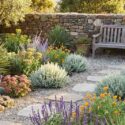
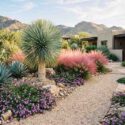
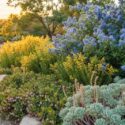
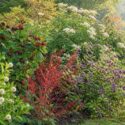
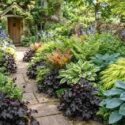
Color-rich summer border with Echinacea, Achillea, Salvia, Verbena and Eryngium along a gravel path. A naturalistic, pollinator-friendly garden design.
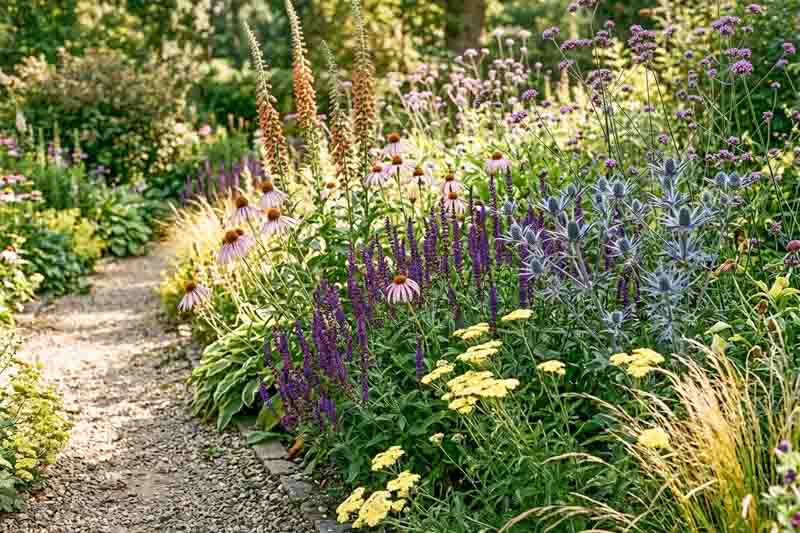


This mature border follows a curving gravel path through a generous mix of pink, purple, blue, yellow, and copper. The planting is full without feeling crowded: pale coneflowers rise through dark purple Salvia, silvery-blue sea hollies punctuate the middle of the bed, and tall Verbena carries small purple flower clusters above the surrounding perennials.
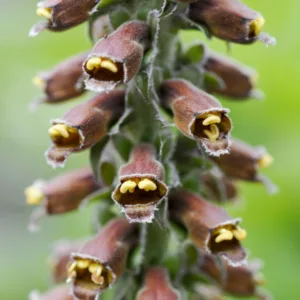
Toward the back, Digitalis parviflora adds slender copper-brown flower spikes, while Achillea ‘Moonshine’ brings lower clusters of soft yellow. Fine ornamental grasses appear throughout the planting and along the path, catching the light and adding movement without becoming the dominant feature.
Main plants used: Echinacea pallida, Salvia nemorosa ‘Caradonna’, Eryngium × zabelii ‘Big Blue’, Achillea ‘Moonshine’, Verbena bonariensis, Digitalis parviflora, and ornamental grasses.
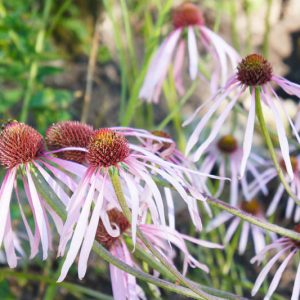
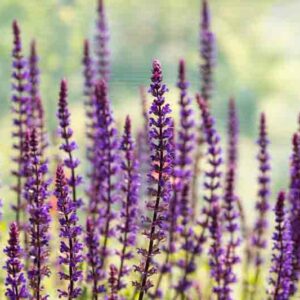
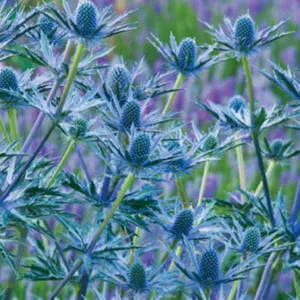
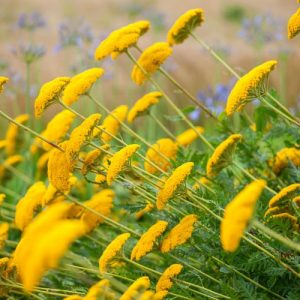
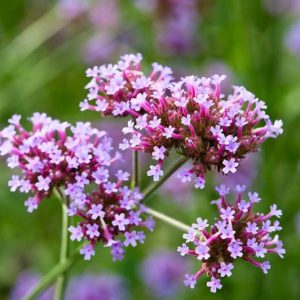
The planting depends as much on flower shape as it does on color. Echinacea pallida has narrow, strongly drooping petals, while Eryngium ‘Big Blue’ produces dense blue flower heads surrounded by spiny bracts. ‘Caradonna’ adds narrow vertical spikes, Achillea forms broad flat-topped flower clusters, and Verbena holds small rounded heads on tall, wiry stems.
The colors are varied but balanced. Pale pink Echinacea softens the stronger purple Salvia, while blue-gray Eryngium introduces a cooler note. Yellow Achillea brightens the lower part of the border, and the coppery Digitalis adds a quieter warm tone behind the main flowering groups.
The photograph also shows the value of repetition without symmetry. Salvia appears in several substantial clumps, while Echinacea, Eryngium, Achillea, and Verbena recur less predictably. The grasses thread through the border in irregular pockets, and some stems lean naturally toward the path. That slight untidiness is part of what makes the planting convincing.
Echinacea pallida brings a light, open quality to the planting. Its pale pink petals hang down from prominent cones, and mature plants work particularly well in repeated groups through the middle of a sunny border. It prefers well-drained soil and copes with periods of dryness once established.
Salvia nemorosa ‘Caradonna’ forms the deepest purple areas. Its dark stems intensify the violet flower spikes, and the clumps are dense enough to give the border some visual weight. Cutting plants back after the first flowering can encourage another flush.
Eryngium × zabelii ‘Big Blue’ provides the strongest architectural texture. Its metallic-blue flower heads and bracts remain distinctive even when surrounded by softer plants. Give it full sun and freely draining soil, and avoid prolonged winter wet.
Achillea ‘Moonshine’ stays lower, producing flat clusters of pale lemon-yellow flowers above gray-green foliage. It performs best in sun and well-drained soil and may become floppy if conditions are overly rich or wet.
Verbena bonariensis adds height without creating a solid screen. Its narrow stems allow views through the plant, making it useful through the middle and back of a border. It often self-seeds where conditions suit it.
Digitalis parviflora is used more sparingly. Its narrow coppery flower spikes rise well above the surrounding foliage and are particularly effective in small repeated groups rather than large blocks.
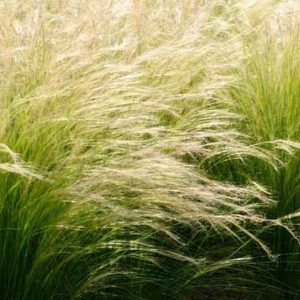
Ornamental grasses provide the quieter background texture. Use fine-leaved grasses in loose groups so their foliage and seedheads can move between the flowering perennials and soften the path edge.
Create a generous sunny border with repeated flowering groups, scattered taller accents, and enough overlap to soften the gravel path without hiding it.
These proportions are a guide to the overall balance of the border rather than a literal plant count.
Start with several substantial groups of Salvia, Echinacea, Achillea, and Eryngium through the front and middle of the bed. Vary the size and position of the groups rather than repeating an identical pattern.
Allow Verbena to rise through several parts of the planting, especially toward the middle and back. Place the taller Digitalis more selectively so its coppery spikes remain noticeable rather than disappearing into a mass of other vertical plants.
Thread ornamental grasses between the flowering groups and repeat a few near the path. Leave enough clear width for comfortable passage, but allow some stems to arch naturally over the edge.
This should not be treated as a uniformly drought-proof planting. Echinacea, Eryngium, Achillea, and established Salvia tolerate relatively dry, well-drained conditions, but newly planted specimens still need regular watering, and the exact needs of the ornamental grasses will depend on which species are chosen.
The same caution applies to deer resistance. Several of these plants are often passed over because of aromatic, coarse, or spiny foliage, but no mixed border should be considered deer-proof where browsing pressure is high.
Verbena bonariensis can also self-seed enthusiastically and is considered invasive in some regions. Check local guidance before planting it and remove seedlings where necessary.
| Hardiness |
7 - 8 |
|---|---|
| Heat Zones |
7 - 8 |
| Exposure | Full Sun |
| Season of Interest | Spring (Late), Summer (Early, Mid) |
| Maintenance | Low |
| Water Needs | Low, Average |
| Soil Type | Chalk, Loam, Sand |
| Soil pH | Acid, Neutral, Alkaline |
| Soil Drainage | Moist but Well-Drained, Well-Drained |
| Characteristics | Cut Flowers, Showy |
| Tolerances | Drought, Deer |
| Attracts | Bees, Butterflies, Hummingbirds, Birds |
| Landscaping Ideas | Beds And Borders |
| Garden Styles | Butterfly Garden, Informal and Cottage, Pollinator Garden |

| Hardiness |
7 - 8 |
|---|---|
| Heat Zones |
7 - 8 |
| Exposure | Full Sun |
| Season of Interest | Spring (Late), Summer (Early, Mid) |
| Maintenance | Low |
| Water Needs | Low, Average |
| Soil Type | Chalk, Loam, Sand |
| Soil pH | Acid, Neutral, Alkaline |
| Soil Drainage | Moist but Well-Drained, Well-Drained |
| Characteristics | Cut Flowers, Showy |
| Tolerances | Drought, Deer |
| Attracts | Bees, Butterflies, Hummingbirds, Birds |
| Landscaping Ideas | Beds And Borders |
| Garden Styles | Butterfly Garden, Informal and Cottage, Pollinator Garden |
Recreate this garden. Specify the percentages you would like to have of each plant and input the dimensions of your garden space.We'll give you a shopping list so you know how many plants you need.
| Plant | Quantity | |
|---|---|---|
| Echinacea pallida (Pale Purple Coneflower) | N/A | Buy Plants |
| Salvia nemorosa 'Caradonna' (Woodland Sage) | N/A | Buy Plants |
| Eryngium x zabelii 'Big Blue' (Sea Holly) | N/A | Buy Plants |
| Achillea 'Moonshine' (Yarrow) | N/A | Buy Plants |
| Verbena bonariensis (Purpletop Vervain) | N/A | Buy Plants |
| Stipa tenuissima (Mexican Feather Grass) | N/A | Buy Plants |
| Digitalis parviflora (Small-Flowered Foxglove) | N/A | Buy Plants |
Create a membership account to save your garden designs and to view them on any device.
Becoming a contributing member of Gardenia is easy and can be done in just a few minutes. If you provide us with your name, email address and the payment of a modest $25 annual membership fee, you will become a full member, enabling you to design and save up to 25 of your garden design ideas.
Join now and start creating your dream garden!
Create a membership account to save your garden designs and to view them on any device.
Becoming a contributing member of Gardenia is easy and can be done in just a few minutes. If you provide us with your name, email address and the payment of a modest $25 annual membership fee, you will become a full member, enabling you to design and save up to 25 of your garden design ideas.
Join now and start creating your dream garden!