Pruning a Japanese maple is about knowing what to leave as much as what to cut. Discover the best pruning seasons, correct branch-cutting techniques, and practical advice for upright, dwarf, and weeping varieties. Learn to shape your tree, remove damaged branches, and preserve its natural beauty for years.
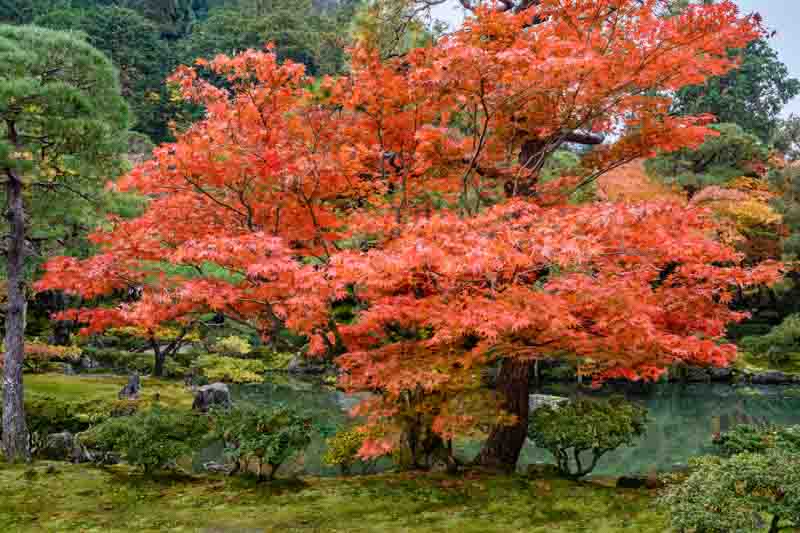


A beautifully pruned Japanese maple rarely looks pruned at all. Its branches spread in graceful layers, delicate leaves catch the light, and the tree retains the distinctive character that makes Japanese maples so appealing.
But one poorly placed cut can change that appearance for years. Shorten every branch to the same length, remove too much interior growth, or shear a weeping maple into a rounded mound, and much of its natural elegance disappears.
Fortunately, most Japanese maples (Acer palmatum) need little pruning. The challenge is knowing when intervention will improve the tree and when it is better to leave it alone.
Whether you are shaping a young Japanese maple, thinning a mature tree, trimming a cascading laceleaf variety, or dealing with an overgrown specimen, this guide explains the best pruning seasons, the correct cuts, and the mistakes to avoid.
Japanese Maple Pruning at a Glance
The golden rule: Every cut should have a clear purpose. If you cannot explain what will improve, leave the branch alone.
The ideal pruning season depends on the work required. Removing a competing structural branch is different from lightly adjusting a tree’s summer outline.
Once the leaves have fallen, the branching framework is easy to examine. You can see crossing limbs, crowded junctions, competing leaders, and branches growing in undesirable directions.
Late autumn to early winter is generally a good period for planned structural pruning. The Royal Horticultural Society specifically recommends pruning Japanese maples after leaf fall but before January to minimize excessive sap bleeding.
Exact timing depends on climate and when dormancy begins. Avoid pruning during severe freezing weather, and do not assume that late winter is equally suitable everywhere.
Summer pruning allows you to evaluate the fully leafed-out tree. It is particularly useful when a branch blocks a view, extends across a walkway, or creates unwanted crowding.
Wait until the spring growth flush has matured. Choose a period of moderate weather rather than a heat wave or prolonged drought.
Remove only selected shoots or small branches. Heavy summer thinning can suddenly expose previously shaded bark and interior foliage to intense sunlight.
Japanese maples can release considerable sap when cut in late winter or early spring, as internal sap pressure increases before and during budbreak.
This bleeding can look alarming, but it is usually not fatal to a healthy tree. Nevertheless, routine pruning is better performed at a more suitable time.
If a branch breaks or creates an immediate safety hazard, remove it correctly rather than delaying necessary work because of the season.
| Season | Recommended pruning | What to avoid |
|---|---|---|
| Late autumn to early winter | Structural correction after leaf fall | Severe frost and unnecessary large cuts |
| Late winter to spring | Essential removal of broken or hazardous branches | Routine pruning during heavy sap flow |
| Early to midsummer | Light shaping and selective thinning after growth matures | Heat waves, drought stress, and over-thinning |
| Late summer to early autumn | Limited corrective work when needed | Heavy cutting that may stimulate tender late growth |
This calendar applies primarily to temperate Northern Hemisphere climates. Adjust the seasonal windows to local growth and weather conditions.
Before picking up the pruners, walk around your tree and study its natural branching. Japanese maples are not meant to have perfectly symmetrical crowns. A slightly irregular silhouette may be exactly what makes a specimen beautiful.
Pruning is appropriate when branches are dead, broken, rubbing together, interfering with a walkway, or developing weak structural connections.
Young trees may also need the occasional removal of a competing leader or poorly positioned shoot. Grafted Japanese maples sometimes produce vigorous rootstock growth below the graft union, which should usually be removed close to its origin.
By contrast, branches that droop naturally, gentle asymmetry, and healthy interior growth rarely need correction.
Gardenia’s first pruning decision: Is the branch unhealthy, structurally problematic, obstructing something important, or simply growing naturally? Only the first three usually justify removing it.
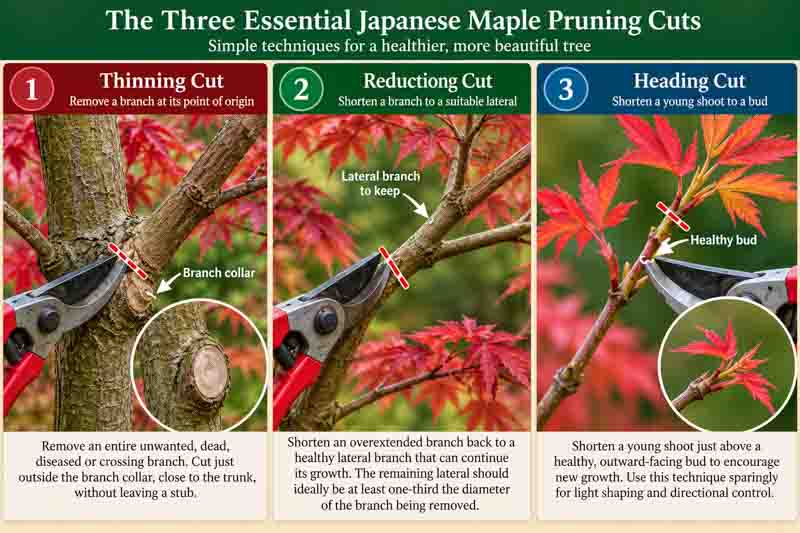
Good pruning begins with choosing the right type of cut. Most Japanese maple work involves thinning, reduction, or occasional small heading cuts.
The practical distinction: Use substantial lateral branches for larger structural reductions. For a small young shoot, a carefully positioned bud cut may be sufficient.
For a healthy, established Japanese maple that needs modest maintenance, follow this sequence.
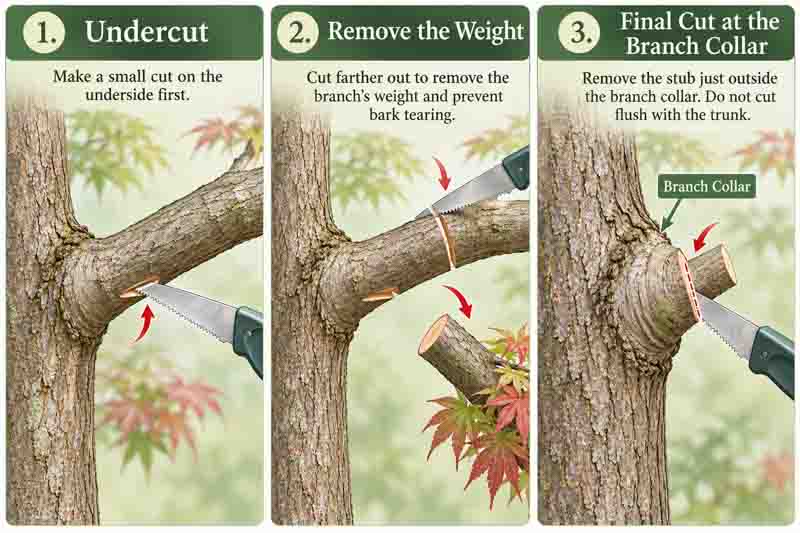
For a branch too heavy to remove with one cut, use the three-cut method.
This protects the trunk from damage and leaves the tree with a properly positioned wound.
Prune conservatively. On a healthy, established Japanese maple, remove only what is necessary, often much less than 10% of the living canopy. Older, weak, or stressed trees may tolerate even less. Do not treat the commonly cited 25% maximum for general tree pruning as a target for ornamental Japanese maples.
Worth remembering: A Japanese maple can take years to replace an important branch. Removing too little is easy to correct later. Removing too much cannot be undone.
Upright Japanese maples develop layered, often vase-shaped or rounded crowns. The aim is to retain a strong framework while allowing branches to occupy their natural positions.
On young trees, look for competing leaders and narrow, weak branch junctions. Small early corrections can prevent larger structural problems later.
On mature specimens, remove occasional rubbing or damaged branches and selectively reduce shoots that interfere with paths or buildings.
Avoid stripping out the interior canopy to create an artificially open tree. Inner foliage helps protect branches from direct sunlight, and lower branches often contribute to the maple’s character.
Compact varieties such as ‘Shaina’ naturally form dense, attractive crowns and generally need little more than selective maintenance.
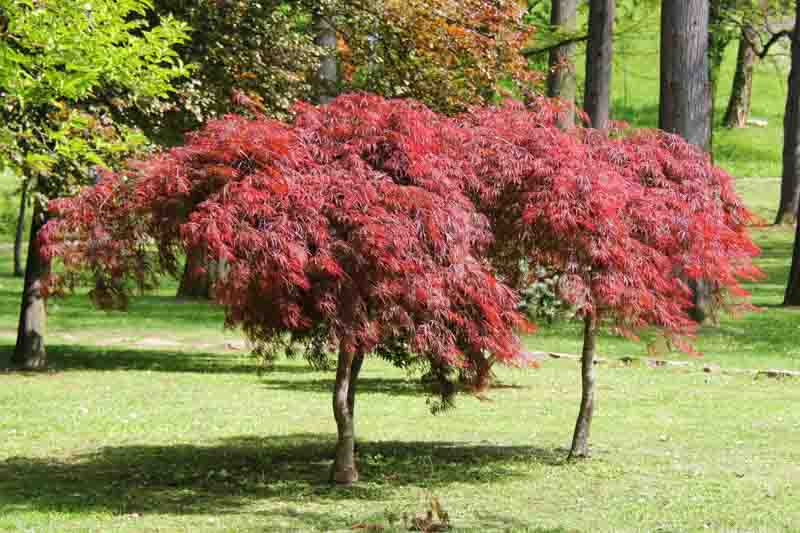
Weeping Japanese maples require a different approach because their arching branches naturally form overlapping curtains of finely divided leaves.
Varieties such as ‘Red Dragon’ are admired for precisely this cascading form. Heavy pruning can replace their beautiful layered outline with an artificial dome.
Lift the foliage gently and examine the branches underneath. Remove deadwood and rubbing shoots first. Then, if necessary, thin a few crowded branches while retaining the main cascading framework.
The goal is to reveal attractive branching without creating large empty gaps.
Not necessarily. Drooping branches are a natural feature of many laceleaf maples.
If branches drag across paving, suffer repeated damage, or block a walkway, shorten selected shoots to appropriate laterals. Avoid clipping the entire canopy into a uniform skirt.
Check their origin. Vigorous shoots growing from below the graft union usually belong to the rootstock and should be removed.
Upright growth originating within the grafted canopy may be normal. Assess its position before deciding whether it needs thinning or reduction.
Gardenia’s laceleaf pruning principle: Follow the branches rather than the outline of the foliage. Correct individual problems while allowing the tree’s naturally cascading structure to remain visible.
Allow newly planted trees to establish before undertaking cosmetic shaping. Remove broken or clearly defective branches, but avoid significant canopy reduction simply to encourage bushier growth.
As the tree develops, occasional small structural corrections are easier and less damaging than removing substantial branches years later.
Dwarf and compact cultivars often grow slowly and form attractive shapes naturally. Remove deadwood and a few misplaced shoots when necessary, but avoid opening their dense crowns excessively.
Japanese maples grown in pots may need occasional trimming to maintain clearance, although healthy growth should not be continuously restricted through hard pruning.
Choose a cultivar appropriate for its container and provide suitable drainage, watering, and periodic root care.
For more advice, explore Great Japanese Maples for Containers.
Sometimes. A few branches extending beyond the available space can often be shortened with carefully positioned reduction cuts.
However, an entire canopy that has outgrown its location is a different challenge. Japanese maples do not respond well aesthetically to severe topping or repeated heavy reduction.
Large wounds, vigorous clusters of new shoots, and an unnatural silhouette can all result from aggressive pruning.
Where substantial reduction is necessary, consult a qualified arborist experienced with ornamental maples. Limited corrections may be possible over several seasons, but there are situations where the tree is simply too large for its site.
Never top a Japanese maple to control its height. Cutting major limbs back to large stubs destroys the natural framework and may encourage poorly attached regrowth. A properly selected cultivar is a much better long-term solution.
Brown or curling Japanese maple leaves do not automatically indicate that branches need pruning.
Leaf scorch frequently results from intense sunshine, dry winds, inconsistent moisture, or root stress. Removing healthy foliage may worsen the problem by exposing more of the canopy.
If the branches remain alive, investigate the growing conditions first. See Gardenia’s Leaf Scorch guide for causes and practical prevention.
Following winter, allow uncertain branches time to develop buds before cutting them away. If dieback is confirmed, prune the affected branch back to healthy wood or an appropriate junction.
Persistent branch death, wilting despite adequate moisture, or progressive canopy decline may indicate root problems or disease and deserves diagnosis rather than repeated cosmetic pruning.
Sharp bypass pruners are ideal for small branches. Loppers handle somewhat thicker growth, while a pruning saw is necessary for larger limbs.
Use clean tools and disinfect blades when working with suspected diseased material, especially before moving to healthy branches or another tree.
Do not routinely apply wound paint or sealant. Properly placed cuts are generally best left uncovered so the tree can develop protective tissues naturally.
After pruning, maintain normal care. Keep soil moisture appropriate, protect the root zone with mulch, and avoid applying excessive fertilizer in an attempt to stimulate rapid regrowth.
For large branches, overhead work, or any situation involving ladders or nearby utilities, hire a qualified professional rather than attempting hazardous pruning yourself.
| Mistake | Why it causes problems | Better approach |
|---|---|---|
| Topping the crown | Removes major structure and encourages undesirable shoots | Use limited reduction cuts where appropriate |
| Shearing a laceleaf maple | Creates an artificial outline and dense outer growth | Selectively thin individual branches |
| Cutting flush with the trunk | Damages the branch collar | Cut just outside the collar |
| Leaving long stubs | Encourages dieback and decay | Prune to a suitable junction or bud |
| Heavy summer thinning | Exposes shaded branches to damaging sunlight | Thin sparingly during moderate weather |
| Pruning a stressed maple heavily | Reduces leaf area needed for recovery | Address watering, drainage, or disease first |
Not every Japanese maple problem can be solved with pruning. This quick guide helps you decide whether to cut, investigate, or simply leave the tree to grow.
| What you notice | Gardenia’s recommended action | Why |
|---|---|---|
| Two branches rubbing | Remove the less desirable branch | Prevents repeated bark injury |
| One branch extending too far | Reduce to an appropriate lateral | Preserves a natural branch outline |
| Crowded weeping canopy | Thin selected shoots only | Maintains graceful cascading layers |
| Brown summer leaves | Check heat, wind, water, and roots first | Scorch is usually not corrected by pruning |
| Entire tree too large | Assess professional reduction options | Severe topping can permanently damage its form |
| Healthy but irregular canopy | Usually leave it alone | Natural asymmetry is often desirable |
The most successful pruning often involves surprisingly few cuts. Understanding the tree’s growth habit is more important than trying to force it into a particular shape.
A Japanese maple makes a beautiful starting point for a garden, but the surrounding plants should share compatible light, soil, moisture, and drainage requirements. Use Gardenia’s Plant Finder to discover suitable companions, then check your choices in the Garden Design Tool.
Late autumn to early winter, after leaf fall and before strong sap flow resumes, is generally best for planned structural pruning. Light shaping can also be done in summer once spring growth has matured. Adjust timing to local climate.
Yes. Summer is suitable for light shaping and selective thinning after spring growth has matured. Avoid pruning during heat waves, prolonged drought, or severe leaf scorch, and avoid removing large amounts of foliage.
Preserve the tree’s naturally cascading layers. Remove dead, damaged, or rubbing branches and selectively thin crowded shoots. Avoid topping, hedge shearing, and cutting all drooping branches to the same height.
Limited height reduction may be possible by cutting selected branches back to suitable lateral branches. Severe topping is not recommended because it damages the natural branch structure. Consult a qualified arborist for major reductions.
Usually not. Japanese maples may release considerable sap from cuts made during late winter or spring, but this bleeding is generally not fatal to a healthy tree. Plan routine pruning for a more suitable season.
Prune sparingly. On healthy established Japanese maples, removing much less than 10% of the living canopy is often sufficient. Older or stressed trees may tolerate even less. There is no need to remove a fixed percentage of growth each year.
Updated and reviewed by Gardenia: October 2026
| Hardiness |
5 - 9 |
|---|---|
| Climate Zones | 2, 3, 4, 5, 6, 7, 8, 9, 10, 12, 14, 15, 16, 17, 18, 19, 20, 21, 22, 23, 24 |
| Plant Type | Shrubs, Trees |
| Plant Family | Sapindaceae |
| Genus | Acer |
| Exposure | Full Sun, Partial Sun |
| Season of Interest | Spring (Early, Mid, Late), Summer (Early, Mid, Late), Fall, Winter |
| Maintenance | Low |
| Water Needs | Average |
| Soil Type | Chalk, Clay, Loam, Sand |
| Soil pH | Acid, Neutral |
| Soil Drainage | Moist but Well-Drained |
| Characteristics | Showy |
| Tolerances | Rabbit |
| Landscaping Ideas | Beds And Borders, Patio And Containers, Small Gardens |
| Garden Styles | City and Courtyard, Gravel and Rock Garden, Informal and Cottage, Japanese Garden, Traditional Garden, Woodland Garden |
Create a membership account to save your garden designs and to view them on any device.
Becoming a contributing member of Gardenia is easy and can be done in just a few minutes. If you provide us with your name, email address and the payment of a modest $25 annual membership fee, you will become a full member, enabling you to design and save up to 25 of your garden design ideas.
Join now and start creating your dream garden!