A beautiful Japanese maple can transform a small garden, but choosing the wrong variety can overwhelm the space. Explore 15 compact, dwarf, upright, and cascading Japanese maples with stunning seasonal foliage. Compare mature sizes, discover the best trees for courtyards and front yards, and find your perfect garden focal point.
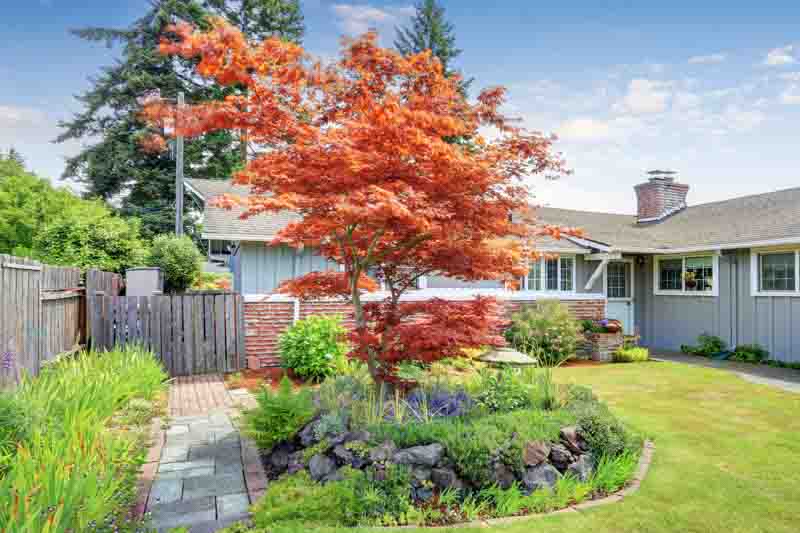


A beautiful Japanese maple can transform even the smallest garden. Imagine a compact red-leaved tree beside your front entrance, a golden maple brightening a sheltered courtyard, or delicate laceleaf branches cascading over a low stone wall.
But choosing the right tree takes more than falling in love with its foliage. Some Japanese maples remain only a few feet tall but spread surprisingly wide. Others have upright, relatively narrow crowns that fit more comfortably into courtyards or small front yards. And a tree described as dwarf may continue growing for decades.
So which Japanese maples are genuinely suitable for small gardens?
We’ve selected 15 beautiful Japanese maple (Acer palmatum) varieties and compared their mature height, spread, growth habit, and landscape value. Whether you have a tiny planting pocket or a modest backyard, this guide will help you find a tree that looks beautiful now and still belongs in the garden years later.
What are the best Japanese maples for small gardens?
Gardenia’s recommendation: Start with the space available for the mature canopy. A tree that naturally fits your garden will be more attractive and easier to maintain than one that needs constant pruning.
Japanese maples vary enormously in size and shape. Some grow into substantial trees, while dwarf and compact varieties develop slowly into rounded shrubs, upright specimens, or graceful cascading mounds.
For a small garden, three characteristics are especially important:
A dwarf maple typically grows more slowly and develops shorter growth increments than a standard form. A compact cultivar may simply have a smaller, denser, or more restrained habit.
Neither term guarantees that a Japanese maple will remain miniature. A dwarf variety may eventually become wider than expected, while a relatively upright cultivar can provide more practical clearance despite growing taller.
Before buying: Measure the usable planting width, including clearance from paths, walls, and other plants. Compare that measurement with the cultivar’s expected spread, leaving extra room where possible. Published dimensions are useful guides, not permanent growth limits.
Gardenia’s Japanese maple profiles provide a useful basis for comparing cultivars. The following table brings together fifteen selections, organized by their approximate landscape dimensions and growth habits.
The measurements reflect Gardenia’s published ranges. Actual growth varies with age, climate, soil, and cultivation, and older specimens may eventually exceed typical nursery sizes.
| Japanese maple | Height | Spread | Habit | Best feature |
|---|---|---|---|---|
| Shaina | 4-6 ft | 3-4 ft | Compact, rounded | Rich red foliage |
| Wilson’s Pink Dwarf | 2-4 ft | 5-6 ft | Low, bushy, spreading | Pink-orange spring leaves |
| Beni-Maiko | 4-8 ft | 4-6 ft | Compact, bushy | Brilliant red spring foliage |
| Red Dragon | 6-8 ft | 6-8 ft | Cascading mound | Dark red laceleaf foliage |
| Orange Dream | 8-10 ft | 5-6 ft | Upright, bushy | Golden-orange spring leaves |
| Butterfly | 7-12 ft | 4-8 ft | Upright, vase-shaped | White-edged leaves |
| Ukigumo | 7-12 ft | 4-8 ft | Upright, compact | White and pink variegation |
| Toyama-nishiki | 5-10 ft | 9-12 ft | Slow-growing, weeping laceleaf | Pink, cream, and white variegation |
| Orangeola | 4-8 ft | 3-7 ft | Cascading, mounding | Changing orange-red foliage |
| Crimson Queen | 8-10 ft | 10-12 ft | Broad, cascading | Persistent dark red foliage |
| Garnet | 6-8 ft | 8-12 ft | Broad, weeping | Elegant laceleaf silhouette |
| Beni-Tsukasa | 10-12 ft | 10-12 ft | Rounded, upright | Peach, pink, and green foliage |
| Shin-Deshojo | 5-10 ft | 5-10 ft | Upright, rounded | Brilliant crimson spring foliage |
| Elegans | 5-10 ft | 6-8 ft | Upright, open | Green foliage, brilliant fall color |
| Dissectum Atropurpureum | 6-8 ft | 6-8 ft | Broad, weeping laceleaf | Deep purple, finely dissected leaves |
Sizes are approximate Gardenia profile ranges, not guaranteed maximum dimensions. Older plants may become larger. The best choice also depends on your climate, sunlight, and drainage.
For particularly restricted gardens, begin with varieties that naturally develop modest crowns. These three are among the most practical choices when a full-sized Japanese maple would overwhelm the planting area.
Acer palmatum ‘Shaina’ is a compact, slow-growing Japanese maple with densely clustered leaves and a naturally rounded, upright form. New foliage opens bright red, deepens to maroon in summer, and turns crimson in autumn.
Its comparatively narrow crown makes it particularly attractive for a small front garden, courtyard, or prominent planting bed. It also works beautifully in a large container.
Choose ‘Shaina’ if: You want rich red foliage without giving over a large portion of the garden to one tree.
Acer palmatum ‘Wilson’s Pink Dwarf’ provides a remarkable succession of color. Salmon-pink and orange leaves appear in spring, soften to lime green during summer, then return to pink, orange, and red in autumn.
Its low, dense, spreading habit is appealing in raised borders and courtyard beds. It is particularly useful where a tall tree would obscure a window, provided there is adequate horizontal space.
Choose ‘Wilson’s Pink Dwarf’ if: You prefer a low, colorful accent rather than an upright tree.
Acer palmatum ‘Beni-Maiko’ is hard to overlook in spring, when its young leaves emerge an intense red. The foliage gradually develops pinkish and green tones, with orange and red returning in autumn.
Its compact, bushy habit suits courtyards and small mixed borders. Unlike a maple valued mainly for persistent summer color, ‘Beni-Maiko’ provides a changing display that makes each season feel different.
Choose ‘Beni-Maiko’ if: You want a striking spring focal point in a relatively small planting area.
| Hardiness |
5 - 9 |
|---|---|
| Climate Zones | 2, 3, 4, 5, 6, 7, 8, 9, 10, 12, 14, 15, 16, 17, 18, 19, 20, 21, 22, 23, 24 |
| Plant Type | Shrubs, Trees |
| Plant Family | Sapindaceae |
| Genus | Acer |
| Exposure | Full Sun, Partial Sun |
| Season of Interest | Spring (Early, Mid, Late), Summer (Early, Mid, Late), Fall, Winter |
| Maintenance | Low |
| Water Needs | Average |
| Soil Type | Chalk, Clay, Loam, Sand |
| Soil pH | Acid, Neutral |
| Soil Drainage | Moist but Well-Drained |
| Characteristics | Showy |
| Tolerances | Rabbit |
| Landscaping Ideas | Beds And Borders, Small Gardens |
| Garden Styles | City and Courtyard, Gravel and Rock Garden, Informal and Cottage, Japanese Garden, Traditional Garden, Woodland Garden |
These selections offer a little more height, an attractive cascading form, or unusual foliage. They are excellent candidates when a small garden has a clearly defined planting bed rather than just a narrow pocket.
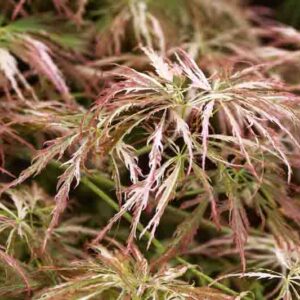
Acer palmatum ‘Red Dragon’ has finely dissected leaves that emerge scarlet, darken to burgundy, and turn bright crimson in autumn.
Its cascading branches form a compact mound, making it a beautiful focal point beside stone paving, a low wall, or a sheltered terrace.
Choose ‘Red Dragon’ if: You want a graceful red laceleaf maple without the broad dimensions of some larger weeping cultivars.
Acer palmatum ‘Orange Dream’ brings luminous yellow-orange spring foliage to the garden. Its leaves gradually become greener during summer before developing warm autumn colors.
The upright, bushy habit can work particularly well in a courtyard where vertical growth is welcome but spreading branches would interfere with circulation.
Its delicate young foliage benefits from protection against intense afternoon sunshine in hot climates.
Choose ‘Orange Dream’ if: You want a bright, upright accent for a sheltered courtyard or woodland-style border.
Acer palmatum ‘Orangeola’ combines finely dissected foliage with a soft, arching silhouette. Orange-red spring growth contrasts beautifully with older, darker leaves, and fresh seasonal flushes extend the display.
It works well where its branches can spill gently over the edge of a raised bed or low retaining wall.
Choose ‘Orangeola’ if: You want a flowing laceleaf form with more varied seasonal color than a traditional burgundy maple.
Variegated Japanese maples can bring extraordinary lightness to shaded courtyards, particularly when planted against dark foliage or evergreens. They need protection from intense afternoon heat and enough space for their upright crowns.
Acer palmatum ‘Butterfly’ produces delicately lobed green leaves edged irregularly with creamy white and often touched with pink.
Its upright, vase-shaped habit makes it especially effective near a shaded entrance or against a dark evergreen background.
Choose ‘Butterfly’ if: You want a light, elegant specimen and have room for a taller, relatively restrained crown.
Acer palmatum ‘Ukigumo’, known as Floating Clouds, displays an unpredictable mixture of green, white, and pale pink. Some leaves are lightly marked, while others may be almost entirely white.
Its upright growth and unusual coloration make it a memorable small-garden specimen. The variegation varies with conditions, and a sheltered position with bright filtered light helps protect the delicate leaves.
Choose ‘Ukigumo’ if: You want something unusual for a lightly shaded courtyard or a small woodland garden.
Acer palmatum ‘Toyama-nishiki’ is an unusual laceleaf Japanese maple with finely dissected foliage splashed unpredictably with pink, cream, and white against reddish-green leaves. Some leaves may be heavily variegated, while others show little or no variegation, giving the tree a wonderfully individual appearance.
Its slow-growing, cascading habit makes it especially appealing in a small courtyard, raised bed, or Japanese-inspired garden. At 10 years, it reaches approximately 3 feet tall and 4-5 feet wide (90 x 120-150 cm). Older specimens may eventually reach 5-10 feet tall and potentially 9-12 feet wide, depending on conditions and grafting.
Plant it in a sheltered position with morning sunshine or bright filtered light. Protection from intense afternoon sun helps preserve the delicate variegated foliage.
Choose ‘Toyama-nishiki’ if: You want a slow-growing, cascading maple with exceptional pink-and-white variegation, and have room for its eventual spread.
Not every small garden is tiny. A modest backyard or spacious courtyard can accommodate a larger ornamental maple, particularly when the tree is the main feature rather than one of several competing specimens.
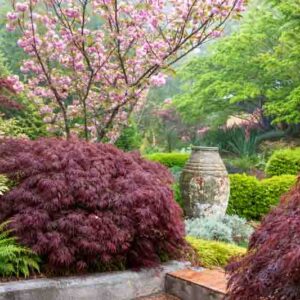
Acer palmatum ‘Crimson Queen’ is admired for its rich red, finely dissected foliage and elegant weeping habit. The leaves retain attractive color through much of summer before becoming scarlet in autumn.
This is a wonderful specimen beside a lawn or terrace, but it needs a broad planting area to display its natural silhouette.
Choose ‘Crimson Queen’ if: You have room for a wide, low-branching focal point.
Acer palmatum ‘Garnet’ forms a spreading mound of finely cut reddish-purple leaves. Its arching branches contrast beautifully with gravel, stone, and bold-leaved companions.
It is especially effective in Japanese-inspired planting, where the shape of the tree is as important as its color.
Choose ‘Garnet’ if: You want a low, sculptural tree for a generous border or open courtyard.
Acer palmatum ‘Beni-Tsukasa’ has delicate foliage that shifts through peach, pink, yellow-green, and red. Its rounded habit creates a softer effect than a dark purple-leaved maple.
With adequate space, it makes a beautiful freestanding specimen in a small backyard, especially where its spring color can be appreciated from a window or seating area.
Choose ‘Beni-Tsukasa’ if: You have room for a rounded small tree with changing seasonal interest.
Some Japanese maples deserve a place in a small garden for their exceptional seasonal color, while others earn it through their graceful shape. These three offer strikingly different effects, from vivid crimson spring foliage to an elegant green canopy and a cascading mound of purple-red leaves.
Acer palmatum ‘Shin-Deshojo’ is one of the most striking Japanese maples in spring. Its small, deeply lobed leaves emerge brilliant crimson-red, creating an almost glowing canopy before gradually softening to green, often lightly speckled with white, during summer. In autumn, the foliage turns attractive shades of orange and red.
Slow-growing and naturally rounded, this award-winning cultivar reaches approximately 5-10 feet tall and wide (1.5-3 m). Its compact habit makes it particularly attractive as a focal point in a sheltered courtyard, small front yard, or Japanese-inspired garden.
Choose ‘Shin-Deshojo’ if: You want exceptionally vivid spring foliage on a relatively compact, rounded Japanese maple.
Acer palmatum ‘Elegans’ offers a softer, more natural appearance than the intensely red cultivars. Its deeply divided leaves emerge delicate green with salmon-pink tones in spring, mature to fresh green during summer, then turn golden-yellow, orange, and red in autumn.
With its open, upright branching and beautifully layered foliage, ‘Elegans’ has a graceful silhouette that works particularly well in small woodland gardens and sheltered courtyards. It generally reaches 5-10 feet tall (1.5-3 m) and 6-8 feet wide (1.8-2.4 m).
Its fine texture provides a lovely contrast with bold-leaved hostas, ferns, and ornamental grasses. Unlike the denser red cultivars, ‘Elegans’ brings a light, airy quality to the planting.
Choose ‘Elegans’ if: You prefer a delicate green Japanese maple with beautiful autumn color and a naturally elegant, open habit.
Acer palmatum ‘Dissectum Atropurpureum’ is a classic laceleaf Japanese maple with finely divided, deep purple-red leaves and gracefully arching branches. Its broad, mounding habit creates an attractive sculptural feature, particularly when planted beside stone paving, a low retaining wall, or a simple carpet of green groundcovers.
The foliage emerges deep purple in spring, gradually develops bronze-green tones toward late summer, and finishes with fiery orange-red autumn color.
Slow-growing, it typically reaches approximately 6-8 feet tall and wide (1.8-2.4 m), according to Gardenia’s plant profile. Its cascading habit makes it best suited to a planting area where the branches can spread naturally without interfering with walkways.
Choose ‘Dissectum Atropurpureum’ if: You want the traditional beauty of a purple laceleaf Japanese maple with a graceful, low-branching silhouette.
The fifteen cultivars above offer very different solutions for limited space. Gardenia’s selection framework considers expected height, spread, growth habit, and the type of garden setting in which each tree can develop naturally.
| Your garden situation | Best starting choices | What matters most |
|---|---|---|
| Very restricted planting width | Shaina | Compact crown and available root space |
| Low planting beneath a window | Wilson’s Pink Dwarf | Low height but sufficient width |
| Compact red focal point | Shaina, Beni-Maiko | Summer-red versus spring-red foliage |
| Small cascading specimen | Red Dragon, Orangeola | Clearance for naturally arching branches |
| Sheltered courtyard with vertical space | Orange Dream, Butterfly, Ukigumo | Afternoon sun and eventual height |
| Larger courtyard or small backyard | Crimson Queen, Garnet, Beni-Tsukasa | Space for the mature canopy |
These are editorial recommendations based on Gardenia’s cultivar descriptions and approximate dimensions, not guarantees of local suitability. Confirm that the chosen maple also matches your hardiness zone, sunlight, soil, and summer climate.
Measure the space available for your tree, then explore Gardenia’s Japanese maple profiles to compare mature height, spread, growth habit, and growing requirements. Save your favorites and use the Garden Design Tool to plan their placement alongside suitable companions.
Choose a single maple as the focal point rather than crowding the entrance with several small trees. ‘Shaina’ or ‘Beni-Maiko’ can provide memorable seasonal color when their mature dimensions suit the setting.
A relatively upright maple can add height without creating the same horizontal effect as a broad laceleaf. ‘Orange Dream’ brings golden foliage, while ‘Butterfly’ and ‘Ukigumo’ offer delicate variegation.
A cascading cultivar such as ‘Red Dragon’ or ‘Garnet’ can soften the edges of stone, gravel, or a low wall. Position the tree where its branch structure remains visible instead of hiding it among tall shrubs.
A pale-leaved cultivar can brighten a darker planting scheme. Combine it with carefully chosen foliage companions, but remember that dry shade beneath established trees may create competition for moisture.
Explore Plant Combination Ideas with Japanese Maples for additional inspiration.
If there is insufficient ground space, a dwarf or compact Japanese maple in a large container can be an excellent alternative.
Choose a stable pot with good drainage and a suitable potting medium. Container-grown trees need more frequent moisture checks, periodic repotting, and winter root protection in cold climates.
Container culture can help manage growth, but it does not turn a naturally vigorous cultivar into a permanent miniature. Root restriction must be managed carefully to avoid declining health.
For cultivar recommendations and detailed care, see Great Japanese Maples for Containers.
Common mistake: Assuming that a young Japanese maple sold in a small nursery pot will remain that size. The cultivar’s natural growth habit and eventual dimensions matter far more than its size at purchase.
Small gardens often contain hard paving, walls, and restricted soil areas. These conditions can increase summer heat, reduce available root space, and make irrigation more important.
Plant your Japanese maple with its root flare at or slightly above soil level in well-drained, moisture-retentive soil. Apply organic mulch without covering the trunk, and maintain consistent moisture while the roots establish.
In hot climates, choose a position protected from intense afternoon sunshine. For detailed advice on planting, watering, sunlight, soil, and seasonal maintenance, explore our complete Japanese Maple Growing and Care Guide.
Avoid unnecessary fertilization and preserve the tree’s natural shape with minimal, selective pruning. If a Japanese maple becomes too large for its position, repeated severe pruning is not a satisfactory long-term solution. Starting with a suitably sized cultivar is far easier than continually restricting one that wants to grow larger.
Is Your Japanese Maple Looking Unhealthy? Brown leaf edges, curling foliage, and wilting branches can have very different causes. Discover how to tell ordinary leaf scorch from watering problems, root damage, and serious diseases in our Japanese Maple Problems: Brown Leaves, Leaf Scorch and Wilting guide, with a practical symptom checker to help you decide what to do next.
Companion plants should complement the maple without obscuring its branching or competing aggressively with its roots.
Japanese forest grass (Hakonechloa) provides soft, flowing foliage that contrasts beautifully with maple leaves. Hostas introduce broader leaves, while heucheras offer attractive foliage colors for partially shaded borders.
Hellebores provide early-season interest, particularly beneath upright maples where sufficient moisture and light are available.
Keep planting modest around established Japanese maple roots and check that companion plants share compatible soil moisture, drainage, and light preferences.
For more ideas, explore Companion Plants for Your Japanese Maples.
Compact cultivars such as ‘Shaina’ and ‘Wilson’s Pink Dwarf’ are useful choices for very small gardens. ‘Shaina’ typically reaches 4-6 feet tall and 3-4 feet wide, while ‘Wilson’s Pink Dwarf’ is lower but spreads approximately 5-6 feet.
‘Shaina’ and ‘Beni-Maiko’ are good starting choices for compact front gardens when their growing requirements suit the site. ‘Red Dragon’ can provide a beautiful cascading focal point where there is enough space for its 6-8-foot spread.
Yes. Many compact Japanese maples grow well in large containers with suitable potting medium, good drainage, regular watering, and periodic repotting. Protect container roots from severe freezing in cold climates.
Selective pruning can refine a Japanese maple’s shape, but repeated heavy pruning is not a good way to keep a naturally large cultivar permanently small. Choose a variety whose mature dimensions suit the planting space.
‘Shaina’ has attractive red to maroon foliage on a compact rounded plant. ‘Red Dragon’ offers dark red laceleaf foliage on cascading branches, while ‘Beni-Maiko’ provides especially bright red leaves in spring.
Many Japanese maples tolerate more sunlight in cool-summer regions. In hot climates, morning sun and afternoon shade are usually preferable. Variegated and pale-leaved cultivars are often particularly sensitive to intense afternoon sunshine.
Gardenia’s Japanese Maple collection lets you explore cultivars with different mature sizes, foliage colors, and growing requirements. Compare your favorites, then use the Garden Design Tool to plan their placement alongside suitable companion plants.
Updated and reviewed by Gardenia: October 2026
| Hardiness |
5 - 9 |
|---|---|
| Climate Zones | 2, 3, 4, 5, 6, 7, 8, 9, 10, 12, 14, 15, 16, 17, 18, 19, 20, 21, 22, 23, 24 |
| Plant Type | Shrubs, Trees |
| Plant Family | Sapindaceae |
| Genus | Acer |
| Exposure | Full Sun, Partial Sun |
| Season of Interest | Spring (Early, Mid, Late), Summer (Early, Mid, Late), Fall, Winter |
| Maintenance | Low |
| Water Needs | Average |
| Soil Type | Chalk, Clay, Loam, Sand |
| Soil pH | Acid, Neutral |
| Soil Drainage | Moist but Well-Drained |
| Characteristics | Showy |
| Tolerances | Rabbit |
| Landscaping Ideas | Beds And Borders, Small Gardens |
| Garden Styles | City and Courtyard, Gravel and Rock Garden, Informal and Cottage, Japanese Garden, Traditional Garden, Woodland Garden |
Create a membership account to save your garden designs and to view them on any device.
Becoming a contributing member of Gardenia is easy and can be done in just a few minutes. If you provide us with your name, email address and the payment of a modest $25 annual membership fee, you will become a full member, enabling you to design and save up to 25 of your garden design ideas.
Join now and start creating your dream garden!