Why are your maple leaves turning brown, yellow, or black? From harmless tar spots and leaf galls to drought stress, chlorosis, pests, and serious diseases, discover what the symptoms reveal. Gardenia's Maple Health Assessment helps you identify likely causes, recognize warning signs, and decide what to do next.


Your maple tree looked perfectly healthy in spring. Now its leaves are turning brown around the edges, developing black spots, or turning yellow months before autumn. Perhaps one branch is wilting while the rest of the canopy still looks green. Is your tree seriously ill, or simply reacting to difficult growing conditions?
Fortunately, many alarming maple tree symptoms are not signs of a dangerous disease. Black tar spots and small leaf galls are usually cosmetic. Brown, crispy margins often indicate environmental stress. Sudden branch dieback, persistent wilting, or a steadily thinning crown deserves closer attention.
Different maples also face different challenges. Red Maples may develop chlorosis in alkaline soils, Sugar Maples can struggle with heat and drought, and Silver Maples may experience leaf diseases, scale infestations, and structural problems.
This guide covers common problems affecting maple trees (Acer species), including Red, Sugar, Silver, Freeman, Norway, and Japanese Maples. Start with Gardenia’s Maple Health Assessment to identify likely causes, understand how serious the symptoms may be, and choose sensible next steps.
Before treating your maple: Check where the damage appears, when it started, and whether the soil is unusually dry or wet. These clues are often more useful than the appearance of one damaged leaf. Avoid applying fertilizer, fungicides, or insecticides until you understand the likely cause.
Maple problems become easier to narrow down when you look at the pattern of damage rather than one isolated symptom. A few dark spots in late summer suggest something very different from a major branch wilting suddenly in spring.
| What you see | Possible causes | What to check | Next step |
|---|---|---|---|
| Brown, crispy leaf edges | Environmental scorch, drought, root stress | Heat, wind, soil moisture, root conditions | Correct the underlying stress |
| Yellow leaves with green veins | Chlorosis, nutrient unavailability, root problems | Soil pH, drainage, leaf age | Test soil before treatment |
| Distinct black, tar-like spots, sometimes slightly raised | Maple tar spot | Spot appearance and seasonal timing | Usually monitor; collect fallen leaves |
| Irregular brown patches along veins | Anthracnose or other leaf diseases | Cool, wet spring weather | Assess severity; support tree health |
| Small red, pink, or green leaf bumps | Leaf gall mites or insects | Raised galls rather than flat lesions | Usually no treatment needed |
| Sticky leaves or black surface coating | Aphids, scale insects, sooty mold | Honeydew, insects, infested twigs | Identify pest and assess infestation |
| One branch wilts or dies | Canker, injury, Verticillium wilt, root damage | Bark injury, branch pattern, progression | Investigate promptly |
| Entire crown wilts while soil remains wet | Waterlogging, root damage, root disease | Drainage, root flare, soil saturation | Assess root health and drainage |
| Premature autumn color or early leaf drop | Drought, root restriction, disease, seasonal stress | Timing, extent, previous symptoms | Evaluate overall tree health |
Gardenia’s diagnostic method: Identify the symptom, confirm which maple species you have, examine growing conditions, and assess whether the damage is spreading. A symptom pattern can narrow the possibilities, but it cannot confirm a particular pathogen.
Some maple problems call for observation, while others deserve prompt investigation. Use this guide to decide how urgently to respond.
| Priority | Typical symptoms | Recommended response |
|---|---|---|
| Usually monitor | Tar spot, minor leaf galls, a few aphids, scattered late-season spots | Observe the tree, maintain normal care, avoid unnecessary spraying |
| Investigate soon | Recurring scorch, widespread yellowing, significant early leaf drop, repeated severe defoliation | Check roots, soil moisture, drainage, pH, and growing conditions |
| Prompt professional assessment | Sudden major branch dieback, progressive canopy decline, suspected severe root damage, structural hazards | Consult a qualified arborist; arrange laboratory testing when appropriate |
Important: Severity depends on how much of the tree is affected, how quickly symptoms progress, and whether branches could endanger people or property. These categories guide your next action rather than establish a diagnosis.
Brown leaves are among the most common maple tree problems, particularly during summer. The distribution of the damage offers useful clues.
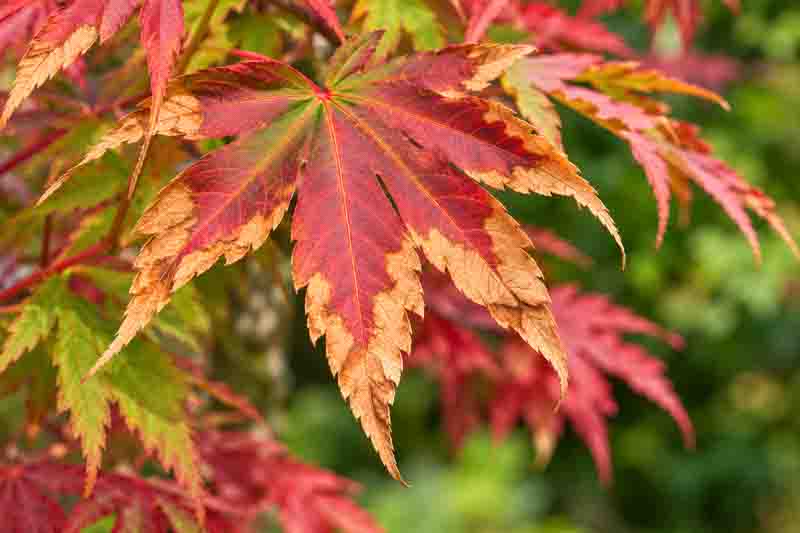 Illustration of Japanese maple leaf scorch, showing dry, brown leaf margins
Environmental leaf scorch occurs when foliage loses water faster than the roots can replace it. Leaf margins turn tan or brown, become brittle, and may curl inward.
Common triggers include intense heat, drought, drying winds, deicing salts, compacted soil, and root damage. Leaves on the most exposed side of the tree may suffer first.
What to do: Check moisture several inches beneath the soil surface, not just at the top. Water when the root zone needs it, avoid repeated shallow irrigation, and protect the soil with organic mulch kept away from the trunk.
Brown tissue will not recover its color, but a tree with healthy roots and branches may produce normal foliage the following season.
Irregular brown areas appearing during cool, rainy spring weather may indicate anthracnose, especially when the dead tissue follows leaf veins. Severe infections can distort new leaves or cause premature defoliation.
Established maples often recover without chemical treatment. Repeated severe outbreaks, however, deserve closer assessment.
More watering is not always the answer. A maple may scorch because its roots are damaged, buried too deeply, deprived of oxygen, or restricted by compacted soil.
Check the root flare, drainage, nearby construction activity, and whether the tree’s growing conditions have changed.
Yellow maple leaves in autumn are expected. Yellowing in spring or midsummer, particularly when the veins remain green, may indicate chlorosis or problems affecting the roots.
Chlorosis develops when leaves produce insufficient chlorophyll. In alkaline soil, iron and manganese can become less available to roots even when these nutrients are present.
Red Maple is especially susceptible to chlorosis on unsuitable alkaline sites. Leaves may turn pale yellow while the veins remain green. Severe cases can develop brown, dead patches.
Check which leaves are affected first. Iron-related chlorosis often begins on the youngest foliage. Other nutrient disorders can produce different patterns, although symptoms overlap and leaf age alone cannot distinguish iron from manganese deficiency reliably.
Yellowing may also result from waterlogged soil, root injury, compaction, or improper irrigation.
What to do: Test soil pH, inspect drainage, and consider professional soil or tissue analysis if symptoms are persistent. Avoid applying iron or manganese products without understanding the underlying problem.
When entire leaves become yellow, especially alongside wilting or premature leaf drop, investigate soil moisture and root function. Scattered yellow leaves deep inside a dense canopy may simply be older shaded foliage being shed.
Gardenia’s yellow-leaf clue: Green veins against yellow tissue suggest investigating chlorosis. Yellowing accompanied by wilting, stunted growth, or early leaf drop calls for a broader assessment of soil and root health. Neither symptom pattern proves a specific nutrient deficiency.
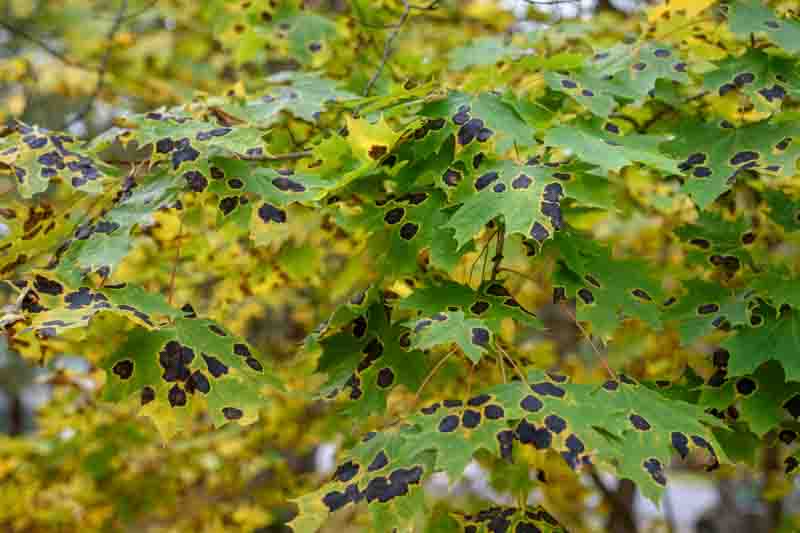
Maple tar spot produces distinctive dark, tar-like marks caused by fungi in the genus Rhytisma. Lesions may begin as lighter yellowish patches before developing black fungal structures later in the season.
Tar spot affects several maple species, including Norway, Red, and Silver Maples. The appearance can be striking, but infections generally cause little lasting harm to established trees.
What to do: Remove fallen leaves where practical to help reduce local sources of infection. Since spores can also arrive from nearby trees, sanitation does not guarantee prevention. Fungicides are rarely warranted on mature landscape maples.
Anthracnose is associated with fungal pathogens that favor prolonged cool, wet spring weather. Symptoms include irregular brown blotches, dead areas following leaf veins, distorted young foliage, and sometimes premature leaf drop.
Most healthy, established trees tolerate occasional infections. Focus on maintaining vigor, avoiding unnecessary stress, and addressing persistent or unusually severe outbreaks.
Various fungi can cause small brown or tan lesions, sometimes bordered by darker purple or reddish tissue. The symptoms may resemble weather damage, chemical injury, or other diseases.
Minor leaf spots usually require no treatment. Gardenia’s Leaf Spot Diseases guide explains the broader patterns and management principles.
For unusually severe infections, consult a plant diagnostic laboratory rather than choosing a fungicide based on the appearance of a photograph.
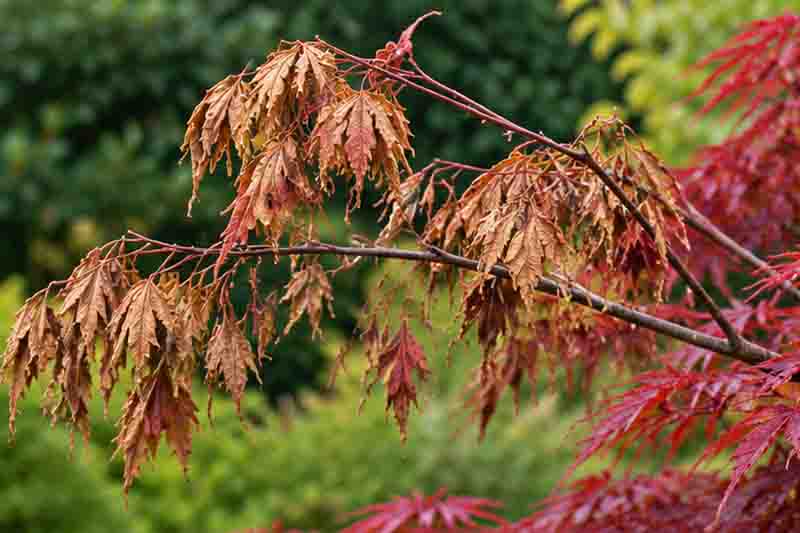 Illustration of localized branch dieback on a Japanese maple. Several causes are possible
When an entire branch wilts or dies, the problem may involve damaged roots, blocked water transport, injured bark, or disease rather than a superficial leaf infection.
Verticillium wilt is caused by soilborne fungi that invade roots and interfere with the tree’s water-conducting tissues. Symptoms may include sudden wilting, small leaves, one-sided crown decline, and progressive branch death.
Some affected branches develop olive-green or brown discoloration inside the sapwood, but staining may be absent or caused by other conditions.
What to do: Protect the roots from additional stress, maintain appropriate soil moisture, and seek professional diagnosis when dieback progresses. There is no reliably curative treatment for an infected mature maple.
Cankers damage localized areas of bark and underlying tissue. Look for sunken, cracked, dead, or discolored bark associated with a declining branch.
Physical injury, frost damage, drought stress, and certain pathogens can contribute to canker development. An arborist can determine whether affected branches should be removed and assess the risk from larger limbs.
A maple may wilt even when the soil is wet. Saturated soil can deprive roots of oxygen, reducing their ability to absorb water. In some cases, pathogens such as Phytophthora also contribute to root or collar rot.
Inspect drainage, the root flare, and any history of deep planting, excavation, or prolonged soil saturation. Wet roots do not automatically mean an infectious root disease.
Important warning: If large branches are dying, the trunk shows significant decay, or the canopy is declining rapidly, arrange a professional arborist assessment. A certified arborist can evaluate structural safety, while laboratory testing may help confirm a suspected pathogen.
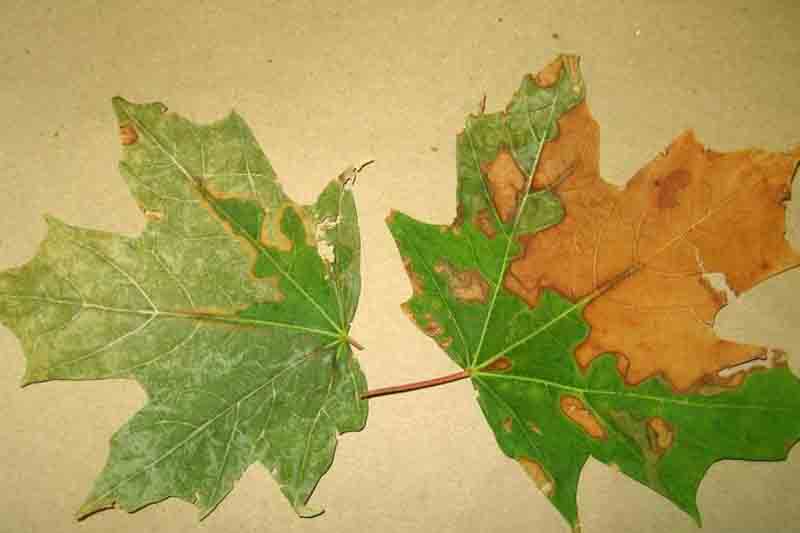
Both conditions can produce brown, dry leaf margins, but their causes and implications are different.
Environmental leaf scorch results from drought, heat, drying winds, salts, or impaired root function. It is not infectious, and improving growing conditions can prevent or reduce future damage.
Bacterial leaf scorch is caused by Xylella fastidiosa, a bacterium that colonizes water-conducting tissues. The disease has been documented on Red Maple and Sugar Maple, among other tree species, but maple species are not equally susceptible.
Symptoms often appear in midsummer or late summer and may recur or progress over successive growing seasons. Some affected leaves develop a yellowish band between healthy tissue and brown margins, but this feature is not diagnostic.
What to do: If scorch recurs annually, spreads through branches, and cannot be explained by growing conditions, ask a diagnostic laboratory about testing for bacterial leaf scorch. Laboratory confirmation is necessary, and there is no reliably curative treatment.
Most importantly, a maple with brown edges after a heat wave should not automatically be suspected of having bacterial leaf scorch.
Many maple pests cause visible symptoms without seriously threatening an established tree. The key is distinguishing a cosmetic infestation from sustained damage.
Aphids feed on young shoots and leaves. Their sugary honeydew can make foliage and surfaces beneath the tree sticky, while dark sooty mold may develop on the deposits.
Natural predators often keep populations under control. On accessible young trees, a gentle water spray can reduce colonies. Avoid broad-spectrum insecticides when damage is minor.
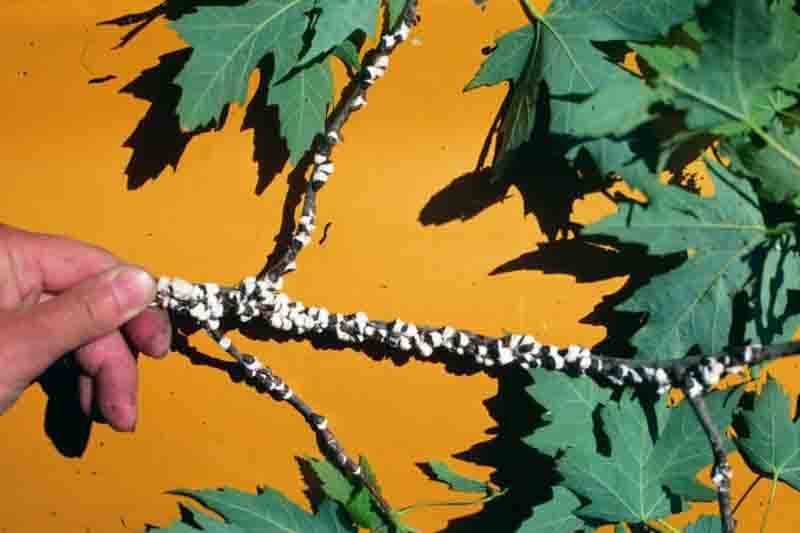
Cottony maple scale (Neopulvinaria innumerabilis, formerly Pulvinaria innumerabilis) is frequently found on Red and Silver Maples. Females produce conspicuous white, cotton-like egg sacs on twigs and branches.
Heavy infestations can lead to honeydew, yellowing foliage, and twig decline, but many populations are regulated by natural enemies. If treatment becomes necessary, correct identification and timing are essential.

Small red, pink, or green bumps on maple leaves are often galls caused by mites or insects. Although unusual in appearance, they rarely harm established trees.
What to do: Usually nothing. Once galls develop, spraying cannot restore the leaf’s original shape, and treatment is generally unnecessary.
Some borers attack stressed or weakened trees, leaving small exit holes, damaged bark, or sawdust-like material. However, such signs do not automatically identify the insect or establish the cause of decline.
Extensive boring activity, significant bark injury, or dying major branches warrants professional assessment.
The same symptom can suggest different priorities depending on the maple species and its growing environment. Gardenia’s species-aware comparison highlights the most useful initial checks.
| Maple species | Common concerns | Most useful first check |
|---|---|---|
| Red Maple | Chlorosis, scorch, leaf spots | Soil pH and drainage, especially when leaves yellow |
| Sugar Maple | Heat, drought, salt injury, decline | Root-zone moisture, compaction, nearby paving |
| Silver Maple | Leaf diseases, scale insects, branch failures | Distinguish cosmetic leaf symptoms from structural problems |
| Freeman Maple | Scorch, root stress, structural defects | Planting conditions and branch structure |
| Norway Maple | Tar spot, anthracnose, root stress | Whether leaf spotting is cosmetic or canopy decline is occurring |
| Japanese Maple | Leaf scorch, frost injury, root problems, branch dieback | Sun exposure, soil moisture, localized versus widespread damage |
For Japanese Maples: Gardenia’s dedicated Japanese Maple Problems: Brown Leaves, Leaf Scorch and Wilting guide provides more detailed troubleshooting for delicate ornamental cultivars, including a symptom checker and practical recovery advice.
Once you have ruled out an immediately hazardous problem, focus on restoring favorable conditions rather than treating damaged leaves individually.
Leave healthy branches intact, even if some leaves are scorched. Dead or hazardous limbs should be assessed and removed appropriately.
The most effective long-term prevention is matching the maple species to its planting location. Sugar Maples generally favor cooler conditions and adequate moisture, while Red Maples may struggle with chlorosis in strongly alkaline soil. Japanese Maple cultivars vary considerably in size, hardiness, and exposure preferences.
Consider mature canopy spread, available root space, soil drainage, and summer climate before choosing a tree. A maple that tolerates your USDA hardiness zone may still perform poorly in an unsuitable site.
Once you understand your maple’s growing requirements, choosing compatible companion plants becomes much easier. Plants sharing the same light, moisture, soil, and hardiness needs are less likely to compete unsuccessfully or require conflicting care.
Use Gardenia’s Plant Finder to explore suitable plants, then check their growing requirements, mature sizes, and compatibility in the Garden Design Tool.
Brown maple leaf margins commonly indicate environmental scorch caused by heat, drought, wind, salts, or impaired root function. Check soil moisture and root-zone conditions before assuming disease. Brown patches following leaf veins, especially during wet spring weather, may suggest anthracnose.
Yellow leaves with green veins may indicate chlorosis associated with iron or manganese unavailability, particularly in alkaline soil. Root damage, waterlogging, and other stresses can produce similar symptoms. Soil pH testing and drainage assessment should precede nutrient treatments.
Maple tar spot is usually a cosmetic fungal disease on established trees. It produces distinctive black, tar-like lesions and may contribute to premature leaf drop. Removing fallen leaves can help reduce local infection pressure, but fungicide applications are rarely necessary for mature landscape maples.
Localized branch dieback can result from physical injury, cankers, root damage, or vascular diseases such as Verticillium wilt. Examine bark damage and the pattern of decline. If major branches are affected or symptoms spread, consult a qualified arborist and consider laboratory diagnosis.
Small red, pink, or green bumps are often leaf galls caused by mites or insects. Most cause little harm to established maple trees and require no treatment. Once galls have formed, spraying will not restore the affected foliage.
Yes. A maple affected by environmental leaf scorch can often recover when heat, drought, irrigation, or root-related stress is corrected. Damaged leaf tissue will remain brown, but healthy roots and branches may support normal new foliage during the following growing season.
Not automatically. Common problems such as tar spot, minor anthracnose, and many fungal leaf spots rarely justify fungicide treatment on established trees. Any chemical treatment should follow an accurate diagnosis and use a product specifically labeled for the host, disease, and application method.
Maple tree problems can look dramatic, but the best response begins with careful observation. A few leaf spots may be harmless, while progressive wilting, repeated premature leaf drop, or significant branch dieback may indicate a more serious problem.
Use Gardenia’s symptom checker to narrow the possibilities, assess the urgency, and decide what to investigate next. For more information about individual maple species and their growing requirements, explore Gardenia’s Maple Plant Collection.
Updated and reviewed by Gardenia: October 2026
| Plant Type | Shrubs, Trees |
|---|---|
| Plant Family | Sapindaceae |
| Genus | Acer |
| Exposure | Full Sun, Partial Sun |
| Season of Interest | Spring (Early, Mid, Late), Summer (Early, Mid, Late), Fall, Winter |
| Characteristics | Showy |
| Garden Styles | City and Courtyard, Gravel and Rock Garden, Informal and Cottage, Japanese Garden, Woodland Garden |
Create a membership account to save your garden designs and to view them on any device.
Becoming a contributing member of Gardenia is easy and can be done in just a few minutes. If you provide us with your name, email address and the payment of a modest $25 annual membership fee, you will become a full member, enabling you to design and save up to 25 of your garden design ideas.
Join now and start creating your dream garden!