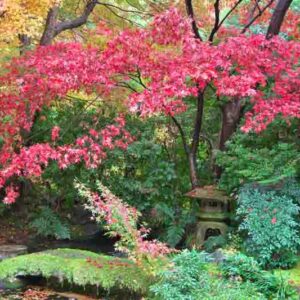
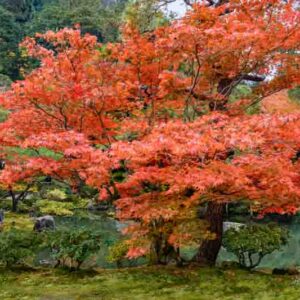
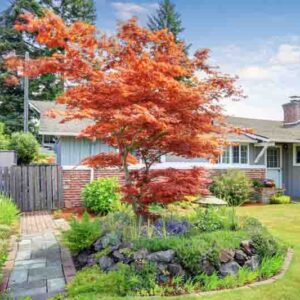
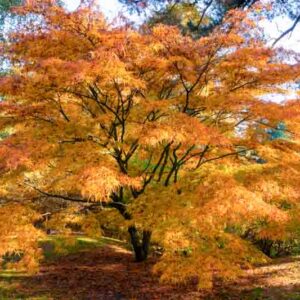
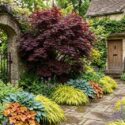
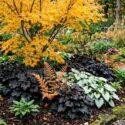
Japanese maple 'Toyama-nishiki', Acer palmatum 'Beni-shidare Tricolor', Acer palmatum 'Beni-shidare Variegated', Acer palmatum 'Goshiki-shidare', Acer palmatum var. dissectum 'Beni-shidare Tricolor', Acer palmatum var. dissectum 'Goshiki-shidare'
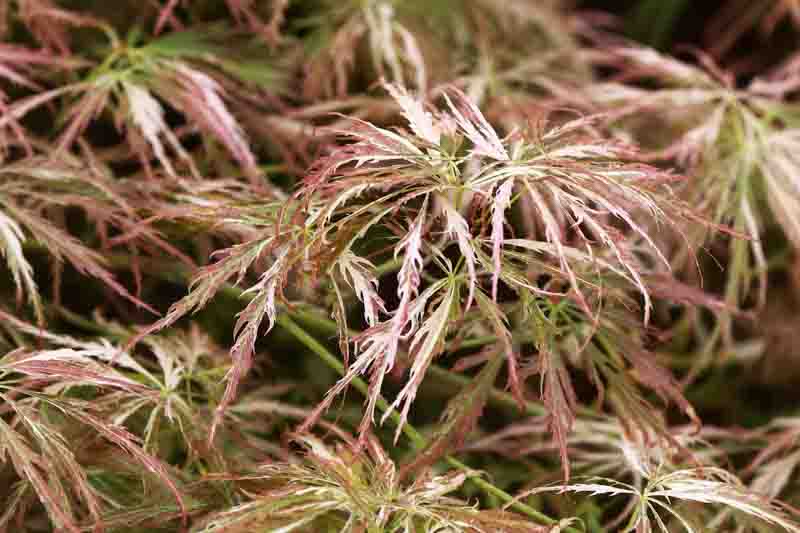
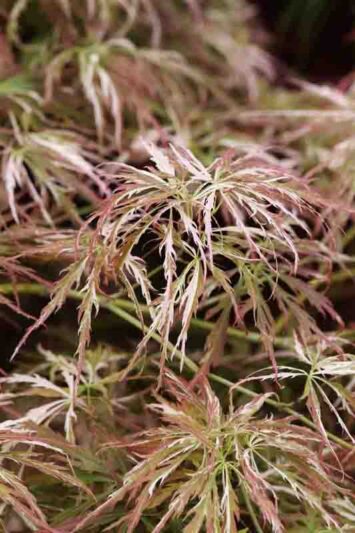


No two branches of Acer palmatum ‘Toyama-nishiki’ seem quite alike. One may carry finely cut burgundy leaves brushed with pink, while another displays reddish-green foliage streaked with cream or white. Add its graceful, cascading branches, and you have one of the more unusual variegated Japanese maples.
Sometimes treated as synonymous with ‘Goshiki-shidare’, but distinguished from it by some specialist growers, this slow-growing laceleaf maple makes a beautiful specimen for small gardens, sheltered courtyards, and containers. Its delicate leaves are especially attractive in bright partial shade, where their unusual markings can be enjoyed without the damage caused by intense afternoon sun.
Summary: Slow-growing, deciduous laceleaf Japanese maple with a rounded, cascading habit.
Use: Ideal for small gardens, Japanese gardens, sheltered borders, courtyards, and containers.
Highlight: Finely dissected burgundy to reddish-green leaves irregularly splashed with pink, cream, and white.
Botanical interest: RHS associates this name with ‘Goshiki-shidare’, while specialist nurseries report differences between the two selections.
| Botanical Name | Acer palmatum ‘Toyama-nishiki’ |
|---|---|
| Alternative Name | ‘Goshiki-shidare’ |
| Family | Sapindaceae |
| Common Name | Toyama-nishiki Japanese Maple, Variegated Laceleaf Japanese Maple |
| Origin | Cultivated selection; parent species native to Japan and neighboring East Asia |
| Plant Type and Habit | Deciduous shrub or small tree; slow-growing, rounded, cascading |
| Hardiness | USDA Zones 5-9; RHS H5 |
| Size at 10 Years / Mature Size | About 3 ft. tall and 4-5 ft. wide (90 x 120-150 cm) at 10 years; older specimens may reach about 5-10 ft. tall (1.5-3 m) and potentially 9-12 ft. wide (2.7-3.6 m), depending on conditions and grafting |
| Exposure | Partial shade; morning sun and afternoon protection in warm climates |
| Soil | Fertile, moist but well-drained clay, loam, or sandy soil; acidic, neutral, or alkaline pH |
| Foliage | Deeply dissected, purple-red to reddish-green, variegated pink and white; orange-yellow in fall |
| Flowers and Fruit | Small greenish spring flowers followed by winged samaras |
| Pet Safety | No established cultivar-specific toxicity classification; discourage ingestion |
‘Toyama-nishiki’ belongs to the Dissectum group of Japanese maples, recognized for their finely divided leaves and graceful branching. The Royal Horticultural Society groups the name with Acer palmatum var. dissectum ‘Goshiki-shidare’. However, specialist nursery MrMaple grows them as distinct selections: in side-by-side observations, ‘Goshiki-shidare’ reportedly retains pink-red spring color longer, while ‘Toyama-nishiki’ tends toward bronze-green in summer. Because horticultural naming differs, provenance matters when purchasing either plant.
Its appeal lies in the combination of irregular variegation and a naturally rounded, cascading silhouette. Unlike ordinary red laceleaf maples, which tend to produce relatively uniform foliage, ‘Toyama-nishiki’ can display several colors on the same branch.
Slow-growing and weeping, ‘Toyama-nishiki’ is typically around 3 ft. (90 cm) high and 4-5 ft. (120-150 cm) wide after 10 years, according to specialist nurseries. Those are ten-year dimensions, not an ultimate size. Older plants may reach approximately 5-10 ft. (1.5-3 m) tall, while published estimates for mature spread can reach 9-12 ft. (2.7-3.6 m). These are variable nursery estimates, not guaranteed measurements. Graft height, training, site and age all affect the eventual rounded, layered canopy. Plan for a wider tree than a young specimen suggests.
The deeply dissected leaves have seven or nine narrow lobes, giving them an almost feathery texture. Their underlying color ranges from purple-red to greenish red, broken by unpredictable pink, cream, or white markings.
The variegation changes with growing conditions and the season. Coloring can be more intense in shade. In autumn, the foliage develops warm orange and yellow tones before falling.
Small, greenish flowers appear in hanging clusters during spring, followed by red-flushed, winged seeds called samaras. These are minor ornamental features compared with the foliage.
Generally hardy in USDA Zones 5-9, ‘Toyama-nishiki’ offers colorful spring growth, finely textured summer foliage, and warm autumn shades. Its intricate branching becomes visible after leaf fall.
Its small spring flowers may be visited by insects, while the branches provide limited shelter. It is primarily an ornamental tree rather than a major wildlife resource.
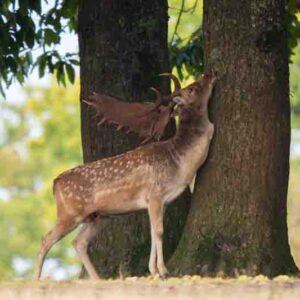
Japanese maples are generally rabbit-resistant and show some resistance to deer browsing. However, deer may occasionally browse young growth or damage trunks through antler rubbing. Protect newly planted trees where deer pressure is high.
Established plants tolerate occasional brief dry periods, but prolonged drought can damage the delicate foliage. This is not a suitable maple for exposed, unirrigated gardens.
No verified cultivar-specific toxicity classification is available. ‘Toyama-nishiki’ should not be confused with red maple (Acer rubrum), whose wilted leaves can be dangerous to horses. Discourage ingestion of ornamental foliage.
‘Toyama-nishiki’ is not generally considered invasive. Nevertheless, locally established seedlings of Japanese maple may warrant attention in regions where the species can naturalize.
Variegated Japanese maples are notoriously difficult to identify from a single photograph. Young plants may not yet display their mature habit, and the intensity of their markings changes with the season.
Important: These characteristics help evaluate a nursery plant but do not conclusively authenticate a cultivar. Reliable provenance and verified nursery stock remain essential.
| Cultivar | Habit | Key Difference |
|---|---|---|
| ‘Toyama-nishiki’ | Cascading | Finely dissected reddish leaves irregularly splashed pink and white |
| ‘Butterfly’ | Upright | Small green leaves with cream-white margins and pink spring highlights |
| ‘Orido-nishiki’ | Upright, spreading | Broader lobed leaves with irregular cream, white, and pink markings |
| ‘Dissectum Variegatum’ | Cascading | Variegated laceleaf foliage; identification requires reliable cultivar provenance |
For a broader comparison, explore Gardenia’s Japanese maples for containers, including upright, cascading, red-leaved, and variegated cultivars.
Bright partial shade is an excellent choice. Gentle morning sunlight is usually tolerated, while strong afternoon sun can scorch the pale leaf markings. In cool climates, plants may tolerate greater exposure; in hot inland gardens, afternoon shade is especially valuable.
Choose fertile, moist but well-drained soil. Clay, loam, and sand are suitable soil types, provided drainage and moisture are appropriate. The cultivar can grow in acidic, neutral, or alkaline soil.
Water deeply during establishment, keeping the root zone evenly moist rather than saturated. Mulch helps moderate soil temperature and reduces evaporation.
Plant in a sheltered position away from drying winds and reflected heat. Containers need particular attention during hot spells because their roots dry out and overheat more quickly than those of trees growing in the ground.
Cream and white leaf tissue contains less chlorophyll and is especially vulnerable to scorching. If the light-colored portions turn brown while darker leaves remain healthy, examine sun exposure before assuming the tree has a disease.
Plant in spring or autumn, setting the root flare at ground level and keeping the graft union above the soil. Avoid burying the trunk or planting directly against paving that reflects intense heat.
In containers, use a generously sized pot with drainage holes and a moisture-retentive, well-drained potting mix. Protect container roots from severe winter freezing and repot when necessary.
Little pruning is required. Remove damaged or crossing branches in late autumn or winter, avoiding heavy pruning in spring when Japanese maples may bleed sap. Preserve the naturally layered, cascading shape.
Feed sparingly in spring if growth is weak. Excess fertilizer can encourage vigorous, poorly balanced shoots.
Named Japanese maples are commonly propagated by grafting onto compatible rootstocks. Seedlings do not reliably retain the parent plant’s variegation or cascading habit.
| What You See | Likely Causes | Check First |
|---|---|---|
| Brown leaf margins | Sun scorch, wind, drought | Sun exposure and soil moisture |
| Wilting in wet soil | Poor drainage or root stress | Root-zone drainage |
| Sudden branch dieback | Root problems, winter injury, possible Verticillium wilt | Branch symptoms and overall plant health |
| Curled, sticky leaves | Aphids | Young shoots and leaf undersides |
| Vigorous solid-green shoots | Possible reversion or rootstock growth | Shoot origin and leaf shape |
Occasional pests include aphids, scale insects, and caterpillars. Japanese maples can also suffer from root diseases and verticillium wilt, particularly when stressed.
Brown, papery leaf edges: Investigate sunlight, dry soil, and wind exposure.
Irregular pink and cream markings: Normal variegation, not disease.
Strong, solid-green shoots: Check for rootstock growth below the graft or reversion within the canopy. Remove confirmed rootstock shoots promptly.
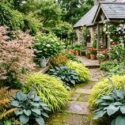
The secret to planting around ‘Toyama-nishiki’ is restraint. Its patterned leaves already provide plenty of color, so companions with simpler foliage create the strongest contrast. Select plants that share its preference for partial shade and moist, well-drained soil.
Growing conditions: USDA Zones 5-9; partial shade; fertile, moist but well-drained soil.
These are illustrative quantities, not a fixed planting plan. Actual spacing depends on bed dimensions, mature plant spread, and local growing conditions. Keep companions away from the maple’s trunk and avoid disturbing established roots.
This combination offers changing foliage interest from spring through autumn without competing with the maple’s variegation. Allow for the potential spread of a mature specimen, not just its ten-year dimensions. For smaller, drier, or more exposed gardens, adjust the plant selection before buying.
RHS groups ‘Toyama-nishiki’ with Acer palmatum var. dissectum ‘Goshiki-shidare’, but specialist grower MrMaple treats them as distinct based on differences in seasonal leaf color. Check a nursery’s provenance when buying.
Specialist nurseries estimate about 3 feet tall and 4-5 feet wide after 10 years. Older specimens can grow substantially larger, with estimates of 5-10 feet tall and potentially 9-12 feet wide depending on site, age, and graft height.
Bright partial shade is ideal, particularly in warm climates. Variegation may color more intensely in shade. Protect the delicate leaves from strong afternoon sunlight and drying winds.
Some green or reddish-green foliage is normal because variegation varies naturally. Vigorous solid-green shoots, however, may indicate reversion or growth from the rootstock. Check the shoot’s origin before pruning.
Yes. Its slow growth makes it suitable for spacious containers with drainage holes and moisture-retentive, well-drained compost. Protect potted roots from extreme winter cold and avoid hot, exposed locations.
Royal Horticultural Society – Acer palmatum var. dissectum ‘Goshiki-shidare’.
Gardenia – Great Japanese Maples for Containers.
Updated: October 2026
| Hardiness |
5 - 9 |
|---|---|
| Heat Zones |
2 - 8 |
| Climate Zones | 2, 2B, 3, 3A, 3B, 4, 5, 6, 7, 8, 9, 10, 12, 14, 15, 16, 17, 18, 19, 20, 21, 22, 23, 24, A3 |
| Plant Type | Shrubs, Trees |
| Plant Family | Sapindaceae |
| Genus | Acer |
| Common names | Japanese Maple, Maple |
| Exposure | Full Sun, Partial Sun |
| Season of Interest | Spring (Early, Mid, Late), Summer (Early, Mid, Late), Fall |
| Height | 5' - 10' (150cm - 3m) |
| Spread | 9' - 12' (270cm - 3.7m) |
| Spacing | 108" - 144" (270cm - 3.7m) |
| Maintenance | Low |
| Water Needs | Average |
| Soil Type | Clay, Loam, Sand |
| Soil pH | Acid, Neutral, Alkaline |
| Soil Drainage | Moist but Well-Drained |
| Characteristics | Showy |
| Tolerances | Rabbit, Clay Soil |
| Garden Uses | Beds And Borders, Patio And Containers |
| Garden Styles | City and Courtyard, Informal and Cottage, Japanese Garden, Traditional Garden |
| Toxic to Humans | No known toxicity |
| Toxic to Cats | No known toxicity |
| Toxic to Dogs | No known toxicity |
| Toxic to Horses | No known toxicity |


| Hardiness |
5 - 9 |
|---|---|
| Heat Zones |
2 - 8 |
| Climate Zones | 2, 2B, 3, 3A, 3B, 4, 5, 6, 7, 8, 9, 10, 12, 14, 15, 16, 17, 18, 19, 20, 21, 22, 23, 24, A3 |
| Plant Type | Shrubs, Trees |
| Plant Family | Sapindaceae |
| Genus | Acer |
| Common names | Japanese Maple, Maple |
| Exposure | Full Sun, Partial Sun |
| Season of Interest | Spring (Early, Mid, Late), Summer (Early, Mid, Late), Fall |
| Height | 5' - 10' (150cm - 3m) |
| Spread | 9' - 12' (270cm - 3.7m) |
| Spacing | 108" - 144" (270cm - 3.7m) |
| Maintenance | Low |
| Water Needs | Average |
| Soil Type | Clay, Loam, Sand |
| Soil pH | Acid, Neutral, Alkaline |
| Soil Drainage | Moist but Well-Drained |
| Characteristics | Showy |
| Tolerances | Rabbit, Clay Soil |
| Garden Uses | Beds And Borders, Patio And Containers |
| Garden Styles | City and Courtyard, Informal and Cottage, Japanese Garden, Traditional Garden |
| Toxic to Humans | No known toxicity |
| Toxic to Cats | No known toxicity |
| Toxic to Dogs | No known toxicity |
| Toxic to Horses | No known toxicity |
How many Acer palmatum ‘Toyama-nishiki’ (Japanese Maple) do I need for my garden?
| Plant | Quantity | |
|---|---|---|
| Acer palmatum ‘Toyama-nishiki’ (Japanese Maple) | N/A | Buy Plants |
Create a membership account to save your garden designs and to view them on any device.
Becoming a contributing member of Gardenia is easy and can be done in just a few minutes. If you provide us with your name, email address and the payment of a modest $25 annual membership fee, you will become a full member, enabling you to design and save up to 25 of your garden design ideas.
Join now and start creating your dream garden!