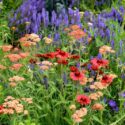
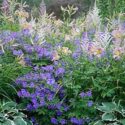
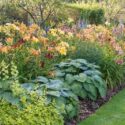
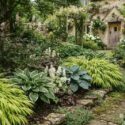
This planting plan shows how to combine ornamental grasses and perennials into a romantic, meadow-style border using repetition, contrast, and restraint.
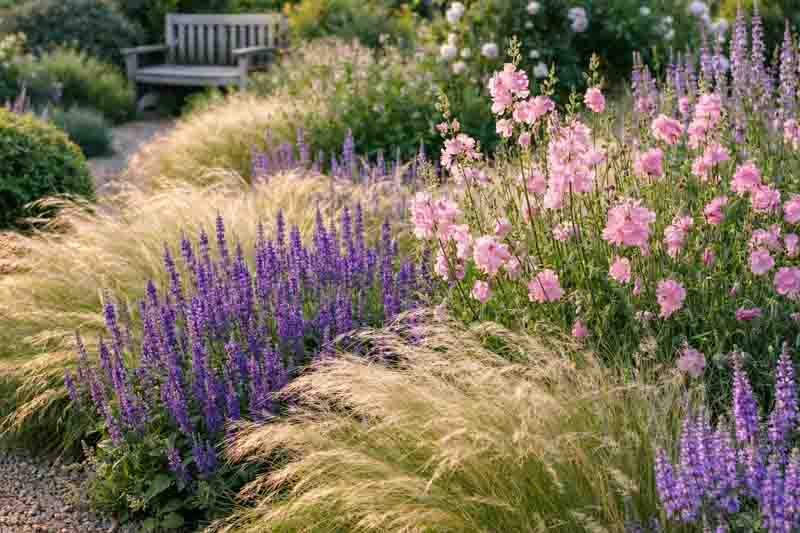


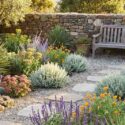
This sunny border combines three plants with very different habits: dense violet flower spikes, tall pink stems, and fine grasses that arch through the spaces between them. Salvia nemorosa ‘Caradonna’ forms substantial purple groups near the front and middle, Sidalcea ‘Elsie Heugh’ rises above them with soft pink flowers, and Mexican feather grass spreads through the planting in broad golden drifts.
The border surrounds a gravel path and seating area, with roses and other perennials continuing into the background. It feels full and mature, but not tightly arranged. The grasses overlap neighboring plants, Salvia groups vary in size, and the Sidalcea appears in taller pockets rather than a continuous row.
Main plants used: Nassella tenuissima (Mexican Feather Grass), Salvia nemorosa ‘Caradonna’, and Sidalcea ‘Elsie Heugh’
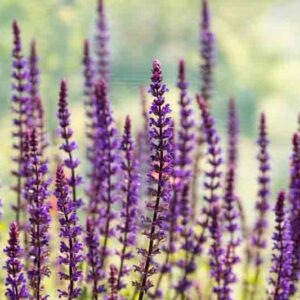
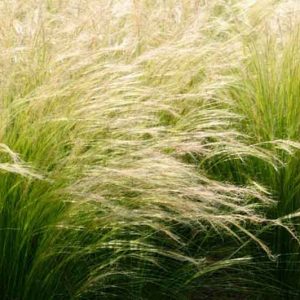
The three plants differ strongly in both shape and texture. ‘Caradonna’ produces dense vertical flower spikes, while ‘Elsie Heugh’ has more open stems carrying individual pink flowers. The grass is finer than either perennial and spreads outward rather than upward.
That difference is especially effective in a large border. Salvia gives the eye clearly defined areas of violet, while Sidalcea rises through the planting without forming a solid wall. The grass fills much of the remaining space and keeps the planting visually connected.
The image also shows why the groups should not be perfectly even. Some Salvia clumps are substantial, others are partly hidden by grass, and the taller pink flowers appear more heavily in one part of the bed. That irregularity makes the planting look established rather than patterned.
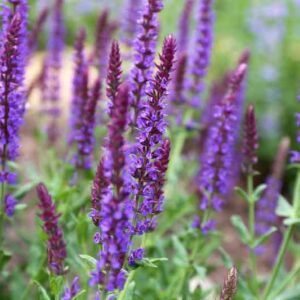
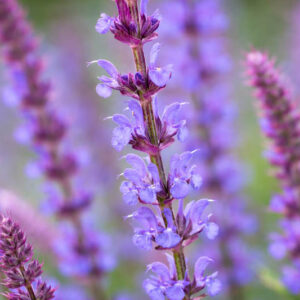
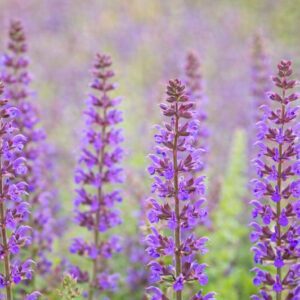
Salvia nemorosa ‘Caradonna’ provides the strongest flower color. Its dark stems and violet-purple spikes are most effective in repeated groups. After the first main flowering, cutting plants back can encourage a second flush of foliage and flowers.
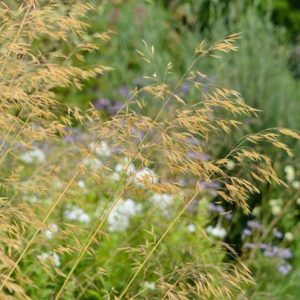
Sidalcea ‘Elsie Heugh’ adds height without much visual weight. Its pale pink, mallow-like flowers are carried along slender stems, making it particularly useful behind or among lower Salvia. In exposed gardens, neighboring plants can provide some support.
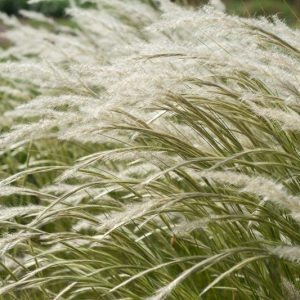
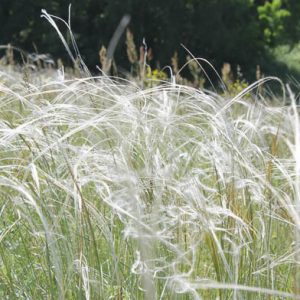
Nassella tenuissima contributes the broadest area of texture. Its fine leaves and flower stems become increasingly golden as the season progresses and move readily in the wind. Use it in loose groups rather than a continuous band.
Important: Mexican feather grass can self-seed aggressively and is invasive or restricted in some regions. Check local guidance before planting it. Where it is unsuitable, substitute a non-invasive fine-textured grass adapted to your area.
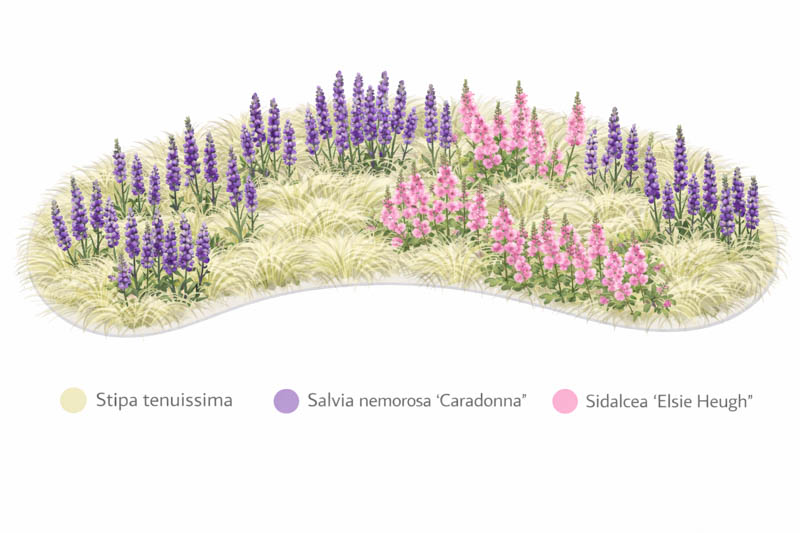
Create a sunny, informal border where repeated violet Salvia and taller pink Sidalcea emerge through broad areas of fine ornamental grass.
Use these proportions as a guide rather than a fixed formula. Other roses and perennials can be incorporated around the three featured plants, as in the garden shown.
Begin with several broad groups of grass, leaving irregular spaces between them.
Place Salvia in repeated groups through the front and middle, allowing some clumps to overlap the grass.
Add Sidalcea farther back and occasionally through the middle so the pink flower stems rise above both plants. Avoid an even three-layer arrangement.
The three plants do not have identical moisture requirements. Sidalcea prefers soil that stays more evenly moist, while Salvia and Mexican feather grass are happier with freer drainage. Slight differences in moisture across a broad border can help accommodate all three.
Most importantly, check the status of Mexican feather grass where you garden. Its fine texture is visually effective, but in regions where it is invasive, replacing it with a suitable non-invasive grass is the responsible choice.
| Hardiness |
7 - 9 |
|---|---|
| Climate Zones | 2B, 3, 3A, 3B, 4, 5, 6, 7, 8, 9, 14, 15, 16, 17, 18, 19, 20, 21, 22, 23, 24 |
| Exposure | Full Sun |
| Season of Interest | Summer (Early, Mid, Late) |
| Maintenance | Low |
| Water Needs | Average |
| Soil Type | Chalk, Loam, Sand |
| Soil pH | Acid, Neutral, Alkaline |
| Soil Drainage | Moist but Well-Drained |
| Characteristics | Cut Flowers, Showy |
| Attracts | Bees, Butterflies, Hummingbirds |
| Landscaping Ideas | Beds And Borders |
| Garden Styles | Butterfly Garden, Informal and Cottage, Pollinator Garden, Prairie and Meadow |


| Hardiness |
7 - 9 |
|---|---|
| Climate Zones | 2B, 3, 3A, 3B, 4, 5, 6, 7, 8, 9, 14, 15, 16, 17, 18, 19, 20, 21, 22, 23, 24 |
| Exposure | Full Sun |
| Season of Interest | Summer (Early, Mid, Late) |
| Maintenance | Low |
| Water Needs | Average |
| Soil Type | Chalk, Loam, Sand |
| Soil pH | Acid, Neutral, Alkaline |
| Soil Drainage | Moist but Well-Drained |
| Characteristics | Cut Flowers, Showy |
| Attracts | Bees, Butterflies, Hummingbirds |
| Landscaping Ideas | Beds And Borders |
| Garden Styles | Butterfly Garden, Informal and Cottage, Pollinator Garden, Prairie and Meadow |
Recreate this garden. Specify the percentages you would like to have of each plant and input the dimensions of your garden space.We'll give you a shopping list so you know how many plants you need.
| Plant | Quantity | |
|---|---|---|
| Sidalcea 'Elsie Heugh' (Checker Bloom) | N/A | Buy Plants |
| Salvia nemorosa 'Caradonna' (Woodland Sage) | N/A | Buy Plants |
| Stipa tenuissima (Mexican Feather Grass) | N/A | Buy Plants |
Create a membership account to save your garden designs and to view them on any device.
Becoming a contributing member of Gardenia is easy and can be done in just a few minutes. If you provide us with your name, email address and the payment of a modest $25 annual membership fee, you will become a full member, enabling you to design and save up to 25 of your garden design ideas.
Join now and start creating your dream garden!