When do lilies bloom? Lily season can stretch from late spring into early fall when you choose the right varieties. Follow this bloom calendar for Asiatic, Martagon, LA, Trumpet, Oriental, Orienpet, tiger, and species lilies, and learn how climate, weather, and cultivar affect flowering time in your garden.
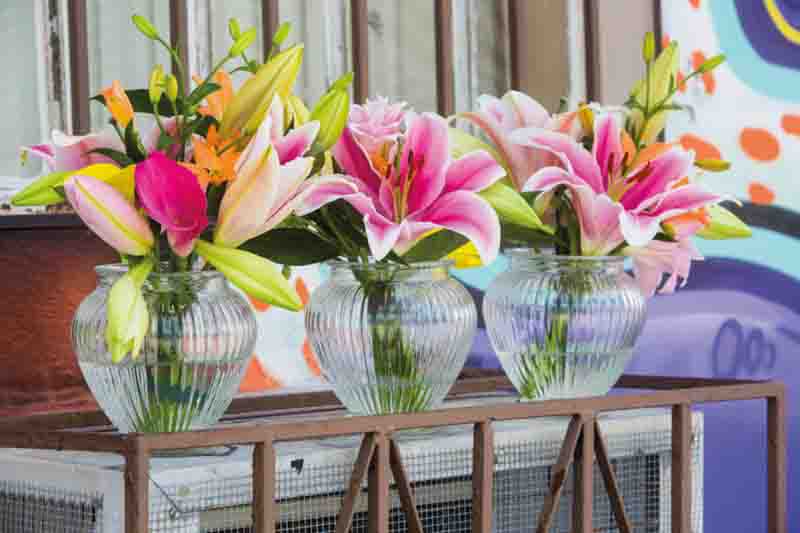


When do lilies bloom? For most gardeners, the answer is not a single month. True lilies in the genus Lilium can flower from late spring through early fall, depending on the species or hybrid, climate, planting time, and growing conditions.
That long season is one of the great advantages of growing lilies. Choose only one type and you may have flowers for several weeks. Combine early, midseason, and late-blooming lilies and the display can continue for much of the summer, with a few species stretching the season even further.
The sequence is generally predictable. Early-flowering species, Martagons, Asiatic lilies, and LA hybrids begin the show. Trumpet lilies follow around midsummer. Oriental and Orienpet lilies dominate the second half of summer, while tiger lilies and several species can carry lily season into late summer or early fall.
| Lily Type | Typical Bloom Season | Role in the Lily Season |
|---|---|---|
| Madonna lily and some early species | Late spring to early summer | Among the first true lilies to flower |
| Asiatic lilies | Early to mid-summer | Main early-season hybrid group |
| Martagon lilies | Early to mid-summer | Early woodland and border display |
| LA hybrids | Early to mid-summer | Bridge between early Asiatic and later groups |
| Trumpet and Aurelian lilies | Mid-summer, sometimes into late summer | Tall, fragrant midseason display |
| Oriental lilies | Mid to late summer | Major late-season fragrant group |
| Orienpet lilies | Mid to late summer | Strong late-summer continuation |
| Tiger lilies | Mid to late summer, sometimes early fall | Reliable late-season species display |
| Species lilies | Late spring to early fall, depending on species | The widest range of flowering times |
The key to months of lily flowers: Do not rely on one lily division. Combine early, midseason, and late-flowering groups so one wave begins as another is fading.
A bloom calendar is more useful than a fixed calendar date because lilies respond to temperature and seasonal development. A cultivar that begins flowering in June in one garden may not open until July in a colder region. In a warm climate, the same cultivar may be weeks earlier.
Altitude, latitude, winter and spring temperatures, planting depth, sun exposure, bulb maturity, soil moisture, and the weather during spring growth can all shift flowering. An unusually cool spring generally delays development, while sustained warmth can move the season forward.
This is why terms such as early summer, mid-summer, and late summer are more transferable than promising that a particular lily will always flower on June 20 or July 15.
Bloom dates move with climate. Use the calendar below as a flowering sequence rather than an exact appointment. The relative order of lily groups is usually more dependable than a specific month.
Lily season can begin before summer is fully underway. Several species flower unusually early, and certain Asiatic cultivars can also start in late spring in favorable climates.
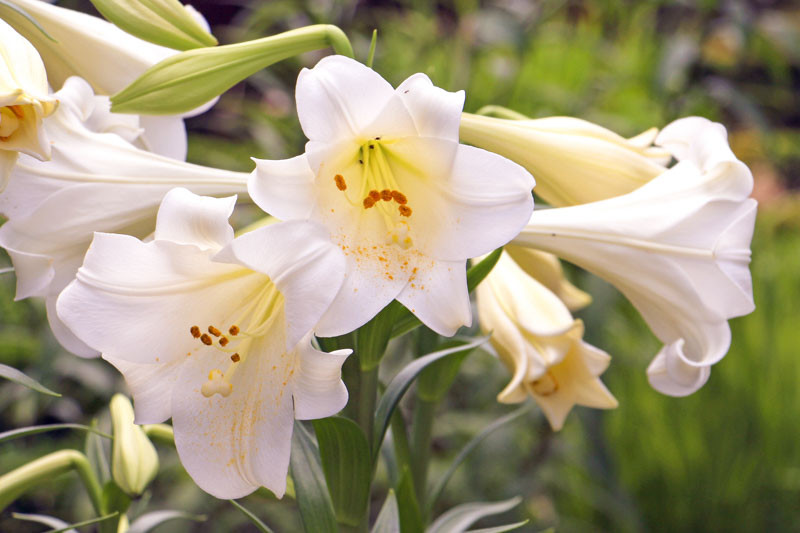
One of the most important early lilies is Lilium candidum, the Madonna lily. Its fragrant white trumpets typically appear in late spring or early summer, placing it near the beginning of the true-lily calendar.
Other early species can overlap this period. Gardenia records such lilies as Lilium bulbiferum var. croceum and some North American or Asian species beginning before the main summer flush. Individual species vary considerably, which is why wild lilies should never be treated as one flowering group.
Some dwarf Asiatic lilies also begin early. In a mild season, they can provide the first brightly colored hybrid lily flowers before the main Asiatic display begins.
Want the earliest lilies? Include an early species such as Madonna lily alongside early Asiatic cultivars. They can begin the display before the larger summer lily groups reach their peak.
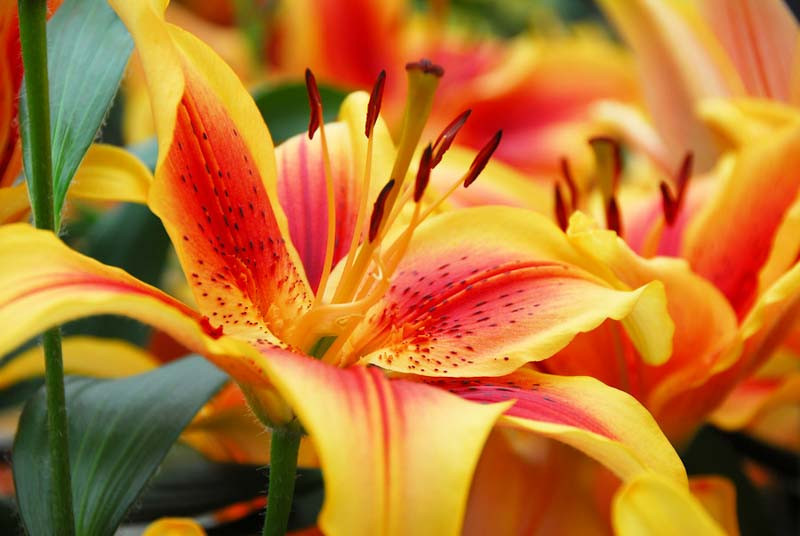
Asiatic lilies are among the earliest major hybrid groups to bloom. Their main season runs from early into mid-summer, although individual cultivars may begin somewhat earlier or later.
This group is ideal for starting a long lily season because it offers an enormous range of colors, including white, yellow, orange, red, pink, burgundy, and bicolors. Most Asiatic lilies are unscented, but they compensate with vigorous growth, abundant flowers, and generally reliable performance.
A single Asiatic cultivar may remain attractive for several weeks because individual buds open successively rather than all at once. Different cultivars within the group also mature at slightly different times, extending the collective Asiatic season.
Gardenia’s lily records place cultivars such as ‘Citronella’, ‘Grand Cru’, ‘Black Out’, ‘Dot Com’, ‘Brunello’, ‘Monte Negro’, ‘Gran Paradiso’, ‘Forever Susan’, and ‘Landini’ primarily in the early-to-mid-summer window.
For gardeners trying to build a continuous sequence, Asiatics are the natural starting point before Trumpet, Oriental, and Orienpet lilies take over.
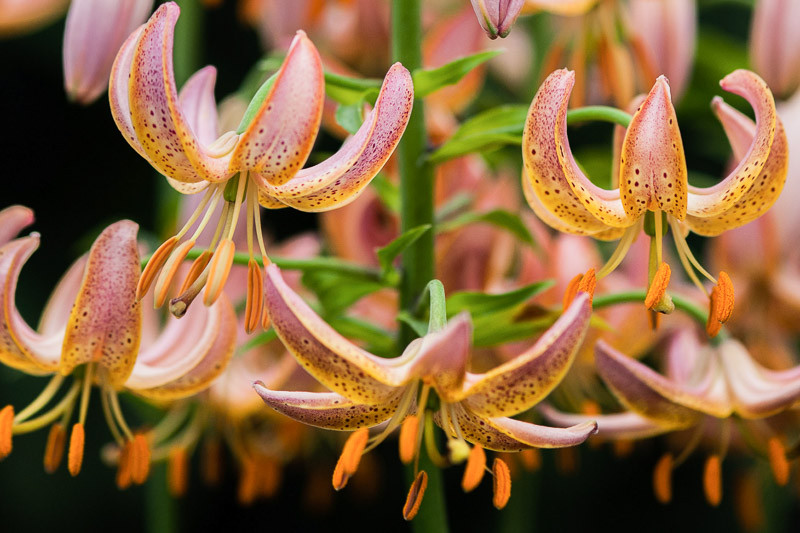
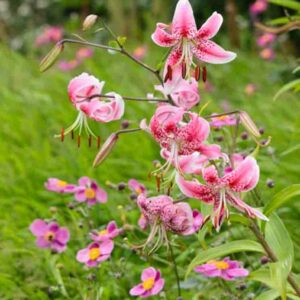
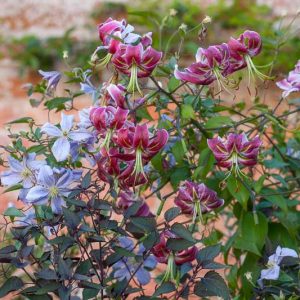
Martagon lilies also belong near the beginning of the summer lily sequence. They generally bloom in early to mid-summer and are especially valuable where a garden has partial shade or a woodland character.
Their flowering style is very different from that of Asiatic hybrids. Tall stems may carry numerous small, nodding flowers with strongly recurved tepals, creating the characteristic Turk’s cap form. Mature plants can produce exceptionally large flower counts.
Gardenia’s bloom data for cultivars such as ‘Claude Shride’, ‘Arabian Knight’, ‘Sunny Morning’, ‘Terrace City’, ‘Pink Morning’, ‘Scarlet Morning’, ‘Manitoba Morning’, ‘Chameleon’, ‘Fairy Morning’, and ‘Gaybird’ consistently places them from early into mid-summer.
One caution is important when interpreting the calendar: newly planted Martagons sometimes take time to establish and may not bloom normally in their first season after planting or disturbance. Once settled, however, they can be exceptionally long-lived.
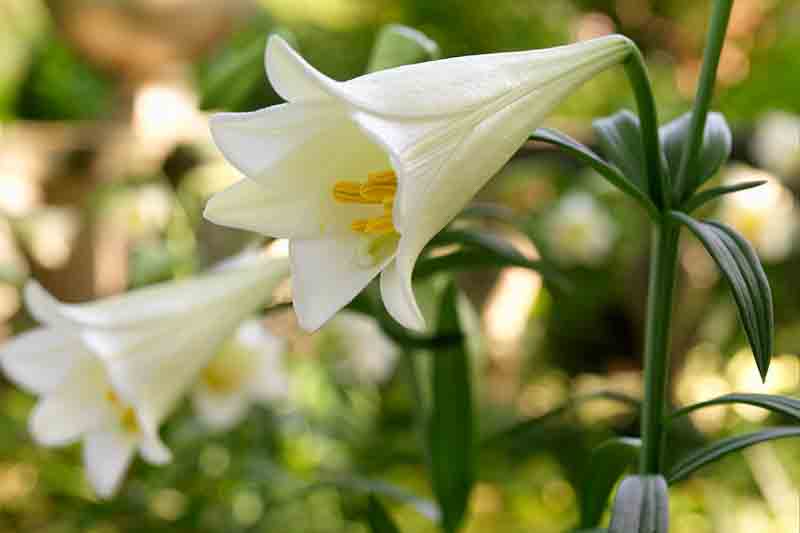
Longiflorum-Asiatic hybrids, usually called LA lilies, combine characteristics of Easter lilies with Asiatic lilies. They generally flower in early to mid-summer, placing them naturally alongside the later Asiatics and Martagons.
Gardenia cultivars such as ‘Brindisi’, ‘Apricot Fudge’, ‘Arbatax’, ‘Beau Soleil’, ‘Bright Diamond’, and ‘Royal Sunset’ fall into this early-to-mid-summer window.
Lilium longiflorum, the Easter lily, is strongly associated with spring because greenhouse growers force millions of plants into flower for Easter. That commercial schedule can be misleading for gardeners. Outdoors, naturally grown longiflorum lilies generally flower later, around early summer into midsummer depending on climate.
Easter lilies do not naturally bloom according to the Easter calendar. Potted Easter lilies sold in spring have been carefully forced in greenhouse production. Once established outdoors, their natural flowering season is generally later.
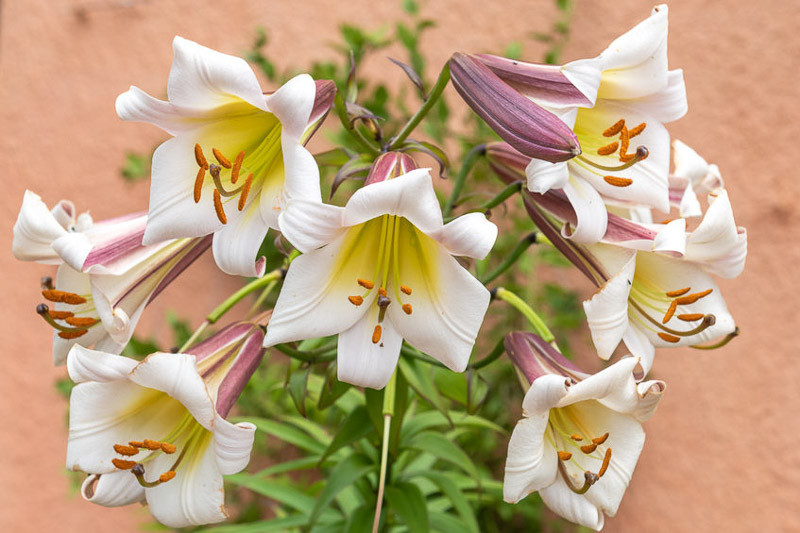
As the earliest lilies begin to fade, Trumpet and Aurelian lilies move into center stage. Their main flowering season is midsummer, with some cultivars continuing into late summer.
Trumpet lilies are among the most spectacular fragrant lilies. Tall stems support large, waxy trumpet-shaped flowers whose perfume can become particularly noticeable during warm evenings.
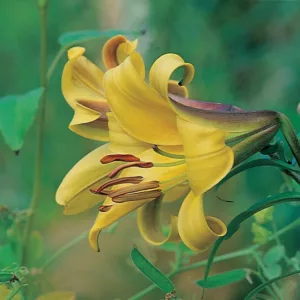
Lilium regale is a classic midsummer example. Other Trumpet selections, including ‘African Queen’, ‘Pink Perfection’, and the Golden Splendor Group, can continue the display toward late summer.
The transition is not abrupt. Late Asiatics may still be flowering as the first Trumpets open, and late Trumpets can overlap with the first Orientals and Orienpets. That overlap is what allows a carefully selected lily planting to look continuously in bloom rather than proceeding through isolated bursts.
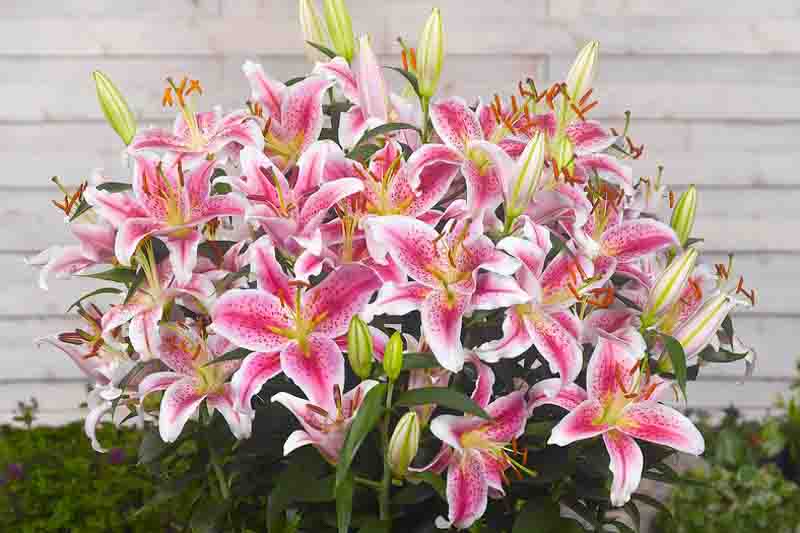
Oriental lilies are among the classic late-season lilies. In Gardenia’s current plant records, their main flowering period runs from mid to late summer, although exact timing can shift with cultivar, climate, and growing conditions.
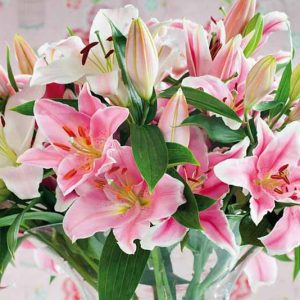
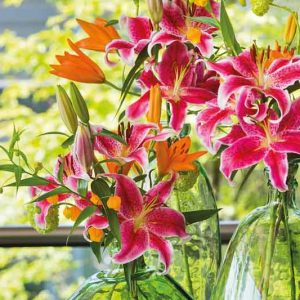
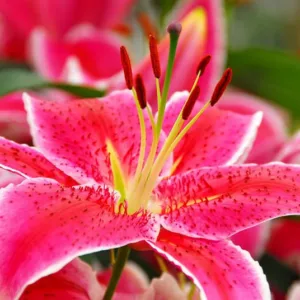
By this point in the season, the character of the lily garden changes dramatically. Oriental flowers are often enormous, richly colored, and intensely fragrant. White, pink, crimson, and bicolored flowers replace many of the brighter yellows and oranges associated with earlier Asiatic lilies.
Gardenia’s records place well-known cultivars such as ‘Casa Blanca’, ‘Muscadet’, ‘Star Gazer’, ‘Starlight Express’, ‘Starfighter’, ‘Tom Pouce’, ‘Dizzy’, ‘Sumatra’, ‘Salmon Star’, and the double Roselily cultivars mainly in the mid-to-late-summer window.
If you want lilies flowering after many early summer perennials have peaked, Orientals are among the most important groups to include.
For fragrance later in summer: Oriental lilies are difficult to beat. Their combination of late flowering, immense flowers, and powerful scent makes them one of the best ways to extend the sensory impact of a lily planting.
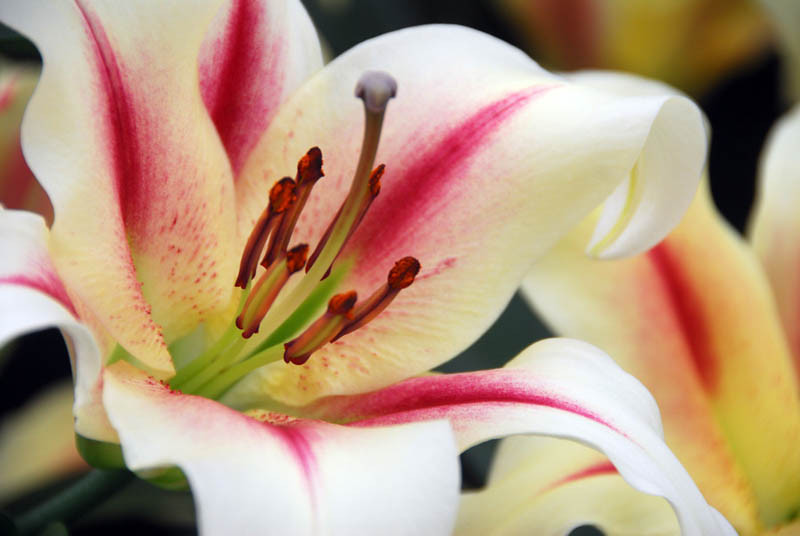
Orienpet lilies, also called OT hybrids, combine Oriental lilies with Trumpet or Aurelian ancestry. They are particularly valuable at the end of lily season, typically flowering from midsummer through late summer.
Many are tall, vigorous plants with large, fragrant flowers. Cultivars such as ‘Scheherazade’, ‘Silk Road’ or ‘Friso’, ‘Conca d’Or’, ‘Anastasia’, ‘Black Beauty’, ‘Nymph’, ‘Candy Club’, and ‘Robert Swanson’ provide a powerful late-summer display.
Gardenia’s Orienpet records are remarkably consistent: the cultivars in the current collection overwhelmingly fall into the mid-summer to late-summer flowering window.
That makes Orienpets especially useful for succession planting. Place them behind or among early Asiatics and Martagons, and the same area can transition from one lily group to another rather than becoming empty after the first flush.
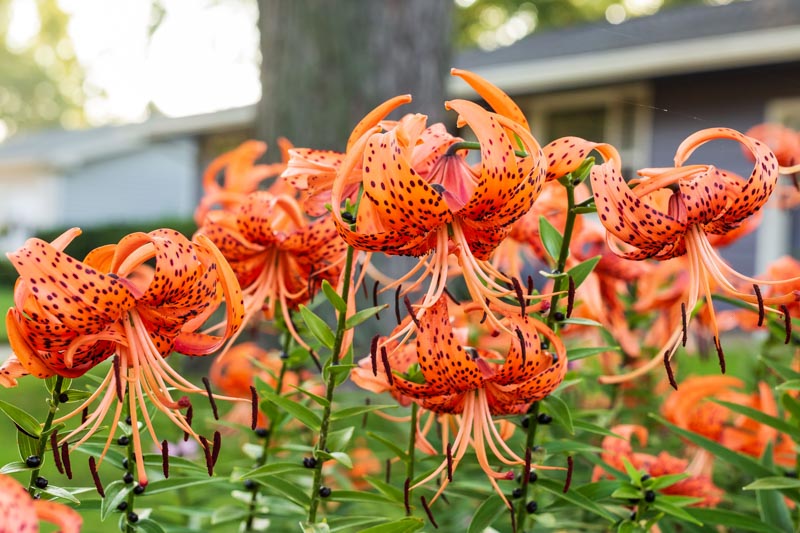
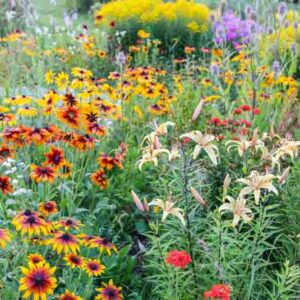
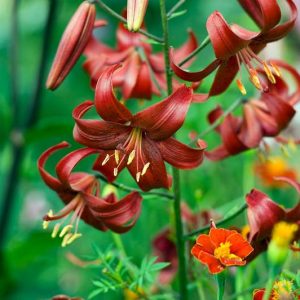
Tiger lilies, most commonly Lilium lancifolium, are another excellent late-season group. They usually flower from mid to late summer, when many earlier lilies are already declining.
The familiar orange flowers with black or crimson spots are downward-facing with recurved tepals. Cultivars can differ in timing: some begin around midsummer, while selections such as ‘Splendens’ can extend toward early fall.
This relatively late flowering period is one reason tiger lilies are so useful in mixed borders. They can keep the lily season alive after Asiatic and Martagon lilies have finished.
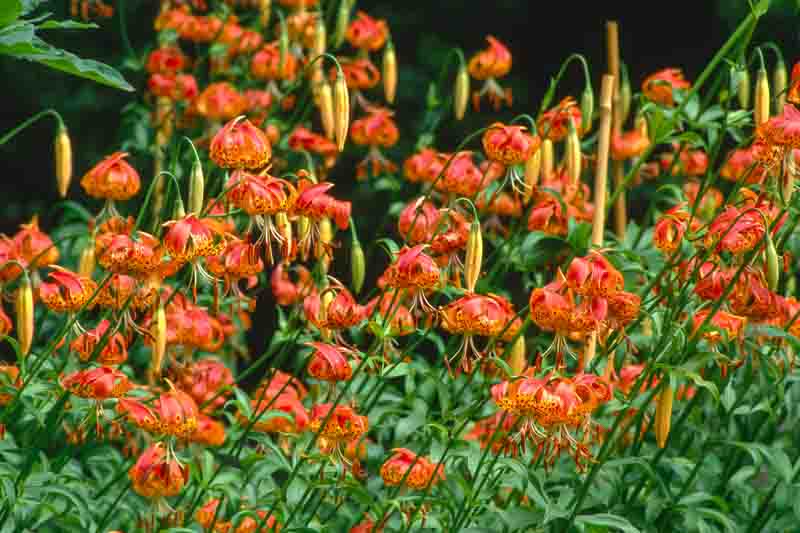
Species lilies are impossible to place into one narrow flowering window because they come from widely different climates and habitats.
Some begin in late spring or early summer. Others flower in midsummer. Still others reach their peak late in summer or continue into early fall.
Examples illustrate how broad the range can be:
This variation makes species lilies particularly valuable to gardeners who want to extend the season beyond the standard hybrid groups. It also means that an unusual species should always be checked individually rather than assigned the generic bloom time “summer.”
A single lily flower does not last all summer, and an individual stem does not usually continue producing new flowers indefinitely. Instead, several buds develop along the stem and open sequentially.
The flowering display of one cultivar commonly lasts several weeks, depending on bud count, temperature, weather, plant health, and cultivar. Cooler weather generally preserves individual flowers longer, while extreme heat can shorten their life.
Some groups can provide particularly substantial displays because strong stems carry many buds. Asiatic lilies may flower for several weeks, while Trumpet, Martagon, Oriental, and Orienpet lilies can also remain impressive as successive buds open.
For a genuinely long lily season, however, the best strategy is not trying to make one plant flower for three months. It is succession.
A well-planned lily border can progress through several distinct flowering waves.
A simple succession plan:
Gardenia’s Lilies for Long Summer Blooms guide offers additional ideas for selecting lilies from different divisions to create a long sequence.
If you are deciding which lily groups best suit your garden, see How to Choose Lilies.
Ready to build your own long-blooming lily display? Use Gardenia’s Plant Finder to narrow your choices by bloom season, flower color, height, hardiness, sun, soil, fragrance, garden use, and many other growing preferences.
If you would rather compare lily varieties side by side, explore Gardenia’s Compare Lilies tool to review different Lilium species and cultivars and choose the combinations that best fit your garden and flowering plan.
Tip: Start by selecting lilies from different bloom periods, then refine the list by height, fragrance, color, and growing conditions. That makes it much easier to create a succession that is both beautiful and well suited to your site.
Two gardens growing the same cultivar can have noticeably different flowering dates. Climate and seasonal weather are among the main reasons, but several other factors contribute.
The important point is to compare your lily with its normal seasonal window, not with a rigid national calendar.
Planting time can influence establishment, particularly during the first growing season, but the genetic flowering season of the lily remains the dominant factor. A late-flowering Oriental does not normally become an early-summer lily simply because it was planted earlier.
Bulbs planted late or after growth has already begun may flower later, less strongly, or irregularly during their first year. Established bulbs generally settle into a more predictable seasonal rhythm.
Correct planting depth is also important for healthy establishment. See Gardenia’s How Deep to Plant Lily Bulbs: Depth and Spacing Guide for detailed recommendations.
A missing flower is different from a late flower. If the lily produces healthy foliage but never forms buds, the problem may involve insufficient light, a weak or immature bulb, previous foliage loss, poor drainage, drought stress, crowding, frost injury, or another cultural problem.
Leaves but no flowers? Use Gardenia’s Why Are My Lilies Not Blooming? Causes and Solutions guide to work through the likely causes.
For complete information on soil, watering, feeding, planting, staking, aftercare, and overwintering, see Gardenia’s How to Grow Lilies: Complete Planting and Care Guide.
Most garden lilies bloom from late spring through late summer, with some species and cultivars continuing into early fall. Exact months vary with climate. Asiatic and Martagon lilies generally flower earlier, Trumpets around midsummer, and Oriental and Orienpet lilies later.
Madonna lily and some species can flower from late spring into early summer. Among the major hybrid groups, Asiatic lilies are among the earliest, generally blooming from early to mid-summer. Martagon and LA hybrid lilies also flower early in the lily season.
Oriental and Orienpet lilies are important late-season groups, generally flowering from mid to late summer. Tiger lilies and some species can also bloom late, while a few lilies such as Lilium formosanum var. pricei may continue into early fall.
Asiatic lilies generally bloom from early to mid-summer and are among the earliest major hybrid lily groups. Individual cultivars and climates can shift the season somewhat earlier or later.
Oriental lilies generally bloom from mid to late summer. Their late flowering, large flowers, and strong fragrance make them particularly useful for extending the lily season.
Trumpet and Aurelian lilies generally flower around midsummer, with some cultivars continuing into late summer. They often overlap with the end of the Asiatic season and the beginning of Oriental and Orienpet flowering.
Orienpet, or OT hybrid, lilies generally bloom from mid to late summer and are among the best lilies for extending color and fragrance toward the end of the lily season.
An individual lily cultivar generally provides several weeks of display as multiple buds open successively. The exact duration depends on cultivar, bud count, temperature, weather, and plant health. Combining several lily groups can extend flowering across much of the summer.
Cool spring weather, a cold climate, elevation, a shaded or cool site, late planting, or slow establishment can delay flowering. Bloom dates naturally vary between regions, so compare your lily with its normal seasonal window rather than a fixed calendar date.
Plant lilies from several flowering groups. Combine early Asiatic, Martagon, and LA lilies with midsummer Trumpets, then add Oriental, Orienpet, tiger, and selected species lilies for later flowers. Overlapping their bloom seasons can provide a succession from early through late summer.
Lilies do not share one universal flowering month. Their great advantage is the opposite: different groups bloom in succession.
Madonna lily and selected species can begin the display in late spring. Asiatic, Martagon, and LA lilies dominate early summer. Trumpet and Aurelian lilies carry the garden through midsummer. Oriental and Orienpet lilies provide some of the most dramatic flowers of mid and late summer, while tiger lilies and selected species can keep the season going toward early fall.
The precise dates will move with climate and weather, but the sequence is remarkably useful. Instead of asking which single lily blooms longest, design around several flowering windows.
Plant the season, not just the flower. A thoughtful mixture of early, midseason, and late lilies can turn a brief burst of bloom into months of changing color, form, and fragrance.
Updated: August 2026 • Reviewed by Gardenia Editors
| Hardiness |
3 - 9 |
|---|---|
| Plant Type | Bulbs, Perennials |
| Genus | Lilium |
| Exposure | Full Sun, Partial Sun |
| Season of Interest | Spring (Late), Summer (Early, Mid, Late), Fall |
| Maintenance | Low |
| Water Needs | Average |
| Soil Drainage | Moist but Well-Drained |
| Characteristics | Cut Flowers, Fragrant, Showy |
| Attracts | Bees, Butterflies, Hummingbirds |
| Landscaping Ideas | Beds And Borders, Patio And Containers |
| Garden Styles | City and Courtyard, Cutting Garden, Informal and Cottage |
| Hardiness |
3 - 9 |
|---|---|
| Plant Type | Bulbs, Perennials |
| Genus | Lilium |
| Exposure | Full Sun, Partial Sun |
| Season of Interest | Spring (Late), Summer (Early, Mid, Late), Fall |
| Maintenance | Low |
| Water Needs | Average |
| Soil Drainage | Moist but Well-Drained |
| Characteristics | Cut Flowers, Fragrant, Showy |
| Attracts | Bees, Butterflies, Hummingbirds |
| Landscaping Ideas | Beds And Borders, Patio And Containers |
| Garden Styles | City and Courtyard, Cutting Garden, Informal and Cottage |
Create a membership account to save your garden designs and to view them on any device.
Becoming a contributing member of Gardenia is easy and can be done in just a few minutes. If you provide us with your name, email address and the payment of a modest $25 annual membership fee, you will become a full member, enabling you to design and save up to 25 of your garden design ideas.
Join now and start creating your dream garden!
Create a membership account to save your garden designs and to view them on any device.
Becoming a contributing member of Gardenia is easy and can be done in just a few minutes. If you provide us with your name, email address and the payment of a modest $25 annual membership fee, you will become a full member, enabling you to design and save up to 25 of your garden design ideas.
Join now and start creating your dream garden!