Nymphalis antiopa


The Mourning Cloak butterfly (Nymphalis antiopa) is one of North America’s most distinctive butterflies – and one of its most unusual. Instead of spending winter as an egg, caterpillar, or chrysalis, the adult itself overwinters, tucked beneath loose bark, inside tree cavities, or in other protected crevices. That allows Mourning Cloaks to reappear on warm late-winter or early-spring days, often before most flowers have opened.
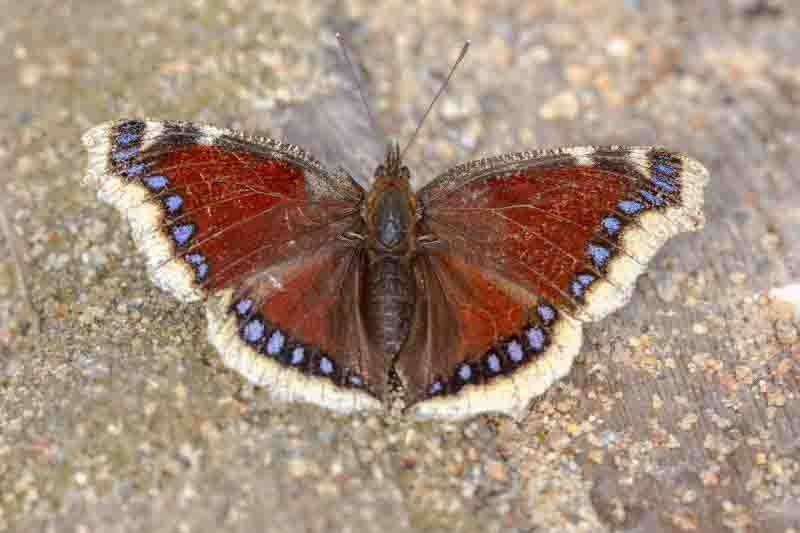
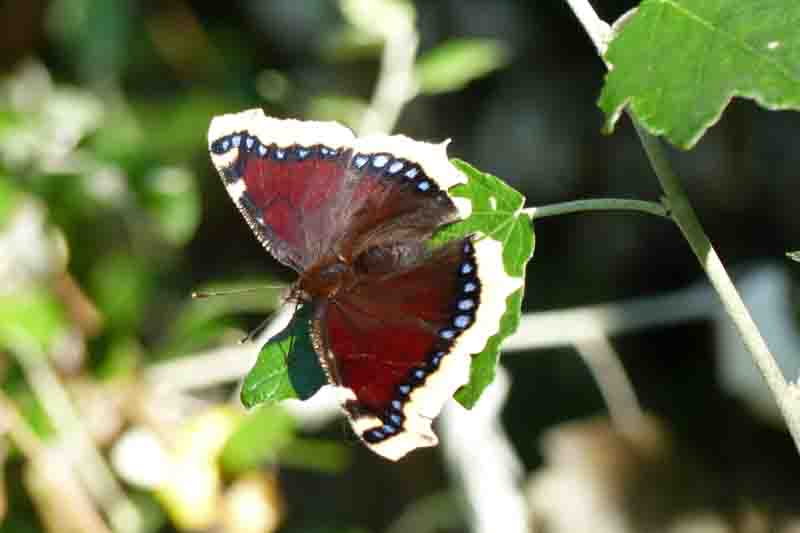
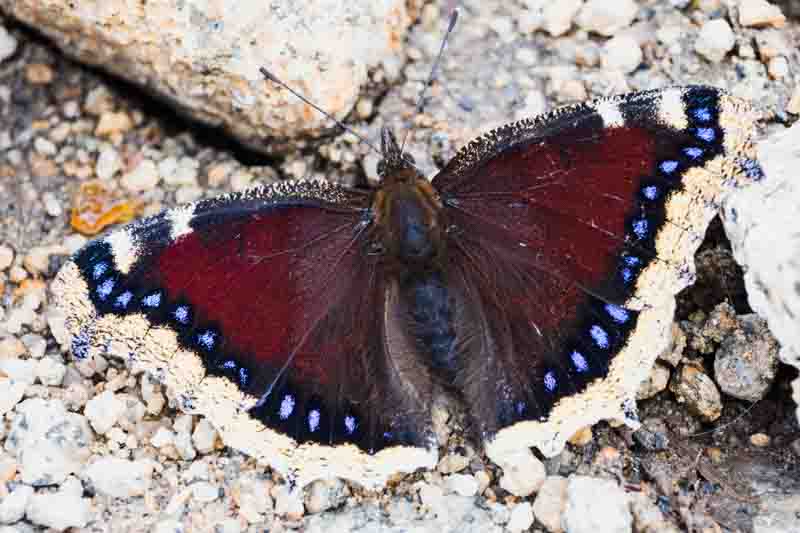
Its appearance is equally memorable: velvety brown-black wings edged with a broad creamy-yellow border and a row of brilliant blue spots. The caterpillar is striking too, with a black body, red dorsal spots, and branching black spines.
For gardeners, the most important lesson is less obvious. Mourning Cloak caterpillars depend on woody host plants such as willows, elms, cottonwoods, aspens, birches, and hackberries. Adults, meanwhile, often rely more heavily on tree sap and rotting fruit than on flower nectar.
Gardenia’s Mourning Cloak principle: butterfly habitat is not always a flower garden. For this species, host foliage, sunny basking space, natural food, and winter shelter may matter more than another bed of nectar plants.
A Mourning Cloak is difficult to confuse with most other North American butterflies once its wings are open.
Wingspan: about 2 1/4 to 4 inches (5.7-10.1 cm).
Upper wings: deep brown to purple-black, creating the dark “cloak” that inspired the common name.
Wing border: a broad pale yellow to creamy band runs around the outer edge. The border can fade noticeably as the butterfly ages.
Blue spots: a row of vivid iridescent blue spots sits just inside the pale border.
Underside: dark, finely patterned, and bark-like, helping the butterfly disappear when it closes its wings against a tree trunk.
The irregular, scalloped wing margins add to its distinctive silhouette. When the butterfly suddenly opens its wings after sitting nearly invisible against bark, the contrast between the dark center, blue spots, and pale border can be startling.
Quick Mourning Cloak ID: very dark wings + broad cream-yellow border + a row of blue spots. Closed wings resemble bark; open wings are unmistakable.
A Mourning Cloak flying on a warm February, March, or early-April day may already have been an adult for many months.
Mourning Cloaks overwinter as adults, sheltering beneath loose bark, inside hollow trees, woodpiles, or other protected spaces. When a mild spell warms the landscape, they can temporarily leave shelter to bask and feed before becoming inactive again when colder weather returns.
This strategy gives them a major head start. Overwintered adults can become active before most spring flowers bloom, mate early, and lay eggs as fresh host-tree foliage develops.
The adult stage may last around 10 to 11 months, making the Mourning Cloak one of North America’s longest-lived adult butterflies.
An early-spring Mourning Cloak may not be newly emerged at all. It may be an adult that survived the entire winter and is taking advantage of the first warm sunshine of the year.
Mourning Cloaks have an enormous range. They occur across most of North America south of the Arctic tundra and extend into Mexico. The species also occurs widely across temperate Eurasia.
In North America, look for them in woodlands, forest openings, riparian corridors, wetlands, parks, suburban landscapes, and gardens where suitable host trees and protected shelter are available.
River and stream corridors can be especially productive because willows, cottonwoods, aspens, and other host plants are common there. Adults also roam widely, so a Mourning Cloak may be seen some distance from the tree on which it developed.
Some adults also move southward in fall rather than remaining in the same location, although overwintering as an adult remains one of the species’ defining life-history strategies.
Mourning Cloak caterpillars feed primarily on the leaves of several deciduous trees and shrubs, especially willows, elms, cottonwoods, aspens, birches, and hackberries. Regional host records also include other woody plants, giving gardeners more options than a list of large shade or riparian trees might suggest.
That distinction matters. The best Mourning Cloak host is not simply a plant the caterpillar can eat. It should also make sense for your climate, soil, moisture, available space, and garden style.
These nine documented host plants offer a useful range of possibilities:
American Pussy Willow – Salix discolor – one of the easiest willows to fit into a residential landscape. Usually 6-15 feet tall, it prefers moist soil and also provides valuable early catkins for bees and other early-season insects.
Black Willow – Salix nigra – an important native host for wet sites, pond edges, streambanks, and naturalized landscapes. Fast growing and potentially 60 feet or more at maturity, it needs plenty of room.
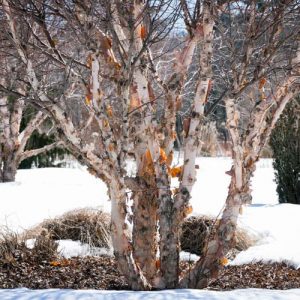
River Birch – Betula nigra – one of the most garden-friendly Mourning Cloak host trees for much of the eastern United States. It tolerates heat, wet soil, and periodic flooding better than many birches and is widely valued for its peeling bark and graceful habit.
Paper Birch – Betula papyrifera – an iconic northern tree with white peeling bark and yellow fall color. It performs best in cooler climates with moist soil and is generally less tolerant of prolonged summer heat than River Birch.
Quaking Aspen – Populus tremuloides – a widespread North American native known for its shimmering foliage and brilliant fall color. It is especially well suited to cooler regions but spreads readily by root suckers, so it is best where colonies can be allowed to develop.
Common Hackberry – Celtis occidentalis – a tough and adaptable native shade tree that tolerates clay, drought, urban conditions, and occasional wet soil. It supports numerous butterflies and birds and fits a broader range of garden conditions than many moisture-loving willow and poplar hosts.
Winged Elm – Ulmus alata – a medium-sized elm native to the southeastern and south-central United States. It is a documented Mourning Cloak larval host and is generally more manageable in a residential landscape than many large riparian trees. Its corky winged twigs also provide distinctive winter interest.
Nootka Rose – Rosa nutkana – a western North American native shrub typically reaching about 3-6 feet tall. Regional records identify it as a Mourning Cloak caterpillar host, making it an especially interesting option for Pacific Northwest and western gardens where a large host tree is impractical. Its fragrant pink flowers, rose hips, dense cover, and wildlife value add considerable ornamental and ecological interest.
Eastern Cottonwood – Populus deltoides – an important native host but also a very large, rapidly growing tree. Reaching roughly 50-80 feet or more, it is best reserved for large properties, floodplains, stream corridors, and naturalized landscapes rather than small residential gardens.
These hosts are not interchangeable. American Pussy Willow can fit into a relatively compact moist garden. Nootka Rose offers western gardeners a much smaller flowering shrub option. River Birch is an excellent ornamental choice for warmer eastern landscapes, while Paper Birch and Quaking Aspen are better suited to cooler climates. Common Hackberry and Winged Elm tolerate a broader range of ordinary garden conditions, whereas Black Willow and Eastern Cottonwood generally belong on larger properties.
Weeping Willow (Salix babylonica) and American Elm (Ulmus americana) are also documented Mourning Cloak hosts. Weeping Willow is a large, specialized landscape tree, while American Elm comes with the complication of Dutch elm disease.
Gardenia’s Mourning Cloak host rule: choose habitat value and garden fit together. For many home landscapes, a Pussy Willow, Nootka Rose, River Birch, Common Hackberry, or Winged Elm may be more practical than a giant cottonwood or Black Willow. The strongest habitat plant is one that suits the region, remains healthy, and can stay in the landscape for years.
The Mourning Cloak caterpillar, sometimes called the Spiny Elm Caterpillar, is almost as distinctive as the adult.
Mature caterpillars grow to about 2 inches long. They have a black body covered with tiny pale speckles, a row of conspicuous red spots along the back, and numerous branching black spines.
The larvae are gregarious and often feed together in conspicuous colonies. Young caterpillars may feed within loose silken webbing, and groups can remove a noticeable amount of foliage from a host branch.
The sight can alarm gardeners, but healthy mature host trees usually tolerate the feeding. Before deciding that a colony is a pest problem, identify the caterpillars first.
Black caterpillars with red spots and branching spines on willow, elm, birch, aspen, or cottonwood deserve a closer look. They may be the next generation of Mourning Cloak butterflies.
The Mourning Cloak’s annual cycle is unusual because the adult butterfly can persist through much of the year.
Spring mating: Adults that survived winter become active as temperatures rise. Males often perch in sunny openings and patrol nearby territory while waiting for females.
Eggs: Females lay clusters of eggs around twigs of suitable host trees.
Caterpillars: Larvae hatch as fresh foliage develops and feed communally on the host leaves.
Chrysalis: Mature caterpillars eventually leave the group and pupate. The angular, mottled chrysalis resembles a curled dead leaf or piece of bark.
New adults: Fresh butterflies often emerge in early to midsummer. Across much of the species’ range there is one principal generation each year, although additional broods can occur farther south.
Summer estivation: Newly emerged adults may become much less active during the hottest part of summer, entering a period of dormancy known as estivation.
Autumn activity: They become active again as conditions moderate, feeding and building reserves before winter.
Adult overwintering: Many adults then shelter through winter and reappear the following spring, while some individuals may move southward in fall.
The Mourning Cloak calendar is unusual: overwintering adult in winter, mating in spring, communal caterpillars on fresh foliage, new adults in summer, reduced activity during heat, renewed feeding in fall, then winter shelter again.
Mourning Cloaks break one of the assumptions gardeners often make about butterflies: flowers are not their primary food source.
Adults commonly feed on tree sap and rotting or fermenting fruit. They may also visit other nutrient-rich materials, including animal droppings and carrion. Flower nectar is used occasionally, but it is far less central to their feeding strategy than it is for many familiar garden butterflies.
This unusual diet explains how overwintered adults can become active long before spring flowers are abundant. A sap flow on a warm tree trunk or fermenting fruit can provide energy when nectar is scarce.
For gardeners, that means a mature tree landscape may support adult Mourning Cloaks even when it does not resemble a conventional pollinator garden.
Gardenia’s feeding takeaway: don’t measure Mourning Cloak habitat by flower count. Sap, fruit, mature trees, and shelter may be more important than a large nectar border.
Attracting Mourning Cloaks requires thinking beyond flowers and planning for several stages of the butterfly’s year.
Grow a suitable host tree or shrub. Willow, hackberry, birch, aspen, cottonwood, and ecardslm can support caterpillars where regionally appropriate.
Keep sunny openings. Overwintered adults use sunshine to warm their bodies on cool late-winter and spring days.
Preserve mature woody structure. Trees provide caterpillar food, feeding opportunities, basking surfaces, and potential shelter.
Allow some natural food sources. Tree sap and occasional overripe fruit can benefit adults, provided fallen fruit is managed if it begins attracting unwanted pests.
Avoid unnecessary insecticides. Communal caterpillar feeding can look dramatic, but it is part of the butterfly’s normal life cycle.
Leave appropriate winter refuge. Loose bark, tree cavities, woodpiles, and other sheltered woody spaces can provide potential overwintering refuge.
The Mourning Cloak shows why butterfly gardening sometimes requires more than planting flowers. Gardenia’s approach maps each major habitat feature to a different part of the butterfly’s life cycle.
1. Provide host foliage for the caterpillar.
Choose a documented host tree or shrub that fits your region, climate, soil, moisture, and mature-space allowance.
2. Provide sunny warmth for the adult.
Keep openings or woodland edges where adults can bask, particularly during the cool days of late winter and early spring.
3. Preserve natural food beyond flowers.
Recognize that tree sap and fermenting fruit can be more important than nectar for this species.
4. Leave shelter through winter.
Retain appropriate woody structure, bark crevices, tree cavities, and protected spaces where adults can overwinter.
Gardenia’s shortcut: host foliage + sunny warmth + natural food + winter shelter. Mourning Cloak habitat is designed around the whole year, not just flowering season.
If you see a Mourning Cloak on a warm spring day, don’t start with flowers. Look at the trees, shelter, and structure already around you.
Build Mourning Cloak habitat that fits your landscape.
The caterpillar needs a suitable host tree or shrub. The adult needs sunny warmth, natural food such as tree sap and fermenting fruit, and protected places to overwinter.
Use the Gardenia Plant Finder to narrow host plants by hardiness, native range, sunlight, soil, drainage, water needs, mature size, wildlife value, and other growing conditions.
Then build the habitat with the Gardenia Garden Design Tool – combine suitable trees, shrubs, and companion plants that can actually thrive together in the same landscape.
Don’t stop at “plant a host tree.” Turn the Mourning Cloak’s unusual life cycle into a year-round habitat plan that works.
Mourning Cloaks have dark brown to purple-black wings edged with a broad pale yellow border and a row of iridescent blue spots. Their wingspan is about 2 1/4 to 4 inches.
Mourning Cloak caterpillars use several deciduous trees and shrubs, including willows, elms, cottonwoods, aspens, birches, and hackberries.
The caterpillar is black with tiny pale speckles, a row of red spots along its back, and numerous branching black spines. Larvae are gregarious and commonly feed together on host-tree foliage.
Yes. Mourning Cloaks overwinter as adult butterflies, sheltering beneath loose bark, inside tree cavities, woodpiles, or other protected spaces. They may become active during warm late-winter or early-spring weather.
Adult Mourning Cloaks feed mainly on tree sap and rotting or fermenting fruit. They may also use animal droppings, carrion, and occasional flower nectar.
They overwinter as adults rather than eggs, caterpillars, or pupae. Warm sunlight can activate them before most flowers and many other butterflies appear.
Adult Mourning Cloaks can live around 10 to 11 months, making them among the longest-lived adult butterflies in North America.
Grow a regionally appropriate host such as willow, hackberry, birch, aspen, cottonwood, or elm, preserve sunny basking areas and woody winter shelter, minimize insecticide use, and retain appropriate natural food sources such as tree sap and occasional overripe fruit.
Create a membership account to save your garden designs and to view them on any device.
Becoming a contributing member of Gardenia is easy and can be done in just a few minutes. If you provide us with your name, email address and the payment of a modest $25 annual membership fee, you will become a full member, enabling you to design and save up to 25 of your garden design ideas.
Join now and start creating your dream garden!