Limenitis archippus
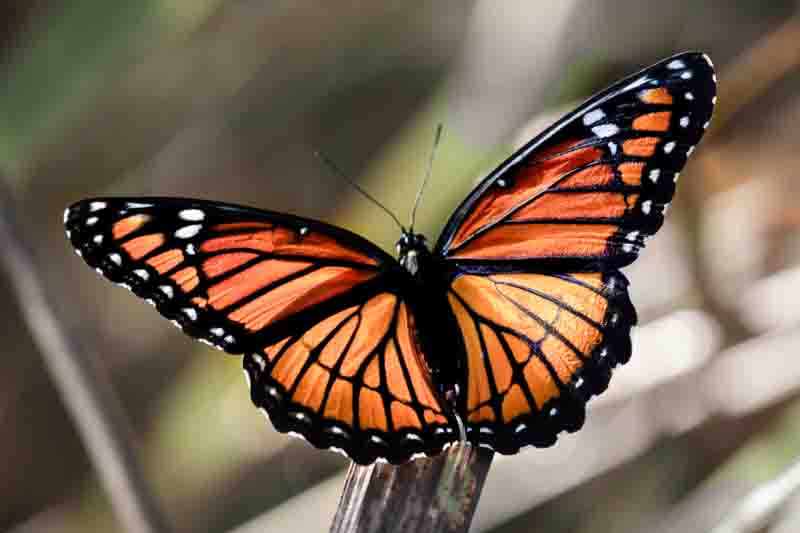


The Viceroy butterfly (Limenitis archippus) is famous for resembling a Monarch, but its life story is very different. A black line crossing each hindwing helps identify the adult, while its caterpillar feeds on willows and poplars rather than milkweed and can survive winter inside a tiny rolled-leaf shelter attached to its host tree.
That difference matters in the garden. A border filled with nectar flowers may feed an adult Viceroy, but it cannot support breeding unless suitable caterpillar host plants grow nearby.
Viceroys are especially associated with willows, cottonwoods, poplars, moist sunny edges, and wetland habitats. Understanding those relationships is the key to moving from simply seeing a Viceroy to creating habitat that supports its entire life cycle.
Gardenia’s Viceroy principle: don’t choose a butterfly plant in isolation. Match the host tree to the site, place adult food within the same habitat, and manage the planting so the butterfly can survive winter as well as summer.
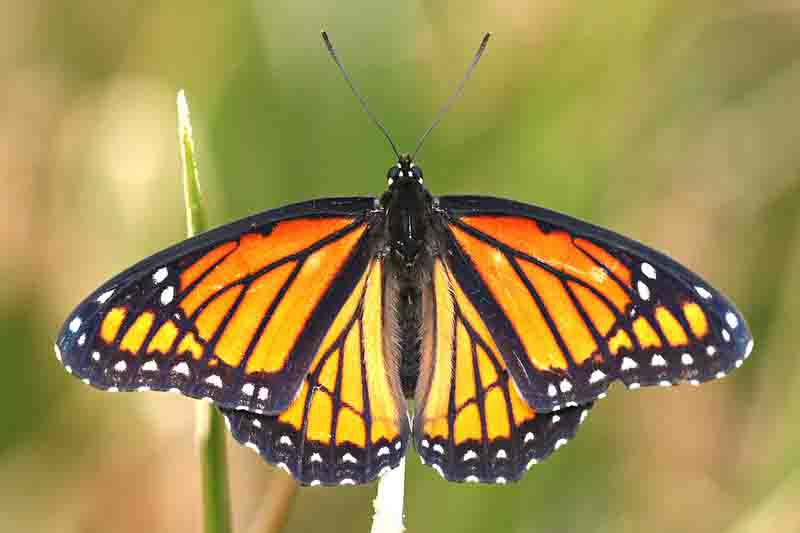
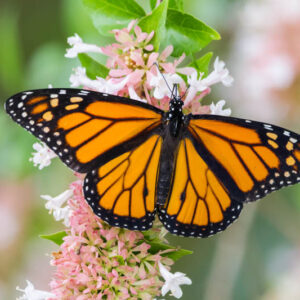
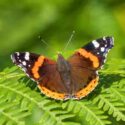
At first glance, the Viceroy can look remarkably like a Monarch. Both have orange wings patterned with black veins, dark borders, and white spots. One field mark makes identification much easier:
The Viceroy has a black line crossing the veins of each hindwing. Monarchs do not.
Wingspan: about 2 1/2 to 3 3/8 inches (6.3-8.6 cm).
Upper wings: orange to reddish-orange with bold black veining and dark margins marked with white spots.
Hindwings: a distinct black transverse line crosses the veins and provides the quickest field mark.
Flight: brisk, often alternating wingbeats with short glides.
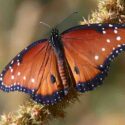
Color varies geographically. In parts of Florida, Georgia, and the Southwest, where Monarchs may be less common, some Viceroys are browner and resemble the Queen butterfly more closely than a bright orange Monarch.
Quick Viceroy ID: orange-and-black butterfly + Monarch-like pattern + a black line crossing each hindwing.
The Viceroy and Monarch form one of North America’s best-known butterfly look-alike pairs, yet their caterpillars depend on completely different plants.
The simplest adult distinction is the black cross-line on the Viceroy’s hindwing. Viceroys are also generally smaller, although size alone is not reliable.
The larvae could hardly be more different. Monarch caterpillars are boldly striped black, white, and yellow and depend on milkweeds (Asclepias). Viceroy caterpillars are mottled brown, cream, greenish, and white, resemble bird droppings or twigs, and feed mainly on plants in the willow family.
The mimicry story is equally fascinating. Viceroys were once described as harmless Batesian mimics protected by their resemblance to distasteful Monarchs. Research later showed that Viceroys themselves can be unpalatable. They are now generally regarded as Müllerian co-mimics, in which defended species benefit from sharing similar warning coloration, although the strength of chemical defense can vary among populations.
Monarch or Viceroy? Look at the hindwing before judging by size. A dark line crossing the veins points strongly to Viceroy.
Viceroys occur across a broad portion of North America, but they are especially associated with moist, open or shrubby habitats where willow-family plants grow.
Look for them around pond and lake margins, streams, riverbanks, wet meadows, willow thickets, swamp edges, moist roadsides, and other sunny riparian habitats.
This explains why a beautiful dry butterfly border may provide nectar yet fail to support breeding. Without suitable host trees nearby, females have nowhere appropriate to lay their eggs.
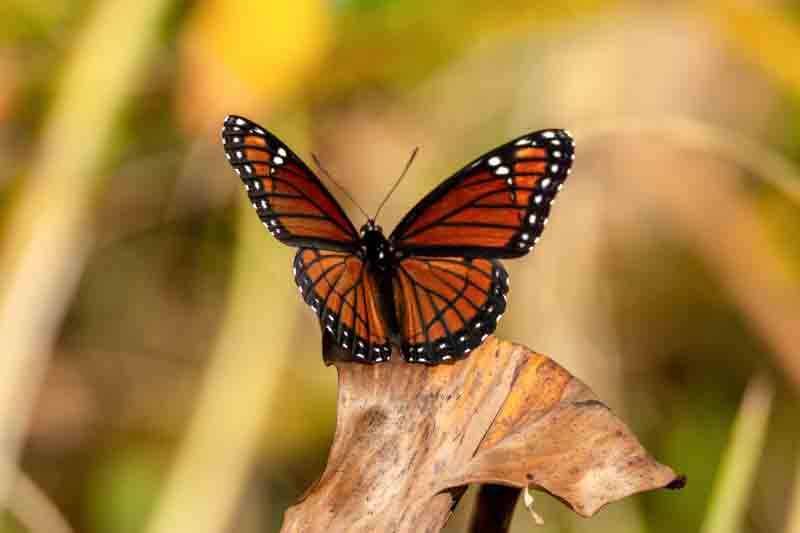
Viceroy caterpillars are best known for feeding on plants in the willow family, Salicaceae, especially willows (Salix) and poplars, cottonwoods, and aspens (Populus). But these are not their only host plants. Viceroy larvae have also been documented on members of the rose family, including serviceberries (Amelanchier) and cherries or plums (Prunus).
That distinction is especially useful for gardeners. A giant cottonwood may be excellent Viceroy habitat along a river or on a large property, but a serviceberry, American Plum, or smaller willow can be far easier to incorporate into a residential landscape.
The best choice depends on where you garden, how much space you have, your soil and moisture conditions, and how much spreading or suckering you are willing to manage.
Six particularly useful options are:
American Pussy Willow – Salix discolor – a relatively compact native willow, usually 6-15 feet tall, that fits smaller northern and eastern landscapes better than many tree-sized willows. It prefers moist soil, and its early catkins also provide valuable pollen and nectar for early-season insects.
Coyote Willow – Salix exigua – a shrubby, suckering willow native across much of western and central North America. It is particularly useful along streams, ponds, wet swales, and naturalized areas where its spreading habit can be accommodated.
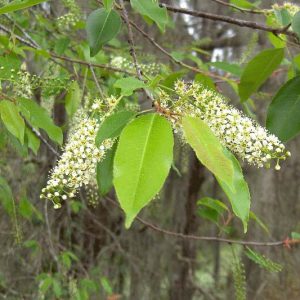
American Plum – Prunus americana – a small native tree or large shrub, generally 15-25 feet tall, with fragrant white spring flowers, edible fruit, and strong wildlife value. NCSU identifies it as a Viceroy larval host. It is much easier to fit into an ordinary garden than a mature cottonwood, although its suckering habit can produce thickets if left unmanaged.
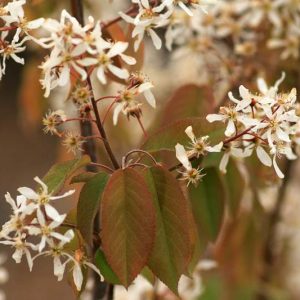
Downy Serviceberry – Amelanchier arborea – an attractive eastern North American shrub or small tree, typically 15-25 feet tall, with white spring flowers, edible summer fruit, and excellent fall color. NCSU lists it as a larval host for both the Viceroy and Red-spotted Purple, while noting that Viceroy use is rare in North Carolina.
Canadian Serviceberry – Amelanchier canadensis – a multi-stemmed large shrub or small tree particularly well suited to moist eastern gardens, woodland edges, ponds, and streams. NCSU specifically identifies it as a host plant for Viceroy and Red-spotted Purple butterflies. Its spring flowers, edible fruits, fall color, and manageable scale make it one of the most garden-friendly Viceroy hosts.
Carolina Cherry Laurel – Prunus caroliniana – a fast-growing evergreen shrub or small tree native to the southern United States. NCSU lists it as a Viceroy larval host, and its dense evergreen foliage makes it useful for screens, hedges, and wildlife plantings in warmer climates. Unlike the deciduous willows and serviceberries, it offers year-round structure, although its leaves, stems, and seeds contain cyanogenic compounds and should not be ingested.
Large native willows and cottonwoods remain important Viceroy hosts, particularly in natural riparian landscapes. Black Willow (Salix nigra), Eastern Cottonwood (Populus deltoides), Quaking Aspen (Populus tremuloides), and Western Cottonwood (Populus fremontii) may be excellent choices where there is sufficient space.
For many residential gardens, however, the smaller woody hosts deserve more attention. A serviceberry can provide spring flowers, berries for birds, fall color, and Viceroy larval habitat in a fraction of the space required by a large cottonwood. American Plum adds flowers, fruit, cover, and caterpillar food, while Pussy Willow can bring Viceroy habitat into a comparatively modest moist garden.
Gardenia’s Butterfly Host Plants Guide connects butterflies with the plants their caterpillars need and helps explain why host plants and adult nectar plants play different roles.
Gardenia’s Viceroy host rule: don’t assume that supporting Viceroys requires planting a giant willow or cottonwood. Start with documented hosts, then choose the one that fits your region, moisture, mature-space allowance, garden style, and maintenance tolerance. In many home gardens, a serviceberry, American Plum, or smaller willow may be the more practical habitat plant.
This is why a generic recommendation to “plant a willow” is not enough. American Pussy Willow may fit a smaller moist garden, Coyote Willow suits many western riparian settings, while Black Willow and cottonwoods need far more space.
A Viceroy caterpillar bears little resemblance to a Monarch larva. It is irregularly mottled in brown, cream, greenish, and white, with prominent projections behind the head.
The caterpillar looks remarkably like a bird dropping or broken twig, helping it disappear against leaves and stems.
Females lay eggs singly near the tips of host leaves. After hatching, young caterpillars feed on the foliage and may leave the central vein of a partly eaten leaf projecting like a perch.
They can also construct a dangling mass of leaf fragments, silk, and waste near the feeding area. This structure may interfere with or distract predators, although its exact protective role is uncertain.
Before treating or heavily pruning a willow, inspect the foliage. The odd-looking caterpillar resembling a bird dropping may be exactly the wildlife your planting was meant to support.
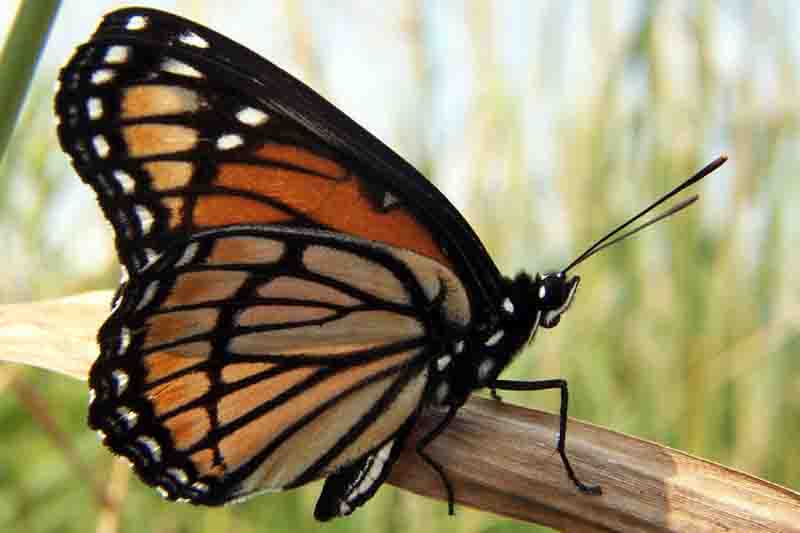
The Viceroy passes through four stages – egg, caterpillar, chrysalis, and adult – but its winter strategy is particularly remarkable.
Egg: Females place eggs singly near the tips of willow or poplar leaves.
Caterpillar: Young larvae feed individually on host foliage.
Winter hibernaculum: Late-season caterpillars enter diapause while still partly grown. A young larva uses silk to fashion part of a host leaf into a small rolled shelter called a hibernaculum and secures it to the twig.
While surrounding leaves fall in autumn, the shelter remains attached. The caterpillar stays inside through winter and resumes feeding when favorable conditions return.
Chrysalis: Mature larvae pupate in a mottled chrysalis whose irregular shape helps it blend with surrounding vegetation.
Adult: Viceroys generally produce two or three broods per year through much of their range, with a longer reproductive season possible in southern areas.
A Viceroy does not undertake the Monarch’s continent-scale seasonal migration. In colder regions, it can face winter as a small caterpillar sheltered inside a rolled leaf fastened to its host tree.
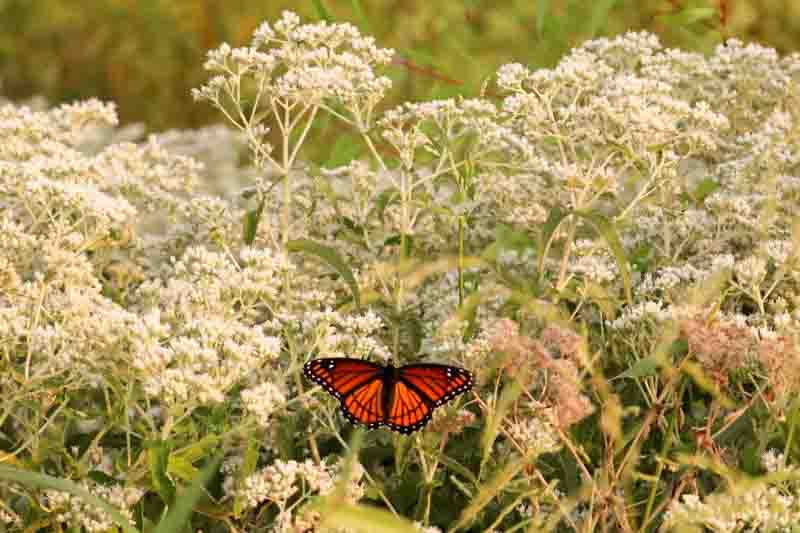
Viceroys visit flowers, but nectar is only part of their adult diet. Especially when flowers are scarce, adults may also feed on aphid honeydew, tree sap, rotting fruit, decaying fungi, carrion, and dung.
Documented nectar sources include asters, goldenrods, Joe-Pye weed, shepherd’s needle, thistles, milkweeds, ironweeds, and vervains. Six garden-worthy choices are:
Asters – valuable late-season flowers that help extend nectar availability into fall.
Goldenrods – Solidago – excellent late-summer and fall nectar plants, with numerous native species available for different regions.
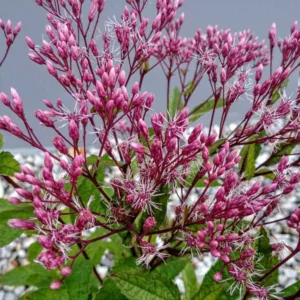
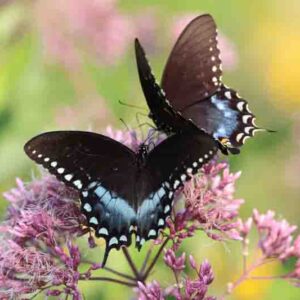
Sweet-Scented Joe-Pye Weed – Eutrochium purpureum – a tall North American perennial especially well suited to the moist meadow and woodland-edge habitats associated with Viceroys.
Milkweeds – Asclepias – not Viceroy caterpillar hosts, but valuable adult nectar plants. Moisture-loving species such as Swamp Milkweed can fit particularly well near Viceroy habitat.
Ironweeds – Vernonia – tall native perennials offering rich summer and late-summer nectar in meadow and wet-edge plantings.
Western Vervain – Verbena lasiostachys – a long-blooming western native whose purple flowers provide nectar for butterflies and other pollinators where its range and growing conditions are appropriate.
Thistles and shepherd’s needle are also documented Viceroy nectar sources, but species choice matters because some thistles are invasive while others are valuable natives.
Aim for a sequence of compatible nectar plants from summer into fall, ideally close enough to host-tree habitat that adults can feed, mate, and search for egg-laying sites within the same landscape.
Gardenia’s Viceroy nectar rule: choose documented nectar plants by habitat fit. The best flower is one that feeds adults and thrives under conditions compatible with the surrounding Viceroy habitat.
If Viceroys occur in your area, start with what the caterpillar needs and build outward.
Provide a suitable host. Choose a regionally appropriate willow, cottonwood, poplar, or aspen with enough room to mature.
Match the moisture conditions. Many Viceroy hosts naturally grow beside streams, ponds, wet meadows, and swales.
Keep some sun. Viceroys favor open or partly wooded edges rather than deep shade.
Add nectar through the season. Combine compatible summer and fall flowers near the host plants.
Avoid broad-spectrum insecticides. Caterpillars feeding on host foliage are evidence that the habitat is working.
Be gentle with winter pruning. A rolled leaf attached to a willow or poplar twig may shelter an overwintering Viceroy caterpillar.
Rather than beginning with flowers, Gardenia’s approach starts with the butterfly’s breeding requirements.
1. Match the host to the site.
Choose a documented willow or poplar that suits your region, hardiness, moisture, and available space.
2. Recreate the habitat edge.
Favor the sunny, open or lightly wooded conditions common beside streams, ponds, moist swales, and wet meadows.
3. Build a nectar sequence.
Use compatible flowers that provide adult food from summer into fall rather than relying on one short bloom season.
4. Protect the invisible stage.
Limit unnecessary insecticides and destructive winter pruning. Next season’s Viceroy may already be overwintering inside a rolled leaf on a twig.
Gardenia’s shortcut: right host + right habitat + nectar sequence + protected winter stage. Supporting Viceroys means designing for the whole life cycle, not only the adult butterfly.
If a Viceroy lands on an aster or goldenrod, you know where the adult found food. The more useful question is “Where could its caterpillar live?”
Build Viceroy habitat that actually fits your garden.
Viceroy caterpillars need suitable woody hosts such as willows, poplars, aspens, cottonwoods, and other documented host plants, while adults benefit from nearby nectar and natural food sources.
Use the Gardenia Plant Finder to narrow host and nectar plants by hardiness, native range, sunlight, soil, drainage, water needs, mature size, wildlife value, and other growing conditions.
Then build the habitat with the Gardenia Garden Design Tool – combine host trees or shrubs with nectar plants that can actually thrive together, compare mature sizes and seasonal interest, and catch planting conflicts before they become garden problems.
Don’t stop at “plant a willow.” Turn the Viceroy’s host relationships into a habitat plan that works in your landscape.
The easiest way to distinguish a Viceroy from a Monarch is the black line crossing each Viceroy hindwing. Monarchs do not have this line. Viceroys are generally smaller, but size alone is not reliable.
Viceroy caterpillars feed primarily on plants in the willow family, especially willows (Salix species) and poplars, cottonwoods, and aspens (Populus species). The best host depends on region, moisture, climate, and available space.
No. Milkweed is the larval host of Monarchs, not Viceroys. Viceroy caterpillars feed mainly on willows, poplars, cottonwoods, and aspens.
Viceroy caterpillars are mottled brown, cream, greenish, and white, with an irregular shape and projections behind the head. Their appearance resembles a bird dropping or small twig and helps camouflage them.
In colder regions, Viceroys overwinter as partly grown caterpillars. A young larva makes a rolled-leaf shelter called a hibernaculum, fastens it to a host-tree twig with silk, and remains inside through winter.
No. Viceroys do not undertake the continent-scale seasonal migration associated with Monarchs. In colder parts of their range, they survive winter as caterpillars inside leaf shelters attached to their host plants.
Adult Viceroys take nectar from flowers such as asters, goldenrods, Joe-Pye weed, milkweeds, ironweeds, and vervains. They may also feed on aphid honeydew, tree sap, rotting fruit, decaying fungi, carrion, and dung.
Start with a regionally suitable willow, cottonwood, poplar, or aspen host plant. Provide compatible nectar flowers nearby, preserve sunny moist habitat, avoid broad-spectrum insecticides, and protect overwintering caterpillar shelters during winter pruning.
Updated and reviewed by Gardenia: September 2026
Create a membership account to save your garden designs and to view them on any device.
Becoming a contributing member of Gardenia is easy and can be done in just a few minutes. If you provide us with your name, email address and the payment of a modest $25 annual membership fee, you will become a full member, enabling you to design and save up to 25 of your garden design ideas.
Join now and start creating your dream garden!