Protographium marcellus, Eurytides marcellus, Neographium marcellus
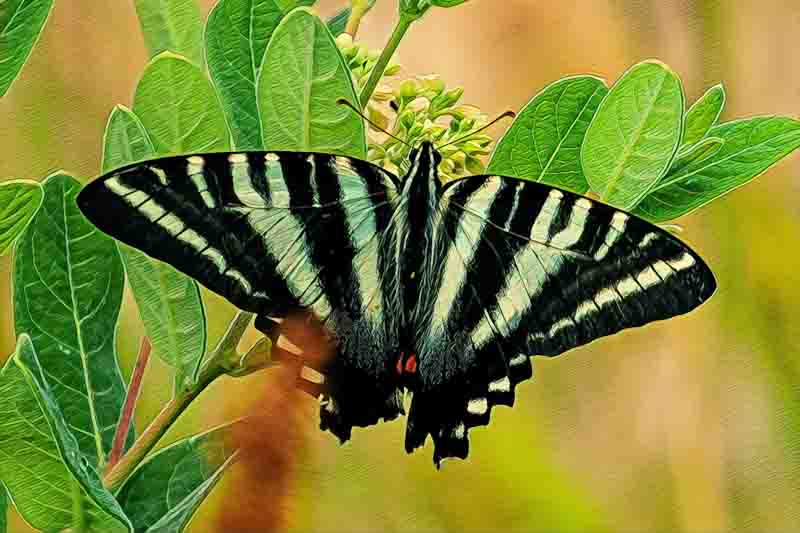


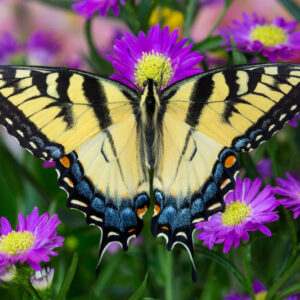
The Zebra Swallowtail butterfly (Protographium marcellus) is one of North America’s most distinctive swallowtails. Its pale wings are crossed by bold black stripes, while exceptionally long, swordlike tails stream from the hindwings. The Zebra Swallowtail is often classified as Protographium marcellus, although Eurytides marcellus and Neographium marcellus also appear in butterfly references.
For gardeners, its most important characteristic is not its appearance but its extraordinary relationship with pawpaw trees and shrubs (Asimina). Throughout most of its range, the caterpillar depends on Common Pawpaw (Asimina triloba). A garden can overflow with butterfly flowers and still provide no breeding habitat if pawpaw is missing.
That makes the Zebra Swallowtail unusually straightforward to understand: pawpaw creates the nursery, fresh pawpaw growth attracts egg-laying females, nearby flowers feed the adults, and protected pupation sites help carry the next generation forward.
Gardenia’s Zebra Swallowtail principle: start with pawpaw, not flowers. Nectar plants may attract a passing adult, but pawpaw is what turns a butterfly visit into potential breeding habitat.
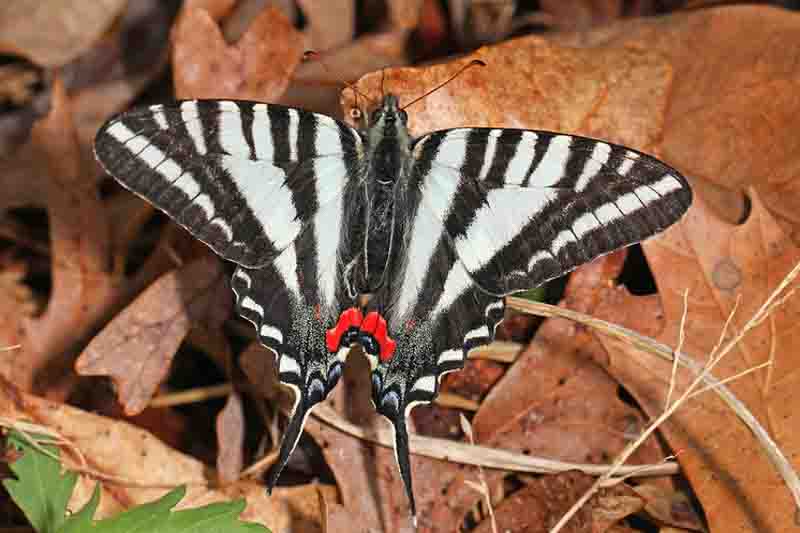
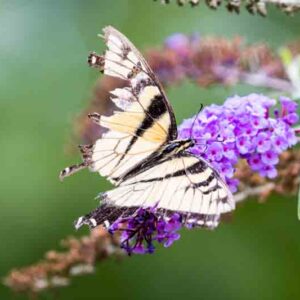
Few North American butterflies combine such dramatic striping with such long, narrow tails.
Wingspan: about 2 1/2 to 4 inches (6.4-10.4 cm).
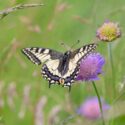
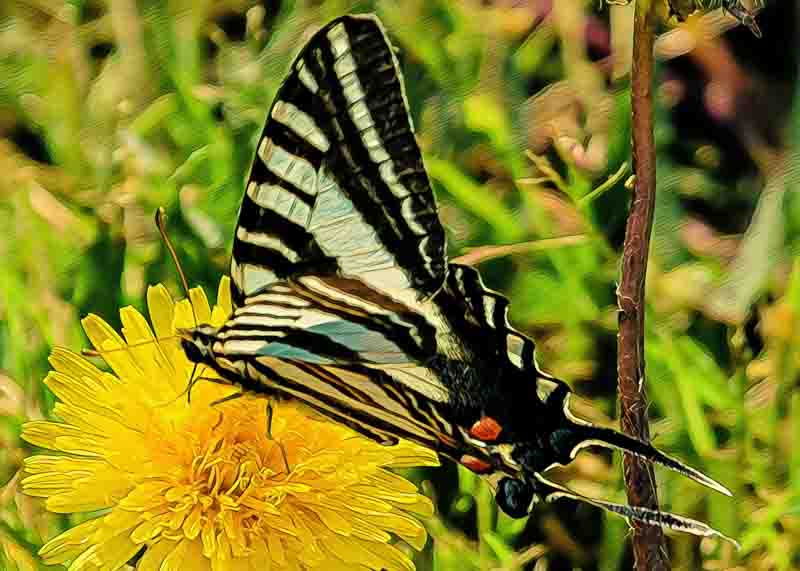
Upper wings: white to pale greenish-white with bold black stripes.
Hindwings: very long, slender tails give the butterfly its elegant, kite-like appearance.
Underside: similar black-and-white patterning, with a reddish stripe across the hindwing and additional red markings near the rear.
Flight: quick and graceful, often low through woodland openings, along edges, or around pawpaw patches.
Zebra Swallowtails also change appearance through the season. Butterflies emerging in early spring are usually smaller, paler, and shorter-tailed. Later spring and summer generations tend to be larger, darker, and much longer-tailed.
Quick Zebra Swallowtail ID: pale wings with bold black stripes + exceptionally long hindwing tails + reddish markings beneath the hindwings.
The Zebra Swallowtail is an eastern North American butterfly, ranging from southern New England west toward eastern Kansas and south through Texas and Florida.
Its distribution closely follows its host plants. Typical breeding habitat includes moist low woodlands, river bottoms, stream corridors, woodland edges, swamps, and shaded slopes where pawpaws grow naturally.
Adults are more mobile than their caterpillars and frequently leave woodland habitat to visit flowers in gardens, meadows, roadsides, and sunny openings.
This creates an important distinction. Seeing a Zebra Swallowtail drinking nectar does not necessarily mean the garden supports reproduction. Adults can travel to flowers, but females need suitable Asimina foliage for their eggs and caterpillars.
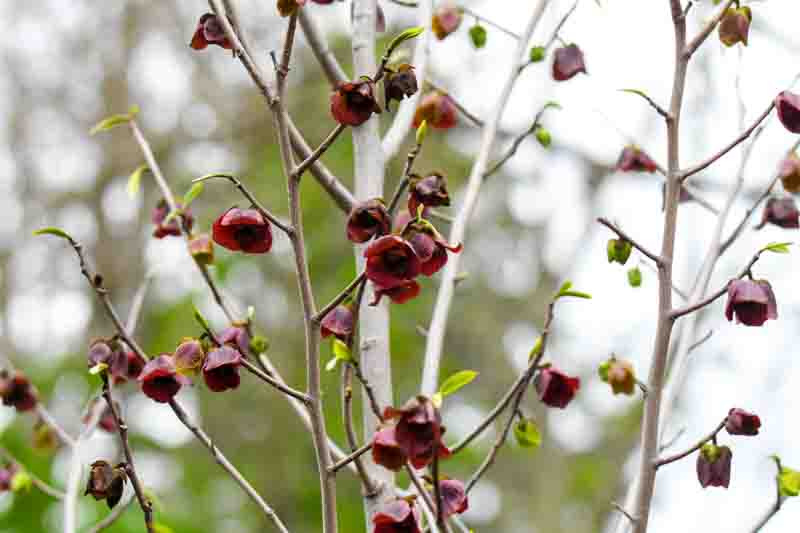
Zebra Swallowtail caterpillars feed on pawpaws (Asimina species) in the custard apple family, Annonaceae. Across most of the butterfly’s range, Common Pawpaw (Asimina triloba) is the principal host.
This is a much tighter host relationship than that of butterflies whose caterpillars can feed on numerous unrelated garden plants.
Common Pawpaw is also an attractive landscape plant. It is a native large shrub or small understory tree with broad, tropical-looking leaves, unusual purple spring flowers, edible fruits, and bright yellow fall color. It grows about 15-30 feet tall and wide, hardy in USDA Zones 5-9, and naturally capable of suckering into colonies.
Females do not simply search for any pawpaw. They favor young plants or plants carrying fresh young foliage, typically laying a single pale-green egg near the tip of a tender leaf.
Other native Asimina species serve as hosts in the South, including Smallflower Pawpaw, Slimleaf Pawpaw, Woolly Pawpaw, Dwarf Pawpaw, Four-petal Pawpaw, Netted Pawpaw, and other regional pawpaws.
Gardenia’s pawpaw rule: if breeding habitat is the goal, choose the pawpaw that fits your region and garden rather than simply planting the first host on a list. Climate, light, moisture, mature size, and room for suckering all matter.
Gardenia’s Butterfly Host Plants Guide explains why caterpillar hosts and adult nectar plants perform completely different jobs in a butterfly garden.
A pawpaw planted for butterflies still has to succeed as a garden plant.
Common Pawpaw grows in full sun to partial shade and favors moist but well-drained, acid to neutral soil. Young plants naturally tolerate woodland shade, while established plants can grow and fruit well with more light where soil moisture remains adequate.
Pawpaw commonly suckers from the roots and can gradually form a colony. In a woodland-edge or wildlife garden, that may be an advantage: shoots of different ages continually provide fresh foliage. In a formal landscape, the same habit may require management.
If fruit production is also important, planting genetically different pawpaws generally improves pollination and fruit set. For Zebra Swallowtails, the priority is different – maintaining healthy foliage and some young growth for egg laying and larval feeding.
Chewed pawpaw leaves should not automatically trigger pest control. A host plant with a few missing leaves may be doing precisely what it was planted to do.
A perfectly untouched pawpaw is not necessarily the most successful wildlife plant. Caterpillar feeding can be evidence that the tree has become functioning habitat.
Zebra Swallowtail caterpillars change dramatically as they grow.
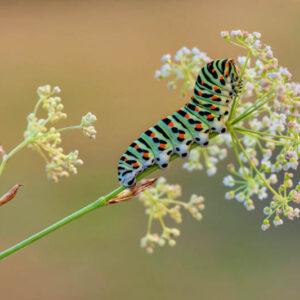
The earliest larvae are dull gray. Middle-stage caterpillars become darker with contrasting black, yellow, and white bands. Mature caterpillars are often green with broad blue, black, and yellow bands, although dark-colored mature larvae also occur.
Like other swallowtail caterpillars, they possess an osmeterium, a forked defensive organ hidden behind the head. When threatened, the caterpillar can extend this yellow structure and release strong-smelling defensive chemicals.
Another behavior helps explain why females spread their eggs out: Zebra Swallowtail caterpillars are highly cannibalistic. Females generally place eggs singly rather than concentrating many larvae on the same leaf.
When fully grown, caterpillars leave their feeding sites and search for a suitable place to pupate rather than remaining continuously on the pawpaw foliage.
The Zebra Swallowtail passes through four stages – egg, caterpillar, pupa, and adult – with the number of generations increasing toward the South.
Egg: Females generally deposit single pale-green eggs on young pawpaw leaves, often near the leaf tip.
Caterpillar: Larvae feed mainly on tender pawpaw foliage and may also consume pawpaw flowers.
Pupa: Mature caterpillars wander away from their feeding sites and pupate. The chrysalis may be green or brown, has fine lines that create a leaf-like appearance, and is held upright by a silken girdle.
Overwintering: Zebra Swallowtails survive winter in the pupal stage. Diapausing pupae are generally brown and can be extremely difficult to distinguish from dead leaves and other plant material.
Adult: Northern populations generally have two main flights, while Florida and other warm southern areas can produce numerous generations through a much longer season.
The generation also affects appearance. Early-spring butterflies emerging from overwintered pupae are usually smaller and paler, with shorter tails. Summer adults tend to be larger, darker, and dramatically longer-tailed.
Avoid overly aggressive cleanup around pawpaw habitat. Brown overwintering pupae can be exceptionally well camouflaged against dead leaves and other vegetation.
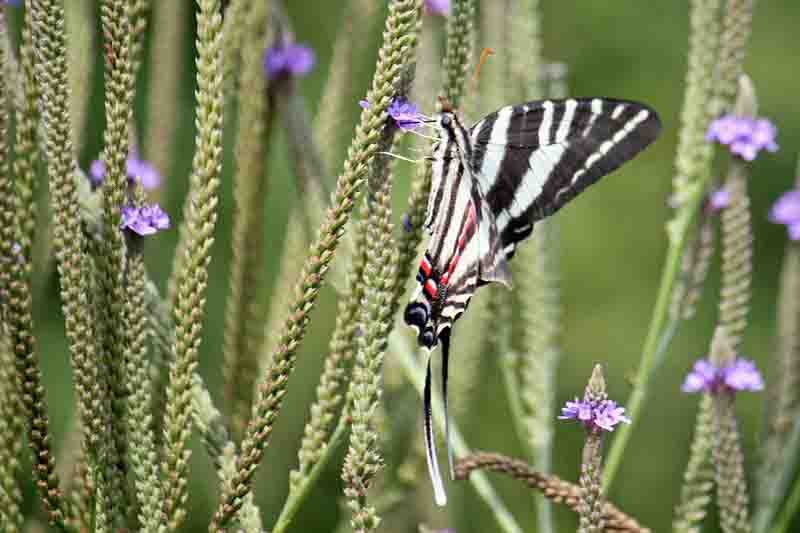
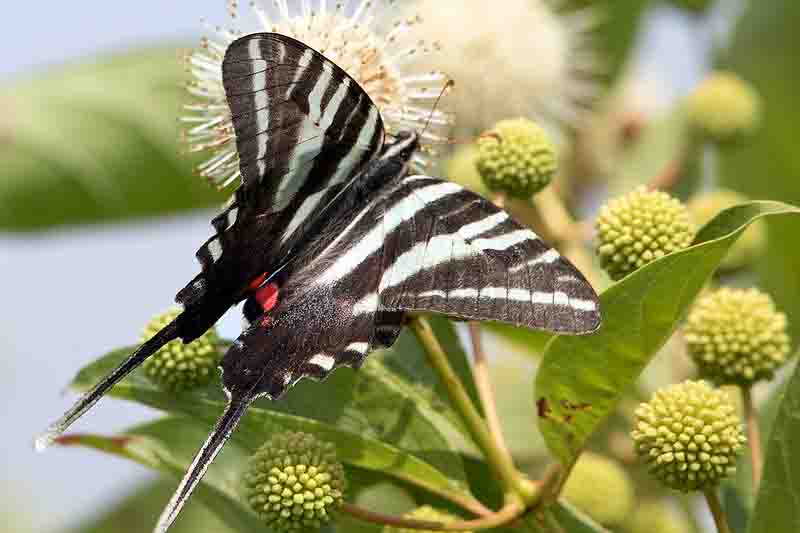
Documented Zebra Swallowtail nectar sources include blueberry, blackberry, redbud, lilac, milkweed, verbena, and dogbane. A broader butterfly planting can also include nectar-rich species such as Buttonbush, Butterfly Weed, Phlox, Joe-Pye Weed, and Ironweed to extend bloom through summer and fall.
Flower shape matters. Zebra Swallowtails have a shorter proboscis than many other swallowtails, so nectar hidden deep inside long tubular flowers may be difficult to reach. Flowers with accessible, clustered, or relatively shallow blossoms are especially useful.
The best garden does not rely on a single nectar plant. Aim for a sequence of flowers from spring through late summer so adults can find food during successive generations.
Twelve useful choices include:
Eastern Redbud – Cercis canadensis – an early-flowering eastern native tree whose rosy-pink blossoms provide nectar close to woodland habitat when relatively few other butterfly plants are blooming.
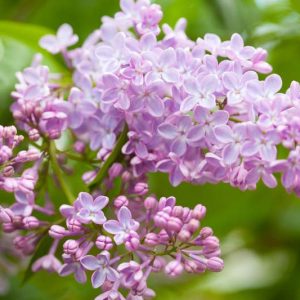
Lilac – Syringa vulgaris – fragrant late-spring flower clusters attract butterflies and help bridge the gap between early woodland bloom and the main summer nectar season. Best suited to cooler climates and sunny, well-drained sites.
Blackberries and other brambles – Rubus – their abundant spring and early-summer flowers offer accessible nectar, while the fruit provides additional value for birds, wildlife, and people.
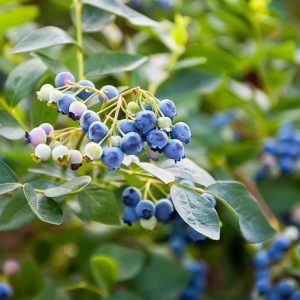
Highbush Blueberry – Vaccinium corymbosum – an eastern native shrub with spring flowers, edible summer berries, and excellent fall color. It is especially useful in acidic soils and woodland-edge settings.
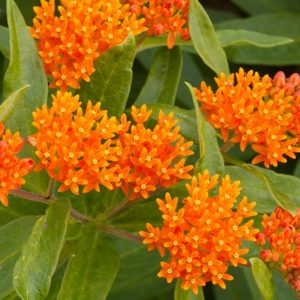
Butterfly Weed – Asclepias tuberosa – brilliant orange flower clusters provide abundant summer nectar in sunny, well-drained sites. Although it is a Monarch host plant, it serves Zebra Swallowtails only as an adult nectar source – pawpaw remains their caterpillar host.
Common Milkweed – Asclepias syriaca – fragrant summer umbels are rich in nectar and attract many butterflies. Its spreading habit makes it particularly well suited to naturalistic gardens, meadows, and wildlife plantings.
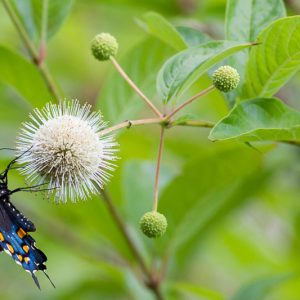
Buttonbush – Cephalanthus occidentalis – an outstanding native shrub for wet soil, ponds, streams, and rain gardens. Its spherical summer flower heads are packed with nectar-rich blossoms and fit especially well into the moist landscapes where pawpaw naturally grows.
American Blue Vervain – Verbena hastata – a long-blooming native perennial suited to moist meadows, rain gardens, and stream edges. Its slender flower spikes provide nectar through much of summer.
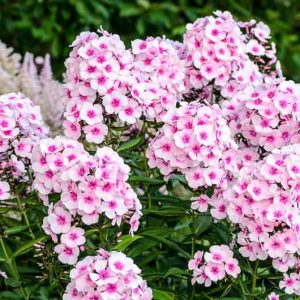
Garden Phlox – Phlox paniculata – a classic summer perennial with large fragrant flower clusters rich in nectar. It works particularly well in sunny to lightly shaded borders where soil remains moderately moist.
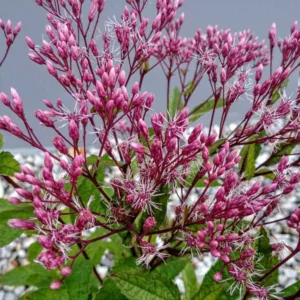
Sweet-Scented Joe-Pye Weed – Eutrochium purpureum – a tall native perennial bearing huge pink-purple flower clusters from midsummer into early fall. Its preference for moist soil and woodland edges makes it a natural companion for pawpaw habitat.
Ironweeds – Vernonia spp. – tall native perennials with vivid purple flowers in late summer and early fall. They provide valuable late-season nectar when many earlier flowers are beginning to fade.
Dogbane – Apocynum cannabinum – a documented Zebra Swallowtail nectar source with clusters of small accessible flowers. It is best used in naturalistic areas where its vigorous spreading habit can be accommodated.
Together, these plants can provide a much longer nectar season than any one species alone. Redbud, lilac, blueberry, and blackberry help feed early adults; milkweeds, Buttonbush, Blue Vervain, and Phlox carry nectar through summer; and Joe-Pye Weed and Ironweed help extend feeding into late summer and early fall.
Not every plant belongs in every Zebra Swallowtail garden. Butterfly Weed prefers sunny, relatively dry soil, while Buttonbush and Blue Vervain favor much wetter conditions. Joe-Pye Weed fits moist borders and woodland edges, while Lilac prefers sunny, well-drained sites. The goal is to select the nectar plants that match your site and complement the pawpaw habitat nearby.
Gardenia’s Zebra Swallowtail nectar rule: don’t simply assemble a list of butterfly flowers. Build a nectar sequence. Choose accessible blooms for spring, summer, and late summer, then filter them for the same climate, sunlight, soil, and moisture conditions present around your pawpaw habitat.
Zebra Swallowtails sometimes gather on damp sand, mud, or stream-edge soil in a behavior called puddling.
Butterflies take up moisture and dissolved minerals, especially sodium, from wet soil. The behavior is primarily associated with males, although females can puddle as well.
This means a butterfly habitat can offer something flowers cannot: access to minerals. A naturally damp, pesticide-free patch of soil near a stream, pond edge, or garden opening can provide an additional resource.
Gardenia’s puddling tip: there is no need to turn the garden into a mud pit. Where conditions permit, a small sunny patch of naturally damp soil or sand can provide the moisture and minerals males seek.
If Zebra Swallowtails occur naturally in your region, build the habitat around their specialization rather than starting with a generic butterfly-flower mix.
Plant pawpaw. Without an appropriate Asimina host, adults may visit but cannot establish breeding habitat.
Keep some young pawpaw growth. Females prefer plants with fresh leaves, so healthy shoots of different ages can be valuable.
Add accessible nectar nearby. Redbud, blueberry, blackberry, milkweed, vervain, and dogbane can help feed adults through different parts of the season.
Preserve woodland-edge structure. Pawpaw naturally fits moist woods and forest margins, while adults also use nearby sunny openings.
Protect potential pupation sites. Avoid unnecessary disturbance and overly aggressive cleanup around host-plant habitat.
Avoid broad-spectrum insecticides. Caterpillar feeding on pawpaw is part of the butterfly’s life cycle, not a failure of the planting.
The Zebra Swallowtail shows why effective butterfly habitat begins with the life cycle rather than with a shopping list of flowers.
1. Build the nursery with pawpaw.
Start with Common Pawpaw or another regionally appropriate Asimina. Without the larval host, the garden cannot support reproduction.
2. Keep fresh host growth available.
Females actively seek young leaves for egg laying, so retain healthy new growth instead of pruning every fresh shoot away.
3. Put accessible nectar within reach.
Choose flowers that adults can physically use and stagger bloom periods around the pawpaw habitat.
4. Protect pupation habitat.
Limit insecticides and overly aggressive cleanup so wandering mature caterpillars and well-camouflaged pupae have places to complete the life cycle.
Gardenia’s shortcut: pawpaw + fresh leaves + accessible nectar + protected pupation habitat. Pawpaw starts the habitat; the surrounding garden helps the butterfly complete the journey.
If a Zebra Swallowtail visits your garden, the next question is not simply “Which flower attracted it?” It is “Can this landscape support its complete life cycle?”
Build a Zebra Swallowtail garden that actually fits your site.
The caterpillar needs pawpaw, but that is only the beginning. A successful habitat also needs fresh host growth, compatible nectar plants, suitable moisture and light, and enough space for the landscape to work as a whole.
Use the Gardenia Plant Finder to narrow plants by hardiness, native status, sunlight, soil, drainage, water needs, mature size, wildlife value, and other growing conditions.
Then build the habitat with the Gardenia Garden Design Tool – combine pawpaw with nectar and companion plants that can actually thrive together in the same garden.
Don’t stop at “plant pawpaw.” Turn the butterfly’s biology into a garden plan that works.
Zebra Swallowtail caterpillars feed on pawpaws (Asimina species). Across most of the butterfly’s range, Common Pawpaw (Asimina triloba) is the principal host plant.
Zebra Swallowtails have pale white to greenish-white wings marked with bold black stripes and exceptionally long hindwing tails. The underside of the hindwing also has reddish markings.
Early larvae are dull gray. Older larvae develop green or dark bodies with black, blue, yellow, and pale bands. They also have a yellow forked defensive organ called an osmeterium.
Zebra Swallowtails use plants in the pawpaw genus Asimina. Common Pawpaw (Asimina triloba) is the principal host across much of the range, while several other native Asimina species are used farther south.
Adults take nectar from flowers including blueberry, blackberry, redbud, milkweed, verbena, and dogbane. Their relatively short proboscis makes accessible flowers particularly useful.
Yes. Zebra Swallowtails overwinter in the pupal stage. Diapausing pupae are generally brown and can be very well camouflaged against dead leaves and other plant material.
This behavior is called puddling. Butterflies, especially males, take up water and dissolved minerals such as sodium from damp soil or sand.
Plant a regionally appropriate pawpaw, retain some fresh host growth, provide nearby accessible nectar flowers, preserve woodland-edge habitat, protect potential pupation sites, and avoid broad-spectrum insecticides.
Updated and reviewed by Gardenia: September 2026
Create a membership account to save your garden designs and to view them on any device.
Becoming a contributing member of Gardenia is easy and can be done in just a few minutes. If you provide us with your name, email address and the payment of a modest $25 annual membership fee, you will become a full member, enabling you to design and save up to 25 of your garden design ideas.
Join now and start creating your dream garden!