Junonia coenia
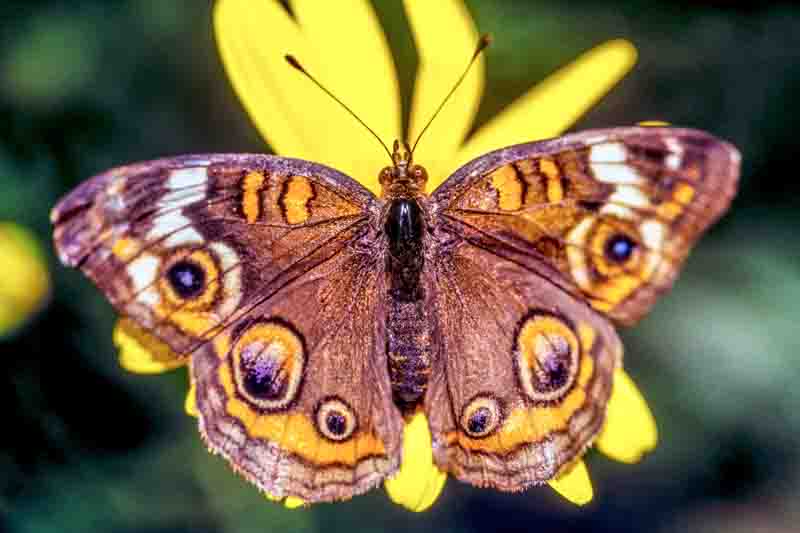


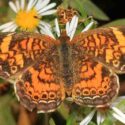
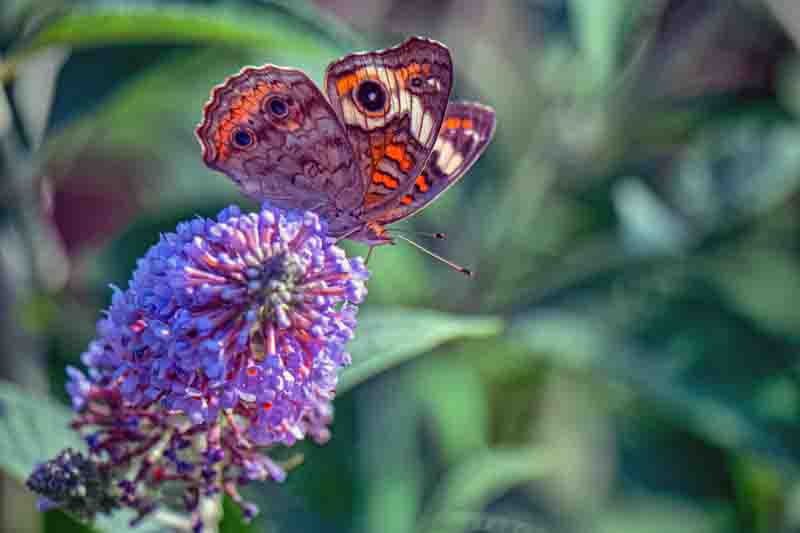
The Common Buckeye (Junonia coenia) is one of North America’s most distinctive butterflies. Warm brown wings are decorated with large, target-like eyespots, orange bands, and flashes of white, creating a pattern that is difficult to forget once you have seen it.
Its behavior is equally characteristic. Common Buckeyes usually fly low and fast over sunny ground, often dropping onto bare soil, paths, gravel, or short vegetation to bask. Males perch close to the ground and periodically patrol for females, while caterpillars develop on an unusually broad assortment of herbaceous plants.
Those host plants are one of the most useful things for gardeners to understand. Buckeye caterpillars can feed on frogfruit, ruellias, plantains, false foxgloves, toadflaxes, snapdragons, and related plants, depending on region. Several of these are attractive enough to fit naturally into a pollinator garden.
Gardenia’s Common Buckeye rule: design from the ground up. Give caterpillars low host plants, place nectar flowers nearby, and preserve some warm open space where adults can bask and patrol.
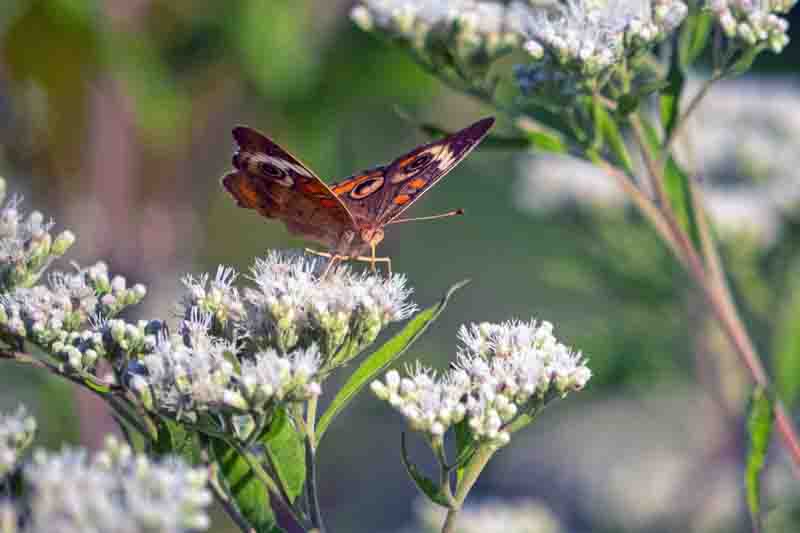
Common Buckeyes are butterflies of open, sunny landscapes. They occur in old fields, roadsides, gardens, parks, yards, utility corridors, meadows, fallow land, pine savannas, and other places where low vegetation is mixed with warm exposed ground.
The species is resident across much of the southern United States and Mexico. Farther north, its presence is much more seasonal. Adults regularly expand northward during the warmer months, temporarily colonizing much of the United States and occasionally reaching southern Canada.
This seasonal movement means Buckeye numbers can vary dramatically. A gardener may see only one or two in a quiet year and repeated visitors during a strong migration or colonization season.
In the Deep South, especially where winters are mild, Common Buckeyes may be active through much of the year. Northern gardens are more likely to receive migrants and their descendants during summer and early fall.
Where to look: sunny paths, meadow edges, open flower borders, low wildflower plantings, and bare patches of warm ground are classic places to spot a Common Buckeye.
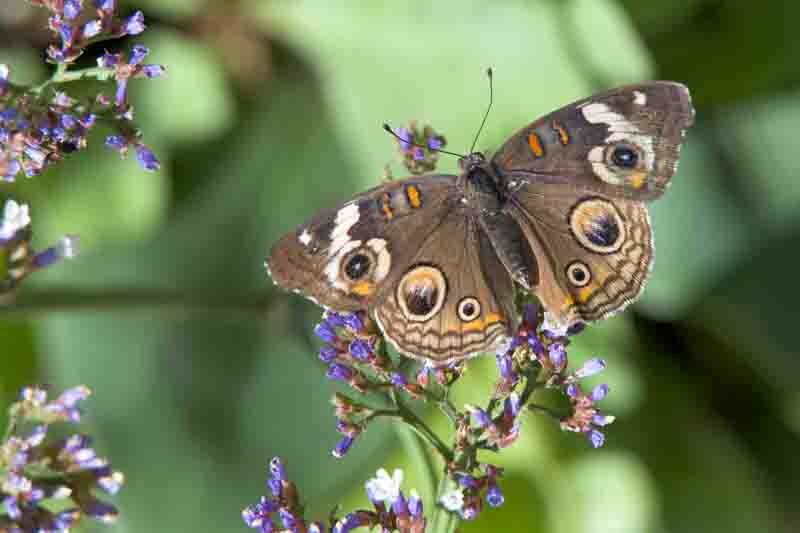
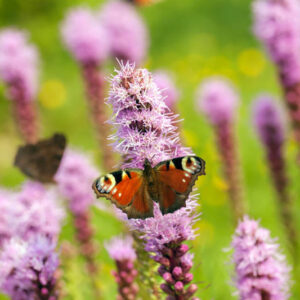
The easiest way to recognize a Common Buckeye is by its large, conspicuous eyespots.
Wingspan: approximately 1 5/8 to 2 3/4 inches (4.2-7 cm).
Upper wings: predominantly brown, with two bright orange bars in the forewing cell.
Forewings: each forewing carries two eyespots. The larger lower eyespot is associated with a pale white subapical band.
Hindwings: each hindwing bears two eyespots. The larger upper eyespot may contain a distinctive magenta or purplish crescent.
Underside: seasonal forms differ. Summer or wet-season butterflies generally have brown to tan hindwing undersides, while dry-season individuals can develop richer reddish-brown tones.
The flight pattern is another useful clue. Common Buckeyes tend to fly quickly, erratically, and close to the ground. They frequently stop after a short flight and settle with the wings open on soil, low foliage, gravel, or a path.
Quick Common Buckeye ID: brown wings + large eyespots + orange forewing bars + low, darting flight over sunny open ground.
Common Buckeye caterpillars look very different from the adults. Mature larvae are generally black or very dark brown and covered with numerous blue-black branching spines.
Small orange, reddish, cream, or pale markings may also be visible, depending on age and individual variation. The overall impression is a dark, bristly caterpillar rather than the smooth-bodied larva many gardeners expect.
They are usually solitary. Unlike Red Admiral caterpillars, they do not typically construct folded-leaf shelters. Instead, they feed openly on the foliage of their host plants.
Because Common Buckeyes use several unrelated host plants, caterpillars can appear in surprising places – on frogfruit creeping through a lawn edge, wild petunia in a border, plantain in an unmown patch, or false foxglove in a meadow.
Before treating chewed frogfruit, ruellia, plantain, or false foxglove, look for caterpillars. What appears to be ordinary foliage damage may be evidence that Common Buckeyes are breeding in the garden.
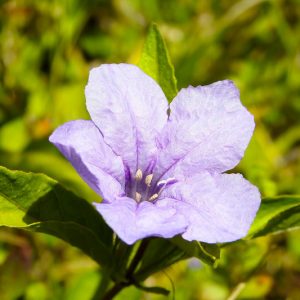
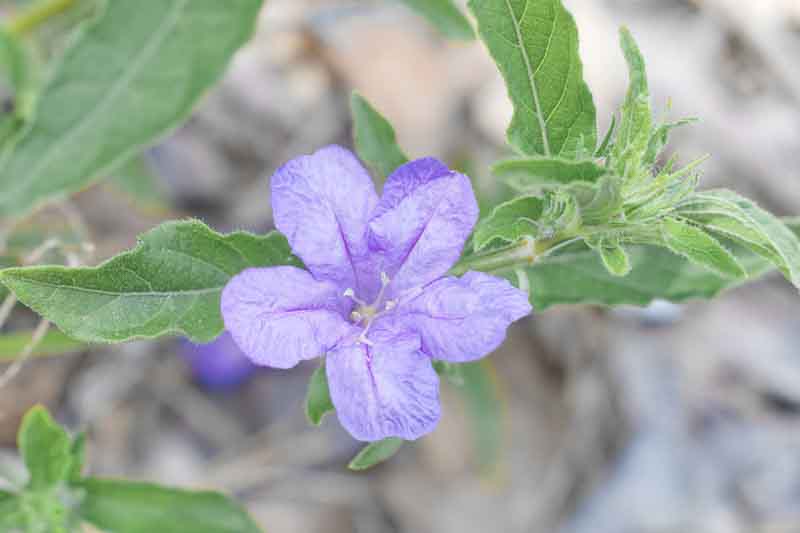 Carolina Wild Petunia – Ruellia caroliniensis
Common Buckeye caterpillars are unusually flexible compared with many familiar garden butterflies. Their host plants come from several different families and include frogfruit, plantains, false foxgloves, ruellias, toadflaxes, snapdragons, American bluehearts, and twinflowers.
Host use varies geographically, so the best planting strategy is to choose species appropriate to your region and garden conditions rather than trying to grow every possible host.
Three especially useful garden choices are:
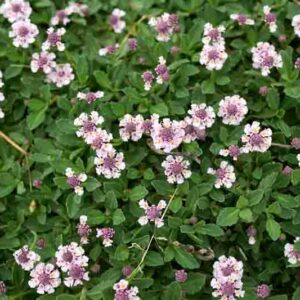
Frogfruit – Phyla nodiflora – a low, creeping groundcover and documented Common Buckeye host. Its small button-like flowers also feed pollinators, making it unusually valuable in the lowest layer of a butterfly garden.
Carolina Wild Petunia – Ruellia caroliniensis – a native eastern perennial whose lavender flowers provide nectar while its foliage can support Buckeye caterpillars.
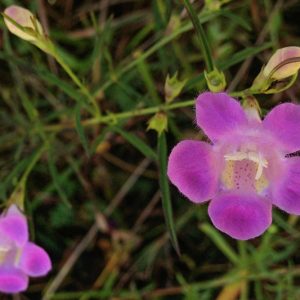
Purple False Foxglove – Agalinis purpurea – a delicate native annual well suited to prairie, meadow, and naturalistic plantings. False foxgloves are documented Buckeye hosts.
Plantains (Plantago species) are also important hosts. They are rarely planted as ornamentals, but allowing a few in an informal wildlife area can add genuine caterpillar habitat. Toadflaxes and snapdragons may also be used, depending on location.
Gardenia’s Butterfly Host Plants Guide helps connect butterfly species with the plants their caterpillars need.
Gardenia’s Buckeye host-plant shortcut: think low and herbaceous. Frogfruit, ruellias, plantains, and false foxgloves can turn the ground layer of a sunny garden into a caterpillar nursery.
The Common Buckeye undergoes complete metamorphosis through four stages: egg, caterpillar, chrysalis, and adult.
Egg: Females lay small green eggs singly on host-plant leaves or developing buds. Each caterpillar therefore begins life close to the foliage it needs.
Caterpillar: The larva feeds alone on its host plant, growing through successive stages until mature. Buckeye caterpillars are exposed feeders rather than communal nest builders.
Chrysalis: The pupa is mottled brown and cream, allowing it to blend with dry vegetation and plant stems.
Adult: After emergence, adults begin feeding and seeking mates. Males commonly perch on low vegetation or bare ground, periodically flying out to patrol or investigate other insects.
Common Buckeyes produce multiple generations per year. Across much of their seasonal range, two to three broods may occur from late spring through fall, while adults can be found throughout the year in parts of the Deep South.
Winter survival is strongly regional. In southern portions of the range, Common Buckeyes can persist through winter, with adults and, in some areas, caterpillars surviving the colder season. Farther north, populations are generally rebuilt by seasonal immigrants.
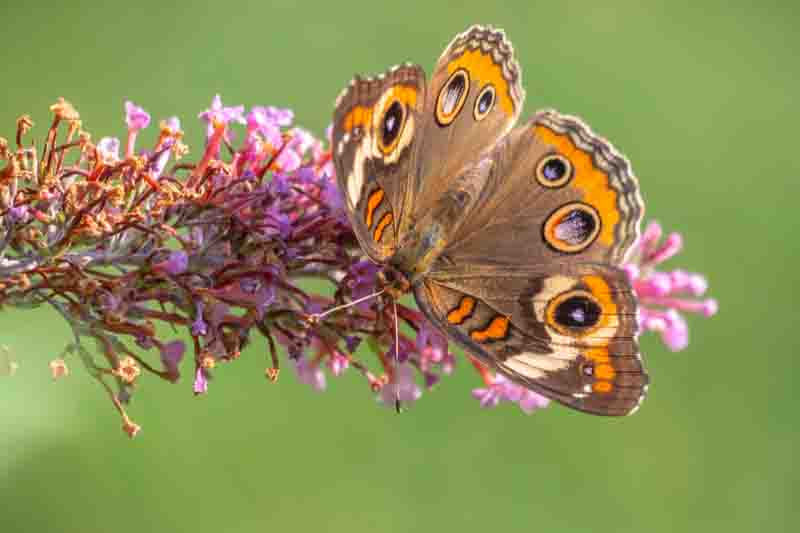
Adult Common Buckeyes feed mainly on flower nectar, although they may also visit rotting fruit.
For gardeners, nectar-rich flowers are therefore the main adult food source to plan around. Buckeyes favor sunny, open feeding sites that match the habitat in which they naturally fly and bask.
Documented nectar sources include asters, chicory, gumweed, knapweed, tickseed sunflower, dogbane, peppermint, and other flowers.
Among those choices, several translate particularly well into garden plantings:
Asters provide valuable late-season nectar, particularly useful when Buckeyes remain active or are moving through the landscape in late summer and fall.
Coreopsis – Tickseed offers the open, daisy-like flowers and sunny growing conditions that fit naturally into Buckeye habitat.
Dogbane – Apocynum species can be valuable nectar plants where appropriate native species occur.
Peppermint and other mints can provide nectar, although vigorous spreading types should be placed where their growth can be controlled.
Other butterfly-friendly plants such as coneflowers, blazing stars, and goldenrods can broaden the nectar season and support many additional butterflies and pollinators.
Rather than relying on one favorite flower, aim for several nectar plants blooming at the same time and a succession of flowers from summer into fall. That gives visiting adults more feeding opportunities while also strengthening the garden for other pollinators.
Gardenia’s Buckeye feeding strategy: place nectar flowers close to the caterpillar host layer. Adults can feed above and around the same low planting where the next generation develops.
Yes. Common Buckeyes are resident in southern parts of North America, but they regularly expand far beyond that core range during the growing season.
Adults from southern populations move north in late spring and summer, temporarily colonizing much of the United States and sometimes reaching southern Canada.
Later in the season, southward movements also occur. In Florida, large numbers can move south during late summer and fall before adults overwinter in the peninsula.
This annual movement explains why a Common Buckeye can appear in a northern garden even though the species may not survive the local winter. The butterfly seen in July or September may belong to a population established only months earlier by migrants from farther south.
Abundance can therefore fluctuate substantially from one year to the next as weather, migration success, and host-plant availability change.
A Buckeye far north of its winter range is often a seasonal colonist. Its presence may reflect successful migration rather than a permanent local population.
The dramatic circles on a Common Buckeye’s wings are called eyespots, and they are probably more than decoration.
Their exact defensive role is difficult to reduce to a single explanation, but the conspicuous markings are thought to help deter, startle, or confuse predators. The pattern may make an approaching bird or other predator hesitate long enough for the butterfly to escape.
The eyespots may also draw attention away from the butterfly’s vulnerable body, although the importance of that mechanism specifically in Common Buckeyes is less certain.
What is clear is that the markings are displayed prominently when a Buckeye sits with its wings open. Combined with the butterfly’s sudden, low, erratic flight, the pattern can make an attempted capture more difficult.
The Buckeye’s eyespots are thought to function as defense. They may startle or confuse predators, giving the butterfly valuable time to launch into its fast, unpredictable flight.
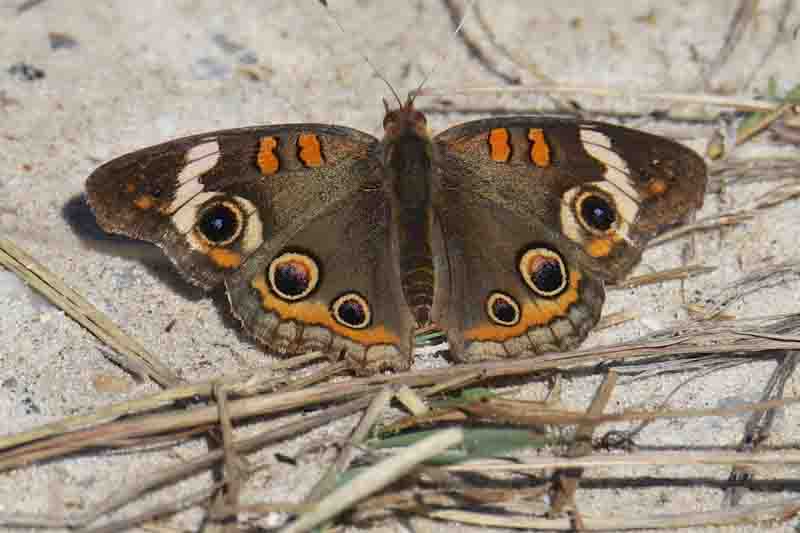 Mangrove Buckeye Butterfly (Junonia evarete)
Across most of the continental United States, a butterfly displaying the familiar Buckeye pattern is likely to be a Common Buckeye. Identification becomes more complicated in southern Florida and other subtropical areas where related Junonia can occur.
The Common Buckeye (Junonia coenia) is widespread and uses a broad range of herbaceous hosts. Other Buckeye species in southern Florida are associated with different habitats and host relationships.
The Mangrove Buckeye, for example, is closely associated with coastal mangrove habitat and uses Black Mangrove as a larval host. Tropical Buckeyes occur in tropical and subtropical parts of the region and may use different host plants.
If you are identifying a Buckeye in southern Florida, consider location, habitat, wing pattern, and nearby host plants together rather than relying on the eyespots alone.
For most gardeners farther north, Junonia coenia is the expected Buckeye.
Attracting Common Buckeyes is not simply a matter of planting more flowers. The strongest habitat combines caterpillar host plants, adult nectar, sunshine, and open structure.
Grow host plants where caterpillars can feed. Frogfruit, ruellias, plantains, false foxgloves, and other regional hosts give females places to lay their eggs.
Put nectar close to the host plants. Asters, Coreopsis, and other sunny flowers allow adults to feed without leaving the same general habitat.
Keep the planting sunny. Common Buckeyes are strongly associated with warm, open environments.
Preserve a little open ground. Adults frequently perch on bare soil, gravel, paths, and short vegetation. A butterfly garden does not need every inch densely planted.
Do not dismiss humble host plants. Frogfruit and plantains may look less spectacular than ornamental perennials, but they can provide something a showy nectar flower cannot – caterpillar food.
Avoid broad-spectrum insecticides. Buckeye larvae feed openly on foliage and can easily be killed by treatments aimed at leaf-eating insects.
Gardenia’s How to Create a Butterfly Garden explains how nectar plants, host plants, sunlight, water, shelter, and pesticide choices work together. For more butterfly-host relationships, explore the Butterfly Host Plants Guide.
Gardenia’s 3-Layer Common Buckeye Habitat Plan translates the butterfly’s behavior into a simple planting strategy: host plants below, nectar nearby, and open sunshine between them.
1. Build the nursery low.
Use frogfruit, ruellias, false foxgloves, plantains, or other regionally suitable host plants in the lowest layer of the planting.
2. Put nectar within easy reach.
Place asters, Coreopsis, and other sunny nectar plants beside or behind the caterpillar-host layer so adults can feed nearby.
3. Leave room for sunshine.
Retain sunny edges, short vegetation, paths, gravel, or small areas of open soil where adults can warm themselves, perch, and patrol.
This arrangement fits the way Common Buckeyes actually use a landscape. The caterpillars feed on herbaceous plants near the ground, while adults repeatedly move between flowers, sunny perches, and open surfaces.
Gardenia’s shortcut: host plants below, nectar nearby, sunshine between them. A Buckeye garden works from the ground up.
If a Common Buckeye is basking on a path or feeding on flowers, the adult has found something useful. The next question is “Does the garden also have a nursery for its caterpillars?”
Build Common Buckeye habitat from the ground up.
Low-growing hosts such as frogfruit, wild petunia, false foxglove, and plantain can provide the caterpillar layer, while nearby nectar flowers, sunny openings, and warm basking spaces support the adults.
Use the Gardenia Plant Finder to narrow host and nectar plants by hardiness, sunlight, soil, drainage, water needs, mature size, native goals, wildlife value, and other growing conditions.
Then build the habitat with the Gardenia Garden Design Tool – combine low host plants with nectar plants that can actually thrive together, compare seasonal interest, and catch compatibility problems before planting.
Don’t stop at “plant more flowers.” Give the adult nectar above and the caterpillar a nursery below.






What does a Common Buckeye butterfly look like?
The Common Buckeye is a medium-sized brown butterfly with several large eyespots, orange bars in the forewings, and pale markings around the forewing eyespots. Its wingspan is approximately 1 5/8 to 2 3/4 inches.
What are the host plants for Common Buckeye caterpillars?
Common Buckeye caterpillars use several herbaceous host plants, including frogfruit, ruellias, plantains, false foxgloves, toadflaxes, snapdragons, American bluehearts, and twinflowers. The exact plants used vary by region.
Is frogfruit a host plant for Common Buckeyes?
Yes. Frogfruit (Phyla nodiflora) is a documented larval host for Common Buckeye caterpillars. It is also a low-growing pollinator plant, making it especially useful in the ground layer of a butterfly garden.
What do Common Buckeye butterflies eat?
Adult Common Buckeyes feed mainly on flower nectar and may also visit rotting fruit. Documented nectar sources include asters, chicory, gumweed, knapweed, tickseed sunflower, dogbane, peppermint, and other flowers.
Do Common Buckeye butterflies migrate?
Yes. Common Buckeyes are resident in southern parts of their range but regularly move north during late spring and summer, temporarily colonizing much of the United States and sometimes southern Canada.
Why does a Common Buckeye have eyespots?
The large eyespots are thought to help deter, startle, or confuse predators. They may make an attacker hesitate long enough for the butterfly to escape in its fast, erratic flight.
How do I attract Common Buckeyes to my garden?
Grow regional host plants such as frogfruit, ruellia, plantain, or false foxglove, place sunny nectar flowers nearby, preserve some warm open ground for basking, and avoid broad-spectrum insecticides.
Where do Common Buckeyes spend the winter?
Common Buckeyes persist through winter mainly in southern parts of their range. Adults overwinter in places such as Florida, and caterpillars may also survive winter in some southern areas. Northern populations are generally rebuilt by seasonal migrants.
Updated and reviewed by Gardenia: September 2026
Create a membership account to save your garden designs and to view them on any device.
Becoming a contributing member of Gardenia is easy and can be done in just a few minutes. If you provide us with your name, email address and the payment of a modest $25 annual membership fee, you will become a full member, enabling you to design and save up to 25 of your garden design ideas.
Join now and start creating your dream garden!